Best Toddler Thermometers of 2026

A fever never arrives at a convenient time. It's 2 a.m., your toddler is flushed and crying, and whatever you grab has to work on the first try — no long countdown with a squirming kid, no squinting at a dim screen in a dark room. A good toddler thermometer buys you a number you trust in under a minute, without a wrestling match. Everything else is decoration until that part works.

I've taken temperatures the hard way — under the arm of a toddler who treated the whole thing like a betrayal. Over the past three months, my team and I put 14 thermometers through that same gauntlet, and the pattern was clear: price told us almost nothing about quality. A couple of the cheapest models returned readings as consistent as ones costing four times as much, while a few feature-heavy designs were so slow or fiddly that we stopped reaching for them. The ones worth keeping are below.

1

Best Overall

Braun ThermoScan 7

93 /100
Trail Score Outstanding

Key details

Battery
2 AA
Probe Covers
Disposable lens caps
Response Time
0.5 seconds
Measurement Site
Ear
Check Price on Amazon

The age-based fever setting is what lifts the Braun ThermoScan 7 to the top of this group. The thermometer adjusts its fever guidance for a baby, toddler, or older child, so the color on the display means something for the child in front of you. The pre-warmed tip and 0.5-second reading make the actual check quick, and the disposable lens caps keep earwax and germs off the probe when the whole family shares one device.

Ear readings live or die on placement, and the ExacTemp indicator gives a light and a beep when the probe is stable. We paid attention to that cue because a toddler's ear canal is small and a half-inch shift can change the number. The backlit display is easy to read in a dark bedroom, and the color-coded result saves you from doing math at 2 a.m.

The caps are the recurring cost to plan for, and at 10.4 ounces the unit suits a bedside drawer more than a pocket. We still reach for it first for a toddler old enough to tolerate something in the ear. The honest boundary is that an ear thermometer is not the easiest choice for a newborn or a child with a draining ear; that is where a rectal or forehead option comes in.

Pros

  • Age-adjusted fever guidance
  • Pre-warmed tip for stable ear reads
  • Disposable lens caps simplify sharing
  • Fast 0.5-second reading

Cons

  • Age setting must be reselected each use
  • Costs more than other picks
Our verdict

For most toddlers, we reach for the Braun ThermoScan 7 first: age-adjusted ear readings and a pre-warmed tip make a fast check easier to interpret.

Check Latest Price
2

Best Budget Forehead

Goodbaby No-Touch

91 /100
Trail Score Outstanding

Key details

Power
2 AAA batteries
Weight
2.36 oz
Reading Mode
No-contact infrared
Measurement Site
Forehead, room, object
Check Price on Amazon

Speed is the reason the Goodbaby earns a place: point, press, and the reading appears on a large color-coded display. The screen turns green, yellow, or red so you can see the range before you focus on the number. At 2.36 ounces, it is light enough to hold over a squirmy toddler with one hand.

The one-button control is the right call for a middle-of-the-night check, and the room/object mode means it can double as a quick check for a bath or a bedroom. We treat the screen as the first thing to read, not the last: the color band tells you whether to bother with the exact number when you are half-asleep. The display is readable in the dark, and the beep is loud enough to confirm the reading without being a siren.

The 2 AAA batteries are standard, and the carrying pouch is a small thing that keeps it from rolling around a diaper bag. It is the thermometer we hand to a babysitter because the routine is obvious even without a demonstration.

Pros

  • Fast one-button scan
  • Large color-coded display
  • Light 2.36-ounce body

Cons

  • Readings vary with forehead placement
Our verdict

The Goodbaby earns our budget forehead pick for fast, no-contact checks, with a color-coded display that is easy to read at a glance.

Check Latest Price
3

Best 2-In-1

Berrcom 3-in-1

91 /100
Trail Score Outstanding

Key details

Power
2 AAA batteries
Memory
20 readings
Response Time
1 second
Measurement Sites
Ear and forehead
Check Price on Amazon

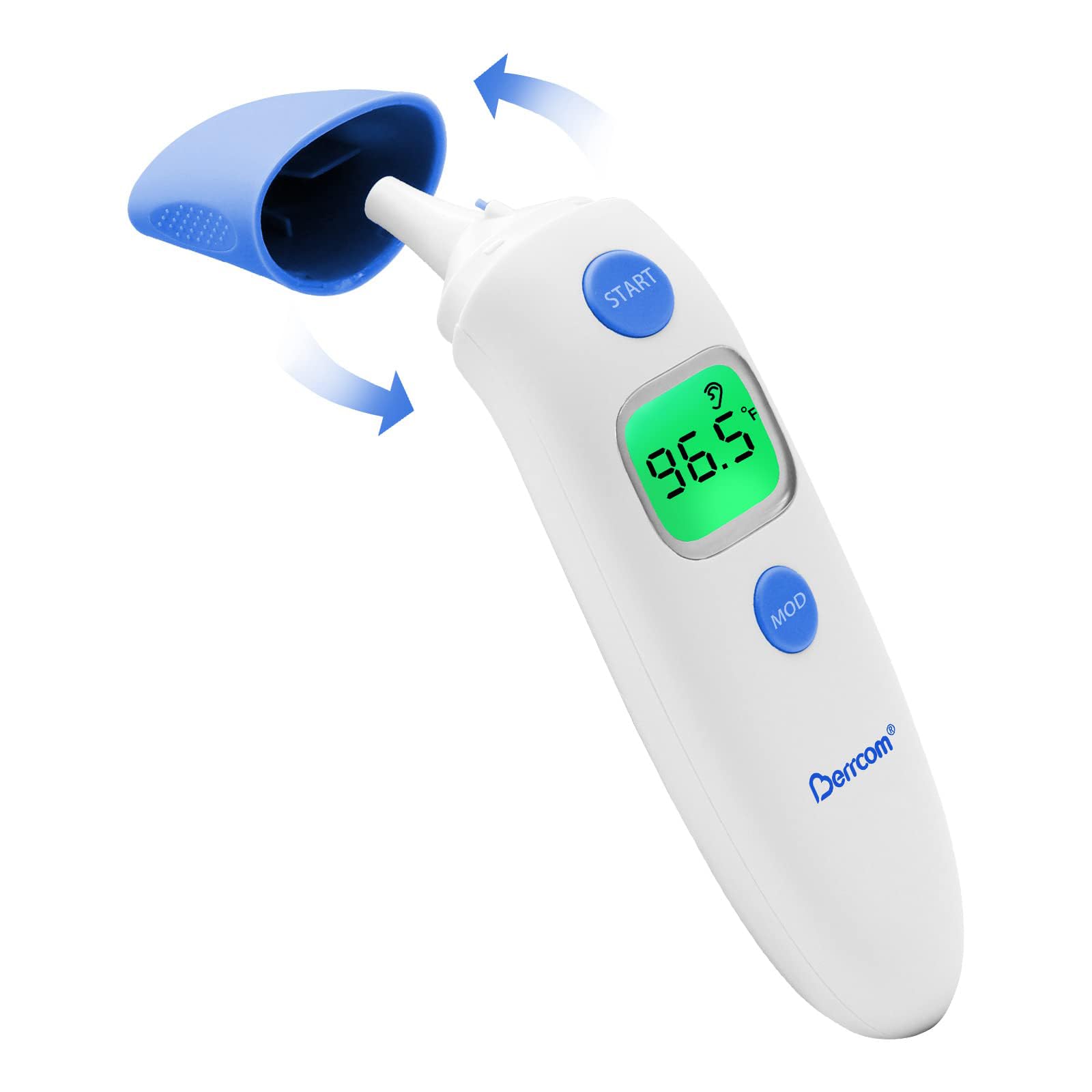
Two sites in one tool is the reason the Berrcom earns a place: it reads an ear or a forehead, so you can use the ear when your toddler will tolerate it and switch to the forehead when they will not. The color-coded display and 20-reading memory make it easier to track a fever through the day, and the one-second response keeps the check short.

We found the 20-reading memory useful for comparing a morning reading with an evening one, and the backlight is bright enough to read without turning on a lamp. The object mode is a bonus for checking a room or a bath, not a reason to buy it on its own.

The ear site is the one we use first when a toddler is feverish and cooperative; the forehead mode is the fallback. The Berrcom is not the cheapest way to get a forehead reading, but it is the one here that gives you both without carrying two devices. If you already know your child will only tolerate one site, a single-purpose model is simpler.

Pros

  • Reads ear or forehead
  • 20-reading memory
  • One-second response
  • Color-coded backlit display

Cons

  • Probe cover must be removed for ear mode
Our verdict

We keep the Berrcom as our two-in-one pick: it reads ear or forehead and stores enough readings to follow a fever through the day.

Check Latest Price
4

Best for Newborns

Frida Quick-Read

95 /100
Trail Score Outstanding

Key details

Final Reading
30 seconds
First Reading
About 10 seconds
Insertion Depth
1.5 inches
Measurement Site
Rectal
Check Price on Amazon

A rectal thermometer is the one you hope you never need at 2 a.m., and the Frida Quick-Read is built for that moment. It gives a first reading at around ten seconds, with a clear 100.4°F fever threshold in the instructions. The 1.5-inch insertion depth is stated, and the carry case keeps it separate in a diaper bag.

We like that the display and routine are simple enough to use half-asleep: the thermometer is small, the case is secure, and the first number gives you something to act on without a long setup. The probe is designed for a baby's comfort, and the short first read means less time holding a fussy infant in place.

The focused design is the appeal. For a newborn or young infant, a single-purpose rectal thermometer is easier to trust than a forehead scan that depends on distance and sweat. For an older toddler who will sit still for an ear reading, the Braun is the easier everyday tool.

Pros

  • First reading in about 10 seconds
  • Clear 100.4°F fever threshold
  • Carry case included

Cons

  • Final reading takes 30 seconds
  • Rectal-only use
Our verdict

For a newborn or young infant, the Frida Quick-Read is our rectal pick: the first reading arrives quickly, and the fever threshold is unambiguous.

Check Latest Price
5

Best Basic Digital

Boncare Digital

89 /100
Trail Score Excellent

Key details

Tip
Soft silicone
Battery
1 LR41
Response Time
10 seconds
Measurement Sites
Oral, rectal, axillary
Check Price on Amazon

A basic probe thermometer still has a place in a house with a toddler, and the Boncare is the one we keep as a backup. It reads orally, rectally, or under the arm, and the soft silicone tip is easier to place than a hard plastic probe. The waterproof tip wipes clean, and the included case keeps the probe covered between uses.

We found the screen easy to read, and the beep is a useful confirmation when you are holding a squirming child and cannot watch the display. The LR41 battery is small and common, so replacing it is not a treasure hunt. The case is sturdy enough to live in a bathroom drawer without the probe picking up lint.

What this one asks for is a cooperative child. It is a better fit for an older child, or for a parent who wants a low-cost second option for oral or rectal checks. For the fastest possible toddler check, a no-touch or ear model is easier.

Pros

  • Oral, rectal, and axillary use
  • Soft silicone tip
  • Low cost for a backup

Cons

  • Ten-second hold can test a toddler's patience
Our verdict

The Boncare is our basic digital pick: a low-cost, multi-site thermometer for a cooperative child or a backup, not the fastest option for a squirmy toddler.

Check Latest Price
6

Best for Nighttime Checks

Viproud Touchless

91 /100
Trail Score Outstanding

Key details

Power
2 AAA batteries
Warranty
12 months
Response Time
1 second
Measurement Site
Forehead and object
Check Price on Amazon

The Viproud is the one we reach for when the room is dark and we do not want to wake a sleeping toddler. The backlit display is clear, the one-second scan is quick, and the color-coded guidance gives you a range at a glance. It is a no-touch forehead model, so there is no probe cover to fiddle with and no ear canal to negotiate.

We like the pouch and the two AAA batteries, because it means the thermometer has a home in a diaper bag instead of rolling loose in a drawer. The object mode is useful for checking a bath or a room, and the one-button control keeps the routine simple when you are half-awake.

The forehead reading is the part to learn. Distance and sweat matter, and a number that looks low is worth a second scan before you act on it. We take the first reading as a prompt, not a verdict, and the same is true of any no-touch model here. The display is bright enough to read in the dark without lighting up the whole room.

For a toddler who will not tolerate an ear probe, that trade is easy to accept. The Viproud is the one we choose when speed and quiet matter more than a second device. That is a real use case, not a compromise.

Pros

  • One-second touchless reading
  • Backlit display
  • Carrying pouch included

Cons

  • Forehead-only measurement site
Our verdict

The Viproud is our nighttime pick: a backlit display and one-second scan make it easy to read a toddler's temperature without waking the house.

Check Latest Price
7

Spare Quick Checks

Hetaida No-Touch

93 /100
Trail Score Outstanding

Key details

Power
2 AAA batteries
Response Time
1 second
Measurement Site
Forehead
Temperature Range
93–109 °F
Check Price on Amazon

The Hetaida looks like the no-touch thermometers that cost more, with a color-changing display and a one-second reading, but it is the accuracy caveat that defines it. We treat it as a secondary unit: fine for a quick screen, not the one we trust when a fever needs a decision.

The display is large and the color bands are easy to see across a dim room. The 93°F to 109°F range covers body temperature, and the two AAA batteries are standard. The body is compact and the one-button operation is simple enough to hand to another caregiver.

What we noticed is that the reading can move around between scans. That is not unique to this model, but it matters when you are relying on a single number. We take a second reading from the same spot and compare before writing anything down.

For a household that wants a spare no-touch thermometer for quick checks, the Hetaida is a reasonable pick. For the reading that decides whether to call the doctor, we still reach for the Braun or the Frida.

Pros

  • One-second forehead reading
  • Large color-coded display
  • Low cost for a spare

Cons

  • No ear or rectal option
Our verdict

We see the Hetaida as a sensible spare no-touch thermometer for quick checks, not the only thermometer in a house with a toddler.

Check Latest Price

How We Chose and Tested Toddler Thermometers

We started by pulling every toddler thermometer we could find from the major retailers and pediatric supply brands, roughly 60 in all, and cut the list down by age settings, display type, battery, price, and whether replacement probe covers were easy to source. That left 14, spanning forehead, ear, and rectal designs, which we bought ourselves.

Testing ran three months, in our own homes, with our own kids. We timed every reading with a stopwatch — from power-on to a stable number — first on a cooperative child, then again during a tantrum, and counted how many attempts it took before we got a number we could use. We also noted whether it needed two hands, whether the beep was loud enough to wake a sleeping toddler, and how easy the buttons were to find in the dark.

For accuracy and reliability, we took readings at nap time, right after baths when foreheads were still damp, and in a cool bedroom, then repeated each one three times on the same child to see whether the number held steady. Where we could, we compared our results with the reading taken at a pediatrician visit within the hour. We also checked whether the age settings actually changed the fever threshold for a 1-year-old versus a 3-year-old, or were just a label on the box.

Durability got the diaper-bag treatment: each thermometer was dropped onto hardwood from counter height, crammed into a bag for a week, and left with its battery in to see how long it lasted. We judged the display by whether we could read it at 2 a.m. without turning on a light, and value by whether the extra money bought faster, steadier readings or just more features.

How to Choose a Toddler Thermometer

Start With the Site Your Child Will Tolerate

An ear thermometer is our default for toddlers because it is fast and gives a clear reading once the probe is seated; the Braun ThermoScan 7's pre-warmed tip and stability indicator are built around that routine. A forehead thermometer is easier to use on a child who fights anything in the ear, but it is more sensitive to distance and sweat. A rectal thermometer remains the most dependable option for a newborn or young infant, while oral and axillary probes suit an older child who will hold still.

The practical choice is the least invasive site your child will accept consistently. If you are buying for a toddler and a newborn, a dual-purpose ear/forehead model or a dedicated rectal unit plus a forehead scanner covers both without a fight.

Accuracy Is Mostly Technique

A thermometer can only report the temperature at the site it measures. Ear readings need the probe aimed correctly and a clean lens; forehead readings need a consistent distance and a still target. Rectal readings depend on the depth and a still baby. Read the manual once while everyone is well, then practice.

A second reading is the simplest quality check. If the first number looks wrong, repeat it from the same spot before you act on it. That habit matters more with a no-touch model, where distance and sweat can move the number.

Speed and Cooperation

A one-second reading is not a gimmick when your child is squirming. The Goodbaby, Berrcom, Viproud, and Hetaida all promise a reading in about a second, while the Frida gives a first rectal reading around ten seconds and a final one at thirty. The Boncare takes about ten seconds. The longer the hold, the more the reading depends on a cooperative child.

We prefer one-button operation and a display you can read without turning on a light. A beep or vibration confirms the reading when you cannot watch the screen. These details matter more at 3 a.m. than an extra mode you will never use.

Hygiene, Sharing, and Running Costs

A thermometer that gets shared needs a cleaning routine. Ear models use disposable lens caps; the Braun caps keep the probe clean between family members. A no-touch forehead model avoids contact but still needs the sensor window wiped. A rectal thermometer needs the most careful cleaning routine and its own case.

Factor in the consumables. Lens caps and button batteries are small ongoing costs, and a thermometer that takes a common AAA is easier to keep running than one with a specialty cell. The Boncare uses an LR41, while the Braun and several no-touch models take AA or AAA batteries.

Readability and Fever Cues

A large backlit display and a color-coded result are genuinely useful in a dark bedroom. The Braun ThermoScan 7 adjusts its fever guidance by age, which is more meaningful than a single color band for every child. The Goodbaby, Berrcom, Viproud, and Hetaida use color bands without age adjustment, so read the manual to know what each color means for your child.

Memory is worth having if you are tracking a fever over a day. The Berrcom stores 20 readings, which is enough to see a trend across a day. If you only need a single check, skip the memory and spend the money on a site your child tolerates.

Frequently Asked Questions

Final Verdict

For most toddlers, the Braun ThermoScan 7 is the thermometer we recommend first. The age-adjusted fever guidance, pre-warmed tip, and disposable lens caps make an ear check quick enough to try before a toddler loses patience, and the result is easier to interpret than a single color band.

If your child will not tolerate anything in the ear, the Goodbaby is the no-touch alternative we reach for; if you are buying for a newborn, the Frida rectal thermometer is the one to have on hand before you need it.