Best Barre for Home Workouts of 2026

I spent the better part of a year holding the back of a dining chair through pliés, and that chair never once wanted to be there — it slid, it tipped, and it pulled my shoulder out of line. A real barre fixes exactly that: a rail at the right height, anchored well enough that you can lean into your palm and think about turnout instead of balance. The trouble is that a bad barre is worse than the furniture you were already using, because it shifts the second you push against it.

We've spent eight months with 11 barres in living rooms, spare bedrooms, and a basement corner, and the differences show up when you press on them, not in the listing photos. What matters is a rail that stays put at a height that fits your body, assembly you can manage alone, and a footprint you can live with — especially if you're renting or working with limited floor space. The picks below are the ones that held up, including a couple that fold flat enough to disappear between sessions.

1

Best Overall

SELEWARE Height Adjustable Ballet Barre

89 /100
Trail Score Excellent

Key details

Bar Length
4 ft
Mount Type
Freestanding
Height Range
11 to 47 inches
Weight Capacity
350 lb
Check Price on Amazon

The number that matters here is 11 inches: that's how low the crossbar drops, and it's why this barre works for a household instead of one person. From there it climbs to 47 inches, so the same frame serves a seven-year-old working on first position and an adult with the bar at waist height. In a category full of one-height stands, that range is the feature we kept coming back to.

It's also the freestanding model we hand most people first. Nothing gets drilled, the alloy steel frame is rated to 350 pounds, and the anti-slip mats under the feet keep it planted on a wood floor. The star-shaped knobs lock each upright where you set it, and once they're tight the frame takes a lean without walking across the room. The 10-year limited warranty is longer than most of the field offers.

What you trade for that is speed. Changing the height means loosening two knobs and sliding the uprights, and the collars can be stiff the first few times — fine if one person owns the setting, tedious if a child and an adult swap it every day. The 4-foot bar is the other limit: generous enough for barre and balance work, short for combinations that travel across the floor.

Pros

  • Height range fits children and adults
  • Freestanding, so no drilling or studs
  • Rated to 350 pounds
  • Light enough to move between rooms

Cons

  • Height changes take two knobs and some effort
Our verdict

We recommend it as the default home barre: freestanding, rated to 350 pounds, and adjustable from a child's height to an adult's.

Check Latest Price
2

Best Double Barre

VITA Barre Prodigy Freestanding

90 /100
Trail Score Outstanding

Key details

Bars
Double
Warranty
10 years
Bar Length
8 ft
Height Range
6 to 46 inches
Check Price on Amazon

Two bars, no tools, and nothing drilled into a wall: the Prodigy is what we point a busy household at. Both 1.5-inch bars adjust independently between 6 and 46 inches, so a parent can hold the top barre through a plié series while a kid works the lower one at their own height.

Setup takes minutes and no tools at all — the sections slot together and the collars tighten by hand — which matters more than it sounds, because the barres that end up behind a door are the ones that are a hassle to put up. It breaks down just as quickly when you need the floor back.

It's also the most transportable double barre here: aluminum tubes with wood accents, light enough to carry from a living room to a basement or load into a car for a workshop. Eight feet of bar, though, needs a genuinely long clear wall, and this is the priciest pick in the guide by a wide margin.

Two things we flag. The collars want a check-and-tighten before each session, since the frame is stable once set but a knob that has worked loose changes that. And for one person in a corner of a bedroom, the SELEWARE does the same job without the wall requirement. For a family with two dancers and a wall to spare, it's the best setup here.

Pros

  • Two bars at independent heights
  • Assembles without tools
  • Breaks down for transport
  • Ten-year warranty

Cons

  • Height knobs loosen and need re-tightening
  • Needs about eight feet of clear wall
Our verdict

For two dancers who need different bar heights at once, we think the Prodigy's tool-free twin bars justify the premium.

Check Latest Price
3

Best Wall-Mounted

VITA Barre Classic WB15 Wall-Mounted

90 /100
Trail Score Outstanding

Key details

Height
Fixed
Bar Length
4 ft
Mount Type
Wall-mounted
Bar Diameter
1.5 inches
Check Price on Amazon

There is no adjustment on this barre, and that's the pitch. You choose a height once, bolt the steel brackets into studs, and the bar stays exactly there — no knobs to check, nothing to slide, nothing to re-tighten before a class. The 1.5-inch wood bar is sanded smooth and left bare, and the brackets hold it well off the wall, which leaves room to hang a mirror behind it and watch your form.

For a permanent practice wall, this is the one we fit. Bolted to studs it doesn't shift when you pull off the bar or lean into a stretch, and the powder-coated brackets give it the look of a studio rather than a gym. Installation is straightforward with the supplied hardware, as long as you're drilling into wood and not chasing a stud line across a window.

Two decisions happen before you pick up a drill: the height, because it's fixed, and the finish, because the wood arrives unfinished and drinks up an oil or a clear coat in an afternoon. Set the height for the tallest person who'll use the barre and find the studs first — drywall alone will not hold a bar you're leaning on.

Pros

  • Rock solid bolted into studs
  • Smooth 1.5-inch wood bar
  • Sits off the wall for mirror work
  • Hardware included for stud installation

Cons

  • Fixed height, decided at installation
  • Wood arrives unfinished
Our verdict

Buy it if you own the wall: we found this the steadiest way to put a barre in a room, and it never needs adjusting again.

Check Latest Price
4

Best Budget Pick

GOFLAME Freestanding Double Barre

90 /100
Trail Score Outstanding

Key details

Bars
Double
Bar Length
4 ft
Mount Type
Freestanding
Height Range
Up to 47 inches
Check Price on Amazon

Two bars at independently set heights for less than our top pick costs: that's the argument for the GOFLAME, and in a house with two dancers it's a strong one. The crossbar climbs to 47 inches, six fasteners let you set each bar where you want it, and four rubber feet sit under the base to keep it from skating on a hard floor. Assembly is quick and the frame carries itself well for the money.

The collars are the part to test on arrival. A fitting that won't bite down hard enough to hold a bar at height is the failure to watch for, and it shows up mid-stretch rather than at assembly — set each height, tighten, then lean on it before you trust it. Get a good one and this is the value pick of the guide; if you want a barre you never have to re-check, a wall-mounted one removes the question entirely.

Pros

  • Two independently adjustable bars
  • Costs less than our top pick
  • Rubber feet grip hard floors
  • Assembles quickly

Cons

  • Collar fittings don't always lock a bar tight
Our verdict

We like it as the value double barre, as long as you test the collars before trusting them with your weight.

Check Latest Price
5

Best Folding Design

Booty Kicker Folding Barre

88 /100
Trail Score Excellent

Key details

Frame
Steel with wood barre
Folded Width
5 inches
Weight Capacity
250 lb
Assembled Dimensions
38 x 34 x 37 inches
Check Price on Amazon

Folded, this barre is about 5 inches wide, which is the entire reason to consider it: it slides behind a sofa or into a closet and comes out when you have twenty minutes. A quick-release hinge does the folding, and the angular frame throws more footprint behind the bar than a straight-legged stand does.

Assembly is the low point. The printed instructions are thin, and the company's video is the better guide; allow a slow half hour the first time and less after that. Once it's up, the steel frame and hardwood bar feel more substantial than that folded profile suggests.

The detail that changed our mind is the post at the front, which doubles as a weight holder. Drop a dumbbell or two onto it and the whole frame plants itself, which is the difference between a folding barre you tolerate and one you actually pull out for a class.

So: a small apartment, a shared living room, a barre that has to disappear. Two limits worth knowing before you buy. There's no height adjustment, and at 37 inches tall it's an adult's and older kid's barre rather than a small child's. And a hard lean — the kind you take in a standing split — brings out some flex in the folding joints that a fixed frame doesn't have. Use it for class, balance, and stretching, and keep the heavy pulling for something anchored.

Pros

  • Folds to about five inches wide
  • Front post doubles as a weight holder
  • Steel frame with a hardwood barre
  • Rated to 250 pounds

Cons

  • Folding joints flex under a hard lean
  • Assembly instructions are hard to follow
Our verdict

We rate it for apartment-sized barre work, provided you want a folding barre more than an adjustable one.

Check Latest Price
6

Young Dancers

Dolibest Freestanding Ballet Bar

89 /100
Trail Score Excellent

Key details

Material
Alloy steel
Bar Length
4 ft
Mount Type
Freestanding
Height Range
11 to 47 inches
Check Price on Amazon

This one is finished for young dancers, and the pink isn't a sticker on a black bar — it's the powder coat, top to bottom, which is why it reads as a gift rather than gym equipment in the corner of a bedroom. Underneath it's alloy steel with four wide rubber pads at the base and a height range of 11 to 47 inches, so the same barre follows a child from first position into the teen years. For that job we take it over a plain black stand.

It's a barre for balance, form, and stretching rather than for hauling yourself up by the hands, and that's the thing to weigh: no weight capacity is published for it. If an adult will be leaning hard, choose a model with a stated limit, like the SELEWARE's 350 pounds, and keep this one where a young dancer can reach the knobs without help.

Pros

  • Height range covers kids through teens
  • Four wide rubber pads at the base
  • Steel tubing rather than plastic
  • Pink finish suited to a bedroom

Cons

  • No published weight capacity
Our verdict

We chose it for a young dancer's room: a real steel barre in a finish a kid wants to use.

Check Latest Price
7

Narrow Walls

Dolibest Space Saver Wall Barre

88 /100
Trail Score Excellent

Key details

Material
Beech wood
Bar Length
3 ft
Mount Type
Wall-mounted
Height Settings
3 positions
Check Price on Amazon

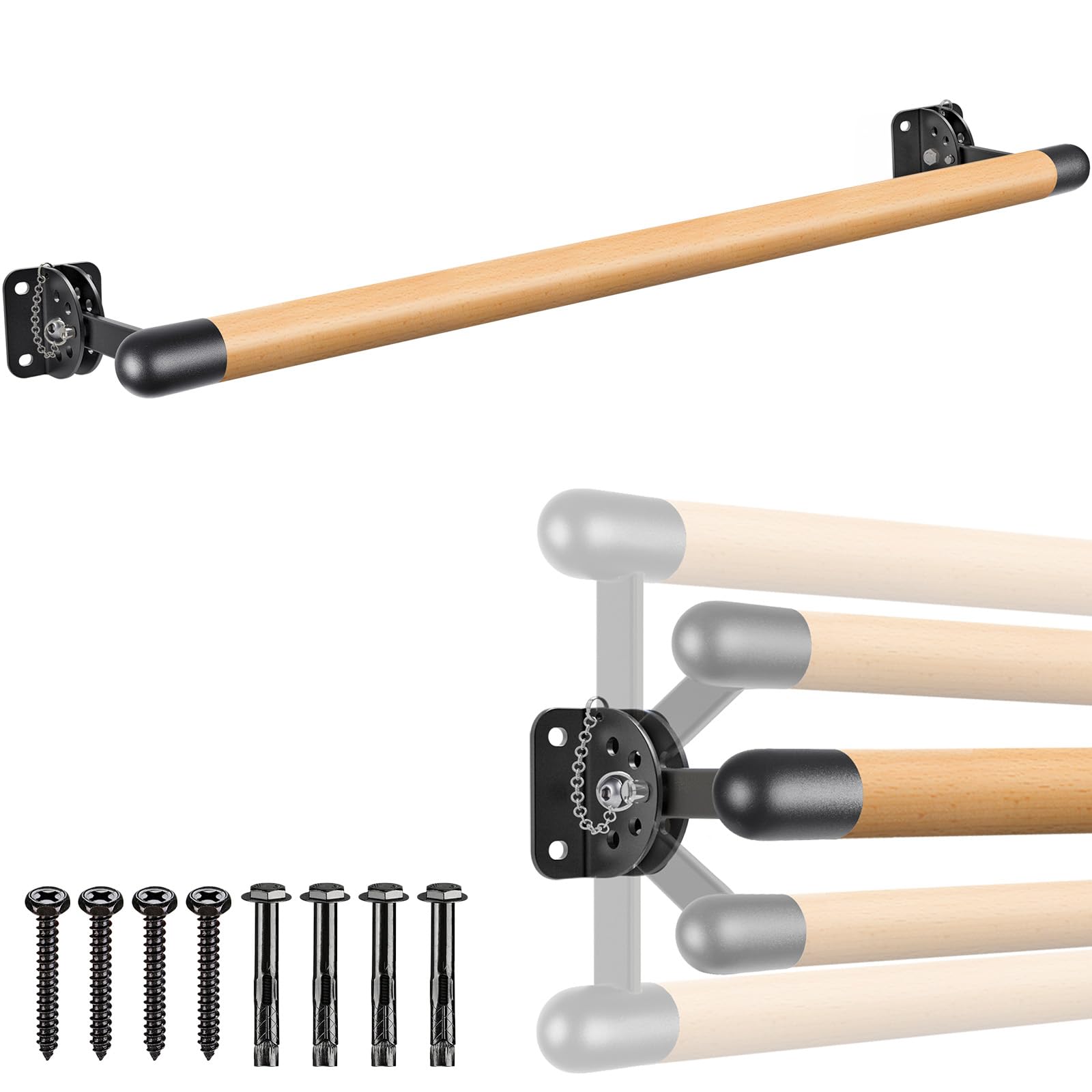
Three preset heights, a bracket that screws to the wall, and a beech bar that lifts out of it — this is the wall-mounted barre for a room that has to do two jobs. At 3 feet it's the shortest bar in this guide, sized for the end of a bedroom, a hallway, or a child's practice corner.

The brackets carry four mounting holes each, which spreads the load across the plate, and the loading-pin design is the space-saving part: the bar lifts off rather than staying bolted in place permanently. The beech is smooth to the hand, with rounded transitions between wood and metal that make it comfortable to hold through a long hold.

We hang it where the ceiling is clear and a stud is easy to find, and set the bracket for the tallest user first, since the three positions are fixed. That's the compromise: three settings, not a continuous glide, so a child gets a good height rather than a perfect one. Where the wall is narrow, though, nothing else here disappears into it so completely — and if you have more room, the VITA Classic gives you a longer bar at a fixed height.

Pros

  • Bar lifts out of the brackets
  • Three height settings
  • Solid beech on steel brackets
  • Fits a narrow strip of wall

Cons

  • Only three preset heights
  • Three-foot span is short for travelling steps
Our verdict

Hang it on a narrow wall: we found the lifting bar and three preset heights make a small space work.

Check Latest Price
8

First Wall Barre

flybold Wall-Mounted Barre

87 /100
Trail Score Excellent

Key details

Includes
Turning board
Material
Beech wood
Bar Length
4 ft
Bar Diameter
1.5 inches
Check Price on Amazon

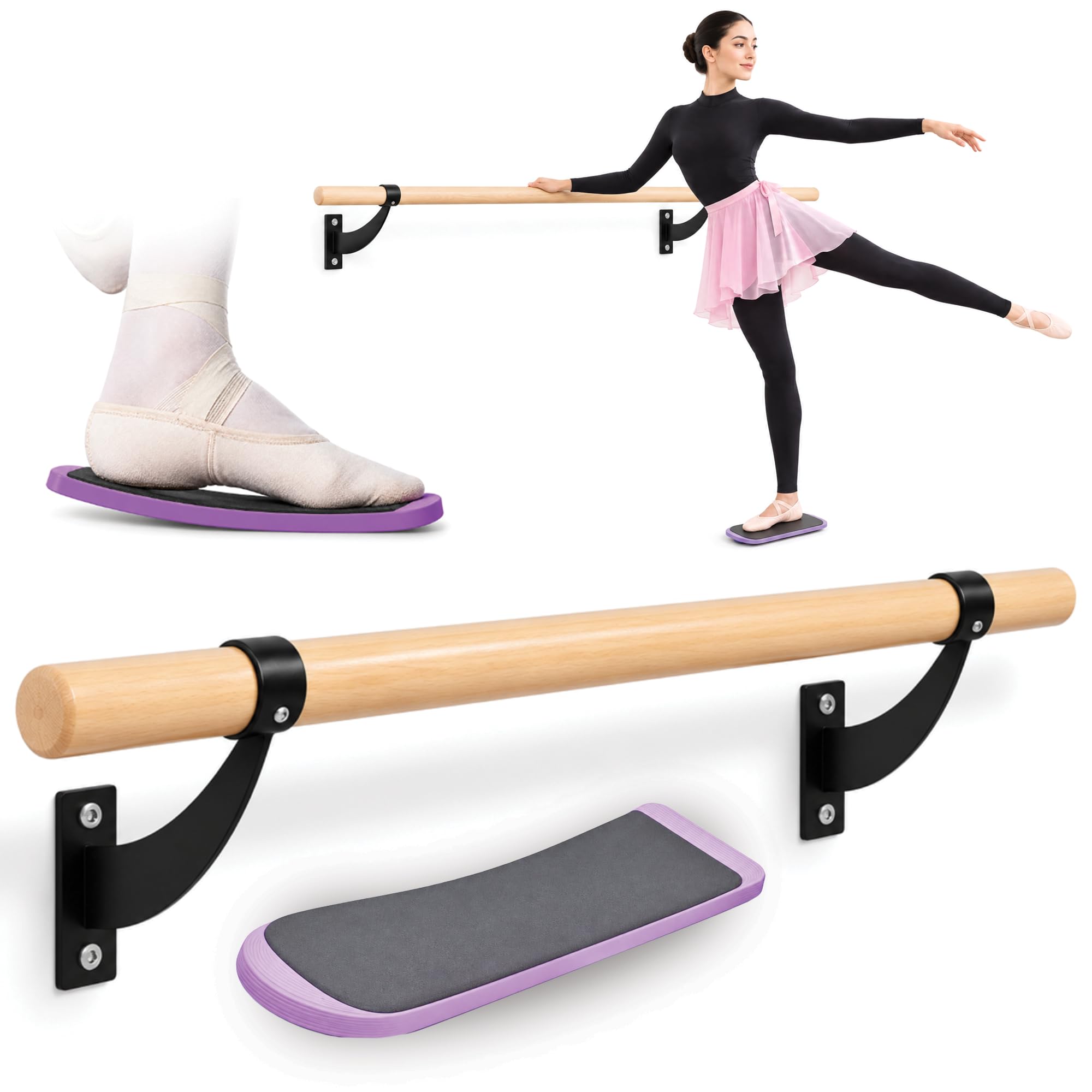
A turning board comes in the box, and that's what separates this kit from every other wall barre here — a disc for practicing pirouettes, the piece of equipment a dancer usually buys separately. The barre itself is a 4-foot beech bar at 1.5 inches in diameter, mounted on steel brackets with locking screws, and the beech has a natural finish that looks warmer than a painted tube.

It's the least expensive way here to get a barre onto a wall, and the hardware is refreshingly plain: a wood bar and simple brackets that don't shout for attention in a small room. Fixing it is a two-person job — one to hold the bar level, one to drive screws into studs — and the supplied hardware wants solid wood behind it rather than hollow drywall.

For a first barre in a kid's room, a rented apartment where you're allowed to put screws into a stud, or the corner of a home office, we take it. What you accept is permanence: the barre stays when you move, and the brackets hold the height you choose, so set it for the tallest person who'll use it. The turning board is the part that travels with you.

Pros

  • Turning board included
  • Four-foot beech bar with 1.5-inch grip
  • Least expensive wall barre here
  • Steel brackets with locking screws

Cons

  • Can't move with you once installed
Our verdict

A sensible first wall barre, and the only one here that throws in a turning board for spins.

Check Latest Price

How We Tested 11 Home Barres Over Eight Months

To build the shortlist, I started with what's genuinely sold as a home barre — freestanding units, wall-mounted rails, and doorway brackets — and filtered out anything that couldn't be used by an adult at full extension or that arrived without a stated weight limit. That left 11 barres, which my team and I used for eight months in a living room in front of streaming classes, in a basement setup, and in a spare room where one tester's teenager claimed it for daily practice.

Assembly was timed solo with a stopwatch, using only what came in the box; we noted whether the instructions assumed two people, whether the hardware required a drill, and how long it took to get from box to first plié. Then we leaned on them, pressing down during grand battements and piqué turns to see whether the base walked across the floor, whether the joints creaked, and whether the rail held steady when weight shifted to one hand. A palm run along each wood rail flagged splinters, raised grain, or a chalky finish, and we checked the feet for scuffs on hardwood.

Height mattered more than anything. We measured each barre against hip and waist height for two testers of different builds, raised and lowered it repeatedly to see whether the collar slipped mid-use, and asked whether a shorter person could reach the rail without hunching. Foldability got a real test: ten folds and unfolds per unit, then a check that it still locked tight and that the folded profile actually cleared a closet door.

We also lived with them for those months — wiping dust off the rails, watching for wobble after weeks of near-daily use, and weighing what each one cost against what it still felt like by month six.

How to Choose a Barre for Home Practice

Freestanding or Wall-Mounted

A freestanding barre asks nothing of your room except floor space, and it moves from the bedroom to the living room between classes. Wall-mounted barres are the steadier option and the one we fit when a room is dedicated to practice — nothing on the floor to bump, no frame to flex, and the bar exactly where you set it.

The trap with wall-mounted kits is the wall itself. The supplied screws are meant for wood studs, and a barre you lean your body weight against will not hold in hollow drywall alone. Find the studs before you order, and if your wall is masonry or plaster, plan on different hardware than what comes in the box.

Height Range and How It Locks

Measure at the barre, not standing up. Most adults want the bar somewhere between hip and waist height, which lands roughly between 33 and 40 inches, and a child needs a setting closer to their own shoulder. A range that starts near 11 inches and tops out around 47 covers nearly everyone in a house, which is why we lean on it so hard.

The second half of the question is how the height holds once it's set. Knob-and-collar systems adjust anywhere in the range but can work loose; three-position brackets never loosen but give you three choices and no more. Whatever you buy, set the height, tighten it, and lean hard on the bar before your first class.

Bar Length, Double Bars, and Floor Space

A 4-foot barre handles a single person's class and standing work. Longer bars — 8 feet on the VITA Prodigy — let you travel through combinations and let two people work side by side, at the cost of a wall and a stretch of floor you can't use for anything else. Double bars matter in a household with two dancers of different heights, since each bar sets independently.

Leave a freestanding stand roughly 30 to 40 inches of depth behind the bar and check that its feet clear the baseboard. Folding designs such as the Booty Kicker store in a fraction of that, which is the whole reason to accept one in a small apartment.

Weight Capacity and What You'll Do on It

Only some barres publish a capacity, and the ones that do here run from 250 to 350 pounds. Those figures are a limit for leaning, balance, and stretching — not a pull-up rating. If two adults will share one barre, or you plan to haul yourself up by the hands, choose a model with a stated limit and stay inside it. A barre with no published capacity is a balance aid, not something you hang from.

Materials, Finish, and Grip

A 1.5-inch bar diameter is the standard here, and it's what makes a barre comfortable to hold with one hand while the other arm is extended. Steel frames are the workhorses; wood bars feel warmer and are usually left bare or lightly oiled; aluminum versions are lighter and easier to carry between rooms. Bare wood needs an oil or a clear coat before daily use, and a powder-coated barre in a color a child picked is far more likely to stay out in the open than one hidden behind a door.

Frequently Asked Questions

Final Verdict

Most people setting up a home barre should start with the SELEWARE. It asks nothing of your walls, its 11-to-47-inch range covers a child and an adult, and the 350-pound rating means you can lean on it the way a class asks you to. The trade is a height change that takes two knobs and a minute of patience.

If the room is yours to alter, the VITA Classic wall barre removes wobble as a category and looks like studio equipment doing it. If two dancers share the space, the Prodigy's twin bars are worth the money.