Best Back Stretchers of 2026

If you’ve ever stood up from a desk after a long day and felt your lower back lock, you know the appeal of a back stretcher. A curved device supports your spine in a gentle extension, so you can lie back and let tight muscles release. The wrong one can dig into your spine, slide across the floor, or feel flimsy under your full weight. What you want is controlled, comfortable traction—something that makes stretching feel easier, not like a chore.

I’ve tried everything from cheap plastic arches to adjustable wooden models, and the difference usually comes down to firmness, stability, and whether the shape actually fits your back. Over the past five months, our team tested 14 back stretchers in daily home routines—on living room floors, beside desks, and in small apartments where storage counts. The ones that worked didn’t just feel good for a minute; they made it easier to get up and move afterward. The picks below earned a permanent spot, whether you want mild morning relief or a more focused stretch.

1

Best Overall

MINOLL Back Stretcher

86 /100
Trail Score Excellent

Key details

Weight
13.8 oz
Material
High-strength PP plastic
Dimensions
15.16 x 9.84 x 1.57 inches
Arch Settings
15°, 28°, 42°
Check Price on Amazon

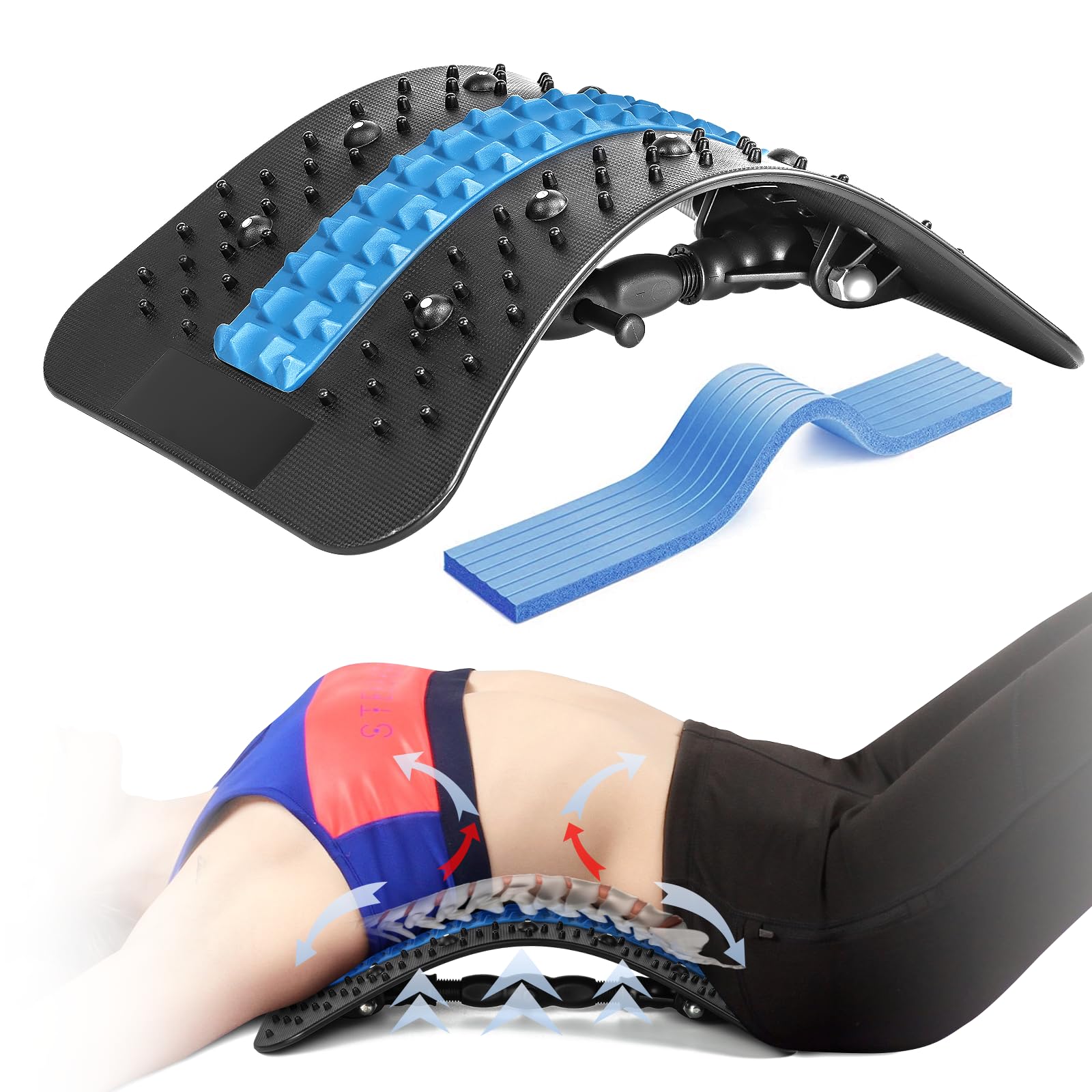
Fifteen, 28 and 42 degrees is the whole feature list, and it turns out that's enough. You flip the board onto one of three notches, lie back, and let your own weight do the work; the lowest setting is a shallow, almost apologetic arch that a stiff back can take on the first try. It's molded from high-strength PP plastic, measures 15.16 by 9.84 inches, and weighs 13.76 ounces, so it slides under a bed or into a duffel without a second thought.

Of the eight devices we tested, this is the one we hand to someone who has never used a back stretcher, because nothing about it is a commitment: not much money, no technique to learn, and a three-step progression that does the thinking for you. The middle setting is where it earns its place — a few minutes and the lower back unloads in a way a foam roller never quite manages. It's also the most consistent of these picks on the thing it's for: lower-back relief and a straightforward daily stretch.

Two practical notes. The surface is nubbed rather than smooth, and those acupressure points are hard plastic against your back — a folded towel laid over the top takes the edge off without killing the stretch. And this is a floor tool: nothing holds it against a chair, so if the ache arrives after eight hours at a desk, the Magic Back Support pad below is the better buy.

Pros

  • Three arch heights to build up through
  • Under a pound, so it stores anywhere
  • Strongest relief record of these picks

Cons

  • Three fixed angles with nothing in between
Our verdict

Our default recommendation for a first back stretcher: three arch heights, under a pound, and the most consistent stretch-and-relief record in this set.

Check Latest Price
2

Best for Upper Back and Ribs

Backpod

89 /100
Trail Score Excellent

Key details

Care
Hand wash only
Made In
New Zealand
Thickness
5 centimeters
Dimensions
2.76 x 5.12 x 7.87 inches
Check Price on Amazon

Smaller than it looks in photos: the Backpod is a five-centimeter-thick molded wedge, roughly the size of half a football, and you lie back over it rather than lowering yourself onto a board. That shape is the point — it concentrates pressure on the mid-back and the rib joints instead of spreading it across the lumbar spine, which is why it doesn't compete with anything else in this set. Physio-designed, made in New Zealand, hand-wash only, and utterly unremarkable to look at.

Using it is a small skill. The booklet sets out hand positions and progressions — arms crossed, arms overhead, a pillow under the head at first — and the pressure is meant to build over weeks rather than in one session. The payoff tends to arrive as more room across the chest and an upper back that stops bracing by mid-afternoon, not as a dramatic pop.

The honest limit is scope. It does nothing for a low back asking for an arch, so buying it for general backache is buying the wrong tool at the top of the price range here. What you're paying for is a specific job done properly, and no other pick on this page attempts that job at all.

Pros

  • Reaches the mid-back and rib joints
  • Printed guidance walks you through the technique
  • Dense, well-finished build

Cons

  • Does nothing for the lower back
  • Firm surface with no give under the spine
Our verdict

The most targeted device here for tightness between the shoulder blades and around the rib joints — and the one we reach for when a lumbar arch does nothing.

Check Latest Price
3

Best for Desk Chairs

Magic Back Support Lumbar Stretcher

86 /100
Trail Score Excellent

Key details

Cover
Removable, washable mesh
Weight
1.43 lb
Cushion
Memory foam
Check Price on Amazon

This is the only pick here built to stay on a chair. A memory-foam pad with a strap that wraps the seat back, it puts a lumbar curve behind you while you work — the difference between a device you use for five minutes and one that is quietly doing something all afternoon.

On the floor it doubles as a padded multi-level stretcher, and the memory foam is what makes that tolerable: the arch arrives without the hard plastic edge of the bare boards. The cover is a breathable 3D mesh that comes off and goes in the wash, which is a small thing that matters a lot for something pressed against your back every day.

If your back trouble is a sitting problem — a long commute, eight hours at a desk, a sofa that swallows you — this is the pick we point to, and the only one that keeps working while you're busy doing something else. It isn't the choice for a deep thoracic arch or for anyone who wants to progress through real angles; the MINOLL and the Backpod cover that ground. What it does better than anything else in this set is disappear into your chair and hold your posture for hours.

Pros

  • Works while you sit, not only on the floor
  • Memory foam softens the arch
  • Removable, washable mesh cover

Cons

  • Thickness can push you forward in a short seat
Our verdict

The desk-hour answer: a memory-foam lumbar pad that straps to a chair and keeps working long after a five-minute floor session would have ended.

Check Latest Price
4

Best Padded Arch

North American Healthcare Arched Back Stretcher

88 /100
Trail Score Excellent

Key details

Arch
Fixed contour
Cover
Synthetic leather
Weight
2.43 lb
Check Price on Amazon

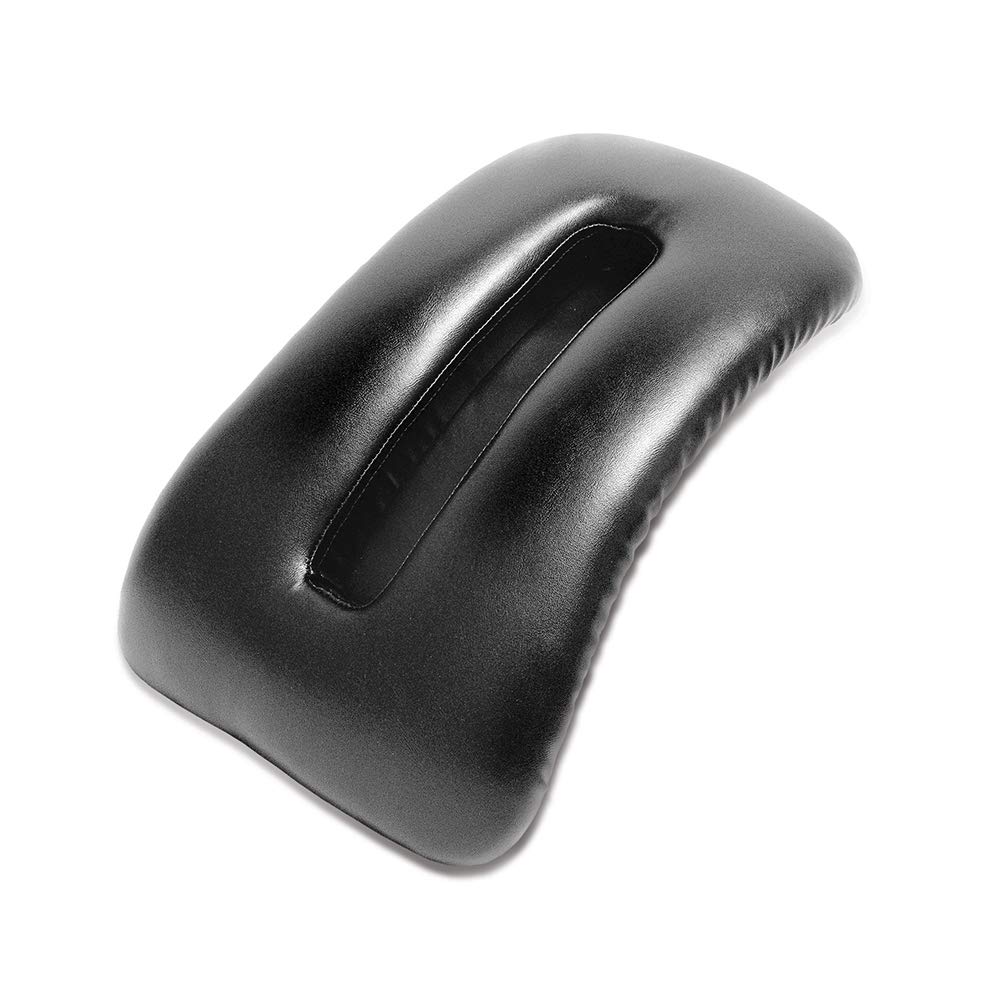
Smooth, padded and upholstered rather than molded: the arch is covered in a firm foam layer under a synthetic leather cover, so nothing digs in and there's no assembly to work through. You lie back over it and gravity does the rest, which makes it the least demanding device here to actually use.

We like this one for the people who bounce off hard plastic. The padding is real rather than token, and it spreads the load enough that a five-minute session doesn't leave a stripe down your spine. For passive, hands-free stretching, it's the most comfortable thing in this set.

It's also the heaviest pick here at 2.43 pounds, which buys a frame that doesn't skitter when you get on it, and it's bulky enough that it lives against a wall rather than in a drawer. The design has been in production since 2001 — a long run for a molded shape in a crowded category — and that kind of staying power is its own quiet endorsement.

Pros

  • Padded, upholstered surface
  • No assembly and no settings to learn
  • Heavy enough to stay put on the floor

Cons

  • One deep, fixed contour with no adjustment
Our verdict

For hands-free passive stretching without bare plastic against your spine, this padded arch is the pick — provided one fixed curve suits you.

Check Latest Price
5

Best Cushioned

RESTCLOUD Back Stretching Cushion

83 /100
Trail Score Excellent

Key details

Weight
1.8 lb
Material
Polyurethane foam
Dimensions
12.6 x 12.4 x 4 inches
Massage Nodes
8 nodes, 16 bars
Check Price on Amazon

Where the plastic boards here are shells you balance on, this is a solid block of polyurethane foam — 12.6 inches wide, four inches tall, 1.8 pounds — and the difference is obvious the moment you lie back. The foam compresses around the shape of your spine instead of asking your spine to match it, and for anyone who has tried a hard board and hated it, that is the whole argument.

Eight massage nodes and 16 bars run along either side of the centerline, leaving a channel for the spine itself, and a removable flexible ball sits in the C-opening to change the height and how much stretch you get. Leave the ball in when you want the arch to press; take it out for a flatter, gentler position.

It's the firmest thing here that isn't plastic — dense foam, not plush — and it sits at the premium end of this set, which is a lot to pay for a shape you can't change much beyond adding or removing the ball. What that buys is a stretch you can relax into rather than brace against, and for a back that has rejected every hard board, that's worth the money.

Pros

  • Foam body is easier on a bony spine
  • Removable ball changes the stretch
  • Channel leaves room for the spine

Cons

  • Wide body can sit broad on a short torso
Our verdict

The cushioned alternative: dense foam instead of plastic, a channel for the spine, and a removable ball to soften or deepen the stretch.

Check Latest Price
6

Budget Acupressure Board

ChiFit Multi-Level Back Stretcher

82 /100
Trail Score Excellent

Key details

Weight
1.14 lb
Dimensions
15 x 4 x 2.8 inches
Arch Settings
3 levels
Acupressure Points
92
Check Price on Amazon

Ninety-two acupressure points is the headline, and they decide whether this board suits you. The nubs are pronounced — pressure running along both muscle groups rather than a smooth arch — and a back that likes deep pressure tends to take to it immediately, while a thin or sensitive one finds it sharp.

Three gears set the arch, changed by folding the two halves onto different notches. Assembly takes a few minutes once and then you leave it together; at 15 inches long and 1.14 pounds it stows behind a door or slides under a sofa without complaint.

As the least expensive way into an adjustable board, it's easy to justify: the stretch is real, the acupressure surface is the most convincing thing about it, and it does the same basic job as boards costing more. Treat the tabs as the wear point and check them before each session — the plastic there is where this design gives up first. Buy it to try acupressure cheaply; spend more if you want a board you never have to think about.

Pros

  • Acupressure points add pressure along the muscles
  • Three arch settings to start easy
  • Cheapest adjustable board here

Cons

  • Tabs can snap under body weight
  • The jump between settings is wide
Our verdict

The budget way to try acupressure: a genuinely effective stretch for very little money, as long as you're careful with the tabs.

Check Latest Price
7

Small-Space Traction

WANYIDA Lumbar Traction Roll

81 /100
Trail Score Excellent

Key details

Levels
3 heights
Weight
6.4 oz
Dimensions
9.8 x 6.3 x 4.9 inches
Load Rating
300 lb
Check Price on Amazon

Six point four ounces and about the footprint of a tablet: this is the smallest device here, and that's exactly what it's for. Instead of a full-length board, it's a foam roll with a shaped ridge that sits under one segment of your low back while you lie over it.

The idea is a fulcrum rather than a stretcher. You position the roll under your lumbar curve and let body weight press the spine over a single point — closer to what a chiropractor does with a rolled towel than to lying on an arch board — and short sessions are the whole technique, 30 seconds to a couple of minutes at first.

Where it beats a board is placement. You can nudge it an inch up or down until the pressure lands on the segment that's tight, and shift your hips to work one side of the low back at a time, which no full-width board allows. Three heights, set with the accompanying cushions, let you add depth as the curve loosens.

For targeted low-back work with almost no floor space, nothing here does more with less: it's the only pick that will go in a carry-on, and the only one that lets you isolate one segment. It is not a whole-back stretch and it is not something you lie on to unwind — it's for the back with one specific spot that won't let go.

Pros

  • Tiny footprint, easy to travel with
  • Fulcrum placement targets one segment
  • Three heights with the included cushions

Cons

  • Dense foam, so sessions stay short
Our verdict

A traction roll rather than a board: the smallest, most precise pick here, built for one stubborn segment of the low back.

Check Latest Price
8

Fine-Tuned Arch Angles

GUBENCI Back Stretcher

83 /100
Trail Score Excellent

Key details

Weight
1.21 lb
Adjustment
0° to 60°, stepless
Dimensions
14 x 13 x 4 inches
Load Rating
275 lb
Check Price on Amazon

Stepless is the difference. Instead of three notches, the arch adjusts continuously from flat to 60 degrees, which means you can find the setting your back actually tolerates rather than the nearest one available. That's the gap in almost every other board on this page, and it's why this one is worth a look despite being the newest thing in the set.

Two pads come in the box — a thick memory-foam one for a softer surface and a firmer silicone one for deeper pressure — and swapping them changes the feel more than the angle does. The surface itself carries 112 small nubs plus 10 larger pressure points, so acupressure is part of the deal whether or not you were looking for it.

The frame is impact-resistant ABS rated to 275 pounds, and it measures 14 by 13 inches at 1.21 pounds. That rating is the lowest among the picks here that publish one, so if you're a heavier user, check the number against your own weight before ordering rather than assuming it's a formality.

For a household where two people want different pressures, the second pad is the detail that makes it work, and the dial means neither of you is stuck on the wrong notch. It's the pick for someone who wants to fine-tune an angle rather than jump between three of them.

Pros

  • Continuous 0-to-60-degree adjustment
  • Two swappable pads for different pressure
  • Lowest price of the adjustable boards

Cons

  • Too new to have a durability record
Our verdict

The most adjustable board here for the least money: a continuous 0-to-60-degree arch and two pads, from a listing too new to have a track record.

Check Latest Price

How We Tested Back Stretchers at Home

To build our shortlist, we started with the back stretchers getting consistent praise in customer reviews, then filtered out models with vague weight limits, flimsy hinges, or footprints too wide for a standard living room rug. We landed on 14 devices—foam arches, adjustable plastic models, and a few wooden ones—and used each for five months in ordinary home settings. That meant stretching after long desk sessions, first thing in the morning when backs felt stiff, and in the evening while watching TV. We used them on both carpet and hardwood, with bare feet and socks, and stored each one in a closet between uses to see how much space it really ate up.

Comfort and firmness got checked the old-fashioned way: we pressed a palm into each surface, then lay on it for five to ten minutes and noted where the curve hit—whether it supported the lower back or dug into a pressure point. We paid attention to feel, too, because a hard plastic ridge can be fine for one person and unbearable for another. For stability, we shifted weight side to side on hardwood and carpet and watched for sliding or tipping. Ease of use came down to setup and position: how long it took to adjust the height, whether we needed a second person to hold it, and how awkward it felt to lower ourselves onto the device.

Effectiveness was the hardest thing to measure, so we kept a simple log: did stiffness ease during the stretch, and did getting up from the floor feel easier afterward? We compared that against price—a $30 arch that we reached for daily often felt like better value than a $120 model that gathered dust. Durability showed up over time: foam that stayed firm, hinges that didn’t wobble, and surfaces that didn’t crack or peel after months of daily use. The devices that made the final list were the ones that felt stable, fit the body in front of us, and earned repeat use without causing new aches.

How to Choose a Back Stretcher

Match the shape to the part of your back that hurts

Four shapes do four different jobs. A lumbar arch board rolls your lower spine over a curve; a thoracic wedge like the Backpod presses into the mid-back and rib joints; a traction roll works a single segment like a fulcrum; a foam C-cushion splits the difference between stretching and support. If the tightness sits between your shoulder blades, no lumbar board will reach it, and if it sits at the belt line, a wedge won't either.

So decide on location before you shop, and be honest about it. Most returns in this category are people who bought a good board for a problem it was never shaped to touch.

Buy for the lowest setting, not the highest

Every adjustable board advertises its top angle, and almost nobody uses it. What matters is whether the bottom setting is gentle enough to lie on for two minutes on day one, and whether there's a usable step above it. Three fixed notches are fine, but they leave gaps — a continuous adjustment like the GUBENCI's lets you land where your back actually stops, which matters more the stiffer you are.

A board whose easiest setting is already too much is a board that ends up behind the sofa.

Padding, nubs, and the channel down the middle

Acupressure points are the most divisive thing in this category: a back that likes deep pressure tends to love them, a thin or bony one finds them sharp. A raised pad or a channel down the centerline gives your spine somewhere to sit, and on the RESTCLOUD cushion that channel is the reason it works for people who hate plastic.

If you're unsure which camp you're in, start with padding and add pressure later. A folded towel over a nubbed board is a cheap way to test the difference before committing.

Where it lives, and whether you can get down to it

The most common reason a back stretcher stops being used isn't the device, it's the floor. Getting down and back up is hard for exactly the people who need one, so be honest about whether you'll kneel on a rug twice a day. If the answer is no, a memory-foam pad that straps to a chair keeps working while you sit, and that's worth more than a better arch you never use.

Otherwise favor something thin enough to slide under a sofa and light enough to move one-handed.

Check the load rating and the plastic

The boards here publish limits between 275 and 300 pounds, and those numbers are worth reading against your own weight rather than assuming. The failure point on molded boards is almost always the hinge tabs, so treat them as a wear item: check them before you lie back, and don't force a stubborn setting with your body weight.

A board that has survived a year of daily use is a better buy than one with more angles and thinner plastic.

Frequently Asked Questions

Final Verdict

The MINOLL is the board we point most people to: three heights, under a pound, and the most consistent record for everyday lower-back relief in this set. If your tightness sits between the shoulder blades or around the ribs, the Backpod does a job the MINOLL can't and justifies the premium.

And if your back complains mainly while you sit, skip both and strap the Magic Back Support pad to your chair — it's the only pick here that keeps working after the five minutes are up.