Best Back Braces for Lower Back Pain

Lower back pain shrinks your world down to the next movement: getting out of a chair, lifting a laundry basket, sitting through a two-hour meeting. A brace doesn't treat what's causing the pain, but a well-made one takes load off tired muscles and gives you enough confidence to move normally again — and a bad one digs into your ribs, rides up your spine, or loses its grip by lunch. That trade-off is the whole game, which is why fit and staying in place matter more than the number of straps a box brags about.

I've kept a brace in my bag since a badly judged deadlift years ago, and over the past four months my team and I wore 14 of them through ordinary life rather than a lab. What separated the good from the rest wasn't support on paper — it was whether the thing was still in the right spot after an hour of sitting, and whether we forgot we had it on. The picks below are the ones we kept reaching for, sorted by who they suit best.

1

Best Overall

Sparthos Back Brace

89 /100
Trail Score Excellent

Key details

Care
Hand wash only
Size
Large
Weight
14.4 oz
Support
Vertical stays + removable lumbar pad
Check Price on Amazon

A removable foam pad sits in a pocket right where your lumbar curve is deepest, and it is the detail that put this brace at the top of our list. Leave it in and you get a focused pressure point exactly where a lower-back ache usually lives; pull it out and the belt becomes a flatter, cooler wrap for the days when direct pressure is the last thing you want.

The two vertical stays are the other half of the story. They hold the back panel upright instead of letting it fold into a roll the moment you sit down or bend, which is the failure we minded most in the softer belts here. At 408 grams it is light enough to leave on under a work shirt, and the mesh body breathes better than the neoprene braces in this group. That mix of targeted pressure, structural support, and a low profile is why it is our default for everything from a long drive to a full shift on your feet.

Sizing is the part to slow down for. It is sold in single sizes rather than a one-size-fits-most range, and the belt is wide enough to come up generous on a smaller frame. Measure your waist at the navel, not your pants size, and if you land at the top of a size, take the next one up rather than hoping it gives.

The care label says hand wash only, which is the one real annoyance in an otherwise easy brace to live with. Rinse it in the sink on a warm evening and it is dry by morning, which is a fair trade for a belt we keep putting back on.

Pros

  • Removable lumbar pad gives two levels of pressure
  • Vertical stays keep the panel from folding
  • Breathable mesh, light at 408 g

Cons

  • Hand wash only
Our verdict

Our default for most lower-back pain: the removable pad dials pressure up or down, and the vertical stays keep the panel from folding through a long day.

Check Latest Price
2

Best for Lifting

FEATOL Back Brace

89 /100
Trail Score Excellent

Key details

Weight
16 oz
Support
4 stays + removable lumbar pad
Material
Neoprene
Fits Waist
24.4-29.8 in (S/M), 29.8-38.6 in (L/XL)
Check Price on Amazon

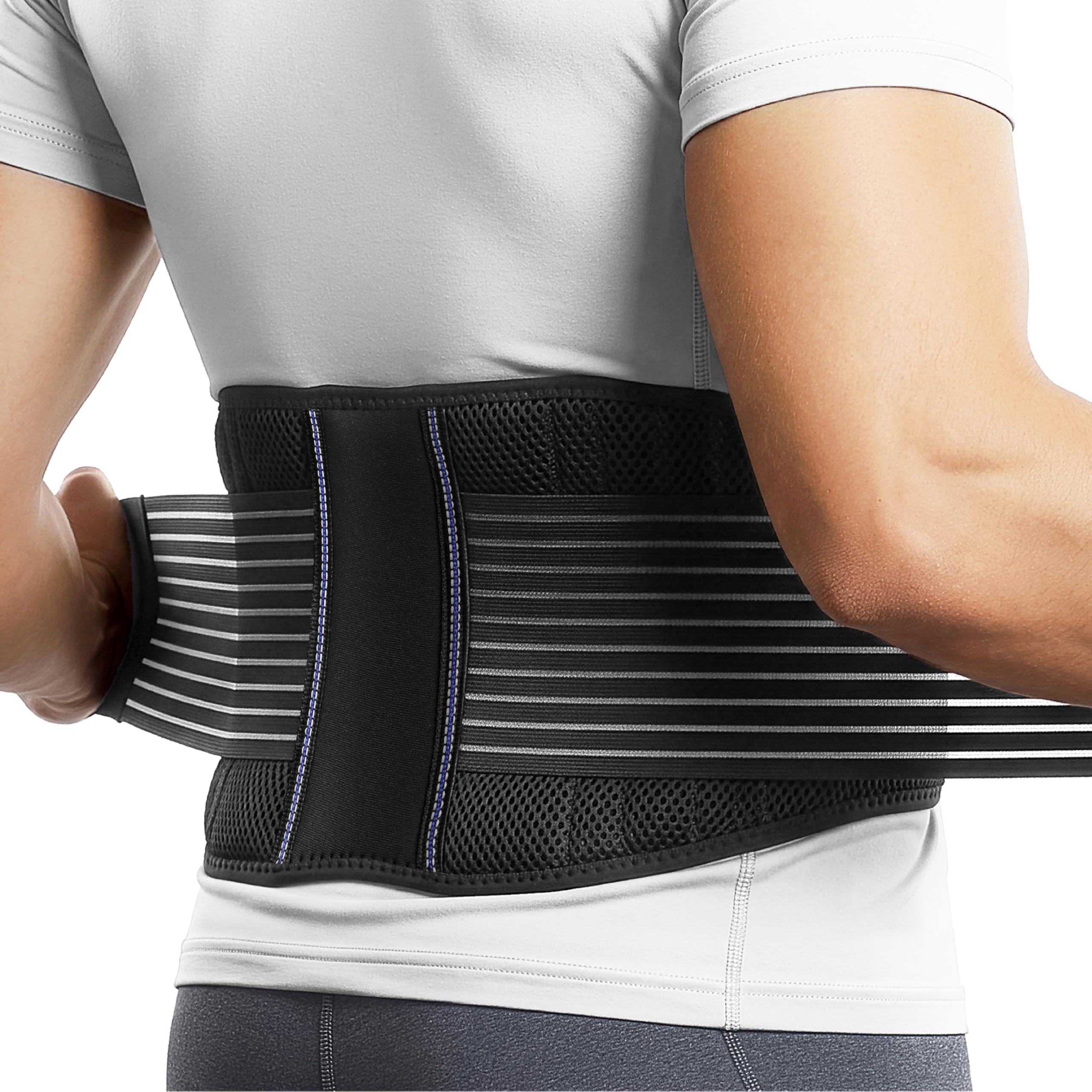
FEATOL's fitting instructions start with a tape measure, and that is the right first impression: waist circumference at the navel, 24.4 to 29.8 inches for S/M and 29.8 to 38.6 inches for L/XL, not your pants size. Get that right and this is one of the best values in the group — four support strips, an extra lumbar pad, and side straps that let you add compression after the main belt is closed.

The four strips are what you feel when you squat. They hold the panel flat against the lower back instead of letting it bunch, and the pad adds a firm nudge right at the curve. Neoprene is the material worth knowing about: it holds compression beautifully and it runs warm, which is welcome in a cold garage and less welcome in July. The side straps double as the fit fix — set the belt, then pull each one until the panel sits flush.

It is a work brace rather than a desk brace. The padding is generous, the profile is thicker than the knit belts here, and it is happiest under a hoodie or a work shirt rather than anything fitted. For lifting, gardening, hauling, and shifts built around repeated bending, though, it is the one we reach for, and it asks for less money than the premium braces while giving up nothing in the support department.

Pros

  • Two waist ranges measured at the navel
  • Four stays plus a lumbar pad
  • Side straps add tension on demand

Cons

  • Neoprene gets hot during activity
Our verdict

If your pain shows up when you lift, bend, or haul, this is the brace we hand over: firm four-stay support, a lumbar pad, and two clearly measured size ranges.

Check Latest Price
3

Best Under Clothes

BraceUP Back Brace

89 /100
Trail Score Excellent

Key details

Weight
9.38 oz
Adjustment
Dual side straps
Fits Waist
35-43 in (L/XL)
Check Price on Amazon

BraceUP is the brace that disappears. The panel is thin, the edges lie flat, and at 9.38 ounces it adds almost nothing under a shirt. This is the one to wear into an office, onto a plane, or through a day of errands where you would rather not explain yourself to anyone.

The useful mechanism is the pair of side straps. Close the main belt, then pull each strap to add compression where you want it, and the result feels less like a rigid corset and more like a steady hand across the lower back. The mesh panel vents heat, and the cut sits low enough that the bottom edge does not dig into your hips when you sit down.

What you trade for that profile is rigidity. There are no steel springs or aluminum stays here, so the lumbar panel supports rather than braces, and a full day of heavy lifting will leave you wanting more structure. For desk work, driving, and long hours on your feet the trade is worth it — and this is the brace most likely to still be on at four in the afternoon.

Pros

  • Low profile that stays hidden under clothing
  • Dual side straps fine-tune compression
  • Mesh panel vents heat

Cons

  • Less rigid than spring-stayed braces
Our verdict

Buy it when the brace has to stay hidden: thin, light, and adjustable enough to wear under a shirt all day, as long as you do not need maximum rigidity.

Check Latest Price
4

Best for Sitting

FREETOO Back Brace 6 Stays

89 /100
Trail Score Excellent

Key details

Weight
12.8 oz
Support
4 aluminum stays + 2 steel springs
Anti-slip
2 silicone grip bands
Check Price on Amazon

Two silicone strips run along the inside of the waistband, and they are the reason this brace stays where you put it. They grip fabric instead of sliding over it, which is the difference between tightening a belt once in the morning and re-tightening it every time you stand up from a chair.

The support is serious as well: four memory-aluminum stays that hold a curve instead of flattening out, two steel springs along the waist, and outer straps that let you add real compression. The 4-way stretch knit is the compromise — it breathes well, but at 12.84 ounces you will know it is on, especially under a slim shirt.

Sizing runs small. The straps give you range, but if your measurement lands within an inch of the top of a size, go up rather than counting on the elastic to make up the difference; a brace that fights your waist is one you will stop wearing by the second week.

For back pain that comes from sitting — a desk, a car, a truck cab — this is the brace in our set we trust most to stay put, and the extra weight is the price of that grip.

Pros

  • Silicone strips resist riding up
  • Four aluminum stays plus two springs
  • Outer straps add genuine compression

Cons

  • Runs small against the size chart
  • Hook-and-loop can loosen on long active days
Our verdict

The one we trust for desk-and-driving pain, because the silicone grip keeps the panel low and the aluminum stays keep it firm.

Check Latest Price
5

Best for Active Work

Ergodyne ProFlex 1600

91 /100
Trail Score Outstanding

Key details

Front Cut
Contoured high-cut
Belt Height
9 in
Fit Retention
Rubber track webbing
Suspender Straps
Adjustable, detachable
Check Price on Amazon

The front of this belt is cut high and contoured, which sounds like a footnote until you spend a morning folding into a truck bed or a garden. A straight-cut belt digs into the front of your hips when you bend forward; this one does not. Add a 9-inch elastic body and rubber track webbing that grips your clothes, and we rate it the best brace here for work that involves movement rather than sitting.

The rest of the detailing is aimed at a shift, not a diagnosis. The polypropylene stays are non-conductive, which matters on electrical jobs, and the suspenders are adjustable and detachable, so you can hang the belt from your shoulders or take them off entirely. It machine washes cold and air dries.

What it does not give you is targeted compression: no lumbar pad, no springs, no contoured back panel, so it supports and reminds rather than pushing back at one point. The suspenders also attach with hook-and-loop and slide off the shoulders for some wearers — thread them under a collar if that happens. For long shifts of lifting and bending, the trade is easy to take.

Pros

  • High-cut front frees forward bending
  • Rubber track webbing resists riding up
  • Machine washable with non-conductive stays

Cons

  • No lumbar pad or springs for targeted pressure
Our verdict

For shift work that is all bending and lifting, this is the pick: the high-cut front stops the digging, and the suspenders keep it in place.

Check Latest Price
6

Best Budget

Ergodyne ProFlex 1650

91 /100
Trail Score Outstanding

Key details

Closure
5 in single strap
Fits Waist
25-58 in
Belt Height
7.5 in
Suspender Straps
Adjustable, detachable
Check Price on Amazon

This is the plainest belt in the group: a 7.5-inch elastic band, one 5-inch closure strap, and a pair of detachable suspenders. Waist sizing is stated from 25 to 58 inches — the widest range on this page — so it is a genuine option for someone who has had trouble finding a size at all.

We keep it as the budget pick because it does the basic job with nothing to fiddle with: put it on, pull the single strap, and go. No pad, no springs, no side straps. For yard work, moving day, or a job where the belt is going to get filthy, that simplicity is the point, and it asks for far less money than the premium braces here.

The thing to know is durability. The polypropylene stays have torn through the elastic for daily wearers within weeks, which is why we treat this as a belt for tasks rather than an everyday medical brace. It machine washes cold and air dries, so keeping it clean between projects takes no effort at all.

Pros

  • Widest stated waist range here (25-58 in)
  • Single-strap closure goes on fast
  • Detachable suspenders and machine washable

Cons

  • Stays can tear through the elastic with daily use
  • No pad or side straps
Our verdict

The budget choice for occasional heavy chores — a simple elastic wrap with suspenders, best treated as a task belt rather than a daily brace.

Check Latest Price
7

Women's Fit

FREETOO Women's Back Brace

91 /100
Trail Score Outstanding

Key details

Size
Medium
Fabric
3D-knit mesh
Support
3D curved panel + 4 stays + 2 springs
Warranty
6 months
Check Price on Amazon

Most braces are rectangles with straps, and they ride up on anyone whose waist is narrower than their ribs. What we noticed first here is the shape: a 3D curved lumbar panel over four aluminum stays and two flexible springs, wrapped in a knit that follows the body instead of stiffening away from it. It is the brace on this page for women who have given up on unisex belts, particularly longer torsos and narrower hips.

The dual straps adjust tension independently on each side, so you can load one flank more than the other, and the triangular lumbar pad lifts out when you want a flatter wrap. It is hand wash only, and it carries a six-month warranty.

Sizing is the catch. It runs small at the top of a range, and the knit feels snug for the first few wears before it settles, so if you are between sizes, take the larger one. The hook-and-loop also wants a firm press on the first try; a half-hearted closure can let go by mid-morning.

Pros

  • Curved panel cut for a narrower waist
  • Removable triangular lumbar pad
  • Breathable 3D-knit fabric with six-month warranty

Cons

  • Pricier than every other brace here
Our verdict

The women's-cut brace we recommend: a curved panel and knit that follow a narrower waist, with the caveat that it runs small.

Check Latest Price
8

Firm Compression

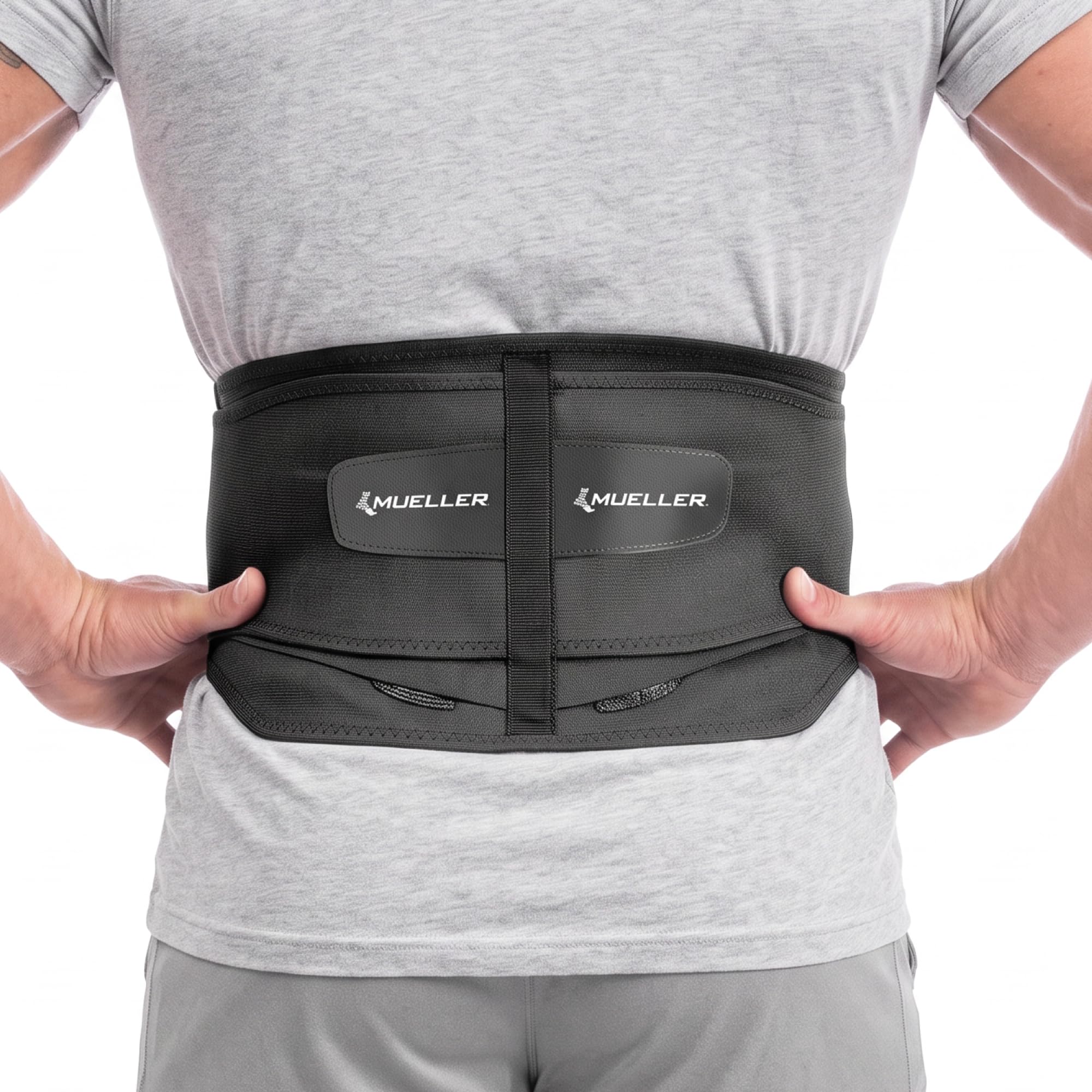
Mueller 255B Lumbar Brace

89 /100
Trail Score Excellent

Key details

Size
One size fits most
Weight
16 oz
Support
4 steel springs
Lumbar Pad
Removable
Check Price on Amazon

Four steel springs sit in the back panel of the Mueller, and they do something a foam pad cannot: they push back. We think the construction is the strongest single thing about this belt — a solid core band, clean stitching, and a shell that holds its shape when you cinch it down.

The lumbar pad is removable, so you can run it with targeted pressure behind the spine or pull it out for a flatter wrap on days when the springs are enough. The mesh is treated to resist odor, which sounds like a marketing line until a brace has spent a week in a gym bag or a work locker.

Fit is where this one asks you to be honest with yourself. It is sold as one size fitting most, and while the range it covers is broad, the experience divides sharply: it wraps some waists perfectly and swims on or pinches others. Measure the widest part of your waist before you order, and if you sit at either end of the usual sizing spread, choose a sized brace instead.

Where it earns its place is firm compression for lifting and standing work. The springs give a rigidity the knit braces here cannot match, and the build suggests it will hold up longer than they will — a combination worth having on a concrete floor or under a loaded bar.

Pros

  • Four steel springs give firm compression
  • Removable lumbar pad
  • Strong stitching and a solid core band

Cons

  • Heavier and firmer than the knit braces
Our verdict

Choose it for firm, spring-loaded compression during lifting and standing work, and only after you have measured to be confident one size will land.

Check Latest Price

How We Tested Lower Back Braces

We started with roughly 40 braces sold by big retailers and smaller medical suppliers, then narrowed the field by reading sizing charts closely. Anything that claimed one size fits everyone got cut, as did braces with straps that couldn't be replaced and return windows too short to wear one for a full week. That left 14, which we rotated through four months of real days.

Each brace went to work: eight-hour desk shifts, the commute, dog walks, unloading groceries, and a few Saturdays of yard work and furniture moving. We counted how many times a day we had to re-tighten the straps, watched whether the back panel rode up when we sat down, and checked if the brace stayed where we put it after an hour of bending. Wearing each one under a normal shirt told us which ones showed through.

Fit was checked against three body types on the team, from a 29-inch waist to a 44-inch one, comparing the stated size range to where the brace actually fastened comfortably, and comfort was judged at the four-hour mark rather than the first ten minutes. For durability, we pulled and released the straps dozens of times a day and inspected stitching and hook-and-loop tape every week, retiring two early when the straps stopped gripping. Support and pain relief came down to observation: whether we could stand up from a chair without bracing a hand on the desk, and how long we could sit before the ache crept back.

How to Choose a Back Brace for Lower Back Pain

Start With the Tape Measure, Not the Label

Waist circumference at the navel is the number that matters, and it is not your pants size. Brands draw their ranges differently — the FEATOL splits S/M and L/XL at 29.8 inches — so the same body can be a medium in one brace and a large in another. Measure late in the day when you are at your fullest, keep the tape snug rather than tight, and write the number down before you shop.

If you land in the top inch of a range, size up. A brace that is slightly generous can be pulled tighter with its straps; one that is too small has nowhere to go.

Match the Stiffness to the Job

A brace's back panel is either flexible or structural. Knit belts with thin stays, like the BraceUP, follow the spine and suit sitting, driving, and desk work. Panels built around aluminum stays or steel springs — the FREETOO braces, the Mueller 255B — push back harder and suit lifting, standing, and repeated bending.

The trap is buying the stiffest brace for a desk job. Rigid support restricts movement, turns uncomfortable by mid-afternoon, and ends up in a drawer. Buy the least structure that covers your hardest task of the day.

What Actually Keeps It in Place

Riding up is the problem that ends most brace relationships, and extra tension is the wrong fix. Look for grip instead: silicone bands inside the waistband on the FREETOO, rubber track webbing on the Ergodyne belts, or detachable suspenders that carry the weight from your shoulders instead of your waist.

A contoured high-cut front helps too, because it lets you fold forward without the belt levering itself upward. If a brace still climbs when you sit, it is usually sitting too high to begin with — start it lower over the sacrum, and tighten the side straps once you are seated.

Heat, Bulk, and Getting It On Alone

Neoprene holds compression well and runs hot; knit mesh breathes but stretches more. If you will wear the brace against skin or under a shirt, weight matters as much as fabric — the lightest brace here is 9.38 ounces, and the firmest is over a pound.

Check how it closes before you buy. A front wrap with side straps is easy to manage alone; a pull-on or back-closure design is not. If shoulder or hand strength is limited, that detail decides the purchase more than any specification.

Frequently Asked Questions

Final Verdict

Start with the Sparthos. The removable lumbar pad lets you tune how much pressure sits behind your spine, the vertical stays keep the panel from folding through a long day, and the mesh body is comfortable enough to leave on. It covers the widest range of ordinary days, from a desk to a drive to a shift on your feet.

Change the pick when your requirement is narrower. The FEATOL when you are lifting and want firm support, the BraceUP when the brace has to disappear under a shirt, and the ProFlex 1600 when the day is spent bending rather than sitting.