Best Back Braces for Heavy Lifting of 2026

A back brace that rides up into your ribs halfway through a lift is worse than wearing nothing at all — you spend the rest of the set thinking about the brace instead of your form. I learned that the hard way during a move that involved far too many boxes and one very steep staircase, and it's the first thing I check now. A good brace spreads the load across your lower back, holds steady when you hinge and twist, and stays quiet under a shirt. What it fixes is straightforward: it lets you keep doing the heavy work instead of sitting out the shift.

Fit is where these live or die, and sizing charts are notoriously unhelpful — most of what we tested runs small, so if you're between sizes, size up. Over the past five months, my team and I put 14 braces through warehouse shifts, gym sessions, and a genuinely regrettable amount of furniture moving. The Velcro got the closest scrutiny, because cheap hook-and-loop loads up with lint and stops gripping by week three. The picks below held their shape, and their hold, well past that.

1

Best Overall

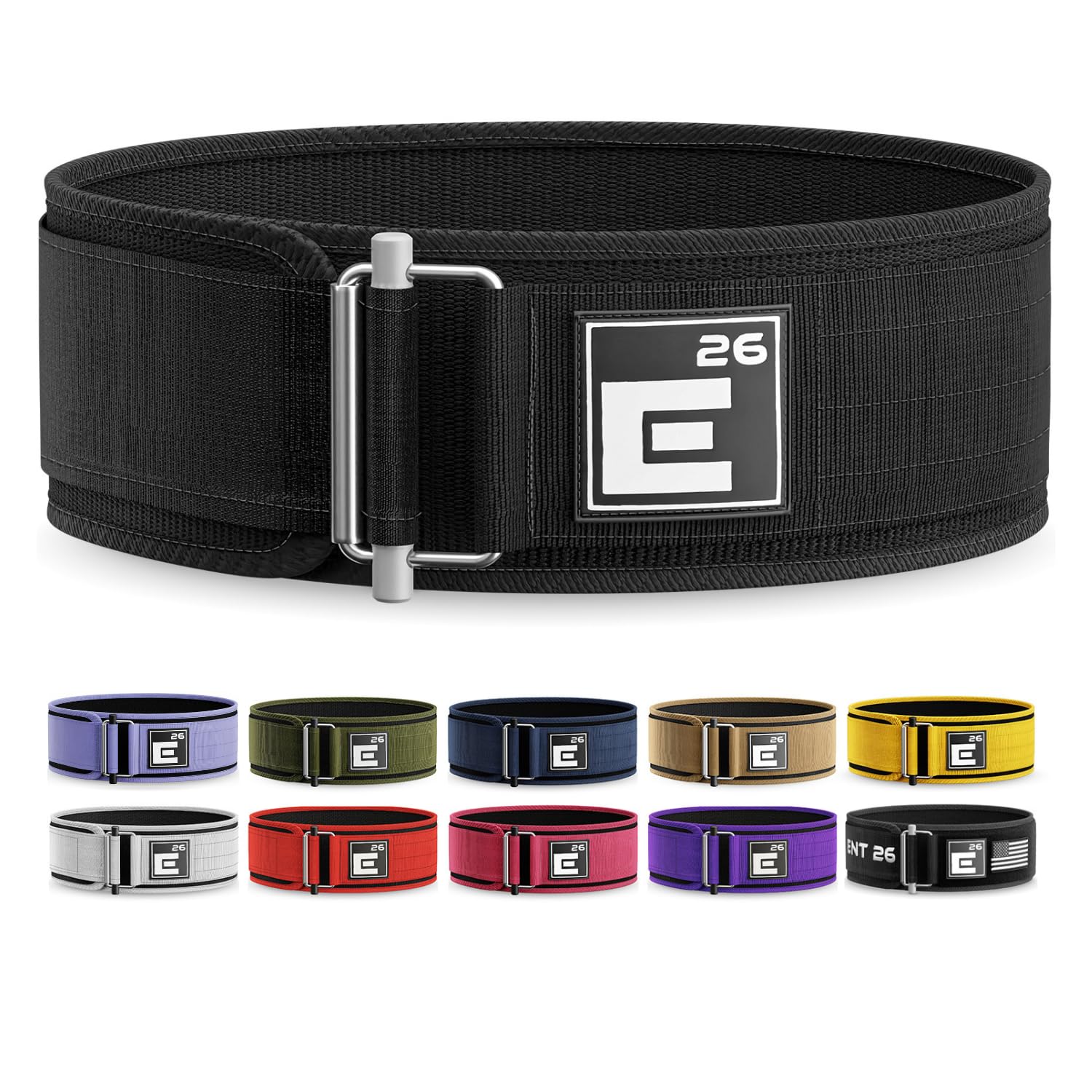
Element 26 Self-Locking Belt

91 /100
Trail Score Outstanding

Key details

Weight
9.7 oz
Closure
Self-locking metal buckle
Material
Nylon
Support Width
4 inches
Check Price on Amazon

The reason to buy this belt is a piece of metal. Set the nylon where you want it, pull the strap, and the self-locking buckle engages as you brace — the harder you push against it, the more firmly it holds. We put it through squats and pulls and kept noticing what wasn't happening: no creeping, no re-tightening between sets, none of the pop-open you half expect from a belt with a hook-and-loop backing.

Four inches of webbing is the other half of the design. It is narrower than the six-inch belts here, and what that buys is clearance: the panel sits between your hip bones and your ribs rather than cutting into either, so you can get into a deadlift setup without the belt deciding where your hips go.

At 275 grams it is light enough to live in a gym bag and forget about until you need it, and it rolls up small in a way a 7 mm leather belt does not. Double stitching at the seams and stress points is the kind of detail you only appreciate in hindsight.

Sizing is where it catches people. The straps run small, so measure your waist at the navel with a soft tape and take the larger size if you land between two — a belt that will not close is not a belt. Do that, and this is the safest money in the guide.

Pros

  • Self-locking buckle tightens as you brace
  • Light 275 g and rolls up small
  • Fast on and off between sets
  • Reinforced stitching at stress points

Cons

  • Four-inch panel covers less of the lower back than the wide belts here
Our verdict

The belt we hand a lifter first: a locking buckle that holds under load, light enough to carry, and quick enough to get off between sets.

Check Latest Price
2

Best for Bigger Frames

FEATOL Lumbar Support Belt

89 /100
Trail Score Excellent

Key details

Care
Hand wash only
Sizes
S/M to 4XL
Support
4 support strips and lumbar pad
Material
Breathable foam
Check Price on Amazon

This brace is cut for a body that most of the others here stop short of. FEATOL runs it from S/M up to a 4XL built for a 63- to 68.9-inch waist measured at the navel, and if you have been squeezing into a brace two sizes too small, that range is the whole reason to read this one.

Four stiffening strips run the length of the back panel and a lumbar pad sits over the spine, which gives the brace a firm shape a plain elastic wrap does not have. The side straps are the part we appreciate most: they set compression around your middle independently of the main closure, so you can press the pad in without cranking the whole belt down. The fabric breathes, and it is hand wash only, which is the trade for that.

Where it earns its spot is the long middle of a working day rather than a single max attempt. It holds the lower back, gives you something to push against when you bend, and stays tolerable under a shirt through a shift. It is not the belt for a heavy squat — there is no buckle to lock down — but that was never the job.

Pros

  • Sizes to a 68.9-inch waist
  • Four stays plus a lumbar pad
  • Side straps adjust compression separately
  • Breathable fabric for all-day wear

Cons

  • Size chart runs small
  • Hand wash only
Our verdict

The brace for a bigger frame or a full shift of lifting, with four stays and a lumbar pad in sizes up to a 68.9-inch waist.

Check Latest Price
3

Best for Long Shifts

Ergodyne ProFlex 1600

91 /100
Trail Score Outstanding

Key details

Size
Large
Stays
Non-conductive polypropylene
Suspenders
Adjustable, detachable
Support Height
9 inches
Check Price on Amazon

Ergodyne puts two braces in this guide, and the gap between them is two inches of elastic and a different kind of workday. The 1600 is the taller one at 9 inches, and it exists for the shift where you bend a hundred times rather than the set where you bend once with everything you have got.

The 9-inch body gives the widest back panel here, and it is the coverage we want on a long shift: it reaches from the sacrum to the lower ribs, so the support is there when you twist as well as when you lift. The contoured high-cut front is the detail that makes it wearable rather than a barrel around your middle — it dips away at the front so you can sit down without the belt biting in.

Ride-up is what kills a work brace, and Ergodyne attacks it twice: rubber track webbing inside the belt and a pair of suspenders that adjust and detach if you do not want them. The stays are non-conductive polypropylene and the whole brace machine washes cold, which matters more than it sounds like it should after a summer of shifts.

Pros

  • Widest back panel here at 9 inches
  • High-cut front keeps you mobile
  • Rubber track webbing resists riding up
  • Machine washable

Cons

  • Shoulder straps can slip when you reach overhead
  • Waist hook-and-loop can loosen with heavy use
Our verdict

The brace for a shift spent bending: nine inches of coverage, a high-cut front that lets you sit, and rubber webbing that fights ride-up.

Check Latest Price
4

Best Budget Work Brace

Ergodyne ProFlex 1650

91 /100
Trail Score Outstanding

Key details

Closure
Single 5-inch strap
Suspenders
Adjustable, detachable
Waist Range
25 to 58 inches
Support Height
7.5 inches
Check Price on Amazon

This is the least expensive brace here, and the trade is visible the moment you pick it up: 7.5 inches of plain elastic, one 5-inch closure strap, no contouring and no track webbing. For occasional lifting rather than a daily shift, that is enough — it does the job, and the price means you can keep one in the truck and one in the toolbox.

Two things it does better than its price suggests. The waist range runs from 25 to 58 inches, one of the broadest fits here, so it lands on a lot of bodies without a special order. And the stays are non-conductive polypropylene, the brace machine washes cold, and the panel is flat enough to disappear under a jacket.

The single strap is where the price shows. With no second strap and no rubber track, it can work its way up when you sit and stand repeatedly; leave the suspenders on and it behaves. Treat it as a light-duty brace that gets replaced when it wears, and it earns its place.

Pros

  • Lowest-priced brace in this guide
  • Fits waists from 25 to 58 inches
  • Detachable suspenders included
  • Machine washable elastic

Cons

  • Sewn-in stays can work through the panel edge
Our verdict

A light-duty work brace for occasional lifting, with detachable suspenders and the broadest low-cost fit range in this guide.

Check Latest Price
5

Best Leather Belt

Jaffick Leather Lifting Belt

94 /100
Trail Score Outstanding

Key details

Width
6 inches
Closure
Buckle
Material
Double-sided leather with suede lining
Thickness
7 mm
Check Price on Amazon

Six inches of double-sided leather at 7 mm arrives stiff, and that stiffness is the feature: a belt that folds easily has nothing to push back against when you brace. It takes a handful of sessions before it stops fighting your ribs, and until then you will know it is there.

The cut is what sells it. Six inches spans more of the lower back than the 4-inch belts here do, and the suede lining keeps the top edge from scraping against bare skin. Then there is the buckle: it pulls down and stays, with no hook-and-loop to wear out and start popping mid-set — the failure that eventually ends most nylon belts.

Leather asks a little more of you. It is heavier in the hand than the nylon belts here, it does not fold into a bag as small, and it wants airing out after a hot session rather than a machine wash. In exchange you get a belt that keeps its shape instead of softening into a strap.

Pros

  • Six-inch leather covers more of the lower back
  • Suede lining protects bare skin
  • Buckle closure cannot pop like hook-and-loop
  • Reinforced top stitching

Cons

  • Size chart runs small; measure at the navel
Our verdict

The leather pick: six inches of double-sided hide and a buckle that cannot pop, for lifters who want a belt that keeps its shape.

Check Latest Price
6

Best Value Gym Belt

RDX Auto Lock Belt

93 /100
Trail Score Outstanding

Key details

Size
L
Closure
Auto-lock roller buckle
Material
Polyester with EVA padding
Support Height
6.5 inches
Check Price on Amazon

The first thing we noticed with the RDX is how little tightening it needs. The auto-lock roller buckle works like a ratchet — feed the tail through, pull, and it holds where you leave it — so you get a locked-in feel without hauling the strap past where you wanted it.

The back panel is 6.5 inches of contoured padding, tapering at the sides, which is how it covers a lot of lumbar without pressing into your hip bones when you sit between sets. RDX builds it from polyester over compressed EVA and finishes it in more colors than anything else here, army green included, if the belt is going to be seen.

What we did not expect at this price is the comfort. High-volume training is where a belt usually starts to feel like a plank, and the padding here is thick enough that it does not. Sizing is the thing to slow down for — the chart reads generously at the top end, so measure at the navel and go down if you land between two. Get that right and this is the best value in the guide for a first serious belt.

Pros

  • Auto-lock buckle holds without over-tightening
  • 6.5-inch contoured back panel
  • Thick padding for high-volume training
  • Color options beyond black

Cons

  • Hook-and-loop backing is the long-term wear point
Our verdict

The value belt we point a first serious lifter toward: an auto-lock buckle, 6.5 inches of contouring, and comfort beyond its price.

Check Latest Price
7

Under Clothes

FREETOO Back Brace

89 /100
Trail Score Excellent

Key details

Size
L
Stays
4 aluminum stays and 2 steel springs
Material
4-way stretch knit
Anti-slip
Silicone bands at the waist
Check Price on Amazon

Most braces announce themselves — a slab of elastic under the shirt, a strap line across the back. The FREETOO is the one here built to disappear: a 4-way stretch knit that sits close, four memory-aluminum stays instead of plastic strips, and a profile low enough to wear under a work shirt.

The stays are what make it feel different from a soft wrap. Aluminum takes the shape of your back rather than sitting flat against it, and paired with the two springs along the waist it gives you a firm edge to brace against without turning the whole brace rigid.

Two elastic side straps add compression on top of the main closure, and silicone bands at the waist grip so the brace stays where you set it. Set it low, over the hips rather than up on the waist, and those bands have something to hold. The knit breathes, which is the difference between wearing it through July and giving up in June.

What it is for is the day you spend lifting rather than the set you spend lifting: under clothes, through a shift, comfortable enough that you stop thinking about it. What it is not is a lifting belt — there is no buckle to lock down, so a max squat or deadlift still wants one of the belts above.

Pros

  • Low profile wears under clothing
  • Aluminum stays and steel springs hold shape
  • Silicone bands resist rolling
  • Breathable knit for long wear

Cons

  • Can roll up on some builds when sitting
Our verdict

The brace that disappears under a work shirt, with aluminum stays for shape — support for a day of lifting, not for a max attempt.

Check Latest Price
8

Wide Waists

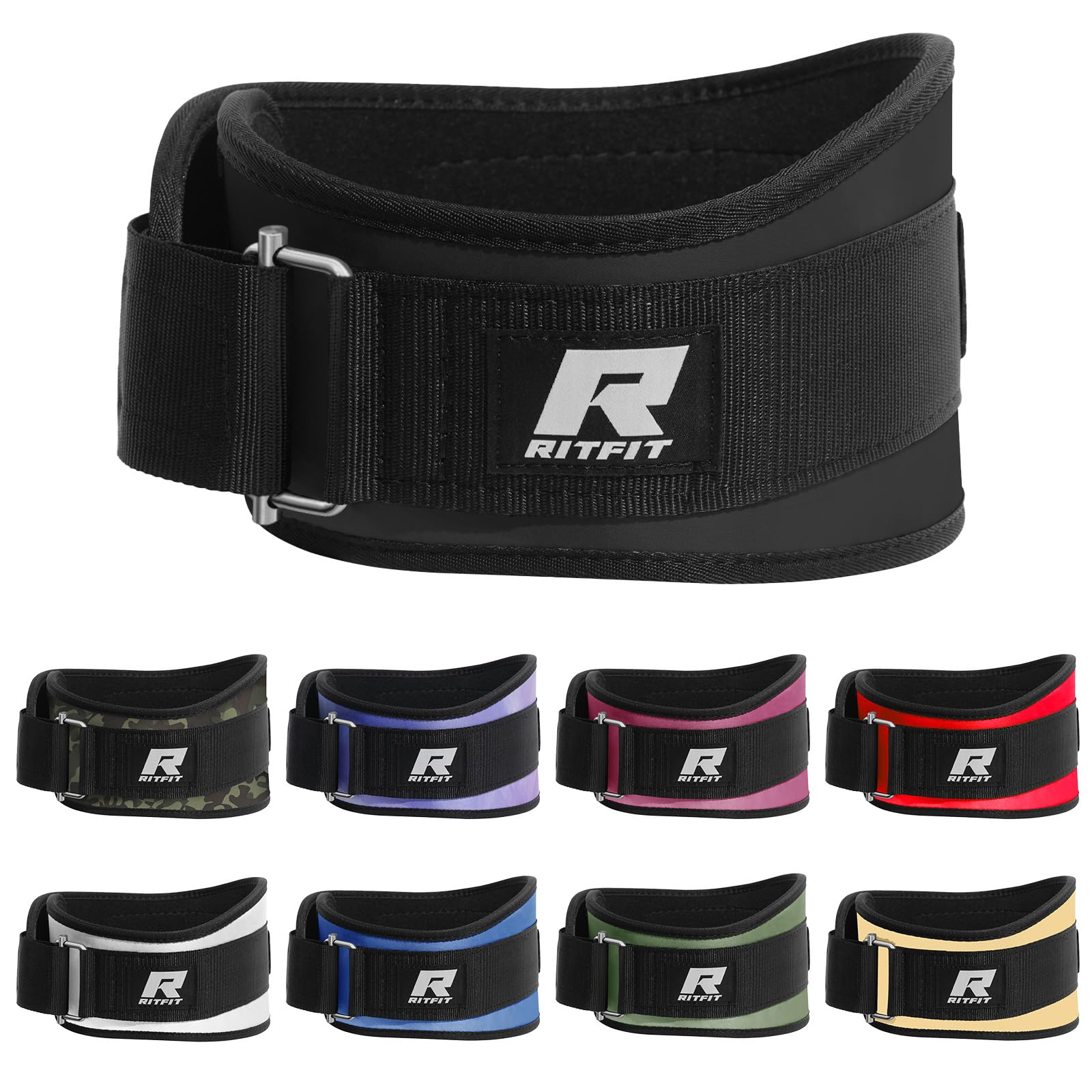
RitFit 6-Inch Lifting Belt

91 /100
Trail Score Outstanding

Key details

Closure
Hook-and-loop with steel buckle
Material
Reinforced tricot and EVA
Waist Range
Up to 51 inches (XL)
Support Height
6 inches
Check Price on Amazon

Every nylon belt in this guide comes down to its hook-and-loop, and the RitFit is the one where that matters most. The 6-inch contoured panel is solid, the stainless steel buckle is solid, and the closure underneath is what you are betting on.

Where it earns its place is size. The XL runs to a 51-inch waist, among the widest lifting belts here, and it is cut to sit on a bigger middle without pinching — the contour narrows at the sides, so there is less material digging in when you set up.

Comfort is the surprise. The reinforced tricot shell over EVA padding is not the stiffest material here; it is the one that folds into a gym bag and skips the break-in, and the padding lands where a squat belt should. It also comes in camo, pink, and galaxy finishes, which is more personality than most of this group bothers with.

We keep it in for the lifter whose waist puts them at the top of every chart, at a price near the bottom of this group. Just know what you are buying: with hook-and-loop doing the holding, plan to replace this belt when it starts to let go rather than expecting years of service. At this price, replacing it is not a tragedy.

Pros

  • XL fits a 51-inch waist
  • Six-inch contouring without pinching
  • No break-in period
  • Multiple colorways

Cons

  • Sizing runs inconsistently against the chart
Our verdict

The belt for a waist that tops every chart, with six inches of contouring and a price that makes replacing it painless.

Check Latest Price

How We Tested the Best Back Braces for Heavy Lifting

We built the shortlist from what buyers actually complain about: braces that roll at the edges, size ranges that lump a 33-inch waist in with a 38-inch one, and closures that quit after a month. From there we filtered by construction — wide lumbar panels, overlapping adjustable straps, breathable back panels for all-day wear, and a sizing range that covers roughly a 28- to 50-inch waist. We ordered 14 braces and wore each one for at least three full days.

Testing happened where backs actually give out: eight-hour warehouse shifts loading and stacking 30- to 50-pound boxes, two deadlift and carry sessions a week, a weekend of hauling furniture up a flight of stairs, and one long afternoon of yard work. Two testers of different heights and torso lengths wore the same size in every model, which is how we found the ones where fit fell apart at the top or bottom of a size band.

We counted how many times each brace needed re-adjusting during a shift, whether the top edge dug into the ribs when we hinged forward, and whether it crept upward during repeated lifts. The closures got their own tally: 50 re-fastenings in a row to see whether the hook tape still bit, then another look after five months of weekly washing. Each tester rated their back ache before and after every shift, and the braces that helped most were the ones we forgot we were wearing.

How to Choose a Back Brace for Heavy Lifting

A Lifting Belt and a Work Brace Do Different Jobs

Both stabilize the lower back, but they solve different problems. A lifting belt gives your abdominal wall something rigid to push against, which is why it goes on for a heavy set and comes off after; a work brace supports posture through hours of bending and stays on. If your lifting is barbells, buy the belt first. If it is bags of cement, sheet goods, or boxes, the brace is the tool.

The Element 26 is the belt here, and the ProFlex 1600 is the brace. Plenty of buyers end up with one of each, and that is not extravagance — it is two different days of work.

Width Decides Where It Sits, Not Just How Much It Covers

Four inches clears the hip bones and the ribs, and it is what most deadlifters want because the panel stays out of the setup. Six to 6.5 inches covers more lumbar for squats and carries. Seven and a half to nine inches is work-brace territory, where coverage matters more than mobility.

More is not automatically better. A tall panel digs into the ribs when you sit and crowds the belt line, which is why the ProFlex 1600 pairs its 9-inch body with a high-cut front. Match the width to the position you are in most of the day.

The Closure Is What You Are Really Buying

Hook-and-loop is fast, infinitely adjustable, and the part that wears out first — every nylon belt here depends on it to some degree. A self-locking or auto-lock buckle adds a mechanical catch so the strap cannot creep, and a leather belt with a single prong simply will not pop at all.

If a strap has ever let go on you mid-lift, pay for the lock. The Element 26 and the RDX both have one, at prices close to the plain hook-and-loop belts.

Measure at the Navel, Not Your Pants Size

This is the biggest source of returns in the category and it is entirely avoidable. Pant size is vanity sizing; waist measurement is not. Run a soft tape around your body at navel level, over a shirt, and write the number down before you open a size chart.

Every brand charts differently and most run small at the top of their range, so if you land between two sizes, take the larger — a brace you cannot close snugly does nothing. The FEATOL reaches a 68.9-inch waist for anyone the standard charts leave out.

Suspenders, Stays, and Long Days

Suspenders are the cheapest fix for ride-up, and on a work brace they earn their keep: they hold the panel over the sacrum instead of letting it climb your back. Removable ones let you leave them off under a jacket.

Stays give the panel its shape — aluminum, polypropylene, or coil springs — and the wider the panel, the more they matter. If the brace is on for eight hours, breathability beats stiffness. If it is on for a single set, the reverse is true.

Frequently Asked Questions

Final Verdict

For most people lifting heavy, the Element 26 is the belt to buy. The self-locking buckle removes the one failure that ends a heavy set, it weighs 275 grams, and it comes off in a second between sets.

If your lifting runs on a clock rather than in sets — a warehouse shift, a move, a day of loading — the ProFlex 1600's nine inches and rubber track webbing do more for a back that bends all day. Buy the brace when the shift is the workout.