Best Whole-House Humidifiers of 2026

Dry winter air rarely announces itself. It shows up as gaps between floorboards, a shock off every doorknob, and a scratchy throat at 6 a.m. A whole-house humidifier addresses all of it at the source, but the category splits in two, and that split matters more than any spec sheet: furnace-mounted units live in the ductwork and humidify room after room without your involvement, while console and pedestal models plug into a wall, roll where you need them, and ask to be filled every day or two.

I spent one full heating season — November through April — with 10 of these, from bypass units bolted into ductwork to consoles humming in my hallway, and the difference between a house that feels humidified and one that feels clammy came down to controls, not capacity. One thing that surprised me: a unit rated for 5,000 square feet in a leaky 1,800-square-foot house will run nonstop and still lose ground. Match output to your actual space first, and the picks below get a lot easier to sort.

1

Best Overall

AprilAire 600

90 /100
Trail Score Outstanding

Key details

Control
Automatic with outdoor sensor
Capacity
17 gallons per day
Coverage
4,000 sq ft
Warranty
5 years
Check Price on Amazon

What separates the 600 from the cheaper AprilAire units is the controller on the wall. It reads indoor humidity and outdoor temperature together, so when the temperature drops overnight it lowers the indoor target on its own instead of leaving you with fogged windows at breakfast. That handoff is the whole argument for stepping up from a dial: the systems that cause trouble are the ones where somebody set a number in November and never touched it again. The same controller can call the furnace blower on by itself, which matters on a variable-speed system that idles through mild afternoons.

Behind it sits a bypass evaporative unit rated at 17 gallons a day, with a Model 35 water panel and a footprint of about 10 by 16 by 16 inches. At 8.7 pounds it's light enough to hold against the plenum with one hand while you mark the cutout, and 17 gallons is the middle of this group's range, with more headroom than the 12-gallon 500M and far less than the steam unit's output. For a tightly built house in the 4,000-square-foot range that's the right amount, and we think that's where most ducted houses land.

Plan on a Saturday. There's a water line to tap, a drain to route, a 24-volt transformer to wire, and a hole to cut, and the manual is clearer about the plumbing than about the wiring. If you're swapping out an older AprilAire, the cutout and the water connection usually line up and the job collapses to about an hour. If you're starting from scratch above a finished ceiling, this is the point where an HVAC tech earns their rate.

Pros

  • 17 gallons a day suits a typical four-bedroom house
  • Automatic control tracks outdoor temperature
  • Usually drops into an old AprilAire cutout
  • Five-year manufacturer warranty

Cons

  • Wiring section of the manual is thin
Our verdict

Our pick for most houses with ductwork: 17 gallons a day, a controller that adjusts itself as the weather changes, and a five-year warranty at a midrange price.

Check Latest Price
2

Best Value

AprilAire 500M

91 /100
Trail Score Outstanding

Key details

Control
Manual dial
Capacity
12 gallons per day
Coverage
3,000 sq ft
Warranty
5 years
Check Price on Amazon

The 500M is the least expensive way into a ducted AprilAire, and for a smaller house it does everything the pricier models do except think. Twelve gallons a day is enough to hold a comfortable winter in roughly 3,000 square feet of tight construction. What you give up is the automatic control: you watch the outdoor temperature yourself and turn the dial down before a cold snap, or you find out about it on the window glass.

Otherwise it's the same family of hardware, which is mostly good news. The cabinet is 13 inches tall and under 8 pounds, small enough to hold in place with one hand while you drill, and it takes the same style of evaporative panel, the same 24-volt transformer, and the same five-year warranty as the step-up models. When the panel needs replacing in a few winters, you'll find one.

Budget for parts the box doesn't include: duct fittings, a water line tap, and wire. Every furnace-mounted humidifier here has that same small print. What we like about the 500M is where the money goes, into a cabinet that's easy to work on and a control you can swap rather than into features you won't use. In a ranch or a small air handler it's a fair trade, and the dial is the only thing you'll notice.

Pros

  • Lowest-cost route into a ducted humidifier
  • Compact and light enough to hang solo
  • Five-year warranty and parts stay available

Cons

  • Manual dial needs adjusting as the weather turns
Our verdict

The budget pick for a smaller ducted house: 12 gallons a day, a five-year warranty, and a dial you adjust a few times each winter instead of a sensor that does it for you.

Check Latest Price
3

Best for Very Large Homes

AprilAire 800

0 /100
Trail Score Fair

Key details

Type
Steam
Capacity
11.5 to 34.6 gallons per day
Coverage
10,300 sq ft
Warranty
5 years
Check Price on Amazon

The 800 is for the house where the others run out of road: 6,000 square feet and up, vaulted ceilings, a lot of glass, or a heat pump that idles through mild weeks. It makes steam in an electrode canister instead of waiting for warm air, so it can humidify with nothing but the blower moving air through the duct. Output runs across six levels from roughly 11.5 to 34.6 gallons a day, depending on the power supplied.

That independence is what you're paying for. We paid close attention to the blower question, because it's the one that separates a humidifier working in December from one working in October: a bypass unit only does its job while air is moving and does it better with warm air, and on a 45-degree week when the heat barely comes on, the difference shows up on the hygrometer. It's also the highest-output unit in this group by a wide margin, which is the other half of the argument for a big house.

It's a real project: a 23-pound box, a steam hose into the duct, a drain line, and line-voltage wiring. Then there's the detail that surprises people about electrode steam. It needs minerals in the water to conduct, so AprilAire tells you not to filter the feed, the opposite of what every evaporative unit here wants. The canister is a consumable, so budget for replacements the way you'd budget for anything else that wears out.

Pros

  • Highest output here, up to 34.6 gallons a day
  • Humidifies without waiting for a heat call
  • Six output levels to match the house

Cons

  • Steam canister is a recurring cost
  • Needs a 240-volt circuit for full output
Our verdict

For a very large or hard-to-humidify house, this is the unit with the output and the independence to keep up, at a premium price and with a steam canister you'll replace.

Check Latest Price
4

Best Console Humidifier

AIRCARE MA1201

88 /100
Trail Score Excellent

Key details

Runtime
36 hours
Capacity
3.6 gallons
Coverage
3,600 sq ft
Warranty
2 years
Check Price on Amazon

You can hear the MA1201. On its higher fan speeds the fan is loud enough that you'll turn the television up, which is the price of pushing that much evaporated water into a house without ductwork. On low it fades into the background, and that's the setting we keep it on in a hallway or on a landing rather than the room where the television lives.

What you get for the noise is the most capacity in the freestanding half of this group: a 3.6-gallon reservoir, a digital humidistat that holds a set point, auto shutoff when it runs dry, and a wick that traps minerals before they reach your furniture. Four casters come in the box, so it moves between floors, and the fill is on the side, so you top it up without unclipping a tank or dragging the unit to a sink. For a house where nobody is going to cut into the ductwork, that's a lot of the whole-house job done from a corner of the living room.

The build is plastic and priced like it, which is why the two-year warranty is worth keeping filed rather than lost in a drawer. Set against the ducted picks it's a stopgap: it won't add value to the house, it occupies floor space all year, and it needs carrying. In a rental, a finished basement, or a house where the furnace sits in a sealed closet with no drain, that trade is an easy one to make.

Pros

  • No installation beyond filling it
  • Digital humidistat with automatic shutoff
  • Side fill and casters make it easy to live with

Cons

  • Audible on the higher fan speeds
  • Wicks are a recurring purchase
Our verdict

The console we recommend when the ductwork is off limits: big reservoir, side fill, digital control, and enough output for a whole floor, with fan noise you'll notice on high.

Check Latest Price
5

Living-Room Placement

AIRCARE EP9 800

88 /100
Trail Score Excellent

Key details

Runtime
70 hours
Capacity
3.5 gallons
Coverage
2,400 sq ft
Dimensions
18"D x 18"W x 27.25"H
Check Price on Amazon

The EP9 800 is the one humidifier here you could mistake for furniture. The nutmeg cabinet stands 27 inches tall with a flat top and a plain front, so in a living room it reads as a side table, and if you put a lamp on it nobody asks what it is. That isn't a small thing in a category where most consoles look like a plastic cooler with a grille.

Under the cabinet it's a competent evaporative unit: 3.5 gallons, a claimed 70 hours on low, a touch control with a low-water indicator, and auto shutoff. The runtime is the number we care about most, because it means a small house can go most of a week between fills, which is more than the consoles with bigger reservoirs manage in cold, dry weather.

The ceiling is 2,400 square feet, and that's the honest boundary: one open floor, a condo, a finished basement, a bedroom wing. Push it into a whole two-story house and you'll be running it on the speeds that make noise, which is the wrong way to use a unit this quiet at the bottom of its range. Where it fits, though, the cabinet earns it a place on looks alone and the long fill interval keeps it there.

Pros

  • Cabinet finish passes as furniture
  • Long run time between fills
  • Quiet on the low fan speeds

Cons

  • No removable tank; refill with a jug
  • Fan noise climbs above the low speeds
Our verdict

Buy the EP9 800 if the humidifier has to live in a room you actually use: it passes as furniture, runs quiet on its low speeds, and goes most of a week on a fill.

Check Latest Price
6

Condos and Basements

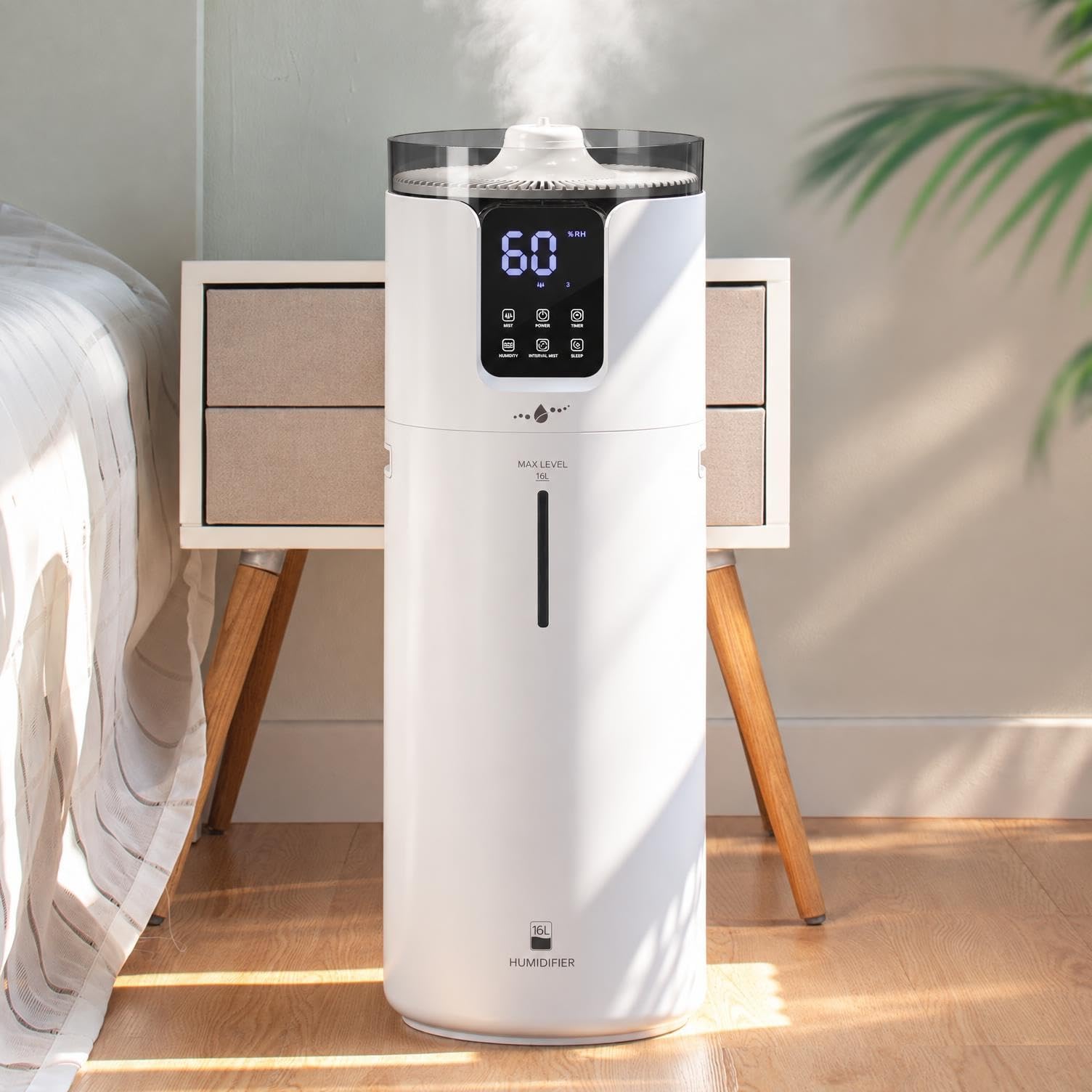
Lacidoll 16L Humidifier

87 /100
Trail Score Excellent

Key details

Type
Ultrasonic cool mist
Control
Remote and touch
Capacity
4.2 gallons
Coverage
1,500 sq ft
Check Price on Amazon

Set this next to the ducted picks and the difference is reach. The Lacidoll treats one spot in one room, up to 1,500 square feet of it, with cool ultrasonic mist while drawing about 50 watts. For a condo, a basement, a converted garage, or an open living space where the furnace is somebody else's problem, that's a genuine whole-house answer for the space you actually occupy.

The kit is more thoughtful than the money suggests: a remote, a humidistat that holds anywhere from 40% to 90%, a night light, an aroma tray, and a flexible extension tube that lifts the mist above a sofa or sends it down a hallway. The tube matters more than it sounds. It's the difference between humidifying the footprint around the unit and humidifying the room. The 4.2-gallon tank fills from the top without lifting anything, and the wide opening means you can wipe it out properly.

It's also the quietest thing here, which is what ultrasonic buys you: no fan big enough to hear. Tap water is the trade, since minerals ride along with the mist, so if a fine white film shows up on the television you should switch to distilled. Durability is the open question with floor-standing ultrasonic units, so buy it for a job you can define and keep the paperwork.

We reach for this one when the ductwork is not ours to touch and the space is a single floor: the basement that's always dry, the rented apartment, the sunroom. It is not the answer for a 2,500-square-foot colonial with four closed bedrooms, because the mist won't find them. Judged against that boundary, it's the cheapest way in this group to add real humidity without a contractor.

Pros

  • Quiet enough to run in a bedroom
  • 4.2-gallon tank fills from the top
  • Remote, humidistat, and extension tube included

Cons

  • Tops out at 1,500 square feet
  • One-year warranty, the shortest here
Our verdict

For a condo, basement, or single open floor, this is the quietest, simplest way to add real humidity, with no ductwork and no filter, and a 1,500-square-foot ceiling to respect.

Check Latest Price

How We Tested Whole-House Humidifiers

We started by pulling every whole-house humidifier we could find that published a gallons-per-day output and a coverage rating, then cut anything with discontinued wicks, no onboard humidistat, or a filter we couldn't reorder mid-season. That left 10 units, which we ran through one full heating season — November through April — in homes ranging from a tight 1,100-square-foot ranch to a drafty 1970s two-story with forced air.

The ducted units went onto furnaces with the humidistat set at 35 percent, and we logged hygrometer readings on every floor twice a day. What we watched for was whether the set humidity held overnight, whether the second floor kept up with the first, and whether anyone woke with a dry throat. We noted the opposite failure too — condensation on window glass and a clammy feel in bedrooms — which is what happens when a unit is oversized or the humidistat drifts. Consoles and pedestals got a different routine: how long a full tank lasted, how heavy that tank was to carry full up a flight of stairs, and a decibel meter at arm's length and from the couch with the TV at normal volume.

Controls got their own pass: we compared each unit's displayed humidity against our hygrometer, counted the taps needed to set a schedule, and pulled the plug mid-run to see whether it remembered anything. We handed the manuals to a homeowner who had never installed one and timed the setup. Over the months we kept an eye on mineral crust forming on ultrasonic plates, wicks that stiffened or sagged, and any drip at the water line — then added up filters, wicks, and water use per season to see what each one really costs to own past year one.

How to Choose a Whole-House Humidifier

Start With the Ductwork

A ducted humidifier hangs on the furnace plenum, taps a water line, and adds moisture to every room the furnace serves. It's the only design that genuinely humidifies a whole house, and it disappears once installed. A console or pedestal stands in a room and moves moisture with its own fan, which works well for one open floor and not at all for the bedrooms upstairs. The trap is the phrase whole house on a freestanding unit: it usually means one large room, not a 3,000-square-foot colonial.

If you can't touch the ductwork, a rental, a sealed mechanical closet, no drain within reach, buy a console and accept the refills.

Size by Gallons, Not Square Feet

Coverage ratings assume tight construction, eight-foot ceilings, and closed doors. Gallons per day is the more honest number: 12 for a small tight house, 17 for a typical four-bedroom, and 18 or more when the house is large or leaky. Open plan, vaulted ceilings, a lot of glass, or an old house with a damp basement all push you up a size. Slightly oversized is the better error, because the unit then spends most of its time at low output, which is quieter and easier on the water panel.

Manual Dial or Automatic Control

A manual humidistat gives you a dial and a sensor. You set it, and you lower it yourself when the weather turns. An automatic control adds an outdoor temperature sensor and makes that adjustment continuously, which is worth paying for on a ducted unit because the failure mode is expensive: over-humidify during a cold snap and you get condensation on glass, then inside the wall.

Set 40% as your ceiling in freezing weather. The step from the AprilAire 500M to the 600 is exactly this decision, plus five gallons a day of headroom.

What It Costs to Own

Every design has a consumable. Evaporative units need a new water panel or wick roughly once a heating season, and hard water shortens that. A steam unit's canister is a consumable too. A bypass unit sends a share of its water down the drain to keep the panel flushed, so a floor drain, sump, or condensate pump belongs in the budget. Consoles waste nothing down a drain, but you carry every gallon to them. Price the first two seasons of consumables alongside the unit itself.

Replacing an Old Humidifier

Measure the cutout in the plenum, the distance to the water line, and the drain location before you order, and note the make of the old unit. Swapping an AprilAire for another AprilAire often drops into the same hole with the same water connection, while a different brand usually means cutting new duct. Check the transformer voltage on the old control too, since a mismatch is the usual reason a new unit won't fire. Twenty minutes with a tape measure saves a Saturday.

Frequently Asked Questions

Final Verdict

The AprilAire 600 is the humidifier we recommend for most houses with ductwork. Seventeen gallons a day covers a normal four-bedroom, the controller handles the cold-weather adjustment most of us forget, and the five-year warranty is as good as it gets in this group. It sits in the middle of AprilAire's range in every sense, which is where a whole-house purchase should sit.

Smaller house or tighter budget: the 500M does the same job with a dial. Past 5,000 square feet, or in a house where the heat barely runs, the 800's steam is the only pick that keeps up. And if the ductwork is off limits, start with the AIRCARE MA1201 and a spare wick.