Best Air Bikes for HIIT of 2026

An air bike has no resistance knob worth turning: the fan is the resistance, and the harder you pull and push, the harder it fights back. That's why 30 seconds all-out on one feels nothing like 30 seconds on a spin bike — there's no easing off, no hiding behind a setting. What you're really shopping for is a machine that can absorb that kind of abuse for years without a wobble, a rattle, or a weld letting go.

Over the past six months, my team and I have put seven air bikes through structured interval work, and the differences come down to things a product photo never shows: how much the frame flexes when you stand up to sprint, how long assembly actually takes, and whether the seat and handlebars move far enough for everyone in the house to use it. A heavy frame is a feature here, not a flaw — just know that before you plan to wheel one into a closet. The picks below are the ones we'd gladly sweat on again.

1

Best Overall

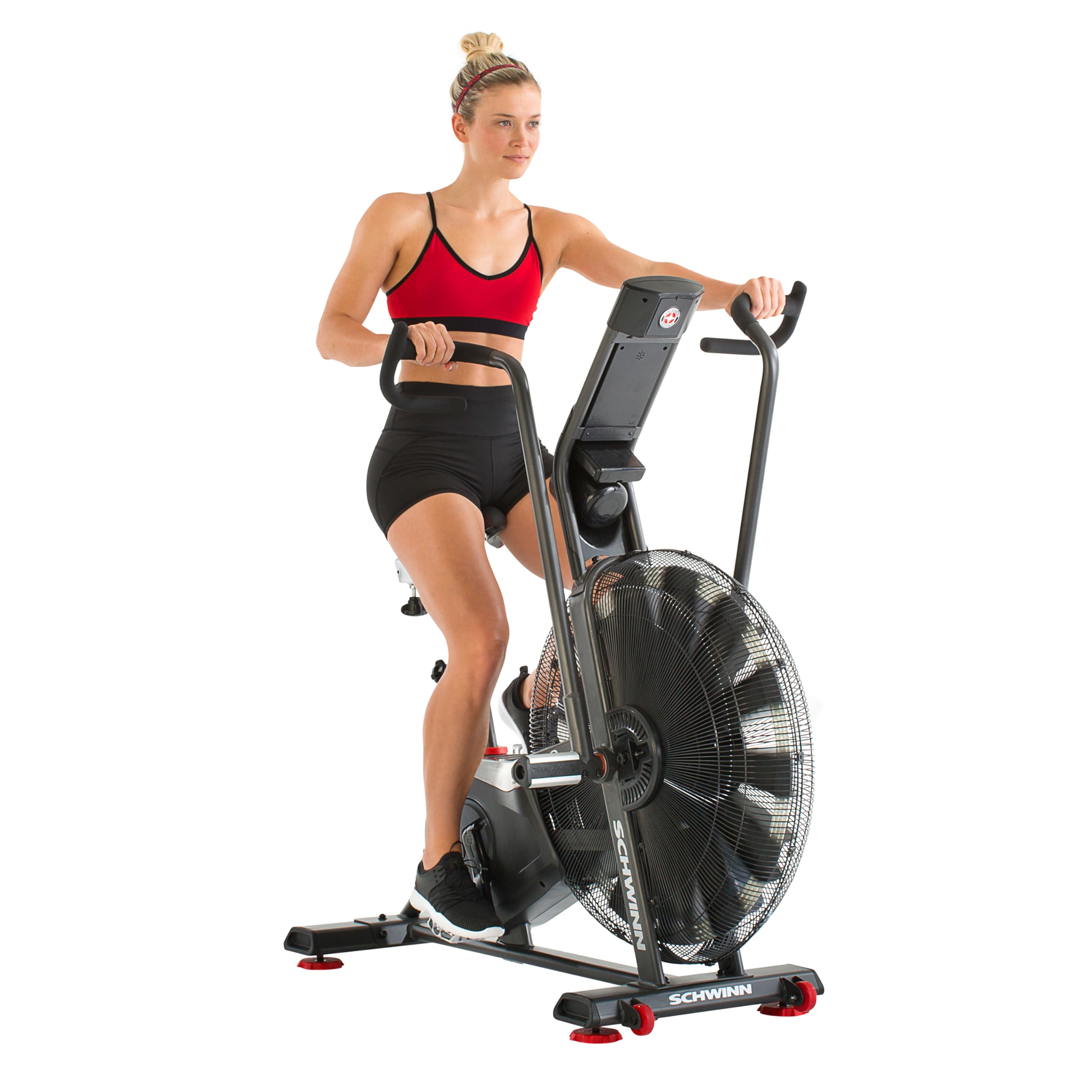
Schwinn Airdyne AD7

91 /100
Trail Score Outstanding

Key details

Drive
Single-stage belt
Footprint
53 x 26.5 x 53 in
Resistance
Progressive air
Max User Weight
348 lb
Check Price on Amazon

The Airdyne's fan is perimeter-weighted, and that single detail is what makes sprint intervals feel less like a wrestling match. An evenly weighted fan spins up smoothly from a dead stop, so the first few seconds of an all-out effort go into the pedals instead of into fighting the machine. Resistance builds with your effort rather than clicking through levels, which is exactly the shape HIIT wants: you cannot outrun the bike, and it never caps how hard you go.

Of everything here, this is the one we kept coming back to for hard sessions. The single-stage belt drive keeps the noise to a low whoosh, so an early-morning interval set does not carry through the house, and the 348-pound steel frame does not shimmy when you stand and pull. We could talk at warm-up pace and only had to raise our voices at the top of an effort.

Build quality is where it separates from the cheaper bikes in this group: the frame, the handlebar mounts, and the crank feel like gym equipment rather than home equipment. The one thing to watch is the seat, which can work loose and start to shift under hard pedaling; check the clamp before a session and it stays put. At 53 inches long and just over 110 pounds, it is furniture once it is assembled, so choose its spot before it arrives.

Pros

  • Perimeter-weighted fan spins up smoothly
  • Progressive air resistance with no ceiling
  • Belt drive keeps the noise low
  • 348 lb capacity on a solid steel frame

Cons

  • Long and heavy
Our verdict

For full-body HIIT at home, the Airdyne AD7 is the bike we recommend: it's the smoothest and quietest machine here, and it takes a sprint without complaint.

Check Latest Price
2

Best for Structured Intervals

Concept2 BikeErg

93 /100
Trail Score Outstanding

Key details

Drive
Chain
Monitor
PM5
Footprint
48 x 24 x 41 in
Max User Weight
300 lb
Check Price on Amazon

The BikeErg is the one pick here that leaves your arms out of it, and for pure interval work we did not miss them. Standing efforts go straight into your legs and lungs, and the chain-driven flywheel is clutched, so it keeps turning when you stop pedaling. That coast is the difference between a real rest and a slow grind — you get genuine recovery between efforts and you are back at threshold within a few strokes.

The PM5 is why this bike is on the list at all. It is the same monitor Concept2 fits to its rowers, so if you have logged meters on a rower you already know how to run a session on this: set the interval, watch the split, repeat. It is the only console here built for comparing one month's efforts with the last, and the smartphone cradle means you can watch something instead if data is not your motivation.

Living with it is easier than with the heavier bikes. It is 68 pounds on an aluminum frame, 48 inches long, with caster wheels, so it tucks into a corner and comes back out without a second pair of hands. Seat height runs from roughly 30.75 to 41 inches and the handlebars adjust too, which covers a wide range of riders in one household. The saddle is narrow and firm, so plan on padded shorts if you stay on longer than the intervals.

Pros

  • Clutched flywheel coasts through rest intervals
  • PM5 monitor makes sessions repeatable
  • 68 lb aluminum frame with caster wheels
  • Compact 48-inch footprint

Cons

  • No arm drive
Our verdict

If you train to numbers, this is the best interval machine here: a PM5 that logs every effort, a flywheel that coasts, and no arm drive to distract you.

Check Latest Price
3

Best App-Connected

Sunny SF-B223018

81 /100
Trail Score Excellent

Key details

Drive
Belt
Monitor
Interval programs, SunnyFit app
Footprint
55.5 x 25.2 x 50.6 in
Max User Weight
330 lb
Check Price on Amazon

Sunny's console ships with preset interval programs and room to build your own, and Bluetooth pairs it to the free SunnyFit app for trainer-led sessions and virtual routes. In practice that takes the bookkeeping out of HIIT: the bike counts the work and the rest, so you spend the interval riding instead of watching a clock.

The ride is what you want from a fan bike. Resistance comes from the fan in both pedaling directions and ramps with effort, the belt drive keeps the sound to a whoosh, and the 330-pound frame stayed planted through standing efforts. The seat adjusts fore and aft as well as up and down, which matters more than it sounds — an inch of reach is the difference between a comfortable half hour and a sore back.

Where it gives ground to the Schwinn is refinement, not function. At 55.5 inches front to back it is the longest bike in this group, and it weighs nearly 109 pounds, so it wants a wall rather than a corner. If the programs are what get you on the bike on a Tuesday night, that is easy to forgive; if you are going to ride by feel, the pooboo does the same work in less space for less money.

Pros

  • Preset and custom interval programs built in
  • Free SunnyFit app with trainer-led workouts
  • Belt drive with dual-direction air resistance
  • Fore-aft seat adjustment for shared use

Cons

  • Longest footprint here at 55.5 inches
Our verdict

We like the SF-B223018 for anyone who wants the bike to run the session: built-in interval programs and a free app take the clock-watching out of HIIT.

Check Latest Price
4

Best Value Full-Body

pooboo Fan Bike S319

86 /100
Trail Score Excellent

Key details

Monitor
Bluetooth performance monitor
Footprint
45 x 25 x 44 in
Handlebars
Dual-action
Max User Weight
350 lb
Check Price on Amazon

At 350 pounds the pooboo carries the heaviest rider in this group, and it does it inside the shortest frame of the full-size bikes: 45 inches long, 25 wide, 44 tall. If your gym is a corner of a spare room rather than a garage bay, those numbers matter more than any console feature, and they are a large part of why we like this one.

The dual-action handles drive the fan along with the pedals, so an interval hits arms, back, and legs together, and the belt-driven fan keeps the soundtrack to a steady rush of air. The Bluetooth monitor covers time, speed, distance, and calories — enough to track a session without turning it into a data exercise.

The caveat is durability, and it is specific: the pedal bearings are the part that can let go early, which is a lot of load to ask of a 90-pound frame rated to 350. Shake the pedals after your first week of sprints and check them again monthly; beyond that, everything about the bike feels planted and better built than the price suggests.

Pros

  • 350 lb capacity, the highest here
  • Shortest footprint of the full-size bikes
  • Dual-action arms and a quiet belt-driven fan
  • Bluetooth monitor for time, speed, calories

Cons

No notable drawbacks to flag.

Our verdict

We think the pooboo is the best value here: full-body arms, a 350-pound limit, and the smallest footprint of the full-size bikes, with a Bluetooth monitor included.

Check Latest Price
5

Budget Garage Gyms

Marcy AIR-1

88 /100
Trail Score Excellent

Key details

Frame
14-gauge steel
Warranty
2 years
Footprint
46 x 24 x 48.5 in
Max User Weight
300 lb
Check Price on Amazon

Seventy-nine pounds of 14-gauge steel is a lot of bike for the money. The AIR-1 is built the way fan bikes have been built for decades: a simple frame, a big fan, dual-action arms, and very little else to break. It is rated to 300 pounds, and the base stays flat when you stand and pull.

For steady half-hour sessions we liked it more than we expected. The upright position and wide seat suit a longer, lower-effort ride better than an all-out sprint set, and the two-year warranty is the longest of anything here. Assembly is one of the jobs this bike gets right, which counts when a heavy frame arrives in a flat box. The seat is the first thing to change if it does not suit you — a gel cover is a cheap experiment.

The trade-off is noise. The fan and drivetrain get louder the harder you push, and at sprint pace this is the noisiest bike in the group — a garage or basement absorbs it, a shared apartment will not. Buy it for a space where you can shut the door, and the simplicity that makes it cheap is also why there is so little to go wrong.

Pros

  • 79 lb steel frame rated to 300 lb
  • Dual-action arms for full-body intervals
  • Two-year warranty
  • Least expensive bike in this group

Cons

  • Basic console
Our verdict

Our budget pick is the AIR-1: dual-action arms, a 300-pound steel frame, and the longest warranty here, all for the least money in this group.

Check Latest Price

How We Tested the Best Air Bikes for HIIT

We started with specs and customer reviews for air bikes across the price range, then cut anything with a low rider weight limit, a frame owners described as flexing under hard efforts, or no way to buy replacement pedals and seat posts down the road. That left seven bikes, which we assembled ourselves and rode for six months.

Every bike arrived boxed and got built on a garage floor by one person using the included tools. We timed the build, counted the steps that sent us back to the manual, and noted whether the pedals, console, and handlebars lined up without persuasion. Then we went around tightening every bolt we could reach and checked them again a month later to see which had started to back out.

The riding happened where these machines actually live: a garage, a spare-room floor, and a living room rug. We ran 30-second sprints, Tabata sets, and 20-minute steady warm-ups, watching how much the frame rocked when we stood to sprint, whether the seat and handlebars adjusted enough for riders from about 5-foot-3 to 6-foot-2, and how the saddle felt at the 25-minute mark. For noise, we rode before 6 a.m. with someone asleep in the next room and asked them about it afterward.

For build quality and value, we checked for play in the fan, listened for rattles at high cadence, wiped sweat off the frame after each session to see how the finish held up, and weighed what each bike cost against how it still felt in month six. Functionality counted too — whether the console ran intervals we'd actually use or just displayed numbers we ignored.

How to Choose an Air Bike for Hiit

Air Resistance Is Not a Setting

On a fan bike the fan is the resistance: pedal harder and the blades catch more air, so the load arrives as your effort does. That is why there are no meaningful levels to click through, and why a twenty-second sprint can leave you flatter than twenty minutes of steady spinning. It is also why an air bike is the wrong tool if you want to sit at a fixed output for an hour; a magnetic bike does that better and quieter. Choose air when the workout you picture is short, brutal, and paced by how you feel.

Arms or Legs Only

Dual-action handles pull your upper body and back into the effort and spike your heart rate faster than legs alone. The catch is that the arms are linked to the pedals on every dual-action bike here: you decide how hard you pull, but you cannot disconnect them and isolate your legs. For cycling-specific conditioning, or if a shoulder problem makes pulling unwise, the fixed-handlebar Concept2 BikeErg is the exception in this group. For conditioning that leaves you flat on the floor in ten minutes, take the arms.

Belt, Chain, and Where the Noise Comes From

Belt drives run quieter and need less upkeep; chains feel more direct and want occasional lubrication. Neither matters as much as the fan, which is the real source of noise and gets louder the faster it spins. If the bike lives in an apartment, favor a belt-driven machine and put a mat under it, because the vibration travels further than the sound does. In a garage or basement, noise stops being a reason to spend more.

What the Console Is Worth

Consoles split into three kinds here: a basic readout of time, speed, distance, and calories; a Bluetooth monitor that pairs with an app; and the PM5, which is a training computer rather than a display. If you resent counting seconds, buy the programs — the Sunny runs the intervals for you. If you want to know whether this month is better than last month, the PM5 is the only one of these built for that comparison.

Fit, Footprint, and the Parts That Wear

These bikes run from 45 to 55.5 inches long and 68 to just over 113 pounds, so measure the floor before anything else — a fan bike lives where you put it. Check the seat's height and fore-aft range against your leg length, especially if two people will share it. Give the wear parts a monthly look: pedal attachment, seat clamp, and handlebar bolts. A maximum user weight is a ceiling, not a target, so leave yourself a margin if you plan to sprint.

Frequently Asked Questions

Final Verdict

Across the bikes we rode, the Schwinn Airdyne AD7 is the one we recommend to most people. The weighted fan, quiet belt drive, and genuinely solid frame make hard intervals feel controlled rather than chaotic, and the 348-pound rating covers nearly every household that will put one in a spare room.

If you train to numbers rather than by feel, the Concept2 BikeErg is the better instrument — the PM5 and the coasting flywheel are made for repeatable efforts, and your arms simply sit it out.