Best Yoga Mats of 2026

A yoga mat looks like the simplest purchase in your bag, right up until you're standing on the wrong one. Go thick for your knees and your balance goes wobbly in a standing pose; go thin for stability and child's pose becomes a negotiation with the floor. What you actually want is a mat that grips when your palms get damp, stays where you put it on hardwood, and doesn't shed foam crumbs onto your leggings by month three — a combination that's harder to find than the wall of mats at the store suggests.

I've practiced on a discount mat that slid halfway across the living room during a sun salutation and on a rubber one that smelled like a tire for a solid week. Over the past six months, my team and I have rotated 12 mats through home practice, studio classes, and enough sweaty vinyasa to know which ones keep their grip, their shape, and their cushioning. The picks below are the ones that earned a permanent spot by the door.

1

Best Overall

Gaiam Premium Print Yoga Mat

95 /100
Trail Score Outstanding

Key details

Width
24 inches
Length
68 inches
Material
PVC
Thickness
6mm
Check Price on Amazon

Six millimeters is the thickness we keep coming back to. There's enough foam that a hardwood floor stops mattering under your knees and wrists in tabletop, and little enough that standing on one leg in tree pose doesn't become a balance exercise against the mat itself. Add the tacky, textured surface and this is the mat we recommend first to anyone who wants one mat for a weekly class and a home practice.

We expected the prints to be decoration and nothing more. They do something practical: the busier patterns hide the scuffs and dust a mat picks up on a wood floor, so you're not wiping it down before every practice, and the range runs from florals to geometrics to deep blues, which keeps it from feeling like a compromise. Design is the honest reason to choose this over the plain 6mm Gaiam in this guide, and it holds up better than that sounds.

Grip is where to be honest with yourself. The surface is genuinely sticky with dry hands, which covers a home practice and a moderate class. Once your palms heat up it gets slick the way PVC does, so put a hand towel at the top of the mat or pull on gripped socks for a hot class. Care is a damp cloth and mild soap, dried flat rather than folded over a radiator.

What you pay over a plain 6mm mat is for the surface you look at every day, not extra performance, and if the mat lives in a room you also live in, that's a fair trade. One detail worth knowing: it ships with access to a downloadable class rather than a carrying strap, so order a strap if it's going to travel.

Pros

  • Tacky surface holds dry hands and feet
  • 6mm cushions knees without a wobbly base
  • Prints hide scuffs and dust

Cons

  • Chemical smell for the first few days
  • 68 inches runs short for very tall users
Our verdict

Our default pick for a normal, dry-handed practice: tacky enough for downward dog, cushioned enough for tabletop, and light enough to carry to a class.

Check Latest Price
2

Best Budget

Fitvids 1/2-Inch Thick Yoga Mat

91 /100
Trail Score Outstanding

Key details

Width
24 inches
Length
71 inches
Material
NBR foam
Thickness
1/2 inch
Check Price on Amazon

Half an inch of foam at the budget end of this guide is the pitch, and the Fitvids delivers it across 71 by 24 inches, a touch longer than the standard 68 and wide enough for a wide stance. When budget is the first line of the decision rather than the last, this is where we point.

The cushioning earns it a place. On tile, concrete, or a thin carpet over a slab, that half inch is the difference between holding a plank and cutting it short because your elbows are complaining, and there's enough give under hips and sit bones for a long supine stretch. What it isn't is a precision instrument: stand up for a balance pose and you can feel the foam give under your standing foot.

Day to day it's easy to live with — a wipe with soap and water, a roll, and the included strap to keep it closed — and the 71-inch length means taller users aren't hanging off the end. It also makes a sensible second mat to keep for floor work, or a first mat for someone still finding out whether a home practice sticks.

Pros

  • Half-inch foam cushions elbows and hips
  • 71-inch length suits taller users
  • Wipes clean and includes a strap

Cons

  • Slides on polished or laminate floors
  • Foam dents where heels land
Our verdict

When the budget decides the purchase, this is the one: half an inch of foam that makes planks, stretches, and floor work comfortable on almost any surface.

Check Latest Price
3

Best Longer Mat

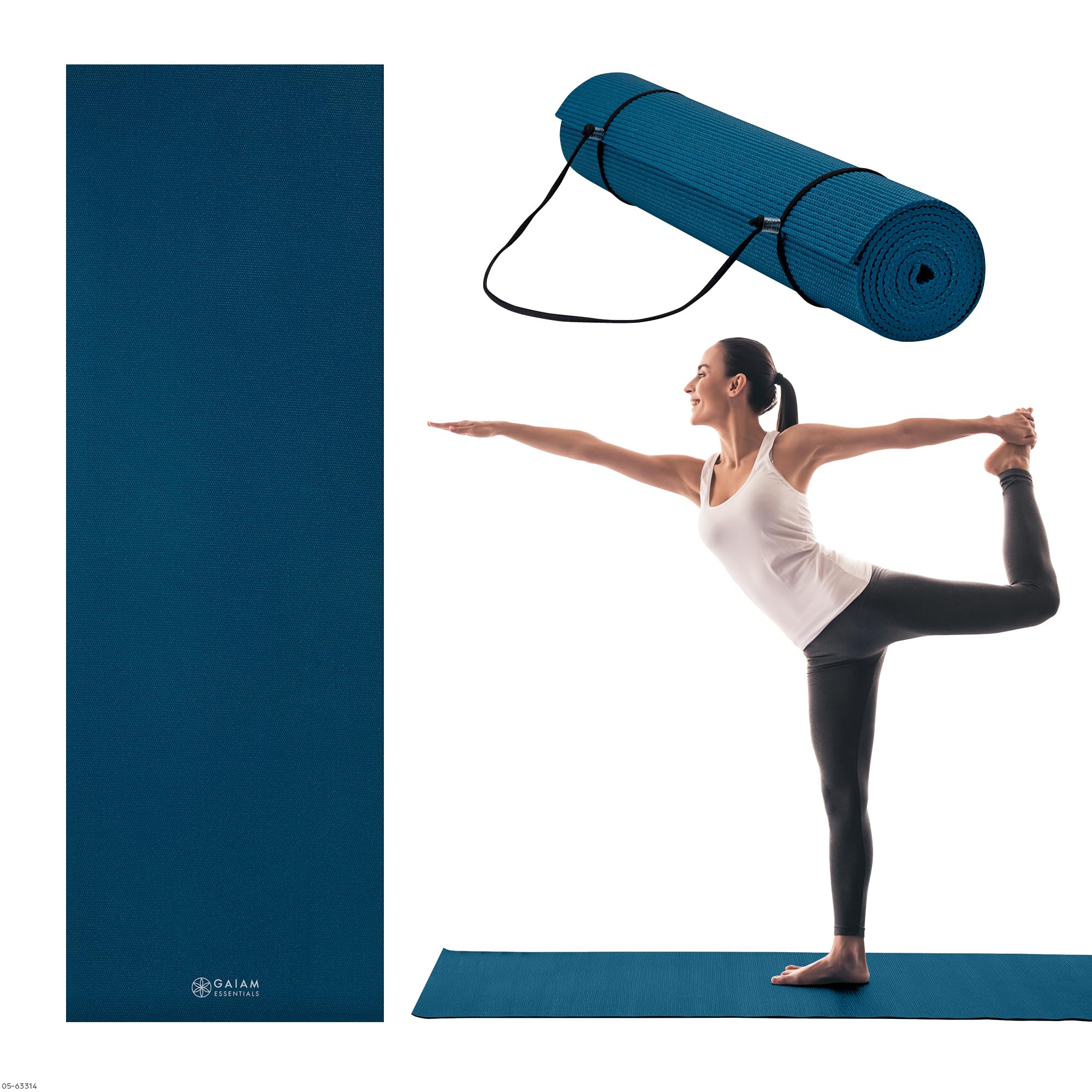
Gaiam Essentials 72-Inch Yoga Mat

93 /100
Trail Score Outstanding

Key details

Width
24 inches
Length
72 inches
Weight
3 lb
Thickness
6mm
Check Price on Amazon

Seventy-two inches is the number that matters here. Two extra inches over the standard 68 sounds like nothing until you're in warrior two with your back foot half off the edge, or you're six feet tall and every forward fold puts your hands past the end of the mat. Gaiam also gives this one a textured circular pattern that adds a little bite to the surface.

At 6mm it's firm rather than plush, closer to the feel of a studio mat than a foam pad, and at around three pounds it rolls and slings over a shoulder with the cinch strap without much fuss. The plain colors are the point: nothing on this mat is asking to be noticed, which suits a mat that disappears into the corner of a room.

For a practice that happens in the same spot every day, we take this one over the printed Gaiam. It unrolls flat, wipes down clean, and asks nothing of you — the sort of mat you stop thinking about, which is the highest compliment a mat can get.

Pros

  • 72-inch length gives tall users room
  • Firm 6mm stays steady in standing poses
  • About three pounds with a cinch strap

Cons

  • Grip fades once hands get sweaty
Our verdict

Buy this one if you're tall or want a plain mat: 72 inches of firm 6mm that stays steady under standing poses and rolls up light.

Check Latest Price
4

Best for Beginners

NewMe Fitness Poses Yoga Mat

95 /100
Trail Score Outstanding

Key details

Length
68 inches
Material
PVC
Thickness
5mm
Printed Poses
70
Check Price on Amazon

If you're still working out what comes after downward dog, seventy poses printed on the mat do something a phone propped against a water bottle can't: they sit exactly where you're already looking. That's the most useful thing a beginner mat can do, and this one manages it without turning the mat into a poster.

The layout is the draw, but the surface underneath is a legitimate 5mm PVC, 68 by 24 inches, with a dual-sided texture that holds the floor and a material made without BPA, latex, or phthalates — worth knowing if you're on it daily. The drawings are big enough to read without stopping mid-pose.

Two things to weigh. At 5mm it's thin under a boney knee in a long pigeon, so fold a blanket under the joint, and it sits near the top of this group on price, which you're paying for the printing rather than the foam. What it does well is remove the reason most home practices stall: not knowing what to do next.

Pros

  • 70 poses printed where you can see them
  • Dual-sided texture holds the floor
  • Made without BPA, latex, or phthalates

Cons

  • Slick once hands get sweaty
Our verdict

We point beginners here because the poses are printed where they practice and the 5mm surface is stable enough to learn on.

Check Latest Price
5

Best Lightweight

Gruper Eco-Friendly Yoga Mat

89 /100
Trail Score Excellent

Key details

Length
72 inches
Included
Strap and storage bag
Material
TPE
Thickness
6mm
Check Price on Amazon

The first time we carried the Gruper to a class, what registered was how little there was to carry: less than two pounds of TPE rolled into its own drawstring bag and slung over a shoulder, where a PVC mat of the same 72-inch length makes itself known by the third block.

That lightness is the whole argument. A 72-inch mat you'll actually carry beats a better mat that stays home, and this one grips well on a dry practice, better than its price suggests, with a slightly rubbery surface that we liked under the hands in downward dog.

It's 6mm, so it cushions a knee without swallowing your balance, and 72 by 24 inches leaves room for taller users. Wipe it with a damp cloth and let it air dry rather than machine washing it, and it's the one we grab for a park session where the ground is uneven.

Pros

  • Under two pounds for a 72-inch mat
  • Strap and storage bag included
  • Dry grip holds up in a normal practice

Cons

  • Drawstring bag is thin
Our verdict

Our pick for a mat that travels: under two pounds, 72 inches long, grippy enough on a dry practice to trust in downward dog.

Check Latest Price
6

Alignment Practice

YOGATI Alignment Yoga Mat

91 /100
Trail Score Outstanding

Key details

Length
72 inches
Weight
1.8 lb
Material
TPE
Thickness
0.24 inch
Check Price on Amazon

A line down the middle of a mat sounds like a gimmick until you're working out whether your hips are square in warrior two. The YOGATI etches center markings and hand and foot placements into the surface, and for a beginner they do the job a teacher's cue does from across the room.

It's also remarkably light for its size: 72 by 24 inches at 1.8 pounds, the sort of mat you roll up and carry without thinking about it. The two-tone finish, warm sand on one side and caramel on the other, is the quietest good-looking mat here, and the surface wipes clean with mild soap and water.

Rolling it takes seconds, the shoulder harness comes with it, and it lies flat within a day of being unrolled, so keeping it in the car for a lunchtime stretch is realistic rather than aspirational.

Our take: this is a second mat, or a first mat for someone who wants posture guidance and doesn't need much between them and the floor. It sits with the budget mats on price, it's handsome enough to leave out, and the markings stay useful for about as long as you need them — after which you still have a light, honest mat with a line down the middle.

Pros

  • Center markings help square up poses
  • 1.8 pounds at 72 inches
  • Wipes clean and looks good left out

Cons

  • 0.24-inch surface gives little knee padding
  • Slides once hands get sweaty
Our verdict

This is the one we hand to anyone learning alignment: light, marked up like a diagram, and too thin to forgive a boney knee.

Check Latest Price
7

Floor Work

BalanceFrom 1-Inch Thick Yoga Mat

95 /100
Trail Score Outstanding

Key details

Width
24 inches
Length
71 inches
Material
NBR foam
Thickness
1 inch
Check Price on Amazon

An inch of NBR foam is the most cushioning in this guide, and it changes what the mat is for. Lying on your back, rolling through bridges, holding a plank, or sitting a long meditation on a concrete floor, the extra depth is genuine luxury — you feel supported rather than padded.

Stand up and the mat works against you. Balance poses on an inch of foam are vague and a little unstable — you can hold them, but you're balancing against the mat as well as training your own steadiness. All that depth also puts more foam between your hand and the floor, softening everything you're trying to feel.

Where it earns its spot is on the floor: stretching, mat Pilates, rehab exercises, and anyone whose hips or spine complain on a hard floor. It rolls up small enough to store under a bed and wipes clean, so keeping it alongside a thinner yoga mat isn't much of an imposition.

Pros

  • Full inch of foam for knees and spine
  • Rolls up small and wipes clean

Cons

  • Foam tears at high-wear spots
Our verdict

We keep it for floor work and stretching: an inch of foam that makes a hard floor disappear, and the wrong surface for standing balance poses.

Check Latest Price

How We Chose and Tested the Best Yoga Mats

We started with specs, because they eliminate a lot of guesswork: listed thickness in millimeters, material, stated weight, and care instructions. Anything that didn't list a weight, or that was built for only one style of practice, came off the list. That left us with 12 mats spanning budget foam, TPE, natural rubber, and cork, and we used each one for six months.

In practice, that meant unrolling them on hardwood and on carpet at home, hauling them to studio classes, and running a short sequence of downward dogs with dry hands and then with damp ones, watching whether the palms crept toward the top edge of the mat. We also checked how each one landed — corners that curled up got weighted overnight and rechecked the next morning.

For comfort and thickness, we paid attention to wrists in tabletop and knees in low lunge, and noted where pressure showed up after 20 minutes. Portability got measured rather than guessed: every mat went on the kitchen scale, then into a tote for a 15-minute walk. Durability came from living with them — rolled tight in a closet, left in a hot car, and inspected at month four for compressed spots, flaking, and stretched edges. Odor got the crudest test of all: a sniff straight out of the packaging, and another a week later.

Value was the last filter. We weighed what each mat cost against how it was holding up, and the ones that still looked new after months of daily use earned their place on this list.

How to Choose a Yoga Mat

Start With Thickness, Not Features

Five or six millimeters is the all-purpose range and where we start for yoga: thin enough that your standing leg knows where the floor is, forgiving enough that tabletop doesn't bruise. Half an inch and up turns a mat into a floor pad — lovely for planks, bridges, and a long savasana on concrete, vague underfoot in tree pose.

The trap is the word extra thick, which reads as more mat for the money. If you're buying one mat for a class, a one-inch pad is the wrong purchase; buy that depth for joints on the floor, not for the practice on your feet.

Grip Is a Wet-Hand Question

A mat is grippiest the day it arrives and least grippy in your first hot class. Most PVC and TPE surfaces hold dry hands well; sweat is what breaks them. If your palms run damp, budget for a hand towel at the top of the mat or gripped socks before you blame the mat.

Then check the underside. A mat that skates across polished concrete needs a different surface beneath it, and no amount of texture on top fixes that.

Length, and Who Needs 72 Inches

Sixty-eight inches is the standard and covers most people up to about 5 feet 10. Taller than that, or wide-stanced in warrior poses, and the extra four inches in the 72-inch mats here — the Gaiam Essentials, the Gruper, the YOGATI — get felt at the hands and feet rather than in the middle, which is exactly where you need them.

Foam, PVC, or TPE

NBR foam is the spongy one: kind under knees, porous, and the first to tear. PVC is denser, wipes clean, holds a texture well, runs heavier, and usually smells for a few days. TPE is the lightest of the three and the one we carry.

Care barely changes between them: wipe with mild soap, air dry out of the sun, never machine wash, and give a new mat two or three days to off-gas before deciding you hate it.

Weight Only Matters If It Leaves the House

A mat that lives in the spare room can weigh whatever it likes. One that goes to class twice a week shouldn't. Across this group the spread runs from about 1.7 pounds to 3.1, and past three pounds you feel it on a walk to the studio. A cinch strap is the difference between carrying a mat and wrestling one; a bag protects it and adds bulk.

Frequently Asked Questions

Final Verdict

Our pick for a normal practice — dry hands, a couple of sessions a week, a mat that lives rolled in the corner — is the Gaiam Premium 6mm Print. It grips when it's dry, cushions tabletop, and hides the scuffs a lighter mat shows by spring.

If you're tall, or you want a plain surface with a couple more inches, the Gaiam Essentials at 72 inches is the better buy. If your knees are the reason you're shopping, go thicker with the Fitvids and keep it for floor work.