Best Walking Boots for a Broken Foot

The night I was handed my first walking boot, the discharge nurse gave me three sentences of instruction and a shell that felt like a bucket with straps. By day three my heel had a blister, the liner had migrated, and I finally understood why so many people quietly stop wearing theirs before the doctor clears them. A good boot keeps weight off the broken bone, holds the foot at the right angle, and gets you to the bathroom, the office, or the back door without a spotter — that's the whole job, and it's remarkable how many boots only do part of it.

What I learned fast is that fit and support are constantly arguing with convenience: the boot that slides on easiest often lets your heel drift, and the rigid one that holds your ankle beautifully can be misery by 4 p.m. once the swelling arrives. We've spent the past six months in 12 different boots — around the house, up and down stairs, on errands — and the gaps in comfort, strap quality, and how much they genuinely help you move are wide, with price predicting almost none of it. The ones worth your recovery are below.

1

Best Overall

Aircast AirSelect Walker Boot

89 /100
Trail Score Excellent

Key details

Fit
Universal left or right
Sole
Shock-absorbing rocker
Shell
Semi-rigid, open-frame
Air Support
Duplex air cells
Check Price on Amazon

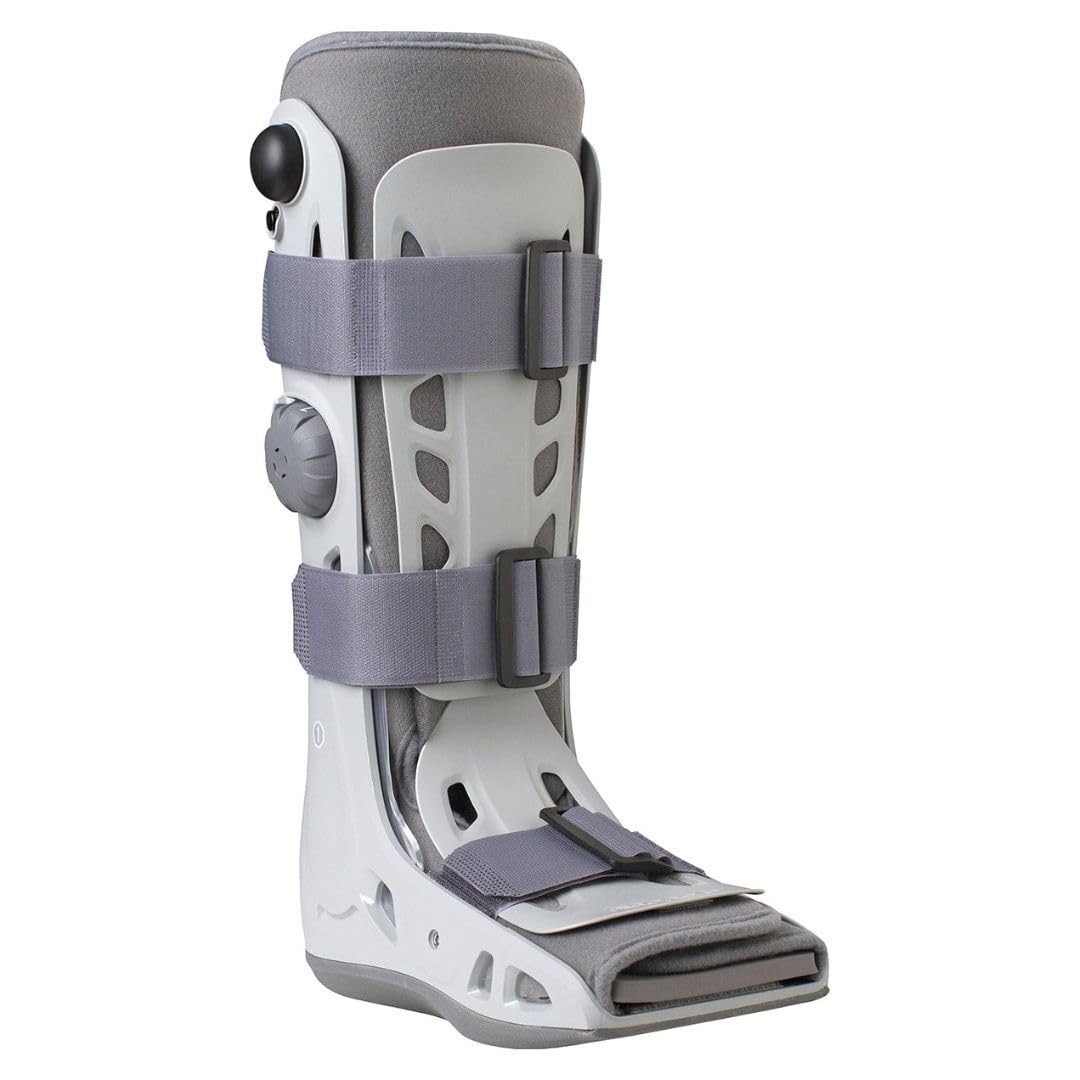
The AirSelect is the boot we reach for when someone needs to walk through a stable foot or ankle fracture rather than just sit in it. Its shell is semi-rigid and open at the sides, so it supports the ankle without the padded, oven-like feel of a conventional CAM walker. The overlapping Duplex air cells wrap the ankle, and the rocker sole has a shock-absorbing heel. Nothing there is decorative: each piece is aimed at keeping you mobile while the injury heals.

What separates it in this group is adjustability. The air cells let you change compression as swelling rises and falls, and the selector dial gives you a single place to tune the air. We also like the open frame for ventilation; it leaves less material against the skin, which matters when you are wearing the boot for weeks. Compared with the United Ortho Air Cam Walker below, it feels more refined and less bulky, and we think the extra outlay is worthwhile for anyone who has to walk farther than the bathroom.

For a stable ankle or lower-leg fracture and a clinician-approved weight-bearing plan, this is the most complete package here. The open frame also makes it easier to check that the air cells are sitting where you want them before you tighten the straps.

Pros

  • Adjustable air-cell compression
  • Open-frame shell reduces bulk
  • Shock-absorbing rocker sole
  • Universal left or right fit

Cons

  • Inner liner can tear with heavy use
Our verdict

We recommend the AirSelect for stable ankle and lower-leg fractures when you want the most supportive, adjustable boot in this group.

Check Latest Price
2

Best Value

United Ortho Air Cam, Small

91 /100
Trail Score Outstanding

Key details

Size
Small (men's 5–7.5, women's 6–8.5)
Weight
2.5 lb
Support
Steel-reinforced uprights
Air Support
Built-in pump
Check Price on Amazon

The value case for this United Ortho boot is easy to see: it has the same rocker sole and air-pump compression as boots that cost far more, and the steel-reinforced uprights give it a sturdy feel. The small size is the first thing to check. It fits men’s 5 to 7.5 and women’s 6 to 8.5, so it is not the boot for an average or larger foot. For a smaller foot, it is a sensible way to get a supportive CAM walker without paying premium prices.

We like the pump for the swelling stage. You can add air to take up room as a bandage thins or a sock changes, and the rocker sole keeps the step from feeling flat. The 2.5-pound weight is noticeable at the end of a long day, but it is in line with full-height boots here. The air pump is the main fit tool; use it to take up room around the ankle rather than overtightening the straps.

Durability is the reservation. The straps and liner can wear before a long recovery ends, so this is not the boot we point to for someone who is hard on gear. For a shorter course or a backup, it earns its place.

Pros

  • Air pump adjusts to swelling
  • Steel-reinforced uprights
  • Low cost for a CAM walker

Cons

  • Size range fits smaller feet only
Our verdict

We recommend this small-size United Ortho as the value pick for anyone whose foot fits its narrow size range.

Check Latest Price
3

Best Short Boot

BraceAbility Short Walking Boot

89 /100
Trail Score Excellent

Key details

Size
Medium (men's 7.5–10, women's 8.5–10.5)
Shell
Rigid polymer
Weight
1.8 lb
Toe Design
Open toe, wide toe bed
Check Price on Amazon

A short boot is the right tool when the injury sits in the toes or forefoot and a full-height CAM walker feels like overkill. The BraceAbility has an open toe and a wide toe bed, which leaves room for a bandage or a swollen forefoot. The rigid polymer shell still runs up both sides of the foot, so it is not just a stiff shoe.

We found the low-profile rocker easy to roll through a step, and the foam liner is a welcome layer against the shell. At 1.8 pounds, it is lighter than the standard-height boots here, which matters if you are hopping or using crutches. The adjustable straps let you snug the midfoot without cranking the toe box.

The short cut is the point: it frees the ankle, which suits a forefoot injury. If the straps are loose, the foot can slide inside, so set the midfoot first and check the heel before you stand. For a broken toe, metatarsal injury, or stable forefoot fracture, we prefer it to a taller boot; for an ankle fracture, look at the Aircast or the 360 instead.

Pros

  • Open toe leaves room for swelling
  • Low-profile rocker for a natural step
  • Lightweight at 1.8 lb

Cons

  • Less ankle coverage than a standard boot
Our verdict

We recommend the BraceAbility short boot for broken toes and forefoot injuries when swelling or bandaging needs an open toe.

Check Latest Price
4

Best Toe Protection

United Ortho 360 Air Walker

86 /100
Trail Score Excellent

Key details

Size
Medium (men's 6.5–10, women's 7.5–11)
Weight
2.6 lb
Air Support
Medial and lateral bladders
Toe Coverage
Hard toe guard
Check Price on Amazon

The 360 is the boot for someone who wants the toes covered as well as the ankle. A hard toe guard sits over the front of the foot, and the semi-rigid shell wraps the leg and ankle. That extra coverage is the reason to choose it over the AirSelect or the short BraceAbility if you have had toe or forefoot surgery and want protection from bumps.

We like the medial and lateral air bladders because they let you add compression on one side of the ankle without overtightening the whole boot. The rocker sole is stable, and the full shell feels reassuringly planted. At 2.6 pounds, it is heavier than the short boots here; that is the cost of the protection, and it is most noticeable on stairs or long walks.

The fit is the part to get right. The medium covers men’s 6.5 to 10 and women’s 7.5 to 11, but a full shell has less give around a wide foot or a thick bandage. If you are between sizes or badly swollen, check the size chart and consider a boot with more open framing.

Pros

  • Hard toe guard protects the forefoot
  • Medial and lateral air bladders
  • Full-shell coverage
  • Rocker sole for a stable step

Cons

  • Heavier than short boots
Our verdict

We recommend the 360 for toe or forefoot recovery when you want full-shell protection and a hard toe guard.

Check Latest Price
5

Short-Term Recovery

Jewlri Walking Boot, Medium

84 /100
Trail Score Excellent

Key details

Size
Medium
Liner
Removable, washable
Weight
1.7 lb
Air Support
Inflatable pump
Check Price on Amazon

If the budget is tight and the recovery is straightforward, this Jewlri boot covers the basics without the clinical price tag. It has a rigid plastic shell, a thick insole, and an air pump, and it weighs 1.7 pounds, one of the lighter boots here. The liner comes out for hand washing, which is a practical detail you notice after a week of wear.

We like the pump for filling in around the ankle, and the rocker bottom rolls forward without feeling clunky. The fit is the weak point: the medium is not a universal size, and the shell runs large for some feet. Check the size chart against your injured foot, not your shoe size, and leave room for swelling. The straps also need a firm press to stay put; if you have limited hand strength, a boot with simpler closure is easier.

Durability is a question mark. The shell and sole can start to separate, and the Velcro can lose its grip, so it is a better choice for a shorter course or a backup than for a hard-wearing six-week stint. The removable liner is the detail that makes it easier to live with day to day.

Pros

  • Removable washable liner
  • Air pump adjusts fit
  • Lightweight at 1.7 lb

Cons

  • Sizing can run large
Our verdict

We recommend the Jewlri as a lightweight, low-cost option for a short recovery, provided you check the size carefully.

Check Latest Price

How We Chose and Tested the Walking Boots

We built the shortlist from about 40 boots sold in the U.S., then filtered hard on the things that matter when you're non-weight-bearing or just starting to load the foot again: shell height, strap count and placement, liner thickness, overall weight, and whether sizing runs true to shoe size or needs a size up for swelling. That cut it to 12 boots, which testers wore over six months following fractures, post-surgical recovery, and a couple of severe sprains. They saw the 2 a.m. bathroom trip, the stairs to a second-floor bedroom, eight hours under a desk, the grocery store, and the evening dog walk.

Fit got tested first, because it's where most boots fail. We checked each shell against a foot that swells by evening, then noted whether the heel stayed seated or slid forward toward the toe after ten minutes of walking. We strapped and unstrapped each one single-handed a few hundred times, the way you'll actually do it on the edge of a bed, and watched the Velcro for curled edges, fuzz, and the loss of grab that means the closure is done.

Support showed up in small observations: whether the ankle rocked side to side, whether the rocker sole rolled the foot forward or made testers clomp, whether the shell was still rigid at week twelve. We checked sole wear, wiped down liners, and tracked whether air bladders and pads held pressure or flattened. Value came down to usable life against price — some cheaper boots lost strap grip within weeks, while a few pricier ones included replaceable liners that outlasted the shell.

How to Choose a Walking Boot for a Broken Foot

Match the boot height to the injury

A short boot leaves the ankle free and works best for toes, metatarsals, and stable forefoot injuries; a standard-height boot wraps the ankle and lower leg for ankle fractures and post-op recovery. We don’t recommend sizing up to a taller boot just for extra protection if it makes every step heavier. If the fracture is in the ankle, start with a standard boot; if it is in the toe, the BraceAbility short boot is the more comfortable shape.

Fit the swelling, not the shoe size

Swelling changes the fit, so measure the injured foot and check the maker’s size chart rather than ordering your usual shoe size. A boot should hold the heel and midfoot without pinching the toes, and you should be able to slide a finger under the straps. Air bladders help because you can add compression as swelling falls; the United Ortho Air Cam Walker uses a pump for that. If you are between sizes, choose the larger shell and take up room with the pads.

Decide whether air compression is worth it

Air bladders give a more tunable fit and can add gentle compression around the ankle, which is why the Aircast and 360 boots use them. They also add a pump, valve, and cells that can fail, and some people prefer simple straps for that reason. Choose air if you have changing swelling or want a snugger hold without overtightening; choose a strap-only boot if you want fewer parts to manage.

Weigh protection against daily effort

Every extra layer of shell adds protection and weight. The 360 standard boot covers the toes and feels planted at 2.6 pounds, while the BraceAbility short boot is 1.8 pounds and easier to swing through a step. If you are mostly at home or using crutches, protection may matter more; if you are walking outdoors or climbing stairs, a lighter short boot can be the kinder choice. Match the shell to the risk, not to the longest feature list.

Check the parts that wear first

Liners, straps, and soles take more abuse than the shell. Look for a removable liner you can wash, straps that are easy to press down, and a sole with a defined rocker and traction. During recovery, check the inside for grit and the strap ends for fraying; a small tear can turn into a pressure point. A boot with a replaceable or washable liner is easier to keep hygienic for weeks.

Frequently Asked Questions

Final Verdict

For most stable ankle and lower-leg fractures, we recommend the Aircast AirSelect. Its air-cell compression, open-frame shell, and rocker sole give you the best balance of support and adjustability in this group, and the fit is easier to tune as swelling changes.

If your foot is on the smaller side and the budget is tight, the United Ortho Air Cam Walker, Small, is the value alternative; for a broken toe or forefoot injury, the BraceAbility short boot is the better shape. The deciding question is where the fracture sits and how much ankle coverage your clinician wants.