Best Elbow Brace for Tendonitis of 2026

The first sign usually isn't at the gym. It's reaching for a coffee mug, cracking a jar lid, or hooking a laptop bag over your shoulder — and a hot, specific pain lights up the outside of your elbow. That's the tendon at the bony knob doing too much work with too little help, and a brace's job is to take some of that load off so you can keep typing, lifting, and swinging a racket while the tissue settles. The right one does it without cutting off circulation, sliding down your forearm, or leaving a rash by lunchtime.

Over the past four months, my team and I wore 14 different braces through workdays, workouts, and a lot of yard work, and the difference between good and bad showed up fast. Fit decides almost everything — a brace sized off one number on a chart will either dig in or drift, so adjustable closures and honest sizing charts matter more than price. Relief came from support that stayed put, not from the stiffest design in the box. Below are the ones we kept reaching for.

1

Best Overall

Kunto Fitness Elbow Sleeve

89 /100
Trail Score Excellent

Key details

Sizing
Medium
Material
70% Nylon/15% Spandex/15% Rubber
Brace Type
Pull-on compression sleeve
Pack Count
1 sleeve
Check Price on Amazon

There is nothing to fasten, line up or re-stick. The Kunto is a knit sleeve you pull over your elbow, and that single design decision is why it is our top pick: no closure to loosen mid-session and no pad to hunt for on the sore spot. The 70% nylon, 15% spandex and 15% rubber blend is a thin, springy knit rather than a thick neoprene cuff, which is what lets it sit flat under a shirt.

What settled it for us is balance. Plenty of braces here are good at one thing and shaky at another; this one holds up on fit, comfort and support at the same time, and the compression is firm enough to feel without cutting off circulation. It is also the one we reach for on days when the elbow is sore but the work still has to happen.

The trade-off is sizing. It is a pull-on sleeve in fixed sizes, so the number you take around your elbow decides whether it works; guess from your shirt size and you will get either a sleeve that slides down your arm or one you take off after an hour. It is hand wash only, and a second sleeve is worth having so one can dry.

Tendonitis is usually worst in the hours you are not playing, when you are typing, driving or asleep, and that is the stretch a sleeve covers better than any strap. If your pain spikes specifically on a backhand, a counterforce band below the elbow will do more for that moment than this will.

Pros

  • Supports the whole joint, not one spot
  • Thin knit that sits flat under a shirt
  • No straps or pads to reposition
  • Comfortable through long wear

Cons

  • Fixed sizes, so fit depends on measuring
Our verdict

Our pick for most people with tendonitis: a breathable pull-on sleeve that supports the whole joint without straps to adjust, so it stays on through a workday.

Check Latest Price
2

Best Value Strap

Bodyprox Elbow Brace 2 Pack

89 /100
Trail Score Excellent

Key details

Sizing
Adjustable hook-and-loop
Material
EVA, nylon, SBR, spandex
Brace Type
Gel-pad counterforce strap
Pack Count
2 braces
Check Price on Amazon

Two braces in the pack is the pitch, and it is a good one: one for the arm that hurts and one for the gym bag, or a spare for when the first is drying. The Bodyprox is a narrow band that wraps below the elbow with a gel pad you seat against the tendon and two hook-and-loop straps to tension it.

The narrowness is the whole design argument. A band this slim disappears under a sleeve and lets your elbow bend freely, and the double closure gives you two places to dial tension instead of one, which helps on a forearm where a single strap lands too high or too low to do anything. What it does not do is spread compression across the joint; that is a sleeve's job, and no amount of tightening turns this into one.

For a first brace it is the low-risk choice: two braces for less than several of the single sleeves here, a spare included, and a quick answer to whether focal pressure is the thing that quiets your elbow. The part we care about most is the pad, because it concentrates pressure where you seat it rather than spreading it around the joint.

The caveat is consistency. A band this narrow is more sensitive to forearm shape than a wide strap, and on a heavier forearm it can feel like it is not grabbing much. Tighten it after a warm-up rather than before, wear it over a thin layer if it creeps during sweaty work, and hand wash it, because the pad and the closure are the parts that go.

Pros

  • Two braces for the price of one
  • Gel pad concentrates pressure
  • Slim enough to wear under a sleeve

Cons

  • Fit varies with forearm shape
Our verdict

We send first-time strap buyers here: two gel-pad braces for less than several single sleeves in this set, and a spare for the gym bag.

Check Latest Price
3

Best Adjustable Fit

Sleeve Stars Tennis Elbow Brace

88 /100
Trail Score Excellent

Key details

Fit Range
9 to 23 inches
Brace Type
Counterforce strap
Pack Count
1 strap
Straps Included
3 lengths
Check Price on Amazon

Nine to 23 inches is a wider fit range than anything else here, and it is the reason this is the strap we hand to someone who has already sent one brace back for being the wrong size. The band closes with hook-and-loop, and the pack includes three strap lengths, so a thin forearm and a heavy one are both covered.

It works the way a counterforce band should: it sits below the elbow and takes tension off the tendon rather than compressing the joint, so you can keep playing or working while it is on. The clasp can slide while you pull the strap tight, so the first few goes are fiddly, and after that it goes on quickly.

Staying put is the weak spot. On a sweaty forearm or through a long shift the band can ride down, and the fix is to re-seat it a little higher and take up the slack rather than cranking it tighter. Against the Bodyprox you are trading a second brace for far more fit range and a cleaner single-band shape, and if your forearm sits nowhere near the middle of a size chart, that is the trade to make.

Pros

  • Fits 9 to 23 inches
  • Three strap lengths included
  • Takes load off the tendon, not the joint
  • Quick to reposition mid-activity

Cons

  • Slides down on a sweaty forearm
  • One strap per pack, not two
Our verdict

Ask us which strap to buy for a forearm that never matches a size chart and we point here: 9 to 23 inches of range, with three strap lengths.

Check Latest Price
4

Best for All-Day Wear

Crucial Compression Elbow Sleeves

89 /100
Trail Score Excellent

Key details

Color
Beige / Nude
Sizing
Medium (12.0-14.0 in elbow circumference)
Brace Type
Pull-on compression sleeve
Pack Count
2 sleeves
Check Price on Amazon

Tendonitis does not stop at the edge of the court. The Crucial pair is built for the hours after: a thin, light sleeve in a beige that vanishes under a work shirt, sold as two so one can be on your arm while the other dries.

The measurements matter here. The medium is listed for a 12 to 14 inch elbow circumference, and these run large, so a measurement that lands between sizes points to the smaller one. Get that right and it is firm, even compression that neither pinches nor rolls down the arm.

Wearing it for a full day is the point. The knit is light enough that we stopped noticing it by mid-morning, and it does not bunch behind the elbow when you bend your arm, which is the usual reason people take a sleeve off at lunch.

So this is the pair for the desk and the commute, and less so for a heavy session where you want something with more bite. It costs more than a single Kunto sleeve and less than the BandIT band, which is fair for two sleeves you can actually rotate through the week.

Pros

  • Pair in a discreet beige
  • Thin and light under clothes
  • Even compression without pinching

Cons

  • Moderate compression, not for heavy lifting
Our verdict

This is the pair we hand someone who needs support through a desk day, not just a match: thin, beige, and comfortable enough to leave on until dinner.

Check Latest Price
5

Best Budget Pair

CAMBIVO Compression Sleeve 2 Pack

89 /100
Trail Score Excellent

Key details

Closure
Pull on
Material
65% nylon, 20% latex, 15% spandex
Brace Type
Seamless 3D-knit sleeve
Pack Count
2 sleeves
Check Price on Amazon

Two seamless sleeves for the least money of any sleeve pair in this set. The knit is 65% nylon, 20% latex and 15% spandex, shaped with a contoured zone over the elbow rather than a flat tube, and there is no strap or pad anywhere on it.

We like the pair logic best: one lives in a desk drawer and one in a gym bag, and stretching or losing one does not end the experiment. The compression is graduated around the joint, which is the right job for a sleeve, giving support and warmth over the whole elbow rather than sharp pressure on a single point.

Two things to know before ordering. The sizing runs large, so take your elbow circumference and size down if you are on a boundary; a sleeve that is too loose rolls at the bicep and does nothing. And the knit can lose its shape with repeated hot washes, so hand wash, air dry and skip the wringer. Expect to replace it eventually: this is the pair you buy to have something on both arms this week, not the one you will still be wearing in two years.

Pros

  • Two sleeves at the lowest sleeve price here
  • Graduated compression around the joint
  • Smooth 3D knit with no straps

Cons

  • Runs large, so measure before ordering
  • Latex in the knit blend
Our verdict

We keep a pair of these around because they are the least expensive sleeves here and the second one is always clean.

Check Latest Price
6

Adjustable Side Pressure

ProBand BandIT Arm Band

89 /100
Trail Score Excellent

Key details

Care
Hand wash only
Sizing
One size
Closure
Hook and loop
Brace Type
Counterforce band with plates
Check Price on Amazon

Two soft-plastic plates, one on each side of the forearm, held by nylon hook-and-loop straps. The BandIT is the most engineered brace here and the most expensive.

The plates are the idea. They let you set pressure independently on the inside and the outside of the arm, which matters when the pain sits clearly on one side of the elbow and a plain band keeps loading both. Nothing else in this set adjusts side to side like that.

For a match or a round of golf, we like it: you can back the pressure off after a shot and take it up again before the next one, and it is light enough to forget between points. It is not the band we leave on all day. Tight enough to support, the plates press into the forearm, and that firmness is what you pay for the control.

One size is the other thing to weigh. There is no sizing to get wrong, which is a relief after a sleeve that arrived too small, but it also means the fit is whatever the strap can take up on your forearm, and sunscreen or sweat will have it moving before the back nine is over.

Pros

  • Independent pressure on both sides of the arm
  • Light band that clears the elbow
  • Adjusts without rebuilding the whole strap

Cons

  • Slides once you sweat or wear sunscreen
  • The priciest band here, for one brace
Our verdict

For a golfer or tennis player who wants to change pressure side to side between shots, this is the most tunable band here, at the highest price.

Check Latest Price
7

First Counterforce Strap

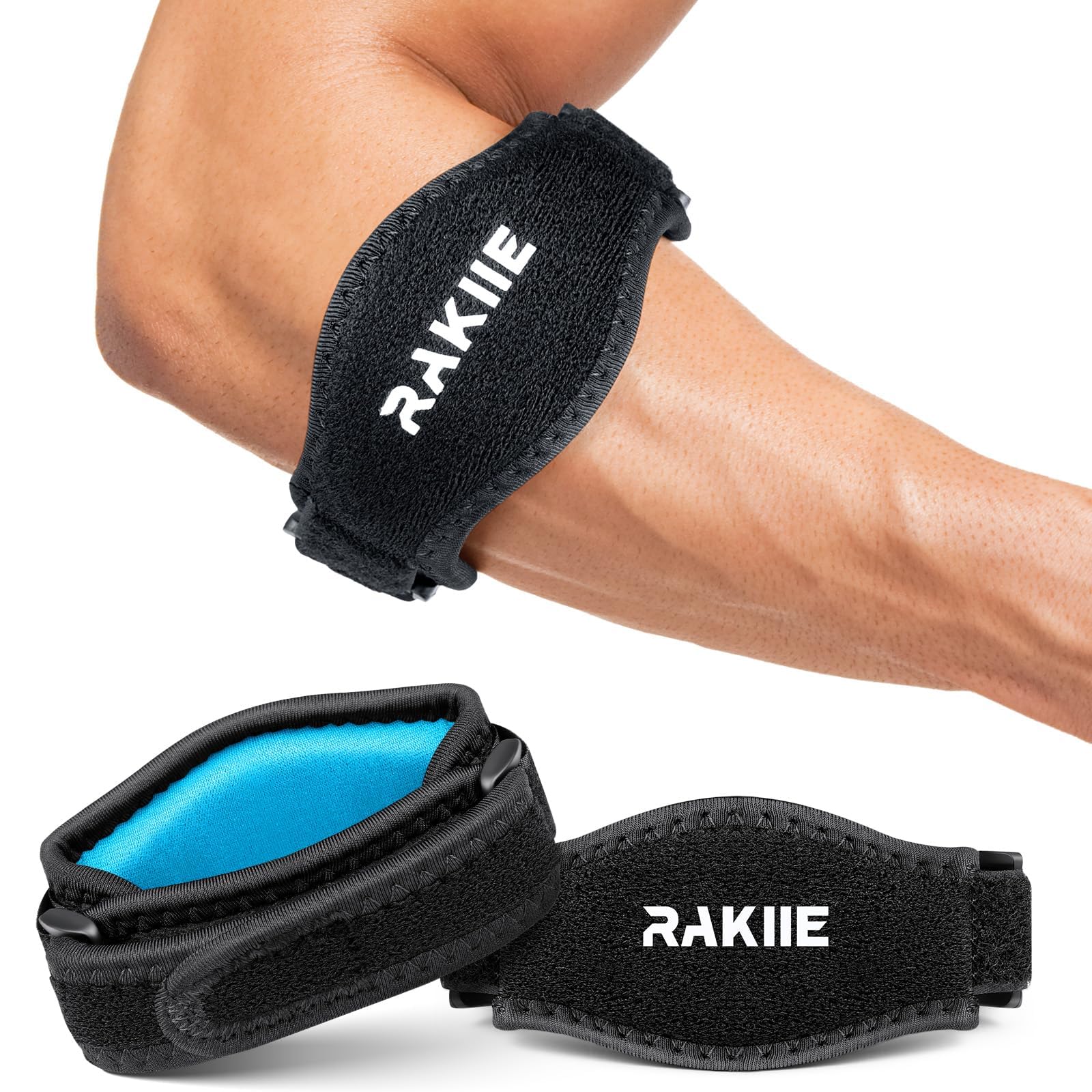
Rakiie Tennis Elbow Brace 2 Pack

89 /100
Trail Score Excellent

Key details

Closure
Touch fastener
Fit Range
7.08 to 14.17 inches
Brace Type
Dual-strap counterforce brace
Pack Count
2 braces
Check Price on Amazon

The listing states a forearm range of 7.08 to 14.17 inches, which is more sizing information than most straps here give you, and it is the cheapest pair in this set. That combination makes it the one we suggest for a first try at counterforce pressure.

Two straps, an EVA pad apiece, and a closure you can adjust from either side. The pad is the part doing the work: seat it on the meaty part of the forearm about an inch below the elbow crease, on the side that hurts, and tighten until the tendon quiets rather than until the strap stops moving.

Worn tight enough to work, it leaves marks, and after a few hours the edge of the pad can itch against bare skin, which is why a thin base layer underneath helps. The closure is what gives out first; the fabric and stitching hold up better than the price suggests. If you have never worn a counterforce strap and do not know whether one will do anything for you, start here rather than with the most expensive band on the page.

Pros

  • Two straps with EVA pads
  • States a 7.08 to 14.17 inch forearm range
  • Adjustable from either side

Cons

  • Closure wears out before the fabric
Our verdict

We suggest this pair for anyone who has never worn a counterforce strap: the fit range is stated, two come in the pack, and the outlay is small.

Check Latest Price

How We Chose and Tested the Best Elbow Braces for Tendonitis

We started with 34 braces sold at major retailers and specialty sports-medicine shops, then cut anything with vague sizing, non-adjustable closures, or a price that suggested the brace was the least important thing in the box. That left 14, split between strap-style tendon bands and full sleeves, which is the first real decision a buyer has to make.

Each tester measured their forearm at the widest point and just below the elbow, matched it to the maker's chart, and noted where a chart ran a full size off. Then every brace went through four months of ordinary life: eight-hour days at a keyboard, a Saturday of yard work and moving boxes, three gym sessions a week with dumbbell rows, pull-ups, and curls, and a couple of tennis and pickleball games — worn on bare skin and under a sleeve.

We watched for drift and pressure more than anything. Did a strap need re-tightening after twenty minutes of typing, and did the pad stay over the tendon or creep up the forearm? Could we grip a dumbbell with support and still straighten the arm all the way? Testers scored pain from 1 to 10 before the brace went on and again after a week of daily wear, then logged skin reactions after a full day — redness, itching, and indentations that outlasted the brace. Velcro got its own trial, opened and closed 100 times to see whether the hook side still bit, since a strap that lets go mid-set is worse than none. We washed each one as the care label allowed and kept an eye on curling seams and frayed edges.

How to Choose an Elbow Brace for Tendonitis

Strap or Sleeve: Pick by the Hour That Hurts

A counterforce strap, the narrow band with a pad, sits an inch or so down the forearm and takes load off the tendon where it attaches. It earns its keep during the activity that hurts: tennis, golf, lifting, a shift with a hand tool. A compression sleeve wraps the whole joint instead and gives broad support and warmth, which suits the desk hours, the commute and the night far better.

The trap is expecting one to do the other's job. No sleeve unloads a tendon the way a seated pad does, and a strap cranked tight all day is a bruise waiting to happen. If you are buying only one, buy for the hours that hurt most and accept the gap.

Measure the Place the Brace Actually Sits

Sleeves are sized on elbow circumference, which is why the Crucial medium covers 12 to 14 inches, while straps are sized on forearm circumference and the Rakiie states 7.08 to 14.17 inches. Measuring the wrong spot is how people end up with a sleeve that rolls down the bicep or a band that presses an inch above the sore part.

Use a tape, not your shirt size, and take the smaller size when a sleeve measurement lands between two. Designs with a wide stated range remove most of the guesswork: the Sleeve Stars covers 9 to 23 inches and includes three strap lengths.

Placement, Tension, and the Numbness Test

Seat a strap's pad on the meaty part of the forearm about an inch below the elbow crease, on the side that hurts: outside for tennis elbow, inside for golfer's elbow. Tighten until the tendon feels quieter when you grip, and no further. Tingling fingers, swelling or a cold hand means it is too tight, so loosen and re-seat rather than pushing through.

Re-check the tension once you warm up. Straps loosen as you move and knit sleeves settle as the fabric stretches, so the setting that felt right in the kitchen is usually a notch off by the second set.

What Wears Out First

Closures, foam pads and elastic fail in that order. A strap whose hook-and-loop has gone slick will not hold tension however hard you pull, and a pad that has flattened stops directing pressure anywhere useful. When either happens, replace the brace; adding tension to a worn closure just gets you a tighter band that still slides.

Hand wash in cool water, air dry, and keep fabric softener away from elastic, since heat and softener are what turn a snug sleeve into a loose one. A pair makes the washing easier, because one can dry while the other is on your arm.

Frequently Asked Questions

Final Verdict

We point most people to the Kunto sleeve, because tendonitis is a whole-day problem and a breathable pull-on sleeve covers more of that day than a strap does. It supports the joint, sits flat under a shirt, and gives you nothing to re-adjust halfway through a meeting.

If your pain is tied to one specific motion, a backhand, a golf swing or a shift with a heavy tool, buy the Bodyprox pair for that and keep a sleeve for the desk. Two braces covering two settings serves you better than one expensive band asked to do both.