Best Toilet Safety Rails of 2026

Every conversation about making a bathroom safer eventually gets to grab bars, and then to the fact that most bathrooms don't have one and the toilet is the hardest place to add one later. That's the gap a toilet safety rail fills. It clamps or bolts to the bowl and gives you a fixed handle exactly where your balance gives out, in that two-foot stretch of floor between sitting, standing, and pivoting. The catch is that a rail only helps if it holds; one that shifts under your hand is worse than nothing.

That turned out to be the entire test. Over the past nine months, my team and I installed 12 rails across our own bathrooms and two relatives' houses — suction-cup frames, clamp-on models that adjust at the legs, and a couple that bolt through the seat hinges. Price was a poor predictor of anything; a few of the plainest frames were the steadiest. The ones that earned a spot below all shared one trait: they didn't budge.

1

Best Overall

Vaunn Foldable Toilet Frame

93 /100
Trail Score Outstanding

Key details

Mounting
Freestanding, folds flat
Width Range
19–24 in
Height Range
26–34 in
Weight Capacity
300 lb
Check Price on Amazon

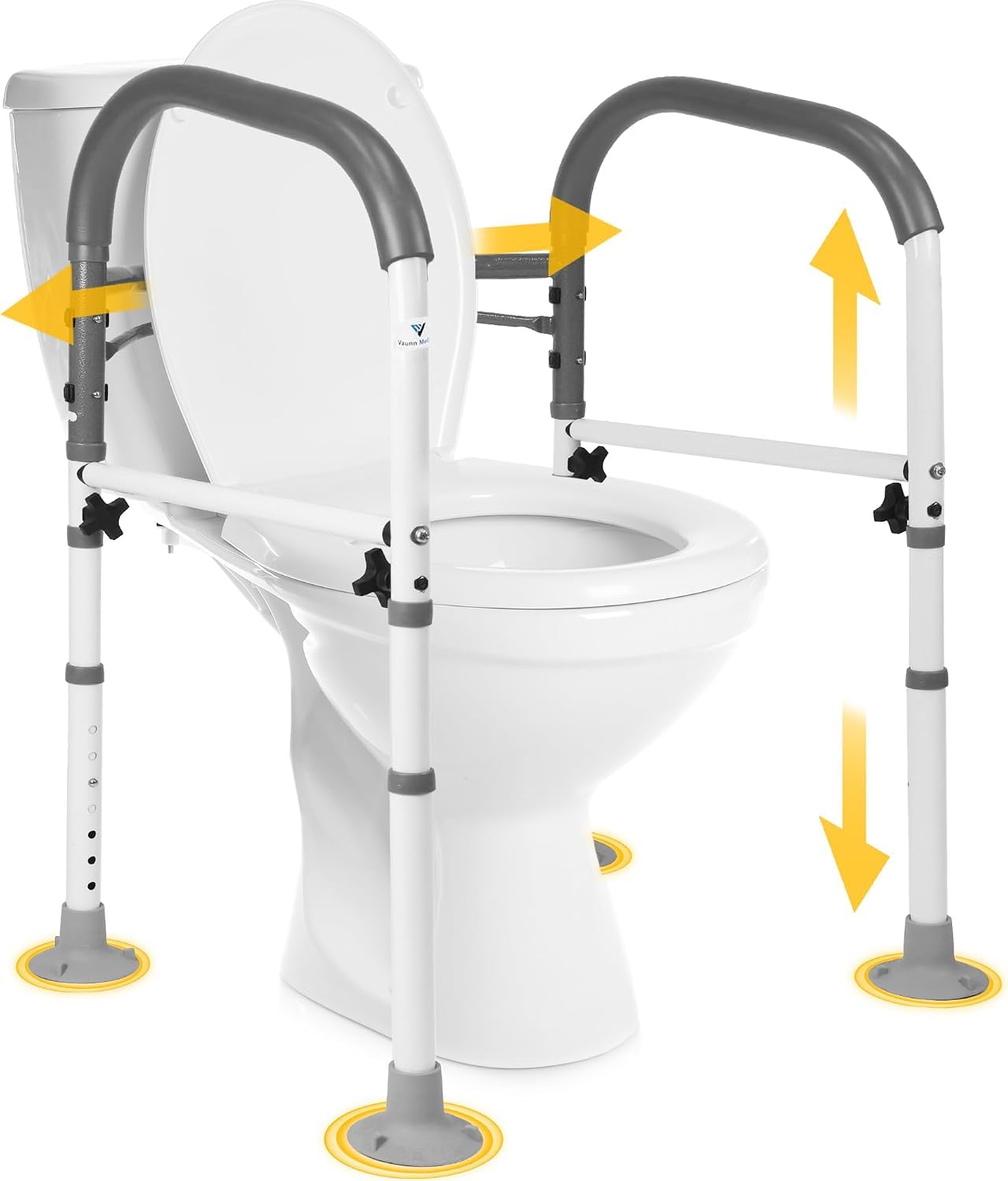
Of the frames we set up, this is the one we recommend for most bathrooms, and the reason is structural: it stands around the bowl on its own, so nobody unbolts a seat or drills tile. Height runs from 26 to 34 inches, the tallest range in this group, and width from 19 to 24 inches, which is narrow enough for a slot between a vanity and a tub and wide enough for a broad one-piece bowl.

Setup takes minutes and no tools. The frame arrives in a few pieces, the legs and back rail slot together, and the whole thing lifts off the toilet when you want it gone. That fold is the part we ended up valuing most: in a shared hall bath, the rail comes out for the person who needs it and stands behind the door the rest of the time, and it is light enough to carry to another floor.

The trade-off is that it is not anchored to anything. Four feet sit on the floor, and where the floor is flat and smooth they hold; over a thick bath mat or deeply grouted tile they do not, and the frame can creep if someone pushes it sideways rather than down. Set it on bare flooring and press the feet down before the first use. It is also the only pick here whose maker lists RV toilets, which makes it the sensible one for a camper.

Pros

  • No drilling, bolts or tools
  • Tallest height range here at 26–34 in
  • Folds flat between uses
  • Fits round, elongated and RV bowls

Cons

  • 300-lb capacity rules out heavier users
Our verdict

For most bathrooms, this is the rail we recommend: no tools, folds out of the way, and a 26-to-34-inch height range that fits more users than anything else here.

Check Latest Price
2

Best Heavy-Duty

KMINA Adjustable Safety Rails

94 /100
Trail Score Outstanding

Key details

Weight
17.5 lb
Adjustment
Height, width and depth
Width Settings
27 in and 30 in
Clearance Needed
15 in from walls on both sides
Check Price on Amazon

This is the most expensive frame here, and the gap is wide enough that it needs justifying. What the money buys is a stainless steel build that weighs 17.5 pounds, arms that adjust in height, width and depth, and the most solid feel of any rail we set up.

It earns the price for a particular household, one where the user leans hard, is tall or heavy, and cannot afford for the frame to flex under a hand. The detail we appreciated most is small: there are buttons under each armrest, so the arms can be repositioned while someone is sitting down. You set them where the person actually pushes, not where it was convenient to assemble.

Space is the catch. The cross tube has to rest against the front of the bowl, and the center line needs at least 15 inches of clearance from walls on both sides. A bathroom wedged between a tub and a vanity often has less than that, so measure before you order. What you get in return is a frame that behaves like a fixture rather than an accessory: lean on one arm and it stays put.

Pros

  • Stainless frame with the firmest feel here
  • Arms adjust in height, width and depth
  • Armrest buttons work while someone is seated
  • Assembles without tools or drilling

Cons

  • Heavy at 17.5 lb to reposition
  • Width settings are 27 and 30 in only
Our verdict

We think it is worth the premium for a heavy, tall or unsteady user: the stainless frame is the most solid here, provided the bathroom gives 15 inches on both sides.

Check Latest Price
3

Best for Larger Users

Loyoda Adjustable Safety Frame

91 /100
Trail Score Outstanding

Key details

Weight
6.03 lb
Width Range
24.41–30.31 in
Height Range
24–30 in
Weight Capacity
350 lb
Check Price on Amazon

Just over 30 inches across at its widest, this is the frame we point to when a standard rail feels like a squeeze. For a broad user or a big one-piece bowl, it is the widest of the freestanding picks here, and that extra span is the whole reason to choose it.

The numbers behind that: width adjusts from 24.41 to 30.31 inches, height has seven positions between 24 and 30 inches, and the frame carries 350 pounds. The legs adjust individually, so you can level the arms on a floor that is not quite flat, and the whole thing folds and moves without tools. At about 6 pounds it lifts out of the way for cleaning without a second thought.

Where it does not work is a small room. The frame starts at 24.41 inches wide, which is already wider than the tightest gaps in this group, and it wants elbow room on both sides. In a bathroom that is a slot between a tub and a vanity, the Coelineao or the Vaunn at its 19-inch setting is the better fit. This one is for the bathroom with space to give.

Pros

  • Widest stance here at 30.31 in
  • 350-lb capacity
  • Seven height positions from 24 to 30 in
  • Folds and moves without tools

Cons

  • Starts at 24.41 in wide, so tight bathrooms are out
Our verdict

For larger users and wide bowls, we point you here: it opens to 30.31 inches and carries 350 pounds, as long as the bathroom has the width to take it.

Check Latest Price
4

Best Value

Lianjindun Toilet Safety Rails

93 /100
Trail Score Outstanding

Key details

Frame
Powder-coated aluminum
Folding
Folds flat, no tools
Height Range
24–31 in
Weight Capacity
350 lb
Check Price on Amazon

Three hundred fifty pounds of capacity and a height range that reaches 31 inches, at a price that sits with the least expensive frames here. That combination is why this one earns the value slot rather than sitting in the middle of the pack.

The height range is the reason to pick it over the other budget frames: 24 to 31 inches covers a tall user or a toilet that sits higher than standard, and the width adjusts to match the bowl. The foam grips are comfortable in bare hands, which matters more than it sounds when someone is gripping hard to stand up.

It is also easy to live with. The frame assembles without tools, folds, and lifts off the bowl so you can clean underneath rather than around it, which removes one of the daily annoyances these rails create. At about 7.6 pounds it is light enough to move between bathrooms without feeling like a toy.

Give some thought to what sits beside the toilet. The frame is broad, and it can crowd a wall-mounted toilet paper holder or a narrow vanity, so check the space alongside the bowl as well as in front of it before you commit.

Pros

  • 350-lb capacity at a value price
  • Height adjusts from 24 to 31 in
  • Folds and assembles without tools
  • Lifts off the bowl for cleaning

Cons

  • Feet can creep on mats and uneven tile
Our verdict

We like this one for the money: 350 pounds of capacity, a 24-to-31-inch height range, and folding that takes no tools.

Check Latest Price
5

Best for Small Bathrooms

Coelineao Toilet Safety Frame

91 /100
Trail Score Outstanding

Key details

Feet
Standard and suction-cup feet
Frame
Aluminum
Assembly
No tools required
Weight Capacity
300 lb
Check Price on Amazon

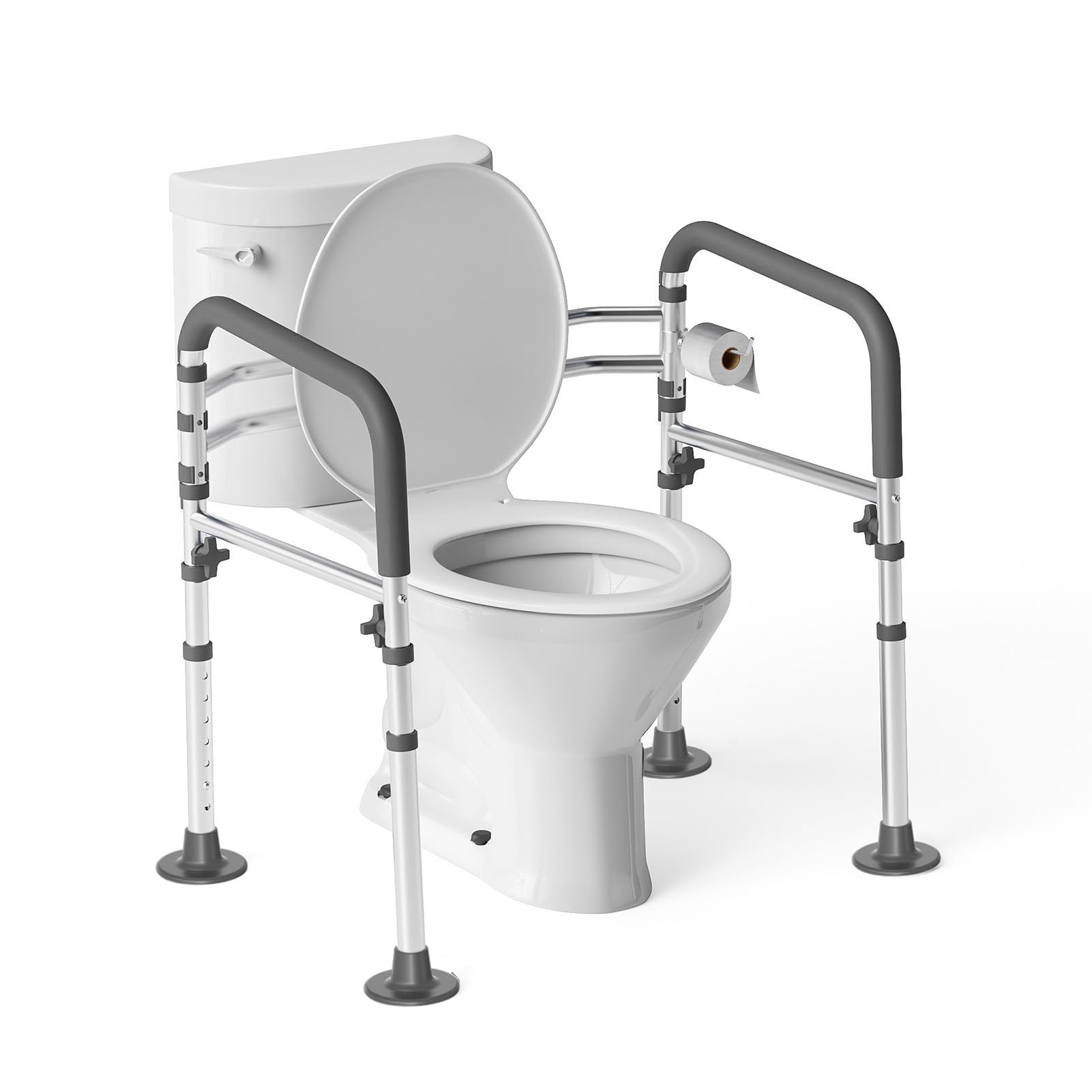
The gap between a tub and a vanity is where this frame makes sense. Width and height both adjust, it weighs 6.6 pounds, and the whole thing lifts out and leans against the wall when the bathroom gets cleaned, so the floor comes back when you need it.

Setup is the least fussy of the budget frames, quick enough to do without a second person and with nothing to drill. It ships with two kinds of feet, plain rubber and suction cups, so you can swap depending on whether the floor is smooth or a little textured, and the handles are wrapped in a full-circle foam grip that is comfortable to hold bare-handed.

Our call is that it is the one to buy when space is the binding constraint, and it is the least expensive rail here, which makes it an easy first rail for a short recovery. What it will not do is match the wide, planted stance of the Loyoda: this is a compact rail for a compact room, and it is happiest in a bathroom where the user needs a handhold rather than a full push-off.

Pros

  • Fits the tightest gaps between fixtures
  • Sets up in minutes without tools
  • Ships with standard and suction-cup feet
  • Full-circle foam grips

Cons

  • 300-lb capacity limits heavier users
Our verdict

Squeeze it into a slot of a bathroom and it does the job: we reach for it when space is the constraint, with a 300-pound limit heavier users should step around.

Check Latest Price
6

Travel and Storage

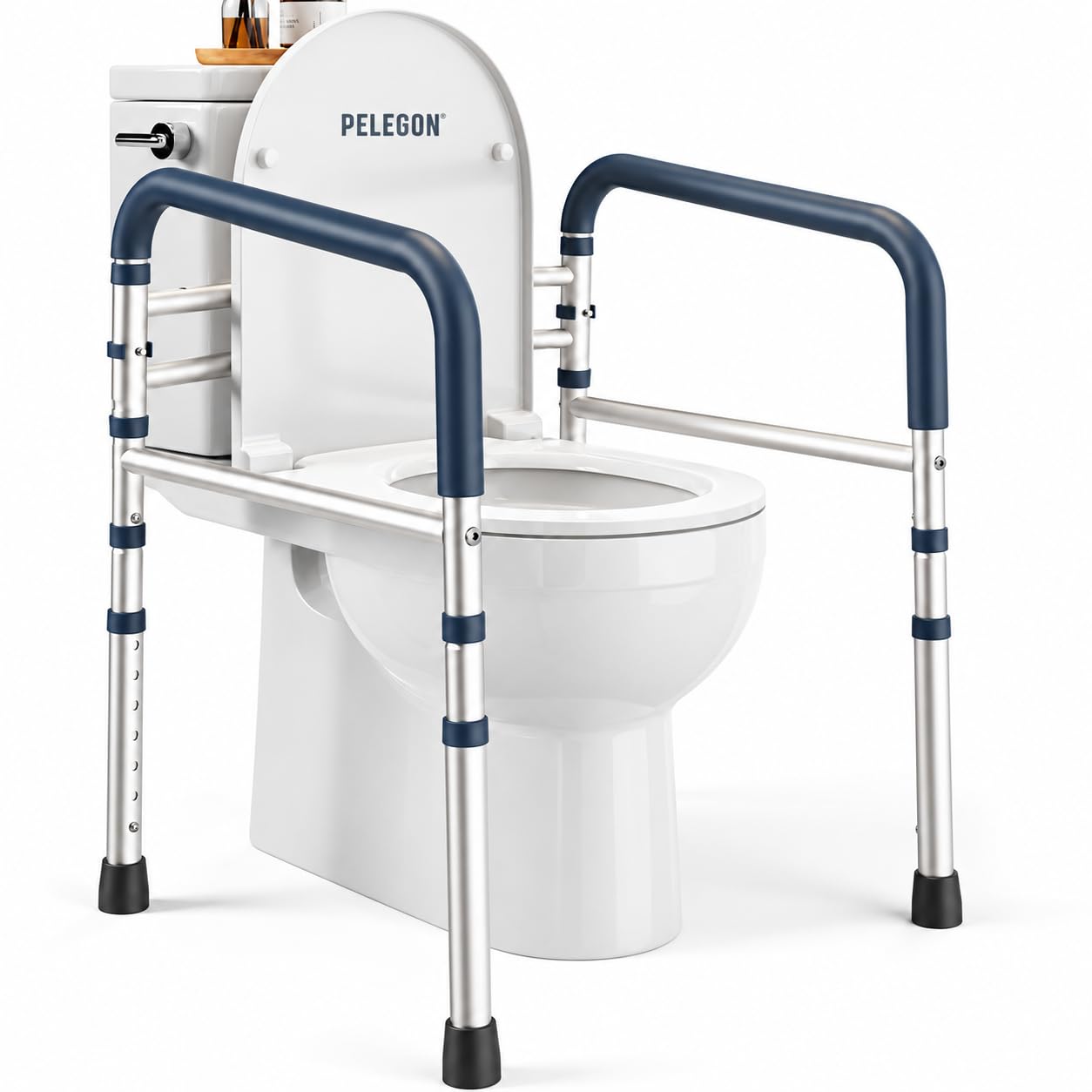
PELEGON Toilet Safety Rails

91 /100
Trail Score Outstanding

Key details

Frame
Powder-coated aluminum
Weight
5.5 lb
Adjustment
Height and width
Weight Capacity
350 lb
Check Price on Amazon

At 5.5 pounds it is the lightest full-size frame in this group, light enough to carry upstairs one-handed or drop in the car for a week at a relative's house. That is the whole case for it, and it is a better case than it sounds if the rail has to serve two bathrooms.

Light does not mean flimsy here. The rating is 350 pounds, which is the highest in this set, and the aluminum frame adjusts in both height and width so it settles around most bowls without tools. The powder-coated finish comes in a dark blue that looks less clinical than the white and gray frames, which counts for something if the rail is going to live in a guest bathroom.

It is the rail we recommend for moving rather than for leaning on hardest. The arms are short, so there is less to push against when you rise, and a user who wants a long lever under each hand does better with the KMINA or the Vaunn. For a second bathroom, a rental, or a trip, the weight is the feature that matters, and nothing else here beats it on that.

Pros

  • Lightest frame here at 5.5 lb
  • 350-lb capacity
  • Adjusts in height and width
  • Assembles without tools

Cons

  • Can conflict with a bidet seat
Our verdict

At 5.5 pounds, this is the one we carry between bathrooms and trips, with a 350-pound rating and no tools required.

Check Latest Price
7

No Floor Space

Vive Compact Toilet Rail

89 /100
Trail Score Excellent

Key details

Weight
5.3 lb
Mounting
Attaches to the toilet, no floor legs
Width Range
17–20 in
Weight Capacity
300 lb
Check Price on Amazon

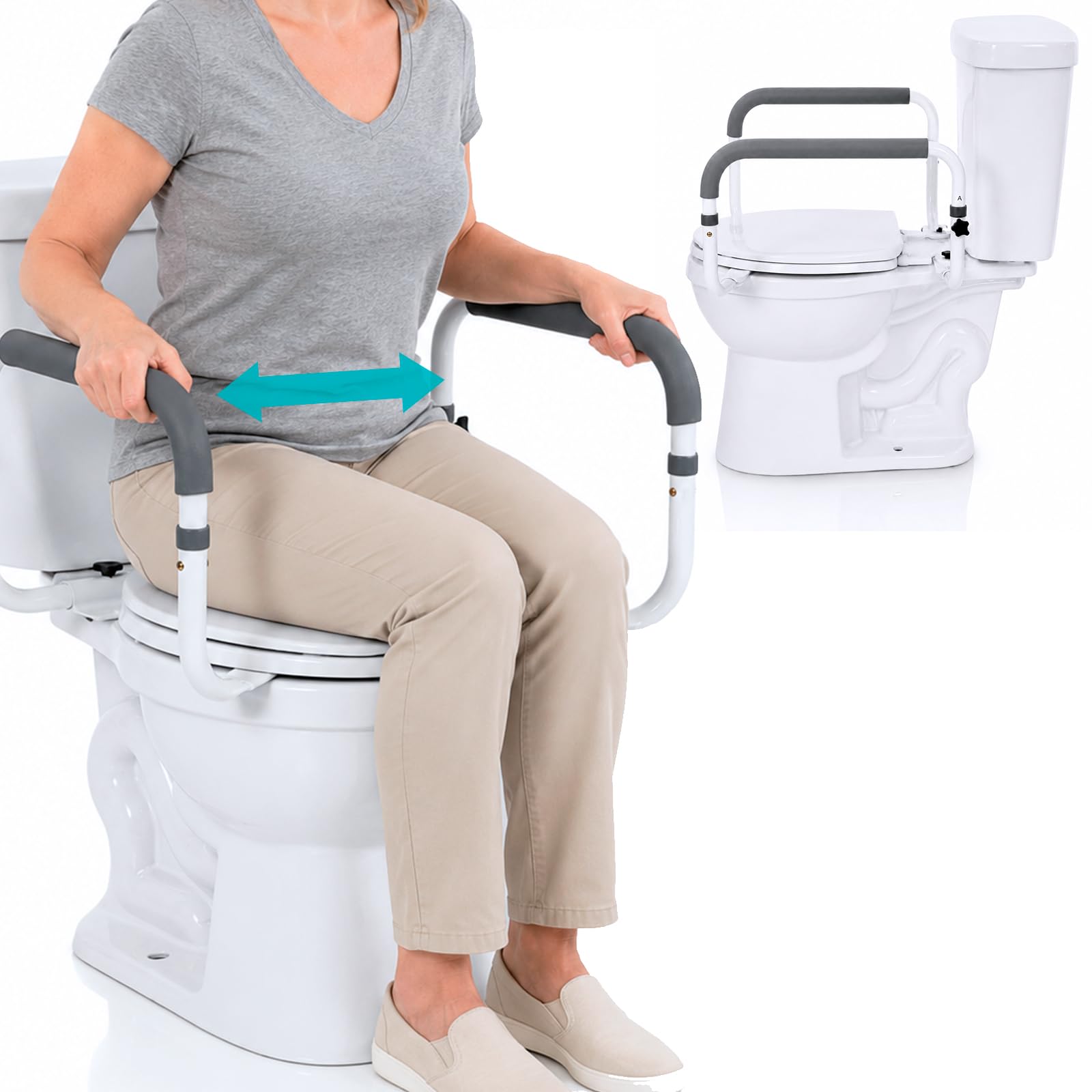
Nothing on this rail touches the floor, which is the whole argument for it: no legs to catch a foot in the night, nothing to mop around, and no footprint in a bathroom that does not have one to spare.

It clamps onto the toilet itself, so installation is a matter of minutes and a couple of tighteners rather than drilling, and the width adjusts between 17 and 20 inches, narrow enough for bowls the freestanding frames cannot straddle. The padded handles and the white finish keep it from looking like hospital equipment, which is not nothing in a bathroom guests use.

The honest part is that this design borrows its stability from your toilet. It holds because the seat bolts hold; when they work loose, or the bowl has an unusual shape, the front edge can slip sideways under a hand. Check the bolts, tighten them, and give the rail a hard shake before anyone leans on it.

So it suits a bathroom where floor space is the problem and a user who wants steadying on the way down and up rather than a full push-off. When someone puts their weight through their arms every single time, we prefer a frame that stands on the floor, even if it costs the floor space this one saves.

Pros

  • Leaves the floor completely clear
  • Narrow 17–20 in stance suits small bathrooms
  • Installs without drilling
  • Padded grips and an unobtrusive look

Cons

  • 300-lb capacity limits heavier users
  • 17–20 in width range will not clear wide bowls
Our verdict

We choose it when floor space is the constraint and the seat bolts are tight: nothing to trip over and a 17-to-20-inch stance that fits narrow bowls.

Check Latest Price

How We Tested a Dozen Toilet Safety Rails

We started with a list of about 40 rails and cut it down by reading specs: weight rating, the width between mounting holes, whether the frame adjusts at the legs or only at the seat bracket, and which ones shipped with hardware for a standard elongated bowl. That left 12, spanning suction-cup models, clamp-on frames, and rails that bolt through the seat hinges.

Each one was installed by a single person, alone, with a stopwatch running and nothing but what came in the box. We noted how long it took, whether the instructions quietly assumed a second pair of hands, and whether the rail ended up crowding the flush handle or the toilet paper roll in a bathroom that's barely five feet wide. Then we checked clearance with the seat up, down, and mid-flip.

For the next nine months, the rails stayed on the toilets. Everyone in the rotation used them daily — one sister through knee surgery and the months after, an aunt with arthritis in both hands, and me, mostly out of habit by the end. We leaned our full weight sideways on each rail, sat down harder than we needed to, and stood up using one hand while watching the floor brackets for any slide. Every suction-cup model got checked weekly: cups that flattened, cups that crept, and one that held fine on day one and drifted by day four.

At the end we went back over each rail, looking at the powder coat where the frame meets the weld, foam grips for splits, and any rust starting at the hardware, then weighed what you actually get in the box against what it cost.

How to Choose a Toilet Safety Rail

Start with how it attaches

Two designs cover almost everything here. A freestanding frame stands on four feet around the bowl: no tools, no drilling, and it moves to another bathroom or folds into a closet when it is not needed. Its grip comes entirely from rubber or suction feet on the floor. A toilet-mounted rail clamps to the bowl or the seat bolts, so nothing sits on the floor, but it inherits whatever your seat and bolts do, and a loose seat makes a loose rail.

If the bathroom has floor space and more than one person will use the rail, start freestanding. If the floor is the obstacle, or the room is too tight for feet in front of the bowl, a mounted rail is the only design that fits.

Measure the gap before anything else

Most disappointment in this category is a fit problem, not a quality problem. Measure the clear width between the tub, vanity or wall and the bowl before you compare features: the frames here start as narrow as 17 inches and run past 30, so your room decides more than the spec sheet does. Then look at the feet, which sit out in front of the bowl roughly where toes land on a middle-of-the-night trip.

Clearance requirements are not decoration. The KMINA frame needs the cross tube resting against the front of the bowl and 15 inches from walls on both sides, so check that one against your room before anything else.

Set the arms where the person actually pushes

Adjustment is less about comfort than mechanics. The arms want to sit at a height where the user can press down with both feet flat and wrists fairly straight, and both arms want to be level. A wide height range buys that for a taller user or a higher bowl: 26 to 34 inches on the Vaunn, 24 to 31 on the lianjindun.

Arms that can be repositioned while someone is seated, as on the KMINA, save a lot of getting up and down during setup. Set them once with the person in place rather than guessing from a standing height.

Treat the weight rating as a ceiling

Capacities here run from 300 to 350 pounds, and the higher ratings tend to come with heavier frames: the KMINA's stainless build weighs 17.5 pounds, while several aluminum frames are around 6. Weight is not the same thing as strength, but it is a fair guide to how planted a frame feels when someone leans on one side.

The rating is a limit rather than a target, and it is worth being clear about what a rail does. It gives you something to push against while you sit and rise. It does not lift anyone, and it does not replace the walker, the caregiver or the rail on the wall.

Feet, floors and what suction cups do

Suction cups are the least predictable part of any freestanding frame. They hold on smooth, flat, non-porous surfaces such as glazed tile, vinyl and linoleum, and let go over grout lines, textured tile and anything soft. Put the frame where the floor is flattest, take the bath mat up, and press the cups down before the first use.

Several frames here ship with plain rubber feet as well as cups, so you can match the foot to the floor. If the floor is genuinely uneven, a toilet-mounted rail sidesteps the problem entirely.

Frequently Asked Questions

Final Verdict

The Vaunn freestanding frame is the one we recommend for most bathrooms: it stands around the bowl, adjusts from 26 to 34 inches, folds out of the way when it is not needed, and asks nobody to unbolt a toilet seat. Two requirements change the answer.

If the user is heavy, tall, or needs the arms at an exact height and angle, the KMINA's stainless frame is worth the premium, so measure its 15 inches of side clearance first. If the bathroom is a narrow slot, start with the Coelineao and check the width before you order.