Best TENS Units for Sciatica of 2026

If you've ever had a sciatic flare-up, you know the drill: you shift in your chair, stand up, lie down, and nothing helps for long. A TENS unit can interrupt the pain signal enough to let you sit through a meeting or fall asleep without another pill. I've dealt with sciatica for years, and over the past six months my team and I have put 14 units through their paces—at my desk, in the car, on the couch, and on walks—to find the ones that take the edge off.

Differences show up in the details: how quickly you can dial in relief, whether the pads stay stuck when you shift, how long a charge holds, and whether the controls make sense at 2 a.m. We weighed what each kit includes against replacement costs, because a cheap unit with flimsy pads isn't a bargain. Some felt sturdy after weeks of use; others showed wear fast. The picks below are the ones we'd reach for first, whether you need something simple for occasional flare-ups or a more adjustable unit for daily pain.

1

Best Overall

TechCare Plus24 TENS Unit

93 /100
Trail Score Outstanding

Key details

Pads
10 (2 large, 6 medium, 2 small)
Modes
24
Battery
Rated up to 20 hours
Channels
Dual, independent
Check Price on Amazon

The feature that makes the TechCare Plus24 our top pick for sciatica is the pair of independent channels. You can put four pads across the low back and hip, then send a different mode or intensity to each pair—useful when the pain runs down one leg but the low back needs broader coverage. The large LCD and clearly separated controls make that adjustment easy to see, even in a dim room. We also like that the kit includes two large electrodes, six medium pads, and two small ones, so you have the right shape for the low back and for the narrower path along the leg.

Twenty-four modes is more than most people need. We found ourselves settling on two or three steady options and ignoring the rest; the value is in the 20 intensity levels and the straightforward controls, not in collecting modes. Start low, especially on the leg, where the sensation can feel sharper than it does across the low back. The buttons are responsive, and the screen is easy to read without making you cycle through a maze.

The built-in battery is rated for up to 20 hours of use, which is enough for a week of short sessions without a charge. The controller is larger than the pocket-sized units here, but it still fits easily in a bag. If you want one unit that can handle a low-back flare and leg involvement in the same session, this is the one we point to first. The replaceable pads are the main consumable, and the included set gives you a reasonable start.

Pros

  • Independent dual channels for two areas
  • 24 modes and 20 intensity levels
  • Rated up to 20 hours per charge
  • 10-pad kit with three sizes

Cons

  • Built-in battery requires charging; no disposable backup
Our verdict

The TechCare Plus24 is our top pick for sciatica because independent dual channels and a 20-hour battery let you treat the low back and leg with separate settings.

Check Latest Price
2

Best for Large Pads

AUVON Dual Channel TENS Unit

93 /100
Trail Score Outstanding

Key details

Pads
4 square, 4 large 2 x 4 inches
Modes
20
Battery
Rechargeable lithium-ion
Channels
Dual, independent
Check Price on Amazon

If the TechCare is the full-featured default, the AUVON Dual Channel is the one we reach for when pad size matters most. The kit includes four 2-inch square pads and four 2-by-4-inch rectangles, and those larger pads cover more of the low back than the squares most units ship with. That matters for sciatica, where you often want one pad set across the lumbar area and another following the pain into the hip or leg.

The independent A/B controls are the other reason it stays near the top. You can run one channel on a steady pulse for the low back and a different mode on the leg channel, then adjust each intensity separately. We like that flexibility more than a long list of exotic modes; 20 modes is plenty, and the controls are simple enough to change mid-session without breaking your position. The controller is genuinely pocket-sized, and the rechargeable battery means no last-minute hunt for a 9-volt.

For a flare that starts in the low back and runs into the hip, the bigger pads are the practical advantage. We also appreciate that the included pad holder keeps the sticky surfaces clean between sessions. If you already know you want large pads and independent channels, this is the AUVON to choose over the smaller 24-mode model. It is the kit we leave set up for the days when one channel on the back is not enough.

Pros

  • Independent A/B channel control
  • Four large 2 x 4-inch pads included
  • Compact rechargeable controller
  • 20 modes with a pad holder

Cons

  • Durability after several months can be uneven
Our verdict

Choose the AUVON Dual Channel if you want the largest pads here and independent channels in a smaller controller; it is the better pad kit for broad low-back coverage.

Check Latest Price
3

Best Complete Kit

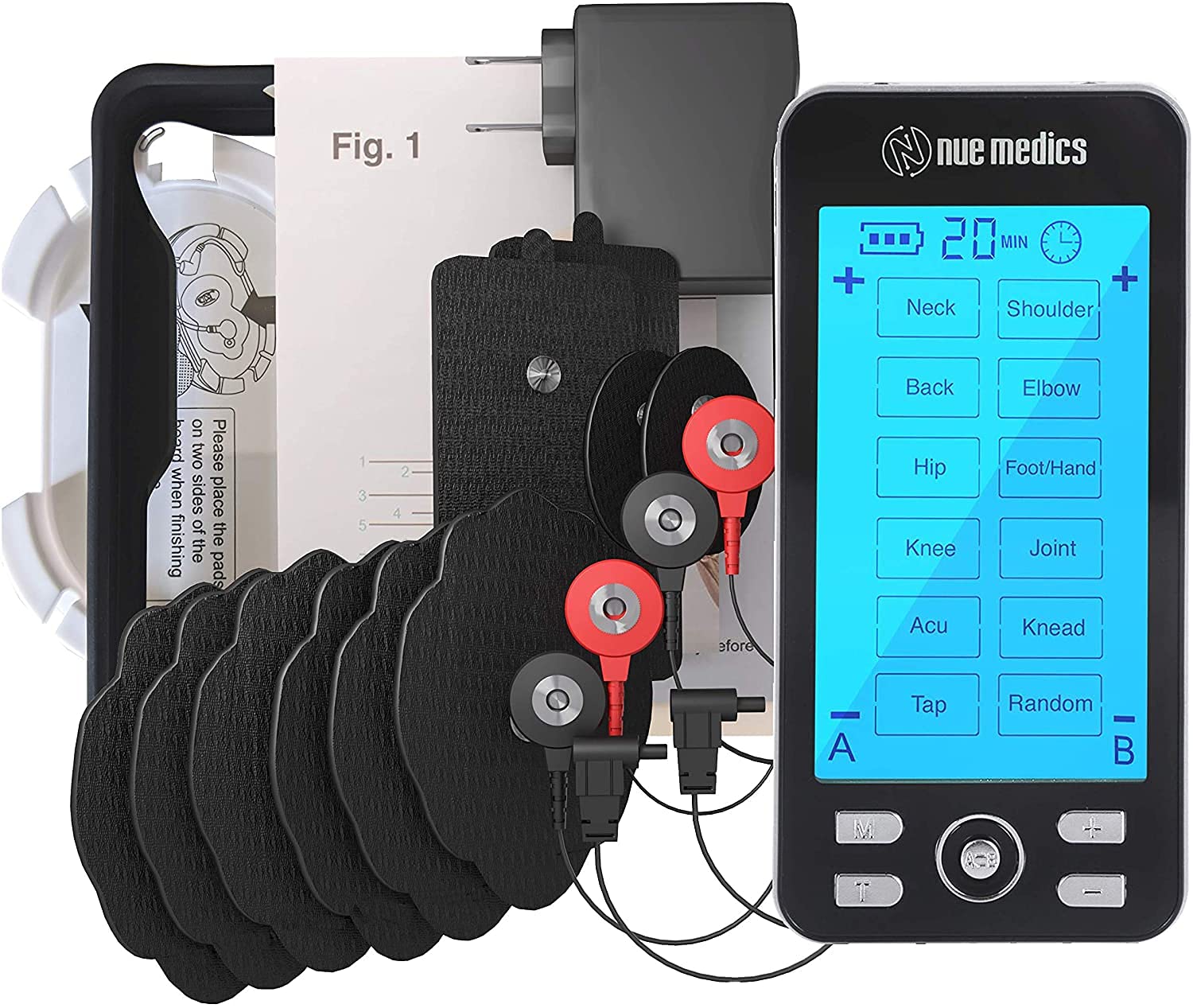
NueMedics Tens 24

93 /100
Trail Score Outstanding

Key details

Pads
6 large electrodes
Modes
24
Charger
USB-C and wall charger
Channels
Dual
Check Price on Amazon

The NueMedics Tens 24 is for the person who wants the whole kit to make sense out of the box. It arrives with six large electrodes, two lead wires, a USB-C cable, a wall charger, and a holder for the pads and wires. That sounds like housekeeping, but it is the difference between a unit you use and one that stays in a drawer because the charger or a spare pad is missing.

The 24 modes are named for body areas and treatment styles—neck, shoulder, back, elbow, hip, foot and hand, knee, joint, acupuncture, kneading, tapping, and random—which makes the first session less of a guessing game. We found the intensity lock reassuring: the unit will not let you ramp up until the pads are securely placed. The controls are straightforward, and the included wall charger is a small convenience that many rechargeable units leave out.

Six large pads are the useful part for sciatica. You can cover the low back and still have pads left for the hip or upper leg, and the larger surface area spreads the sensation rather than concentrating it on one spot. The controller is pocket-sized and the battery is rechargeable, so it travels well. This is not the unit for someone who wants four independent channels, but for a first TENS unit or a straightforward home kit, it is one of the easiest to live with.

Pros

  • Six large electrodes included
  • Modes named for common pain areas
  • USB-C and wall charger in the box
  • Intensity locks until pads are placed

Cons

No notable drawbacks to flag.

Our verdict

The NueMedics Tens 24 is the easiest complete kit for a first TENS user, with six large pads, a wall charger, and a safety lock that prevents accidental intensity.

Check Latest Price
4

Best Organized Kit

Belifu Dual Channel TENS Unit

91 /100
Trail Score Outstanding

Key details

Pads
10
Modes
24
Battery
Rechargeable lithium polymer
Channels
Dual A/B
Check Price on Amazon

The Belifu kit comes with a drawstring storage bag and reusable cable ties, which sounds minor until you have had lead wires tangled in a drawer. The bag holds the controller, leads, and a few spare pads, so the whole setup stays together between sessions. The 10 included pads are another practical touch: you get a spare set without ordering refills on day one.

The dual A/B channels and 24 modes put it in the same functional neighborhood as the other midrange units here. You can run two areas at once, adjust intensity separately, and set a timer. We like the simple button layout and the fact that the rechargeable battery is built in; there is no 9-volt to buy. The 20 intensity levels give you enough room to start low and work up, especially on the leg where the current can feel stronger.

The storage system is what earns it a place for us. A dual-channel kit with 10 pads can turn into a tangle, and the bag and ties keep it ready to use. The controller is small enough to pack, and the included pad holder protects the adhesive between sessions. If you want a tidy dual-channel kit and do not need the longest battery rating here, the Belifu is a sensible value pick.

Pros

  • Dual A/B channels with separate intensity
  • 10 reusable pads included
  • Storage bag and cable ties
  • Rechargeable lithium battery

Cons

  • Pads can lose grip after limited use
Our verdict

The Belifu is the tidy dual-channel kit we pack when we want 10 pads and a storage bag in one grab-and-go case, provided you budget for replacement pads.

Check Latest Price
5

Best Budget

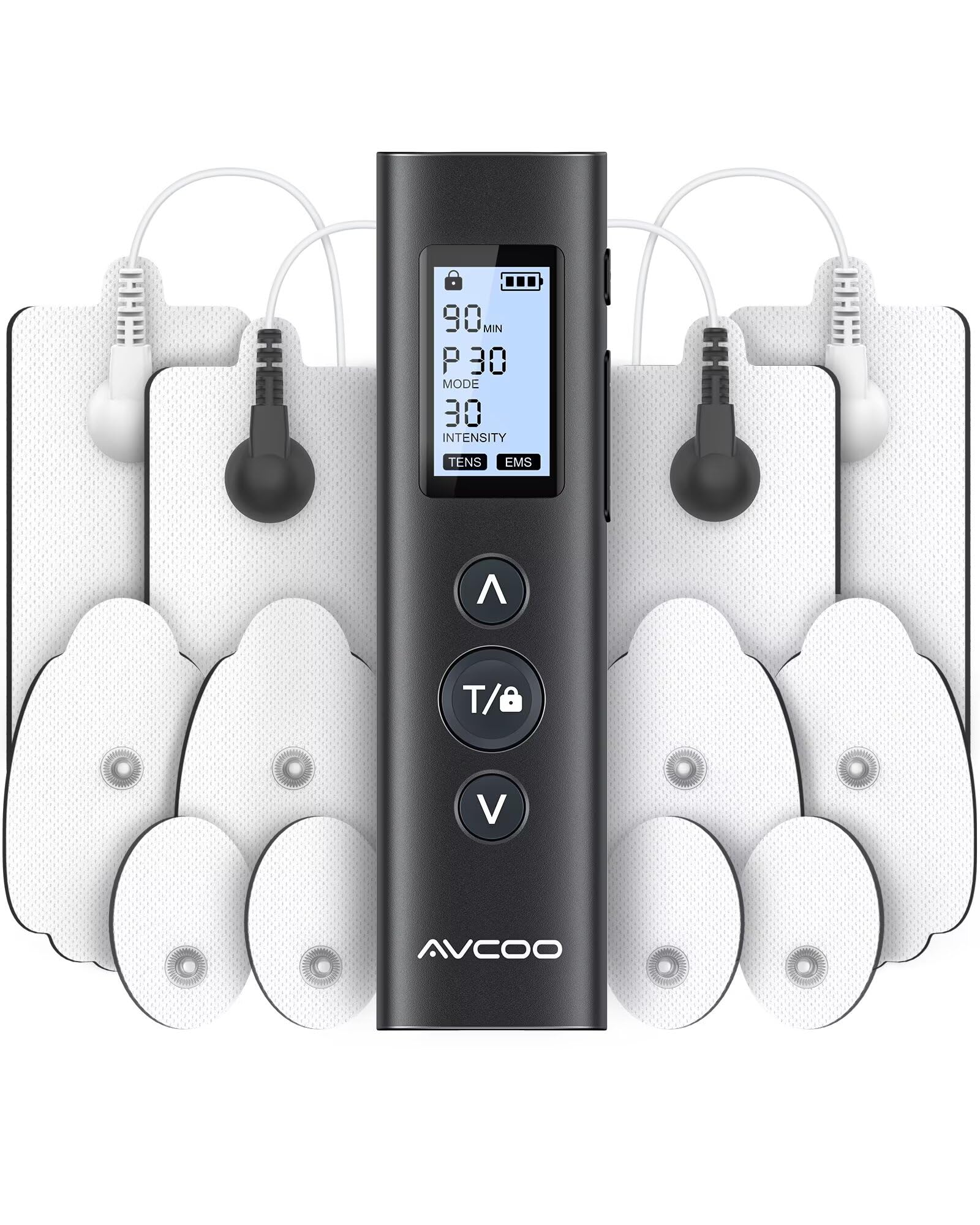
AVCOO 30 Modes TENS EMS Unit

93 /100
Trail Score Outstanding

Key details

Pads
12 (4 large, 4 palm, 4 oval)
Modes
30
Battery
Rated up to 30 hours
Intensity Levels
30
Check Price on Amazon

Most TENS units are pocket-sized in name only; the AVCOO 30 Modes is genuinely slim at 4.8 by 1.3 by 0.5 inches and 0.09 pound. That makes it the one we tuck into a bag or a jacket pocket without thinking about it. The 30 modes and 30 intensity levels give you more range than you will probably use, but the deeper bench is useful when you want a different rhythm for the low back than for the leg.

The pad mix is the practical part for sciatica: four 2-by-4-inch rectangles, four 2-by-3-inch palm-shaped pads, and four 1-by-2-inch ovals. The large rectangles are the ones to start with across the low back; the smaller shapes are better for following the pain into the hip or along the leg. We like that the unit has a memory function, so it returns to your last setting instead of making you rebuild the session every time.

The battery is rated for up to 30 hours of use, which is generous for a unit this small. The controls take a little getting used to because there are so many modes, but the screen and buttons are legible, and the slim body is comfortable to carry. If you want the lowest-cost way into TENS and do not need a large display, this is the one we point to. It is also a good second unit for travel because it takes up so little room.

Pros

  • 30 modes and 30 intensity levels
  • 12 pads in three shapes
  • Slim 0.09-pound body
  • Rated up to 30 hours of use

Cons

No notable drawbacks to flag.

Our verdict

The AVCOO 30 Modes is the slim, light budget pick for someone who wants plenty of modes and 12 pads without carrying a bulky controller.

Check Latest Price
6

Best for Beginners

AUVON 24 Modes TENS Unit

93 /100
Trail Score Outstanding

Key details

Pads
8 square
Modes
24
Battery
Rated up to 10 hours
Intensity Levels
20
Check Price on Amazon

The AUVON 24 Modes is the unit we hand to someone who has never used TENS before. It is small enough to hold in one hand, the buttons are clearly labeled, and the 24 modes are organized in a way that does not require a manual consultation every time. The 8 included square pads are enough for the low back, and the controller fits in a pocket while the leads run under a shirt.

The 20 intensity levels are the part that matters. You can start at the bottom, edge up until you feel a comfortable tingling, and stay there; the higher levels are genuinely strong for a unit this size. The rechargeable battery is rated for up to 10 hours of use, and the unit charges by USB-C, so a laptop or power bank can top it up. We like that the controls are simple enough to adjust while lying down.

For a first-time user who wants a compact controller and does not need independent channels, the AUVON 24 Modes is an easy place to start. We kept it in the beginner slot because it removes the intimidation factor: one pad set, a clear screen, and a price that makes trying TENS feel low-risk. The controls are the reason it stays in that slot, not the mode count.

Pros

  • Pocket-sized controller
  • 24 modes and 20 intensity levels
  • 8 square pads included
  • Rated up to 10 hours per charge

Cons

  • Pads lose adhesion over time
Our verdict

The AUVON 24 Modes is the simple, pocket-sized unit we suggest for a first TENS session, with enough intensity range to find a comfortable level.

Check Latest Price
7

Multiple Pain Areas

Etekcity 4-Channel TENS Unit

93 /100
Trail Score Outstanding

Key details

Pads
Up to 8
Weight
3.4 oz
Battery
Rated up to 7 days
Channels
4 independent
Check Price on Amazon

Sciatica rarely travels alone. If you also want to treat a shoulder, both sides of the low back, or a second area at the same time, the Etekcity's four channels are the reason to look at it. It supports up to eight pads at once, with four independent channels, so you can cover a wide area without daisy-chaining leads or choosing one spot over another.

The controller is small—3.4 ounces and small enough to set on a nightstand—and the large LCD keeps the channel settings visible. The memory function is useful: it returns to your last setup, which saves time when you are using the same placement every evening. The rechargeable battery is rated for up to seven days on a single charge, and it charges by USB from a wall charger, power bank, or laptop.

Four channels mean more wires, and you will want a routine for keeping the pads paired and untangled. The unit is not as pocketable as the single-channel controllers here, but it is still light enough to wear on a waistband or set beside you. We found the channel buttons logical, though the small labels take a session or two to learn.

If you need to treat several areas at once, the four-channel layout is worth the extra fuss. For a single spot, a simpler unit is easier to live with, and the extra pads and wires do not buy you anything. That is the boundary of what this one is for: it is a multi-area tool, not the smallest everyday controller.

Pros

  • Four independent channels
  • Supports up to eight pads
  • Rated up to seven days per charge
  • FSA and HSA eligible

Cons

  • Pads can lose adhesion
  • Battery life is inconsistent
Our verdict

The Etekcity is for the buyer who wants to treat several areas at once; its four independent channels and eight-pad capacity are unmatched in this set.

Check Latest Price
8

Budget Spare Unit

TENKER 24 Modes TENS Unit

91 /100
Trail Score Outstanding

Key details

Pads
8 (six 2-inch, two 2 x 4-inch)
Modes
24
Charger
USB cable; adapter not included
Intensity Levels
20
Check Price on Amazon

The TENKER 24 Modes fills the budget slot in this lineup. It has the essentials—24 modes, 20 intensity levels, dual output, and a rechargeable battery—without the larger display or the premium pad kit of the top picks. The controller is small and light, and the included pouch keeps the leads together.

Dual output is the feature that makes it more than a starter unit. You can run two areas at once, or two people can use it, and the 20 intensity levels give you enough room to start low on the leg. The 8 included pads include two 2-by-4-inch rectangles, which are the ones to use across the low back; the six 2-inch squares are better for the hip or a smaller spot.

We like the straightforward button layout and the fact that it charges by USB, so a power bank or laptop can top it up. The included pouch and cable ties keep the leads together, and the 12-month warranty is a useful safety net for a budget unit. The controller is small enough to keep in a bag, which is the point of a backup unit.

For a spare unit, a travel bag, or a first TENS purchase on a tight budget, the TENKER is a sensible way to get dual output and large pads without paying for extras. The controls are simple enough that we did not need the manual after the first session. It is not the unit to choose if you want the longest battery rating or the most complete pad kit, but it covers the basics.

Pros

  • 24 modes and 20 intensity levels
  • Dual output for two areas
  • 8 pads including two large rectangles
  • Rechargeable battery and pouch

Cons

  • USB cable only; wall adapter not included
Our verdict

The TENKER is the budget dual-output unit we keep as a spare, with large pads and 24 modes, as long as you can supply your own USB wall adapter.

Check Latest Price

How We Chose and Tested TENS Units for Sciatica

We started by pulling together the TENS units that show up most often in sciatica forums and retailer reviews, then narrowed the list by specs that matter for nerve pain: adjustable intensity, pad size and shape, number of modes, battery type, and what comes in the box. We ruled out models with vague intensity steps or pads that seemed too small to sit over the sciatic path. That left 14 units, which we tested over six months.

Testing happened where sciatica actually flares: at a desk during workdays, on the couch during evening wind-downs, in the car on commutes, and on walks when the ache moved from buttock to calf. For each unit, we noted how quickly we could get from unboxing to a comfortable intensity, whether the controls were readable in low light, and how many intensity levels felt useful rather than redundant. We wore each unit through a full workday, then checked whether the pads were still tacky or had curled at the edges; we also tracked how many sessions a set of pads lasted before needing replacement.

Battery life got its own test: we drained each unit from full to empty, counting sessions rather than hours, then timed a full recharge. We dropped units from waist height, tugged the lead wires, and checked whether buttons felt mushy after a few weeks. To judge value, we compared what each kit included—pads, case, cables—against what you'd spend to replace those pieces separately. Pain relief was the hardest thing to quantify, so we rated it on whether a session dulled the ache enough to sit through a meeting or fall asleep without shifting every few minutes.

How to Choose a Tens Unit for Sciatica

Start With Two Independent Channels

Sciatica pain often starts in the low back and runs through the hip or leg. A dual-channel unit with independent controls lets you put one pair of pads across the low back and another along the path of the pain, then set a different intensity for each. That is the configuration we prioritise; a single-channel unit can cover one spot, but it cannot follow the nerve path while you adjust the low back separately.

Pad size matters as much as channel count. A 2-by-4-inch rectangle covers more of the low back than a 2-inch square, while a smaller pad is easier to place on the leg. Look for a kit that includes both shapes, such as the AUVON Dual Channel or the TechCare Plus24. If you mostly treat one spot, you can save money with a simpler unit.

Treat Mode Count as a Nice-to-Have

Sixteen, 24, or 30 modes all sound impressive, but most people settle on two or three: a steady pulse for the low back and a gentler rhythm for the leg. The more useful specifications are the number of intensity levels, the timer, and clear buttons you can operate while lying down. A unit with 20 levels and a simple layout is easier to live with than one with 30 modes and a menu you have to relearn each session. Start at the lowest level that produces a comfortable tingling, not a sting.

Choose the Battery Around Your Routine

Rechargeable lithium batteries suit daily use and save you from buying 9-volt cells, but a built-in battery means charging is part of the routine. A disposable-battery unit is easier to keep as a backup because you can store it with a fresh cell. If you travel, check the charger: USB-C is convenient, but some kits include only a cable and no wall adapter. Battery ratings range from about 10 hours to several days of short sessions, so match the claim to how often you treat.

Budget for Pads and Check the Connector

Pads are the recurring cost of TENS. They lose adhesion as skin oils and dust build up, and large rectangles cost more to replace than small squares. Before you buy, check that replacement pads are easy to find and use the same snap connector as the leads. Keep a spare set sealed in the storage bag, and wipe your skin dry before applying pads; that does more for adhesion than pressing harder. A unit with inexpensive, widely available pads is cheaper to own than a bargain controller with hard-to-find pads.

Frequently Asked Questions

Final Verdict

For most people with sciatica, the TechCare Plus24 is the one we recommend. Its independent channels let you treat the low back and the leg with separate settings, the 20-hour battery covers a week of short sessions, and the large LCD is easy to read when you are lying down.

If you want the biggest pads and a smaller controller, choose the AUVON Dual Channel; if this is your first TENS unit, the AUVON 24 Modes is the simpler, lower-cost start. The right choice is the one whose pad placement and controls you will actually use.