Best Stethoscopes for Nurses of 2026

A stethoscope is the one piece of gear you touch on every patient, and it carries the most annoying tradeoff in nursing equipment: the models that let you pick out a soft murmur through a noisy hallway are heavy, stiff, and expensive, while the light ones that disappear around your neck leave you straining at a blood pressure dial. Spend a shift with a bad one and you feel it, in pinched ear canals, a sore neck, and the nagging worry that you missed something worth catching. A good one handles all three at once.

My team and I spent six months rotating 12 stethoscopes through real shifts, in med-surg hallways, ICUs at change of shift, and quiet rooms where we compared them side by side on the same chest. Here's what nobody tells a first-year nurse: the chest piece gets all the attention, but the seal in your ears decides how much you actually hear. The picks below run from a solid budget option for clinicals to the one worth keeping for a career.

1

Best Overall

Littmann Classic III

96 /100
Trail Score Outstanding

Key details

Weight
5.29 oz
Tube Length
27 inches
Recommended Use
General physical assessment
Chestpiece Finish
Rainbow stainless steel
Check Price on Amazon

The Classic III is the scope we hand to a nurse who needs one stethoscope for most of the floor: med-surg, clinic, urgent care, OB/GYN, or a mix of adult and pediatric patients. It has a 27-inch tube, a stainless-steel rainbow chestpiece, and a listed weight of 0.15 kg, so it sits in the middle of this group: not the featherweight, not the critical-care tank. That middle ground is exactly why it earns the top spot.

What settled it for us was the balance of sound and wearability. The Classic III is easy to hear through in ordinary room noise, and the 27-inch tube gives enough reach to assess a patient without leaning into the bed. We also appreciate that it works across adult and pediatric patients, which matters on a floor where assignments change. The chestpiece has more mass than the ADC, but the sound has more body to our ear, and the tube does not fight you when you move from a chest to a back.

It is not the scope for every nurse. If you spend your shift in a noisy ICU or need extra acoustic headroom for subtle murmurs, the Cardiology IV is the better tool. A student who only needs to get through clinicals has other good options here, but we think the generalist gets the better long-term deal. The raspberry tube and rainbow finish are not just cosmetic: in a shared break room, a distinctive scope is easier to spot.

Pros

  • Balanced sound and everyday wearability
  • 27-inch tube gives useful reach
  • Works for general adult and pediatric use
  • Distinctive finish is easy to spot

Cons

  • Costs more than the budget picks
Our verdict

We recommend the Classic III as the default nurse stethoscope because it balances clear everyday auscultation, light wear, and a chestpiece that suits most general patients.

Check Latest Price
2

Best for Critical Care

Littmann Cardiology IV

96 /100
Trail Score Outstanding

Key details

Weight
6.24 oz
Warranty
7-year
Recommended Use
Critical care
Chestpiece Finish
Stainless steel
Check Price on Amazon

The Cardiology IV is the scope in this group that feels like a piece of equipment rather than an accessory: 177 grams, a stainless-steel chestpiece, and a seven-year warranty. That substantial build is the first thing you notice.

In critical care, the extra mass and acoustic design earn their keep. We found it easier to pick out subtle heart and lung sounds in a busy room than with the lighter general-duty scopes, and the seven-year warranty matters for a tool that lives on your shoulders. The chestpiece is designed for adult and pediatric patients, so it can follow you from the ED to a step-down unit.

We recommend it for nurses who assess unstable or complex patients, not for every new grad. The chestpiece components can loosen over time, so check the diaphragm and bell seating before a shift; that is a maintenance habit, not a reason to skip the scope. If your day is mostly vitals and quick assessments, the Classic III is the more comfortable default, and the Adscope 619 is easier on the neck if you want a second scope for lighter days.

Where it earns its place is in the assessment, not the spec sheet. If you regularly need to distinguish a murmur from breath noise, or you work in an ED where the background never goes quiet, the extra acoustic headroom is the reason to carry the weight. If you do not, the Classic III covers more of the day.

Pros

  • Strong acoustic detail for critical care
  • Seven-year warranty
  • Stainless-steel chestpiece
  • Works for adult and pediatric patients

Cons

  • Premium price
  • Heavier on the neck for long shifts
Our verdict

We reach for the Cardiology IV when the assessment is the hard part: it gives critical-care nurses more acoustic headroom, at the cost of a heavier neck.

Check Latest Price
3

Best Lightweight

ADC Adscope 619

91 /100
Trail Score Outstanding

Key details

Length
30 inches
Weight
3.7 oz
Warranty
Free parts forever
Chestpiece
AFD tunable
Check Price on Amazon

At 3.7 ounces, the Adscope 619 is the one we noticed least on a long shift. That is the whole point of this pick: a 30-inch scope that disappears around your neck and still gives you enough reach to assess a patient without stepping into the bed. We recommend it for nurses who are tired of a heavy scope pulling at their collar by noon.

The AFD tunable chestpiece is the feature that keeps it from feeling like a compromise. We could move between high and low frequencies without swapping heads, which is useful when you are listening to breath sounds and then checking a blood pressure. The extra eartips and free-parts-forever support are the kind of practical backup that matters when a scope gets lost or a tip goes missing. The 30-inch length is also a quiet advantage on a tall bed or a patient who cannot sit up.

It is not the most revealing scope here. In a noisy room, the Cardiology IV has more acoustic headroom, and the Classic III has a fuller sound to our ear. The Adscope is the better choice when comfort and reach matter more than critical-care detail. For a general-floor nurse, that is the right trade.

Pros

  • Very light at 3.7 ounces
  • 30-inch reach
  • Tunable AFD chestpiece
  • Free parts forever

Cons

  • Headset can feel tight on some ears
Our verdict

We like the Adscope 619 for nurses who want a genuinely light scope that still feels solid and reaches across a patient without straining.

Check Latest Price
4

Best Kit for Students

Paramed Classic

89 /100
Trail Score Excellent

Key details

Eartips
4 included
Chestpiece
Dual head
Accessories
Case and name tag
Tube Length
29.5 inches
Check Price on Amazon

The Paramed kit arrives with four eartips, an extra diaphragm, a name tag, and a case, which is more than most nurses need on day one and exactly what a student needs during clinicals. The scope itself is a 29.5-inch dual-head model with a 360-degree rotating chestpiece. The case is not fancy, but it keeps the spare parts together in a backpack or locker.

We recommend it as a first clinical scope because it removes the small friction points that make a new nurse late: you can swap eartips until the seal feels right, label the scope before it walks off, and keep the spare diaphragm in the case. The 29.5-inch tube gives a little more reach than the 27-inch Classic III, and the dual head rotates for adult and pediatric assessment. The kit is the reason to choose it over a bare budget scope.

The sound is the compromise. We found it clear enough for routine heart and lung checks, but it can struggle in a loud room, and it does not have the acoustic headroom of the Littmann picks. For clinicals and a first job, that is a fair trade; for critical care, spend more.

Pros

  • Complete accessory kit
  • 29.5-inch tube
  • Dual head for adult and pediatric
  • Name tag helps prevent loss

Cons

  • Eartips can slide off
Our verdict

We recommend the Paramed kit for students and new grads who want a complete, affordable setup without hunting for eartips and a name tag.

Check Latest Price
5

Budget Dual-Head

MDF Acoustica

91 /100
Trail Score Outstanding

Key details

Weight
4.83 oz
Eartips
3 pairs
Warranty
Lifetime
Chestpiece
Dual head
Check Price on Amazon

The MDF Acoustica is the budget dual-head scope that comes with a lifetime warranty, three pairs of eartips, and an extra diaphragm. On paper, it looks like the value pick of the group. The price is low, and the parts program takes some of the fear out of buying a cheaper scope.

The dual head gives you a true bell and a true diaphragm, and the rotating stem lets you switch without fumbling. We like that for nurses who still do a lot of manual blood pressures and want a low-frequency bell on hand. The included eartips are a genuine help, because fit is the first thing that goes wrong with a budget scope. The headset is comfortable enough for a shift, though it is not as light as the Adscope.

Sound is where it gets complicated. We found the Acoustica clear enough for routine assessments, but it is not as consistent as the Littmann Classic III, and it can be harder to hear in a noisy room. The lifetime warranty covers parts, not the cost of a scope that does not fit your ears, so try the different tips before you commit. If you need one scope for a busy floor and want the most reliable sound, this is not it.

We see it as a backup, home-visit, or second-scope option rather than a primary critical-care tool. If you want a dual-head scope with spare parts and a lifetime warranty at a budget price, the MDF earns a place. If you are choosing one scope for a hospital floor, the Classic III is the safer default.

Pros

  • Dual head with true bell and diaphragm
  • Lifetime warranty and spare parts
  • Three pairs of eartips included
  • Low-cost backup scope

Cons

  • Bulkier than the lightest scopes here
Our verdict

We see the MDF Acoustica as a budget dual-head scope for backup or home visits, provided you test the sound against your own hearing before relying on it.

Check Latest Price
6

Budget Sprague

PrimaCare Sprague

89 /100
Trail Score Excellent

Key details

Design
Sprague Rappaport
Weight
5.7 oz
Chestpiece
Dual head
Tube Length
30 inches
Check Price on Amazon

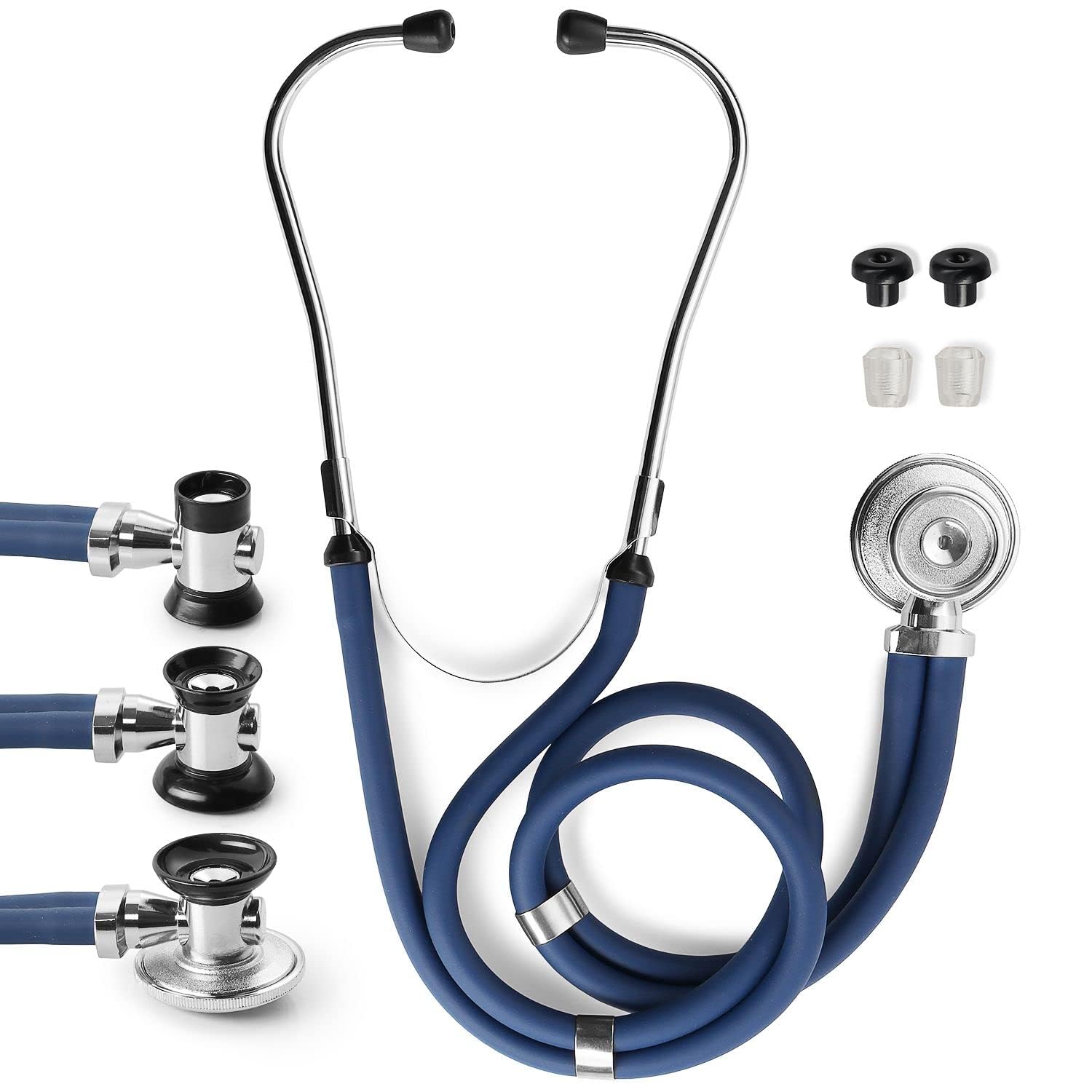
The PrimaCare DS-9295 is a Sprague Rappaport-style scope: two tubes, a rotating dual head, and a 30-inch length. That design is old-school, but it gives you a lot of reach and a chestpiece that can be turned to the patient's chest or back. The aluminum chestpiece is lighter than it looks, but the double tubing still makes it a presence around the neck.

We recommend it for budget blood-pressure work and as a spare scope for a clinic bag, not as an all-day neck companion. The double tube is bulky, and the included spare parts are the real draw: you get extra pieces without paying for a premium brand. The 30-inch length also helps when you are reaching across a bed or working around equipment.

Sound is serviceable for heartbeats and Korotkoff sounds, but it is not a subtle-sound scope. In a quiet room, it does the job; in a noisy hallway, it is outclassed by the Littmann picks. If you need a cheap second scope for blood pressures or a backup, it earns a look. If you need one scope for everything, keep looking.

Pros

  • Very low-cost Sprague design
  • 30-inch reach
  • Dual head rotates 360 degrees
  • Spare parts included

Cons

  • Earpieces can be uncomfortable
Our verdict

We recommend the PrimaCare Sprague for budget blood-pressure work and spare-parts convenience, not for nurses who need all-day ear comfort.

Check Latest Price
7

Style and Pediatrics

Scienlodic Double-Sided

89 /100
Trail Score Excellent

Key details

Tubing
Dual-lumen
Weight
6.7 oz
Chestpiece
Double-sided
Diaphragm Diameter
50/45 mm
Check Price on Amazon

The Scienlodic double-sided scope is the one for a nurse who wants a pink stethoscope that still does adult and pediatric work: the 50/45 mm chestpiece has a pediatric side that converts to an open bell when you remove the diaphragm and fit the non-chill rim. We like it as a style-forward secondary scope for a nurse who sees both adults and kids, not as the main critical-care tool.

The dual-lumen tubing is meant to cut the rubbing noise of a traditional double-tube scope, and the eartubes adjust for angle. In practice, we found it comfortable enough for short assessments, and the pediatric conversion is a genuinely useful feature on a busy clinic day. The pink finish is not a reason to buy on its own, but it is easy to spot in a drawer. The 6.7-ounce package is light enough to carry in a tote.

Sound is the risk. It is not as consistent as the Littmann picks, and in a noisy room it can be hard to hear a faint heartbeat. Check the return policy before making it a primary scope. For a style-forward backup or a pediatric-heavy clinic, it is a reasonable budget choice.

Pros

  • Double-sided adult and pediatric chestpiece
  • Dual-lumen tubing reduces rubbing noise
  • Pink finish is easy to spot
  • Pediatric side converts to open bell

Cons

  • Earpieces may be too large for smaller ears
Our verdict

We like the Scienlodic for nurses who want a pink, double-sided scope with pediatric conversion, as long as the eartips fit.

Check Latest Price

How We Picked and Tested Stethoscopes for Nurses

To build the shortlist, I started with what nurses actually carry, then narrowed by acoustics, tubing weight, tunable versus traditional diaphragms, replaceable eartips, and price, so the 12 we tested spanned budget to buy-it-for-a-career rather than clustering at one end.

None of the listening happened on a bench. Each stethoscope went onto the same colleague's chest and back, in the same spot, so we were hearing the difference between models and not between patients, and then we repeated it in a hallway with a linen cart rolling past to see which ones held up in noise. We also took blood pressures on each other and noted whether the Korotkoff sounds arrived clean and separate or blurred together, and whether the bell pulled out low-pitched sounds the diaphragm flattened.

Comfort got judged at hour eight, not minute five: we wore each one for a full shift and logged ear soreness, headset tension, whether the eartips kept their seal when we turned our heads, and how the neck felt by the end. Durability meant coiling and uncoiling the tubing, hanging it off a chair back, burying it in a tote with a water bottle and keys, and dropping it from waist height, then checking for kinks, cracking, and loose binaurics. We flipped between bell and diaphragm one-handed, with gloves on, mid-assessment, and weighed value by what came in the box, from spare eartips and replacement diaphragms to the warranty, plus whether the finish still looked new after a few weeks.

How to Choose a Nurse Stethoscope

Sound Comes From the Seal, Not the Badge

A stethoscope is an acoustic tool, and most of its clarity comes from a closed seal at the eartips and firm, quiet contact with the chestpiece. A premium chestpiece cannot rescue a loose tip or a tube rubbing against a badge reel. When you try a scope, listen in a quiet room first, then in the noisiest hallway you can find. The Classic III is our general reference for everyday sound; the Cardiology IV gives more headroom when subtle sounds matter.

Match the Chestpiece to Your Patient Mix

A dual-head or tunable chestpiece is the flexible choice for a nurse who moves between blood pressures, lung sounds, and general assessments. A true bell helps with low-frequency sounds; a diaphragm is better for higher frequencies. If you see children, a pediatric side or a convertible chestpiece saves you from carrying a second scope. The Scienlodic's pediatric side converts to an open bell, while the PrimaCare Sprague gives you a rotating dual head at a low cost.

If most of your day is critical care, spend on a cardiology-style chestpiece instead of accessories. If you mostly need a reliable general scope, a dual-head model is enough.

Weight, Length, and the Long Shift

Weight matters most in the last two hours of a shift. The Adscope 619 is the lightest scope here at 3.7 ounces; the Cardiology IV is 177 grams, and you feel the difference when it hangs around your neck. Tube length is a separate trade: 27 inches is easy to manage, while 30 inches gives more reach on a tall bed or around equipment. Neither is better in every room.

Try the scope on before you commit. A light scope with a tight headset can be less comfortable than a heavier one with a good seal.

Durability, Parts, and the Cost of Losing One

A stethoscope gets dropped, borrowed, and wiped down every day. Look for replaceable eartips, a spare diaphragm, and a warranty that covers parts. The MDF Acoustica includes a lifetime warranty and three pairs of eartips; the Adscope 619 includes free parts forever; the Paramed kit bundles the spares a student needs. Those extras matter more than a fancy finish.

A premium scope is worth it when the patient mix demands the extra sound, not because it looks more professional. If you tend to lose things, a good budget scope with replaceable parts is the smarter first buy.

Frequently Asked Questions

Final Verdict

Start with the Littmann Classic III if you want one stethoscope for general nursing. It has the best balance here of clear everyday sound, useful reach, and all-day wear, and it handles most adult and pediatric assessments without making you think about it. If you work in critical care, the Cardiology IV is the better tool. If you want the lightest scope on your neck, choose the ADC Adscope 619.