Best Sonic Toothbrushes of 2026

A sonic toothbrush isn't a magic wand, but it does make the two minutes you spend brushing feel more purposeful. High-frequency vibrations break up plaque while you guide the brush along your gumline, so the brush does more of the work than a manual one does. The catch is that the category is crowded with handles that buzz impressively and clean only so-so. A good one fixes the daily grind: it reaches the back molars, holds a charge through a week of normal use, and feels solid enough to keep on the counter for years.

I've used electric brushes for years, and over the past eight months my team and I lived with 12 sonic models, charging them, traveling with them, and passing them among family members with different brushing habits. We paid attention to the weird stuff, too: the taste of a new brush head, whether the settings felt meaningfully different, and whether the handle rattled against our teeth. The ones that earned a spot cleaned thoroughly, held their charge, and felt worth the money. The picks below are the ones we kept reaching for after the novelty wore off.

1

Best Overall

Aquasonic Black Series

91 /100
Trail Score Outstanding

Key details

Charging
Wireless charging base
Cleaning Modes
4
Brush Movements
40,000 VPM
Included Brush Heads
8
Check Price on Amazon

The Black Series earns its place with the least glamorous kind of advantage: it covers the basics without asking you to buy a starter kit. You get a 40,000 VPM motor, four cleaning modes, a two-minute smart timer, a wireless charging base, eight DuPont brush heads, and a travel case in one box. The ADA acceptance is the detail we kept coming back to, because it puts a recognized oral-care standard behind the brush rather than just a big vibration number.

In everyday use, that combination is easy to live with. The timer nudges you through a full session, and the four modes give you room to move beyond the default setting when you want a different pace. The controls are simple enough to use without a tutorial, which matters if you are upgrading from a manual brush.

Eight heads are the practical clincher. Each is designed to last three to four months, so the box covers a long stretch before you need to shop for replacements. In a category where heads can cost as much as the handle over time, that head count is a real part of the value, not just a number on the box.

The wireless base is a small pleasure: no exposed contacts to line up, and the handle sits securely between brushes. The travel case is basic, but it keeps the brush out of a toiletry bag. If you want the same idea with a smaller handle, the COSLUS C30 is easier to pack; the Black Series remains the better all-around brush.

Pros

  • ADA-accepted cleaning
  • Eight DuPont brush heads included
  • Four modes and smart timer
  • Wireless charging base and travel case

Cons

  • Longevity can be inconsistent
  • Strong vibration takes adjusting
Our verdict

The Black Series is the sonic brush we tell most adults to buy first: ADA-accepted cleaning, four modes, eight heads, and a travel case in one sensible package.
Check Latest Price
2

Best for Sensitive Gums

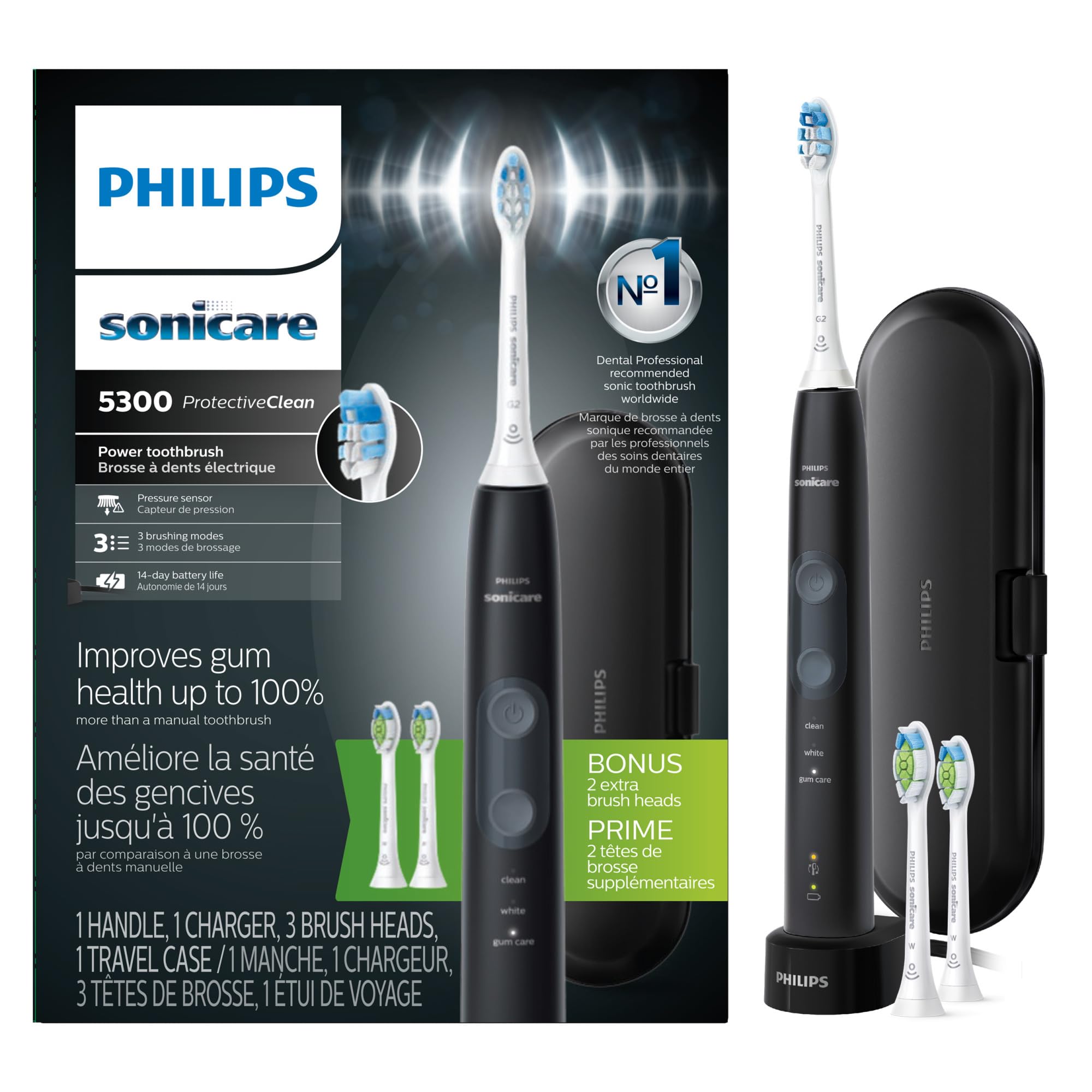
Philips Sonicare 5300

91 /100
Trail Score Outstanding

Key details

Battery Life
Up to 2 weeks
Cleaning Modes
Clean, White, Gum Care
Pressure Sensor
Yes
Included Brush Heads
3
Check Price on Amazon

A pressure sensor is one of those features that sounds like a gimmick until you catch yourself bearing down on a back molar. The 5300 pulses when you press too hard, and that cue is why we keep it in the sensitive-gums slot. The Gum Care mode and the three-mode setup are simpler than the feature lists on some rivals, but they cover the routines most people actually use.

The rest of the package is tidy: a two-minute Smartimer, QuadPacer prompts every 30 seconds, BrushSync head reminders, and up to two weeks of use on a charge. The three included heads are enough to get started, and the handle is easy to pair with the charger without lining up a fussy contact. We appreciated that the 5300 does not make you learn a complicated control scheme before you can brush.

Noise is the trade-off. This is a loud brush, and the handle's vibration can feel buzzy in the hand, especially in a small bathroom. If you brush while someone is sleeping, the 6500's extra intensity levels may help you find a gentler setting, but the 5300's gum protection remains the main draw. The real advantage is not the mode count; it is the habit the pressure cue builds.

Pros

  • Pressure sensor protects gums
  • Gum Care mode plus Clean and White
  • Up to two weeks per charge
  • BrushSync head reminder

Cons

  • Replacement heads are costly
  • Battery and durability are mixed
Our verdict

For tender gums, the 5300's pressure sensor and Gum Care mode make it the protective everyday brush we reach for ahead of the budget handles.

Check Latest Price
3

Best for Couples

Aquasonic Duo PRO UV

93 /100
Trail Score Outstanding

Key details

Brush Movements
50,000 VPM
Handles Included
2
UV Sanitizing Base
Yes
Included Brush Heads
10
Check Price on Amazon

A shared bathroom usually ends up with two chargers, two handles, and a tangle of cords. The Duo PRO UV replaces that with one dual inductive dock, two handles, two travel cases, and ten ProFlex brush heads. The UV sanitizing base is the extra that makes the set feel more deliberate than simply buying two brushes.

For couples, this is the most sensible set here. Each handle has its own color, both use the same dock, and the 50,000 VPM motor and five modes give you enough range for daily cleaning and a softer pass. The UV light is a nice hygiene touch, though we still rinse and air-dry the heads like any other brush. The ADA acceptance is another point in its favor.

The commitment is counter space. The dual dock is wider than a single charger, and the set costs more than two basic handles. If you have the shelf space and want one tidy setup, the Duo PRO UV earns it. The two travel cases are a thoughtful detail for couples who pack one bag and do not want to untangle chargers on the road.

Pros

  • Two handles and one dual dock
  • UV sanitizing base
  • Ten brush heads and two travel cases
  • 50,000 VPM and five modes

Cons

  • Mixed battery and durability
Our verdict

We think the Duo PRO UV is the tidiest shared-bathroom setup here: two handles, one dual charging dock, a UV sanitizer, and ten heads.

Check Latest Price
4

Best Budget

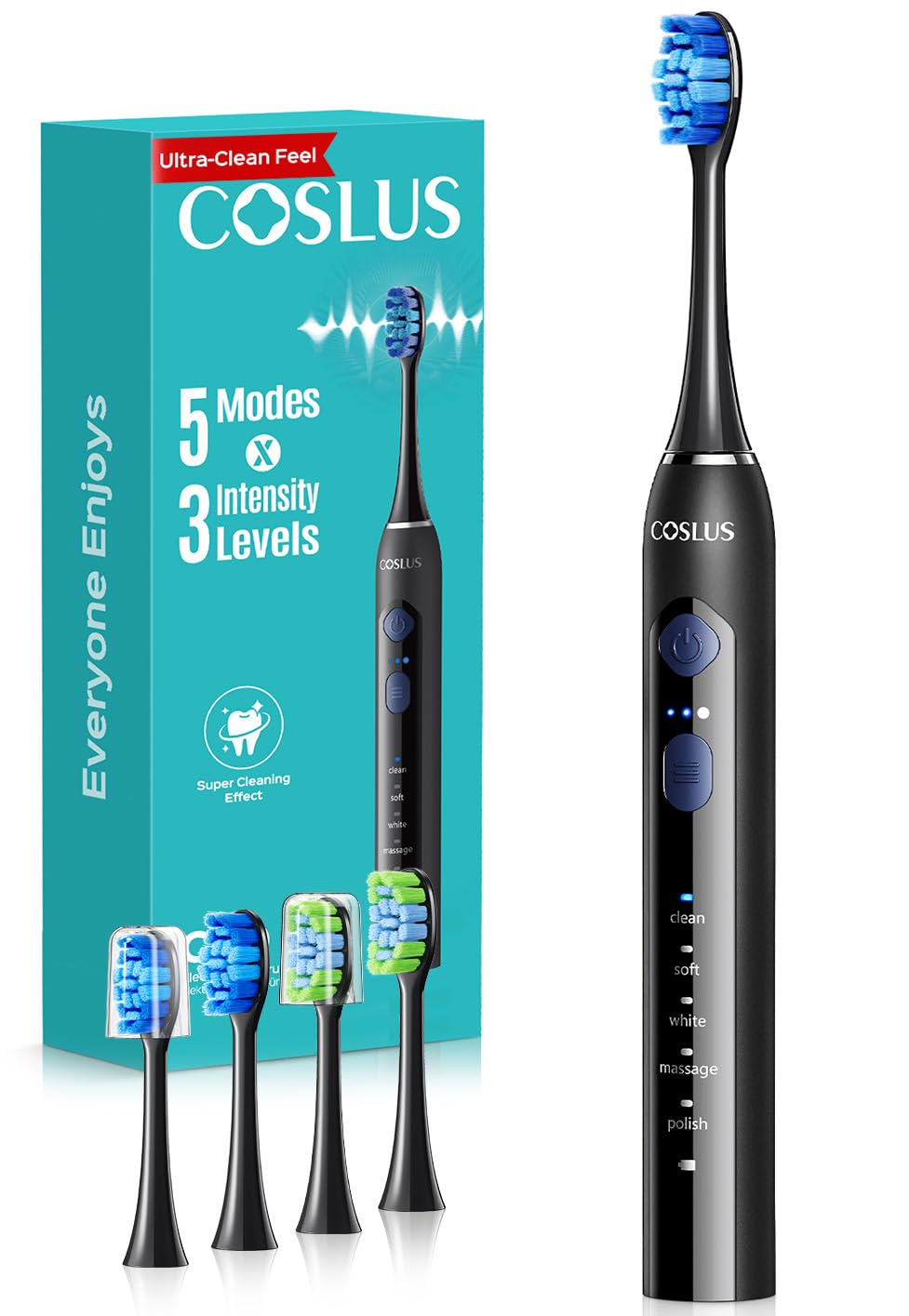
COSLUS C40

91 /100
Trail Score Outstanding

Key details

Cleaning Modes
5
Brush Movements
47,000 VPM
Waterproof Rating
IPX7
Included Brush Heads
6
Check Price on Amazon

The C40 is the budget brush we reach for when someone wants a full kit, not a bare handle. It pairs a 47,000 VPM motor with five modes, six brush heads, a travel case, and an IPX7 waterproof handle. For a family or a first sonic brush, that combination is more useful than a single premium feature.

The six heads are the quiet value story. At the usual three-to-four-month replacement pace, one person is covered for a long stretch, and a family can split them without immediately buying refills. The five modes give you options beyond a single default clean, and the IPX7 rating means you can rinse the handle under the tap without treating it like a delicate object.

The C40 is heavier than the compact C30, which makes it feel substantial but less nimble in a travel bag. If you have sensitive gums, the Philips 5300's pressure sensor is the more protective choice. For everyone else, the C40 is the value benchmark here. The travel case is simple, but it keeps the handle dry in a toiletry bag.

Pros

  • 47,000 VPM motor
  • Five modes and six brush heads
  • IPX7 waterproof handle
  • Travel case included

Cons

  • Strong vibration on high modes
Our verdict

The C40 is our budget pick for families: a 47,000 VPM motor, five modes, six heads, and a travel case make it a complete sonic setup.

Check Latest Price
5

Best for Whitening

Philips Sonicare 6500

93 /100
Trail Score Outstanding

Key details

Battery Life
14 days
Cleaning Modes
Clean, White, Gum Care
Brush Movements
Up to 62,000 per minute
Intensity Levels
3
Check Price on Amazon

The 6500 is the Sonicare for someone who wants the full routine: a pressure sensor, Clean, White, and Gum Care modes, three intensity levels, and a charging travel case. The feature set reads like a premium brush.

The 62,000 brush movements per minute are the headline, but the three intensity levels are what make the brush adaptable. We found the lower settings useful on days when our gums felt tender, while the White mode is the one to use if surface stains are your main concern. The pressure sensor still steps in if you lean too hard.

The charging travel case is the detail that separates it from the 5300. It protects the handle in a bag and lets you charge on the road, and the rated 14-day battery means you can leave the charger at home on a short trip. That is a meaningful convenience if you travel often, and a feature you will not miss if you do not.

This is the premium pick we recommend when whitening and travel are priorities. It costs more than the 5300, and replacement heads are expensive over time, so it makes the most sense for someone who will use the extra intensity settings and the case. If you just want a reliable sonic clean, the 5300 is the better-value route.

Pros

  • Three intensity levels
  • White mode and Gum Care mode
  • Charging travel case
  • Up to 62,000 movements per minute

Cons

  • Reliability record is mixed
Our verdict

When whitening and travel matter, we take the 6500: three intensities, a White mode, and a charging travel case make it the most polished brush here.

Check Latest Price
6

Travel

COSLUS C30

91 /100
Trail Score Outstanding

Key details

Length
7.16 inches
For Ages
12 and up
Cleaning Modes
5
Intensity Levels
3
Check Price on Amazon

At just over seven inches long, the C30 is the smallest handle in this group. That matters if your bathroom shelf is crowded or your toiletry bag is already full. It still packs five cleaning modes and three intensity levels, so you are not giving up adjustment for the smaller size.

The C30 is designed for ages 12 and up, which makes it a reasonable family spare or a brush for an older child who has outgrown a kids' model. The five modes and three intensities are more than we expect at this size, and the handle is light enough to travel without feeling like a brick in a wash bag.

The trade-off is that the C30 comes as a bare-bones kit compared with the C40. It does not match the C40's head count or the Philips 5300's gum-focused features. As a compact second brush or a travel backup, it earns its place; as an only brush for someone with sensitive gums, the Philips 5300 is the safer choice. The compact body also makes it easy to store in a medicine cabinet.

Pros

  • Five modes and three intensities
  • Compact 7.16-inch handle
  • Designed for ages 12 and up

Cons

  • Vibration can feel strong
Our verdict

The C30 earns its spot as our compact travel brush: five modes and three intensities in a handle just over seven inches long.

Check Latest Price

How We Tested 12 Sonic Toothbrushes

We started by scanning specs and owner reviews, then narrowed the field by brush-head size, replacement cost, and the features each handle actually offered—not just the modes printed on the box. We bought 12 models across price tiers and used them for eight months, rotating them among testers with sensitive gums, crowded teeth, and a bad habit of brushing too hard.

Most of the testing happened in ordinary bathrooms, not a lab. We brushed after coffee and breakfast, timed the two-minute cycles, and used plaque-disclosing tablets before and after a few sessions to see which bristles reached behind the molars and along the gumline. We ran every setting and noted whether the speed changes felt distinct or just louder, and we held each handle at each setting to judge whether the vibration felt controlled or harsh. We rated noise by standing a room away while each brush ran, and we asked testers to flag any plastic or rubber taste from new brush heads and whether toothpaste lingered differently on the bristles.

Battery life got its own log. We drained each handle completely, charged it to full, and counted days until the low-battery warning—including a week of two-person use and a weekend trip without the charger. For durability and reliability, we dropped each brush from counter height onto tile, rinsed and shook off the handles daily, and tracked any cracked heads, sticky buttons, random shutoffs, or charging faults. We also weighed brush-head replacement costs against handle quality, because a cheap brush that needs expensive heads isn't a value.

How to Choose a Sonic Toothbrush

Start With the Clean, Not the Vibration Count

Vibration numbers are the easiest thing to compare and the least useful thing to buy on. A 62,000-movement brush is not automatically twice as effective as a 40,000-VPM model; brush-head design, pressure control, and whether you actually use the timer matter more. We look for a handle that feels controlled in the mouth, a brush head that is easy to replace, and a two-minute timer that prompts you through all four quadrants. If two brushes clean well, choose the one with the head you can buy conveniently and afford to replace.

Match the Modes to Your Gums

More modes do not make a better brush if you never leave the default setting. For most adults, a clean mode, a gentler mode, and a two-minute timer are enough. If your gums bleed or feel tender, a pressure sensor is worth more than a long menu of modes: it warns you when you are pressing too hard instead of letting you scrub harder. The Philips 5300 is our sensitive-gums pick for that reason; the 6500 adds three intensity levels for people who want finer control.

Treat Charging as Part of the Routine

A two-week battery is convenient, but the charger matters just as much. A compact base that sits on the counter is fine at home; a travel case that charges the handle is better if you pack it often. Check the box for a wall adapter, because some rechargeable brushes include only a USB cord. If your bathroom has one crowded outlet, a dual dock like the Aquasonic Duo PRO UV can replace two chargers, provided you have the shelf space.

Price the Brush Heads, Not Just the Handle

The handle is the purchase; the heads are the subscription. A kit with six or eight heads can cover a year or more, while a premium handle with expensive refills costs more later. Count the included heads, check how often the maker recommends changing them, and look at replacement prices before you commit. Value is not the same as the lowest upfront price, and a brush that comes with a generous head count can be the cheaper long-term choice.

Plan for Longevity

Sonic toothbrushes are more likely to fail at the charging contact, battery, or seal than at the motor. That does not mean every handle will let you down, but it does mean the return window and warranty matter as much as the spec sheet. Buy from a seller with a straightforward return policy, keep the receipt, and register the product if the maker asks. If the housing cracks or water gets inside, stop using it rather than hoping the seal holds.

Frequently Asked Questions

Final Verdict

For most adults, the Aquasonic Black Series is the sonic toothbrush we recommend. It has ADA acceptance, a 40,000 VPM motor, four modes, eight heads, and a travel case, and it delivers the everyday clean most people need without premium pricing. If your gums are sensitive, the Philips Sonicare 5300's pressure sensor is the better fit. For a shared bathroom, the Aquasonic Duo PRO UV is the tidy two-handle answer.