Best Sinus Rinse Kits of 2026

The first squirt of salt water up your nose is a leap of faith — every instinct says this isn't what nostrils are for. Then the pressure that's been sitting behind your eyes for a week loosens, and you can breathe through both sides again. A good kit makes that leap easy: a bottle that doesn't glug or blast, a packet that dissolves clear instead of leaving grit, a tip that seals without pressing hard enough to sting. The wrong one turns a two-minute routine into a wet-shirt argument with your own face.

I've kept a rinse bottle on my sink ledge through two allergy seasons, and our team has spent the past four months with 12 kits — morning rinses, cold-season congestion, and the pollen haze after a long walk. The thing nobody tells a first-time buyer is that the water matters as much as the kit: distilled or previously boiled, every time, no shortcuts from the tap. The ones that earned a spot below mixed clean, sealed comfortably, and were still going strong in month four.

1

Best Overall

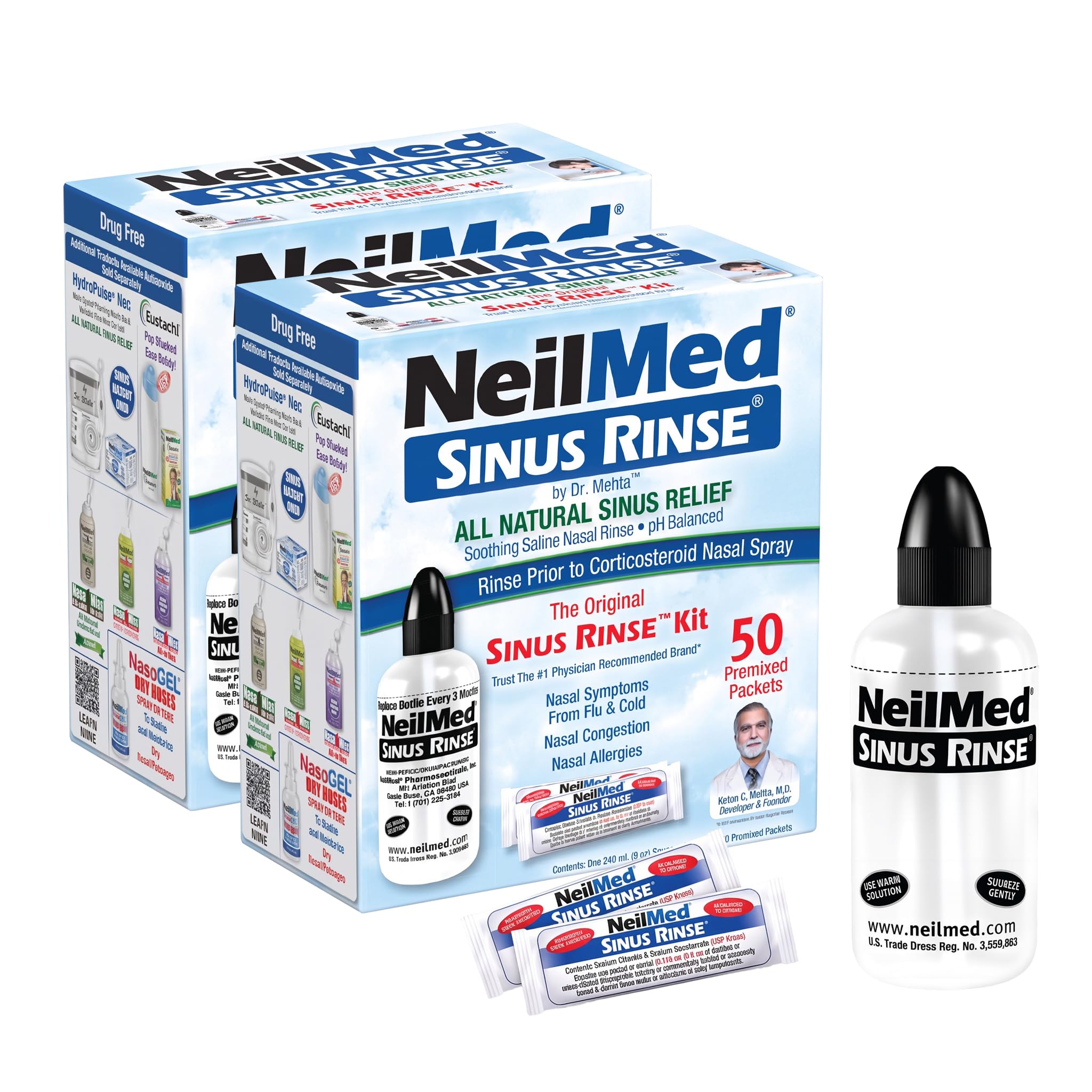
NeilMed Sinus Rinse Complete Kit

95 /100
Trail Score Outstanding

Key details

Saline
50 packets per pack, 2-pack
Delivery
Squeeze bottle
Solution
pH-balanced isotonic, preservative-free
Dimensions
6.25 x 5.75 x 2.5 in
Check Price on Amazon

The argument for a squeeze bottle over a neti pot is control, and it is why this is the kit we hand to most people. You fill to the line, add a packet, and squeeze: the pressure is set by your hand, so you can ease off the moment a stream feels like too much and pick it up again when you are ready. For a first rinse, with your head tilted over the sink and no idea what to expect, that matters more than anything printed on the box.

The packets do the quiet work. They are pH-balanced, isotonic and buffered, free of preservatives and iodine, which is the difference between a rinse that feels like warm salt water and one that stings. It arrives as a two-pack — a complete kit with 50 packets in each — and that is more useful than it sounds: one bottle per person in the house, or a spare that is already dry while the other air-dries on the counter. The box is listed at 6.25 by 5.75 by 2.5 inches, small enough to live in a cabinet rather than on the sink.

The routine is simple once you have done it twice: lukewarm water rather than cold, the full volume the bottle calls for, then wash the bottle and tip, shake them out, and stand both open to dry. Sealing a damp bottle in a cabinet is how these kits start to smell. Fifty packets per bottle is a long runway, which is why the two-pack suits a household better than a single rinser.

Pros

  • Squeeze bottle puts the pressure under your hand
  • Buffered, pH-balanced packets that do not sting
  • Two complete kits in one order

Cons

  • No temperature strip or pressure gauge on the bottle
Our verdict

For most people this is the kit to start with: a squeeze bottle you steer by hand, buffered packets that do not sting, and two complete kits in one order.

Check Latest Price
2

Best for Tap Water

SinuCleanse Soft Tip Micro-Filtered Kit

91 /100
Trail Score Outstanding

Key details

Water
Certified filter for tap water
Saline
30 buffered packets
Delivery
Soft tip with built-in filter
Dimensions
3.8 x 3.6 x 6.3 in
Check Price on Amazon

Distilled water is the hidden chore of nasal rinsing. Anyone who rinses daily goes through a lot of it, and the jugs are heavy, awkward to store, and the first thing you forget to buy.

This is the kit we point at people who already know they will rinse every day. SinuCleanse built a certified water filter into the device — one the maker says reduces the risk of harmful cysts and meets the CDC's recommendation for safe rinsing water — so you can fill from the tap at whatever temperature you like instead of boiling a kettle and waiting for it to cool. That last part is the underrated half: the water you want is lukewarm, and a filter lets you get there in seconds.

The rest of the kit is the familiar SinuCleanse package: a soft tip that seals against the nostril without pressing hard, 30 buffered, pharmaceutical-grade saline packets, and BPA- and latex-free construction. The saline is made in the U.S. in an FDA-registered facility, a detail that matters more when the powder is going up your nose.

The filter is the whole argument. If you already keep distilled water on hand and do not mind heating it, the maker's unfiltered soft-tip kit rinses just as well for less money. If the water errand is the thing that would stop you after a week, this is the version to buy.

Pros

  • Certified filter makes tap water safe to rinse with
  • Soft tip seals comfortably against the nostril
  • 30 pharmaceutical-grade buffered packets included

Cons

  • Clear plastic can crack around the tip over time
Our verdict

Worth the premium if you rinse every day: the built-in filter turns tap water into a safe rinse, so you stop hauling distilled gallons home.

Check Latest Price
3

Best for Beginners

MAOEVER Neti Pot Rinse Bottle

93 /100
Trail Score Outstanding

Key details

Capacity
300 ml
Delivery
Valve button, no squeezing
Included
30 packets, temperature sticker
Dimensions
2.76 x 4.33 x 6.3 in
Check Price on Amazon

Squeezing a bottle through a full rinse sounds trivial until your hands are arthritic, or until you are concentrating so hard on the angle of your head that you forget to keep squeezing. MAOEVER takes the squeeze out of it: you press a valve button at the bottom of the bottle and the water moves on its own.

The valve does two jobs. It holds the flow at a steady rate instead of alternating a weak trickle with a blast, and a one-way anti-backflow valve keeps used water from draining back into the bottle. The bottle is BPA-free polypropylene and holds 300 ml, enough for both nostrils without refilling, and the box includes 30 individually sealed saline packets and a stick-on temperature strip.

Where it earns its place is the two things it removes: grip strength and the guessing. Of the budget kits here, this is the one we reach for when someone says a squeeze bottle makes their hands ache, and the temperature strip is the detail we appreciated most — you are aiming for body temperature, and the strip tells you when you are close without hunting for a thermometer.

The learning curve is all in the angle rather than the device. The first couple of attempts take a minute of tilting before the water goes where you want it, and after that it is routine.

Pros

  • Valve button means no squeezing at all
  • Anti-backflow valve keeps used water out of the bottle
  • 300 ml covers both nostrils in one fill
  • Temperature strip takes the guesswork out of the water

Cons

  • Flow rate is fixed once you press the button
Our verdict

The easiest kit here for aching hands or a nervous first attempt: press a valve and the rinse moves at its own steady pace.

Check Latest Price
4

Best for Kids and Families

Waterpulse Neti Pot 300ml Kit

93 /100
Trail Score Outstanding

Key details

Nozzles
2, adult and kids
Capacity
300 ml
Delivery
Valve-button gravity flow
Included
30 packets, temperature sticker
Check Price on Amazon

Two nozzles is what puts this one ahead of the other valve bottles here for a household. The wide-spray tip is shaped for adult noses; the mist tip is gentler and meant for a child's, and having both in one box means you are not buying a second kit just to find out whether your kid will tolerate a rinse at all.

The rest is a 300 ml bottle with a patented valve button at the bottom: press it and the saline runs in a steady stream without any squeezing. The saline is pH-balanced and drug-free, everything is BPA-free, and the box includes 30 individually wrapped packets and a stick-on temperature strip that points you toward 37 C, or 98.6 F — body temperature, which is where a rinse stops feeling like a shock. At 7.09 by 3.94 by 1.97 inches it lies flat in a bathroom drawer.

The children's tip is the reason to buy it; the reason not to expect magic is that a rinse is still a rinse, and a child who hates water up their nose will not love it in mist form either. Give it a week of short attempts before you decide, and let them watch you go first.

Pros

  • Adult and child nozzles in a single kit
  • Valve button gives a steady stream without squeezing
  • Temperature sticker targets body temperature

Cons

  • You cannot ease off mid-rinse, only stop and start
Our verdict

The kit we point families to: a 300 ml bottle, an adult nozzle and a child's mist nozzle, and enough packets to find out whether the habit sticks.

Check Latest Price
5

Best Traditional Neti Pot

Himalayan Chandra Neti Pot Starter Kit

92 /100
Trail Score Outstanding

Key details

Salt
Jar with scoop, plus Neti Wash Plus
Cleaning
Dishwasher safe
Delivery
Gravity-flow neti pot
Dimensions
5.5 x 3.75 x 8 in
Check Price on Amazon

There are no foil packets in this box. Himalayan Chandra gives you a jar of salt with a scoop and a bottle of Neti Wash Plus alongside the pot, so a bad week does not leave you tearing open the last sachet and ordering more at midnight.

The pot itself is the oldest design here: fill it from the jar, tip your head to one side, breathe through your mouth, and the saline runs in through the upper nostril and out the lower. No valve, no batteries, nothing to assemble. At 5.5 by 3.75 by 8 inches it wants a corner of a shelf rather than a drawer.

Dishwasher safe is the line that keeps this one in the guide. Among the kits here, it is the one that goes in the machine instead of getting a hand rinse and a hope, and over months of daily use that is the difference between a routine you keep and one you quietly abandon. The trade-off is measuring: a scoop of salt instead of a torn packet, slower and less forgiving on a rushed morning, though the jar never runs out mid-week the way a box of packets does.

Pros

  • Salt comes as a jar, not a dwindling box of packets
  • Pot is dishwasher safe
  • Nothing to assemble or prime before a rinse

Cons

  • No way to adjust the flow while you rinse
Our verdict

For anyone who wants the old ritual — a gravity pot, a jar of salt, and parts that go in the dishwasher — this starter kit is genuinely complete.

Check Latest Price
6

High-Volume Rinsing

Medi Grade Sinus Rinse Bottle

91 /100
Trail Score Outstanding

Key details

Capacity
500 ml
Delivery
Stop-flow valve bottle
Included
30 double-size packets, 2 tips, travel bag
Dimensions
7.68 x 4.13 x 3.23 in
Check Price on Amazon

Five hundred milliliters is roughly double what most of the bottles here hold, and that changes the routine: one fill covers both nostrils with water to spare, so you are not standing at the sink refilling halfway through with your head tilted and water running down your wrist.

For a budget kit, the capacity is the story — 500 ml against the 300 ml of the other bottles we picked, a stop-flow valve so the water pauses when you do, two tips, and a fabric bag that holds a month of packets. The bag is the piece we did not expect to care about: packets stay together in a drawer, and they travel without scattering through a suitcase.

The packets need a note. They are double-sized, enough for a full 16 oz bottle, which suits this one and would overpower a 300 ml bottle, so keep each kit's own packets with it. And a month's supply assumes one rinse a day: at twice daily, 30 packets covers two weeks, not four.

Pros

  • 500 ml covers both nostrils with water to spare
  • Stop-flow valve lets you pause without pulling out
  • Travel bag keeps a month of packets together

Cons

  • More water to warm and more to pour away if you stop
Our verdict

The most capacity for the money here: a 500 ml bottle, a stop-flow valve, two tips, a travel bag, and 30 double-size packets.

Check Latest Price

How We Tested a Dozen Sinus Rinse Kits

We read the instructions and packet ingredients on every kit we could find, then cut the list to 12 — squeeze bottles, gravity-fed pots, and a couple of pressurized options — deliberately spread across price points so we weren't only testing the expensive end. Each one got four months, and each one got used the way people actually use them: over the bathroom sink after a morning shower, standing at the mirror before bed, and through two head colds that hit our testers mid-winter. One traveled in a carry-on for a long weekend.

Ease of use was easy to judge because it annoyed us when it failed. We counted how long a packet took to dissolve in the amount of water the kit specified, and whether powder was still sitting at the bottom of the bottle when the rinse was finished. We timed a full squeeze or a full pot and noted whether the stream flooded the back of the nose, dribbled down the chin, or came out the other nostril the way it's supposed to. Fill lines got checked again in week six, after the bottles had been washed as directed and left to air-dry.

We kept a log of how quickly breathing got easier after each rinse and whether that lasted past the next hour, since that's the whole point. Testers noted stinging around the nostril rim, redness that lingered, and which tips needed firm pressure to seal — the hypertonic packets and hard plastic tips drew most of the complaints. For value, we divided the price of a box of packets by the number of rinses it held and weighed that against the bottle's cost. Durability got tested by ordinary life: soft bottles that lost their spring, caps that cracked, seams that split, and packets that clumped in a humid bathroom.

How to Choose a Sinus Rinse Kit

Pressure: Squeeze, Valve, or Gravity

Every kit here delivers saline one of three ways, and the choice decides how the first week feels. A squeeze bottle such as the NeilMed puts the pressure under your hand, so you can ease off mid-rinse. A valve bottle like the Waterpulse holds a steady flow so you never squeeze at all, which suits weaker hands. A gravity pot lets the water fall at its own pace with no input from you.

There is no best in the abstract. Choose squeeze for control, valve for effortlessness, gravity for the fewest parts to clean.

The Water Comes Before the Device

This is the part people get wrong. Rinsing with untreated tap water is the one genuine hazard in the whole routine, which is why every maker tells you to use distilled, sterile, or boiled-and-cooled water — or to buy a device with a certified filter built in, as SinuCleanse does with its micro-filtered kit.

If you rinse daily, do the arithmetic on your water supply before you choose the kit. A filter costs more upfront and saves a weekly errand; a plain bottle costs less and commits you to buying water.

Packets, Jars, and the Recurring Cost

Saline is where the money goes over time. Pre-measured packets are the simplest and least error-prone — tear, pour, done — but they are consumable and they run out, often mid-cold. A kit with a jar of salt and a scoop, like the Himalayan Chandra starter set, never runs dry but asks you to measure each time.

Match packet size to bottle size as well. Medi Grade's double-size packets suit its 500 ml bottle and would be far too strong tipped into a 300 ml one.

Comfort at the Nose and the Angle

Two things make a rinse comfortable: a tip that seals against the nostril without pressing hard, and saline at body temperature. SinuCleanse's soft tip gives the gentlest seal in this group, and the stick-on temperature strips on the MAOEVER and Waterpulse bottles exist because lukewarm water is the difference between soothing and stinging.

The other half is technique, and it is the same on every device: tilt your head, keep your mouth open and breathe through it, and let the water travel across rather than up.

Cleaning, Drying, and When to Ask First

Every kit here wants the same aftercare: rinse the bottle and tip with clean water, shake out the excess, and stand both open to dry rather than sealing a damp device in a cabinet. Dishwasher-safe parts, as on the Himalayan Chandra pot, make that routine shorter.

Ask a clinician before you start if you have had recent nasal or sinus surgery, and get pediatric guidance before rinsing a young child who needs help holding still.

Frequently Asked Questions

Final Verdict

The NeilMed Complete Sinus Rinse Kit is what we tell most people to buy: a squeeze bottle that keeps the pressure under your hand, buffered packets that do not sting, and a second complete kit in the box so two people can rinse without waiting for a bottle to dry.

If you rinse daily and resent hauling distilled water home, the SinuCleanse micro-filtered kit is the upgrade worth paying for. And if a child will be rinsing too, start with the Waterpulse — two nozzles, one bottle, no second purchase to find out whether the habit sticks.