Best Pain Relievers for Arthritis of 2026

The first sign usually isn't a diagnosis. It's a jar lid that won't budge, or a hand that doesn't want to close around a mug at seven in the morning. Arthritis pain is stubborn, it migrates, and it behaves differently in a knuckle than it does in a knee — so the shelf in front of you looks the way it does. What you actually want is narrower: relief that arrives quickly, holds long enough to matter, and doesn't leave you with a sour stomach, a menthol haze, or a tube that expired in a drawer two winters ago.

I've stood in that aisle at 11 p.m. more than once. Over the past three months, my team and I have run 16 pain relievers — tablets, chewables, gels, creams, patches — past a panel of people with arthritis in their hands, knees, and lower backs, and used them ourselves. The surprise was how much format matters: the warming options aren't automatically the stronger ones, and the priciest bottle isn't the one that lasted longest. Below, the ones worth keeping within reach.

1

Best Overall

Tylenol 8-Hour Arthritis Caplets

96 /100
Trail Score Outstanding

Key details

Form
Extended-release caplet
Count
100 caplets
Relief Duration
Up to 8 hours
Active Ingredient
Acetaminophen 650 mg
Check Price on Amazon

Eight hours is the number that decides this one. Arthritis pain isn't a headache you treat and forget — it's the background ache that determines whether you take the stairs — and a dose that lasts from breakfast to dinner means you stop negotiating with it at 2 p.m. The 650 mg caplets are built in two layers, so part of the dose gets working and the rest releases over the hours after. We noticed the difference most on long days away from home, when a second dose simply wasn't going to happen.

Acetaminophen isn't an NSAID, which is the whole reason we reach for this one for daily use. It doesn't carry the stomach-bleeding risk that naproxen and aspirin do, and it won't irritate your stomach the way ibuprofen can. What it also won't do is reduce inflammation, so a hot, puffy joint is a job for the NSAID options further down this list. The other ceiling is the liver: acetaminophen turns up in cold and flu products, sleep aids, and plenty of combination pills, and the daily total is what counts. We read the label of anything else we're taking before adding a dose.

The 100-count bottle is the part we mind. At a couple of doses a day it empties quickly, and the store-brand version below puts four times as many caplets in one bottle. What keeps us on the Tylenol is how legible the whole package is: the label names arthritis, the eight hours are printed right there, and the two-layer release explains itself. For something you might take most days for years, that plainness counts for more than it sounds like it should.

Pros

  • Up to eight hours from one dose
  • No NSAID stomach-bleeding risk
  • Labeled specifically for arthritis pain

Cons

  • Won't reduce swelling or inflammation
  • 100-count bottle empties quickly
Our verdict

The one we recommend first: 650 mg of extended-release acetaminophen that holds a workday without the stomach cost of a daily NSAID.
Check Latest Price
2

Best Topical Gel

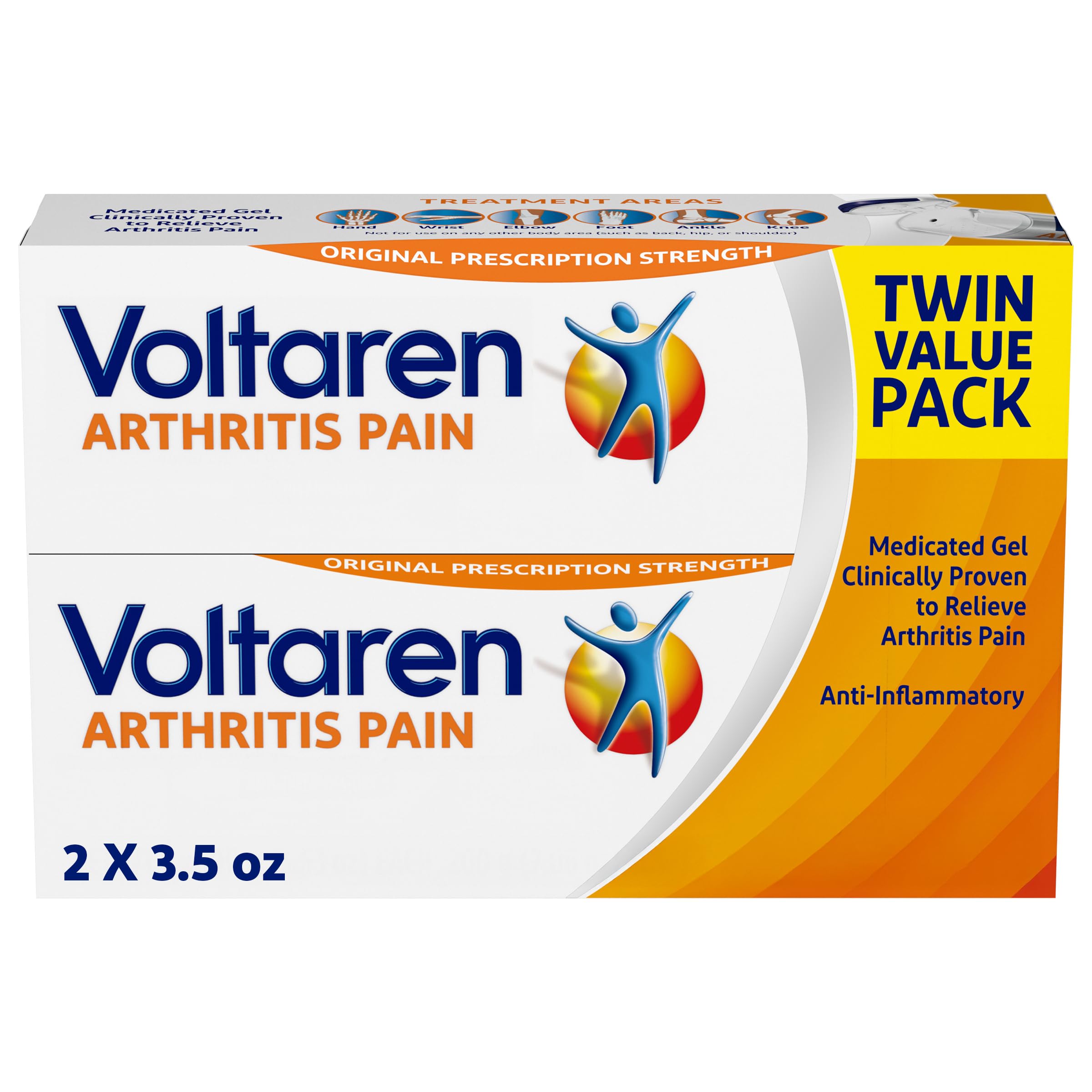
Voltaren Arthritis Pain Gel

93 /100
Trail Score Outstanding

Key details

Size
100 g tubes, 2 pack
Format
Topical gel
Application
4 times daily, 2 joints max
Active Ingredient
Diclofenac sodium 1%
Check Price on Amazon

Four times a day, two joints at most, and up to a week of steady use before the full effect arrives. Those directions are the least attractive thing about this gel, and they're the reason people give up on it before it has a chance to work. Better to know that before you open the box than to expect a rub-on version of a pill. What you get in exchange is diclofenac delivered into the joint itself, with far less of the drug reaching the rest of your body than a swallowed NSAID.

For a knee that complains on stairs, or a hand that's stiff before your first coffee, the trade is worth making. The gel spreads easily and sinks in fast — faster than most creams we've tried — and the scent is mild enough that nobody across a desk will identify it. Two things make the routine survivable: wash your hands right after applying, or your palms stay tacky for a while, and keep the second tube wherever you actually spend your day so a missed application doesn't become a missed day.

The store-brand diclofenac further down this list is the same 1% concentration in a bigger tube, and it's the one to buy once the routine has stuck and you want to spend less per gram. What keeps the brand-name gel as our first recommendation is the feel of it. It's the pleasanter of the two to apply four times a day, and four times a day is a lot of chances to decide you dislike something.

Pros

  • Delivers diclofenac straight into the joint
  • Far less drug reaches the rest of the body
  • Mild scent and fast absorption
  • Two tubes, so one can stay in a bag

Cons

  • Skin irritation or rash at the site
  • Costs more per gram than generic diclofenac
Our verdict

The one to try if the pain lives in one knee or hand and you want to skip the pill bottle — just plan around four applications a day.

Check Latest Price
3

Best Value

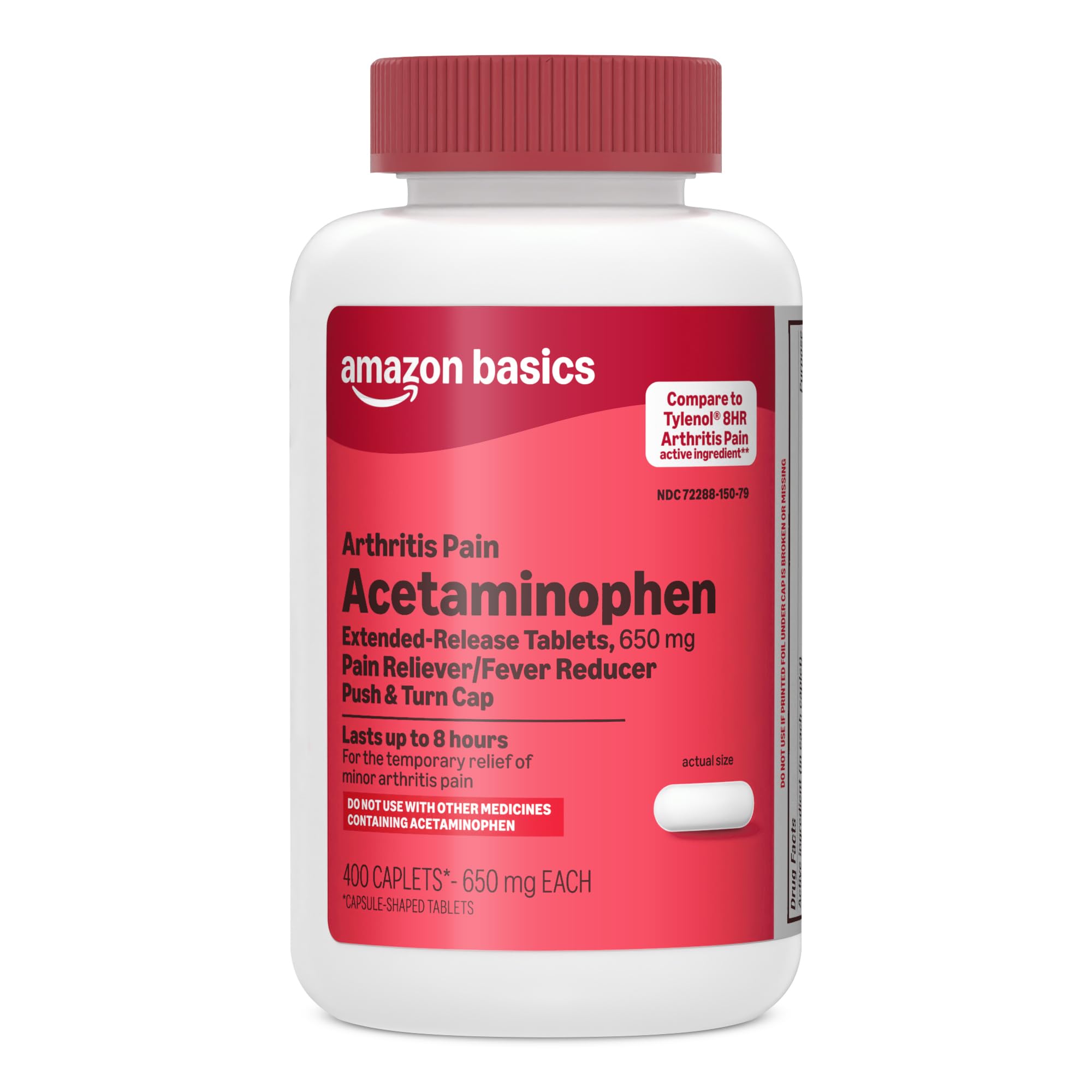
Amazon Basics Acetaminophen ER

96 /100
Trail Score Outstanding

Key details

Cap
Child-resistant push-and-turn
Count
400 caplets
Relief Duration
Up to 8 hours
Active Ingredient
Acetaminophen 650 mg
Check Price on Amazon

The drug is identical to our top pick: 650 mg of extended-release acetaminophen, labeled for the same minor arthritis pain. What's different is the bottle, and the bottle is the whole point. Four hundred caplets at a couple of doses a day covers months, which changes the arithmetic of a daily habit more than the price on the label does.

Mostly you're giving up polish. The tablet is a plain caplet with a child-resistant push-and-turn cap, no two-layer story, and packaging that looks exactly like what it is. The cap is the part we noticed first, because press-down-and-twist is the motion bad hands are worst at; if your grip is the problem, the Aleve bottle with the cushioned easy-open cap is the more considerate design and worth the difference. The caplets themselves go down without drama.

The other thing worth knowing is duration. Relief can thin out before the eight hours are up, and extended-release acetaminophen is a target rather than a promise — how long it holds depends on the day, the joint, and how much you're asking of it. We treat the eight hours as the outer edge. Two bottles in, what we didn't expect is how quickly the plain white bottle stopped feeling like a compromise.

Pros

  • Same 650 mg extended-release dose as our top pick
  • 400 caplets last months
  • Aspirin-free and gluten-free

Cons

  • Child-resistant cap is awkward with stiff hands
  • Relief can thin out before eight hours
Our verdict

Buy this one if you already know extended-release acetaminophen works for you — same drug and dose as our top pick, in a bottle that lasts.

Check Latest Price
4

Best for Stiff Hands

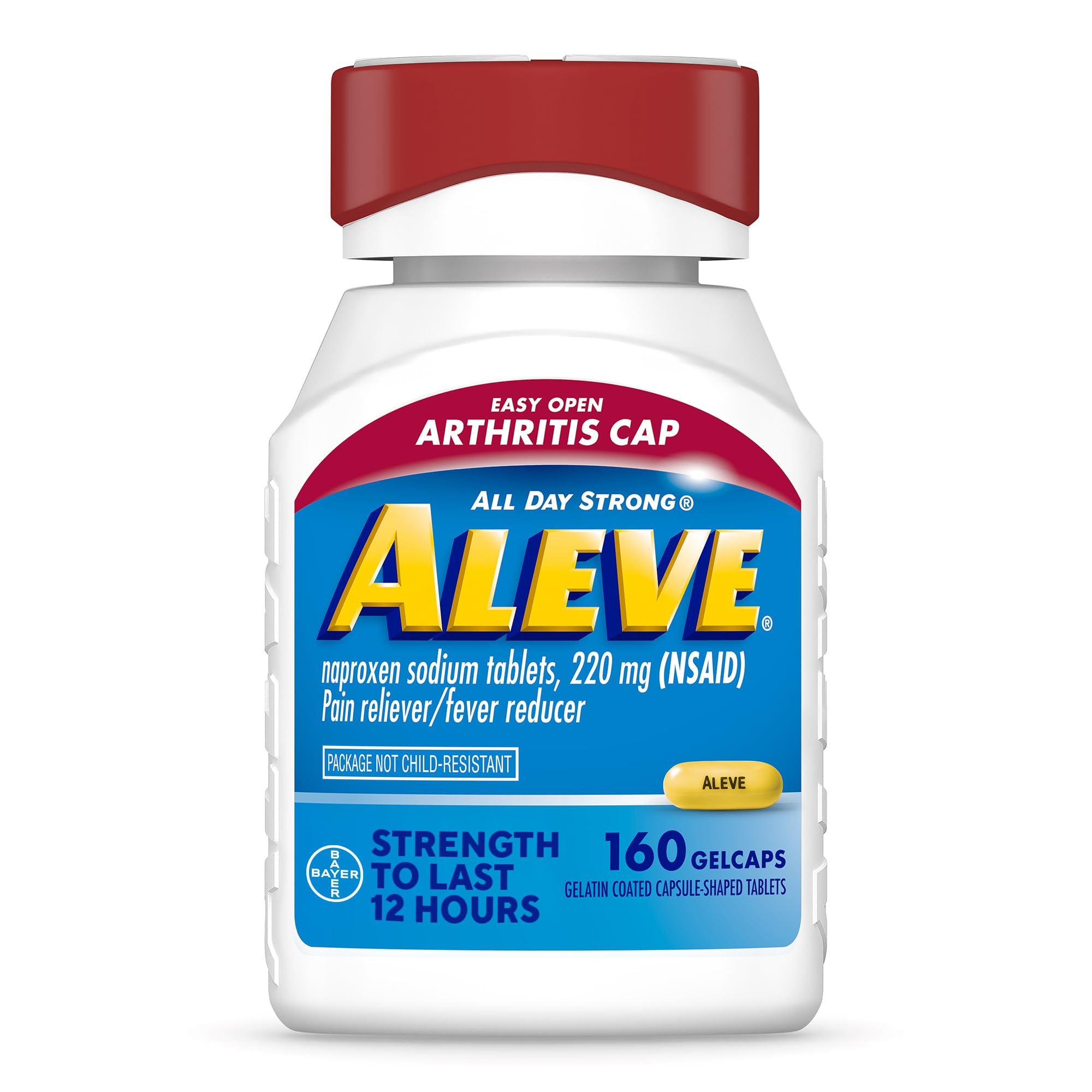
Aleve Gelcaps Easy Open

96 /100
Trail Score Outstanding

Key details

Cap
Easy-open cushioned
Count
160 gelcaps
Relief Duration
Up to 12 hours
Active Ingredient
Naproxen sodium 220 mg
Check Price on Amazon

The cap is the reason to look twice at this bottle. It's cushioned, the bottle is contoured to fit a palm, and it opens without the press-down-and-twist that a standard child-resistant closure demands — which is precisely the motion sore thumbs are worst at. Naproxen is the drug doing the work here, but the packaging is what makes it usable on a bad morning, and no other bottle on this list is designed around that problem.

Twelve hours is the rest of the argument. A dose in the morning and a dose at night covers a full day, and because naproxen is an NSAID it goes after the inflammation behind a swollen knuckle rather than only the pain signal. That's also the caution: NSAIDs carry stomach and bleeding risks that acetaminophen doesn't, so this isn't the bottle to reach for casually if you take a blood thinner or have a history of ulcers. Settle that with a pharmacist once and it stops being a question.

What you pay for the name is real. The store-brand naproxen below is the same 220 mg of the same drug in a bottle holding nearly twice as many tablets, and it costs less per dose. We still keep the Aleve in the house, because the cap matters more to us than the savings, and because a gelcap slides down easier than a dry caplet when you're in a hurry. What settles it is the two seconds it takes to get this bottle open at six in the morning, before the coffee, when your hands are at their worst.

Pros

  • Easy-open cushioned cap for stiff hands
  • Up to 12 hours per dose
  • Gelcaps are easy to swallow
  • Eases inflammation, not just pain

Cons

  • Costs more per gelcap than store-brand naproxen
Our verdict

Twelve hours of naproxen in a bottle designed for arthritic hands — the one we point to when a standard child-resistant cap is the real barrier.

Check Latest Price
5

Best Budget NSAID

Amazon Basic Care Naproxen

96 /100
Trail Score Outstanding

Key details

Form
Capsule-shaped tablet
Count
300 tablets
Relief Duration
Up to 12 hours
Active Ingredient
Naproxen sodium 220 mg
Check Price on Amazon

Store-brand naproxen gets the same question every time: is it the same pill? It is — 220 mg of naproxen sodium, the same strength and the same twelve hours, in a bottle holding nearly twice as many tablets as the gelcaps above. Once you know naproxen suits you, the only remaining question is packaging, and this is the packaging that costs least.

What you give up is the cushioned easy-open cap and the gelcap coating. These are plainer capsule-shaped tablets, and getting one down without water is a chore whether your hands are stiff or not; keep a glass nearby and it stops mattering. The count is the real luxury. This bottle sits in a cabinet for a long stretch, so you're not reordering every few weeks.

Where it earns its place is a household with one regular naproxen user and a cabinet with room. You aren't buying a nicer experience than the name brand; you're buying the same chemical in a bigger box, and for something taken most days that's the only comparison that matters. Check the date stamp when the bottle arrives, since bulk bottles sometimes ship with a shorter runway than you expect — if it's close, return it unopened and reorder. Otherwise it goes on the shelf and gets thought about twice a year.

Pros

  • Same 220 mg naproxen as the name brand
  • 300 tablets per bottle
  • Lowest cost per tablet of the NSAIDs here
  • Gluten-free formula

Cons

  • Capsule-shaped tablets rather than gelcaps
Our verdict

The same 220 mg of naproxen sodium as the name brand in a 300-count bottle — the sensible buy for anyone already comfortable with an NSAID.

Check Latest Price
6

Diclofenac Refills

HealthCareAisle Diclofenac Gel

93 /100
Trail Score Outstanding

Key details

Size
150 g tube
Application
4 times daily, up to 21 days
Active Ingredient
Diclofenac sodium 1%
Check Price on Amazon

A 150 g tube holds half again as much gel as a standard 100 g one, and at four applications a day that difference shows up fast: a tube runs out mid-week and the routine collapses with it. The active ingredient is identical — diclofenac sodium 1%, same four-times-a-day limit, same two-joint ceiling, same instruction to stop if your skin reacts.

What it isn't is as pleasant to use. The gel smells of rubbing alcohol rather than anything designed, and the tube is a plain white one that's harder to read in a dim bathroom. Neither affects the drug, and neither is something you think about after the first few days. Patch-test on your forearm before committing to a knee, though — topical diclofenac can irritate skin, and finding that out on a joint you're treating four times a day is worse than finding it out on a wrist.

Set against the brand-name gel, the trade is simple: same drug, more of it, lower cost per gram, slightly worse experience getting it on. We keep a tube of this in the bathroom and a tube of Voltaren in a bag, and between them the running-out problem disappears entirely.

Pros

  • 150 g tube, half again the standard size
  • Same 1% diclofenac as the brand-name gel
  • Lower cost per gram

Cons

  • Tubes can arrive with a short shelf life
Our verdict

A bigger tube of the same 1% diclofenac for less per gram — the refill to buy once you know the four-times-a-day routine suits you.

Check Latest Price
7

Evening Stiffness

Sombra Warm Pain Relief

93 /100
Trail Score Outstanding

Key details

Size
8 oz tubes, 2 pack
Scent
Orange
Format
Warming gel
Check Price on Amazon

Warm first, then a cool edge underneath, with an orange scent that doesn't smell like medicine. That combination is why this gel has the following it does: it's the most pleasant thing on this list to put on your skin, and for something you use most evenings, pleasant is not a small thing. It's alcohol-free and non-greasy, so it doesn't sting a patch that's already irritated or leave a film on your hands.

It isn't an NSAID, and we're careful about that distinction. The camphor and menthol go after the sensation of pain — they make a stiff joint feel looser and a sore muscle feel quieter — but they don't reduce inflammation in a knuckle that's genuinely swollen. We use it last thing before bed, and on days when the problem is stiffness rather than swelling. For a puffy joint, reach for the diclofenac instead.

The catch is the format. It comes as two 8 oz tubes, which is more gel than one person gets through quickly; split the pack with someone who also has a bad knee and it makes a lot more sense. The scent is the other thing to plan around — it's lovely, and it's strong enough that we save this one for evenings at home rather than a morning before the office.

Pros

  • Warming and cooling in one application
  • Pleasant orange scent, non-greasy
  • Alcohol-free, so it doesn't sting
  • Two 8 oz tubes per pack

Cons

  • Sold only as a two-pack
  • Priciest rub in this group
Our verdict

The rub we reach for at the end of a long day, when the joint is sore and stiff rather than swollen — warming, cooling, and unmistakably orange.

Check Latest Price
8

Budget Warming Relief

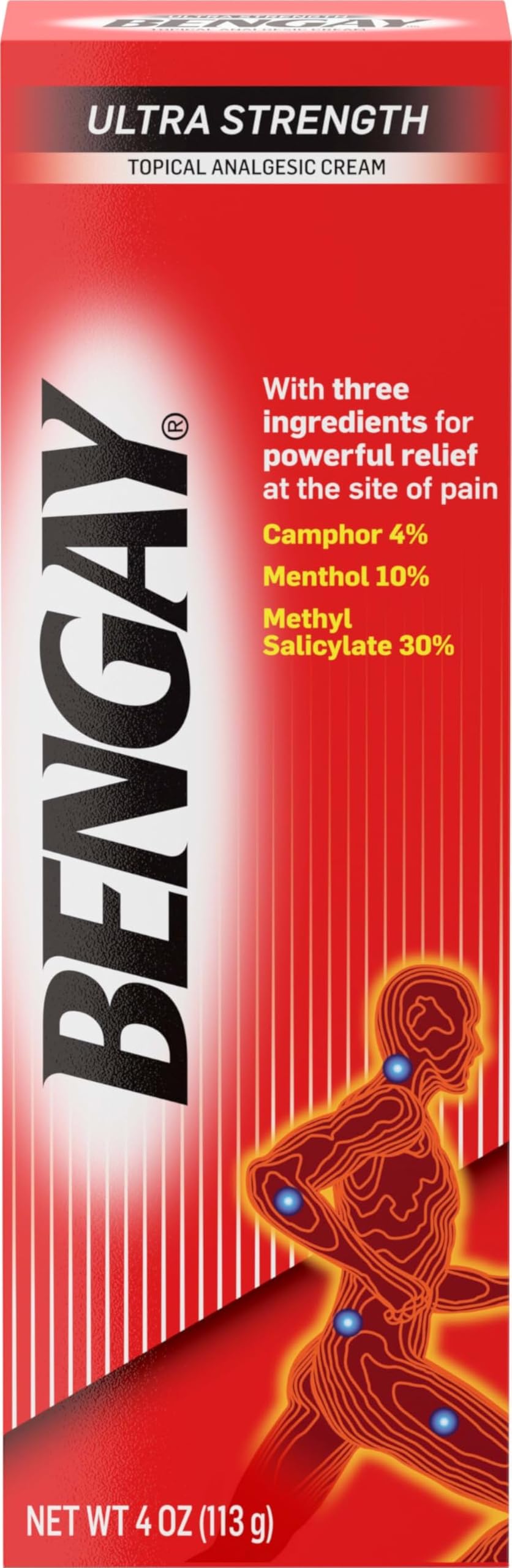
Bengay Ultra Strength

95 /100
Trail Score Outstanding

Key details

Size
4 oz tube
Format
Non-greasy cream
Active Ingredients
4% camphor, 10% menthol, 30% methyl salicylate
Check Price on Amazon

Four percent camphor, ten percent menthol, and thirty percent methyl salicylate: three actives, more than any other Bengay product carries and more than anything else on this list. What that buys is intensity. The cooling arrives within a minute or two and then a warmth settles in behind it, and for a shoulder that's been complaining since lunch it's a real kind of relief — even though what's happening is in the skin rather than in the joint.

The smell is the whole decision. Menthol and methyl salicylate don't hide, and in a small room they announce themselves; we could still smell this on a sleeve hours later. If that scent reads as a grandmother's medicine cabinet, it's a feature. If it doesn't, the tube will sit in a drawer and no amount of relief is worth that. It's intense enough that we keep it well away from the face and wash our hands straight after.

Where it earns its spot is size and cost. A 4 oz tube fits in a gym bag, lasts a good while because a thin layer is all you need, and it's the least expensive way onto this list. We take it hiking or to a job site before we take one of the pricier gels. What we don't do is rely on it for a swollen knee — that's a job for the diclofenac.

Pros

  • Three active ingredients
  • Strong cooling followed by warmth
  • Small tube, easy to carry

Cons

  • Feels hot on sensitive skin
Our verdict

Three pain-relieving ingredients in one small tube — the strongest counterirritant here, if you can live with the menthol.

Check Latest Price
9

Fast, Portable Relief

BC Powder Arthritis

96 /100
Trail Score Outstanding

Key details

Count
50 stick packs
Format
Powder
Active Ingredients
1000 mg aspirin, 65 mg caffeine
Check Price on Amazon

Pour the packet on your tongue, take a swig of water, swallow. That's the whole ritual, and it's why the format has stuck around: a powder gets into your system faster than a tablet that has to break down first, and one stick pack lies flat in a wallet. Each carries 1,000 mg of aspirin and 65 mg of caffeine — a full NSAID dose and a mild stimulant in the same swallow.

Two things decide whether this suits you. Aspirin is the harshest of the NSAIDs on the stomach, so this is not the packet for twice a day, every day; it's the one for a flare when you're out and need something working within twenty minutes. And the 65 mg of caffeine is small but real enough that we don't take one late in the evening.

That's a narrow job, and it does it better than anything else here. Flat packets go in a purse, a glove box, a desk drawer, with no bottle to open using hands that hurt. We keep a box in the car and use it a handful of times a year, which is about the right frequency for something this fast and this uncompromising.

Pros

  • Faster absorption than a tablet
  • Flat packets carry anywhere
  • 1,000 mg aspirin per dose

Cons

  • Bitter taste that lingers
Our verdict

A thousand milligrams of aspirin in a flat, pocket-sized packet — the fastest way to take something when you're away from the bottle.

Check Latest Price

How We Tested Arthritis Pain Relievers

We began with the pain-relief aisle and the shelf behind the pharmacy counter, since a few of the strongest options require asking — then cut a long list down by active ingredient, price per dose, availability, and how clear the label directions are. That left 16 products: coated tablets and caplets, two chewables, an effervescent option, several topical gels and creams, and three patches. Twelve testers with arthritis in the hands, knees, or lower back used them for three months, and so did I.

The testing happened where the pain does — in the kitchen wrestling with a jar lid, at a desk after two hours of typing, on the stairs, on evening walks, and in bed at 2 a.m. When someone took something, they noted the time, rated the relief an hour in, and wrote down when they reached for a second dose; the gap between those two numbers turned out to be a better guide than anything printed on the box. We also logged side effects, mostly stomach upset from the oral options, and whether relief faded gradually or fell off a cliff.

For anything swallowed, we paid attention to taste — whether a tablet went down clean or left a bitter, chalky aftertaste, and whether the coated ones were easier on a morning-empty stomach. For topicals, we recorded how strong the menthol or camphor smell was at arm's length, whether it lingered on skin and sheets, whether it delivered genuine warmth or just a tingle, and whether anyone's skin reddened. Value came down to how far a tube or bottle stretched against its cost per application, and we checked the expiration date on every package so we could say how long an unopened box stays usable.

How to Choose a Pain Reliever for Arthritis

Start With the Route, Not the Brand

Count the joints that hurt. If it's one knee, one hand, or one shoulder, a topical NSAID such as diclofenac puts the drug where the pain is, and far less of it reaches the rest of your body than a swallowed pill does — which is why it's worth trying first if pills upset your stomach. If the pain moves around, or there are more joints than you can reasonably rub four times a day, an oral option covers more ground.

Give a topical gel about a week of steady use before you judge it. That's the ramp on the label, and quitting on day three is the most common way people conclude a gel doesn't work when it never had a chance.

Acetaminophen or an NSAID

Acetaminophen eases pain but doesn't reduce inflammation, so a hot, puffy joint won't change much on it. In exchange, it doesn't carry the stomach-bleeding risk that naproxen, aspirin, and diclofenac do, which is what makes it the easier thing to take every day. NSAIDs go after swelling as well as ache, and that's the difference you feel in a joint that's puffy rather than merely sore.

Your medical history often makes the choice for you. If you take a blood thinner, have had an ulcer, or have kidney or heart problems, ask a pharmacist before buying an NSAID — five minutes settles a question you'd otherwise guess at. Otherwise, acetaminophen for daily ache and an NSAID for flare-ups is a reasonable split.

Match the Duration to Your Day

Duration changes what the day looks like. Eight-hour extended-release acetaminophen covers a workday in one dose; twelve-hour naproxen covers it in two. An immediate-release 500 mg tablet is for the half hour when you need something now, and it's the wrong tool for all-day background ache because you'll be back at the bottle constantly.

Longer isn't automatically better — twelve hours of an NSAID you don't tolerate is worse than six hours of one you do. Among the drugs that suit you, take the longest duration your schedule and your stomach will support.

Open It With Stiff Hands

Arthritis changes which bottle you can use, not just which drug. Child-resistant push-and-turn caps demand the exact pinch-and-twist that sore thumbs are worst at, and a bottle you can't open is a bottle you skip. Look for a cushioned, easy-open cap — the Aleve arthritis bottle is built around this — and prefer gelcaps to large caplets if swallowing is part of the problem.

Tubes are easier than bottles here, but a small cap on a big tube still fights back. If there are no young children in the house, ask a pharmacist about non-child-resistant packaging for your regular bottle. It's a legitimate option and almost nobody thinks to ask.

Price It by the Month, Not the Bottle

If you're taking something most days, the bottle price is the wrong number. A 400-count bottle of 650 mg extended-release acetaminophen does the same job as a 100-count one and costs less per caplet, and store-brand naproxen is the same 220 mg of the same drug as the gelcaps with the easy-open cap.

The exception is a bottle so large you don't finish it. Match the count to your pace, and don't pay a premium for a name unless you're paying it for something real — a cap you can open, a form you can swallow, or a gel that doesn't make you dread the routine.

Frequently Asked Questions

Final Verdict

If we were buying one bottle for everyday arthritis ache, it's the Tylenol 8-Hour Arthritis caplets. Eight hours of extended-release acetaminophen covers a workday, it doesn't carry the stomach risk of a daily NSAID, and it's the version most people can take for years without rethinking it.

Two things change our answer. If the pain lives in one knee or one hand, or pills upset your stomach, Voltaren's diclofenac gel puts the drug in the joint instead. And if you're restocking every month, the store-brand 650 mg extended-release bottle is the same drug at a lower cost per caplet — you trade the familiar label for a child-resistant cap and a much bigger bottle.