Best Respiratory Muscle Trainers of 2026

A respiratory muscle trainer is a small device you breathe through against resistance to strengthen the muscles that power each inhale and exhale. That makes them appealing for singers, runners, or anyone working on lung capacity and breath control. But the wrong one can feel flimsy, uncomfortable, or so confusing to set up that you never stick with it. Over four months, my team and I tested 12 trainers in daily breathing sessions to see which ones actually delivered.

What separates a good trainer from a disappointing one isn't just resistance level—it's how natural the breathing feels, whether the instructions make sense on day one, and whether the device holds up after weeks of use. I used each one at my desk in the morning, after workouts, and during evening wind-downs, paying attention to comfort, durability, and value. The picks below earned a permanent spot in my routine; the rest broke, frustrated me, or never felt like they were doing much for my lung capacity.

1

Best Overall

The Breather

89 /100
Trail Score Excellent

Key details

Weight
1.59 oz
Cleaning
Disassembles for washing
Dimensions
5.1 x 1.7 x 1.8 in
Resistance
Separate inhale and exhale dials
Check Price on Amazon

Two resistance dials — one for the breath in, one for the breath out — are the reason this sits at the top of our list. Plenty of handheld trainers give you a single knob for both directions; the Breather lets you set each side on its own, so a weak exhale can be trained without turning every inhale into a fight. It also comes apart for washing. You're putting this in your mouth twice a day, and a trainer you can't rinse through is one that ends up in a drawer.

That combination is what earns it the default recommendation. It's 5.1 inches long and 1.59 ounces, so it disappears into a gym bag, and the two dials give you months of small increases rather than three settings and a wall. The price is the part we argue with: it costs as much as several two-way trainers here that manage both directions with one knob, and you have to decide whether independent dials and a body that opens for cleaning are worth that. For us they are — those are the two features that keep it in the routine.

Our one reservation is the paperwork. The training protocol lives online as a video rather than in the box, and what's printed is thin, so plan on watching it once and writing the routine down. That's a ten-minute task rather than a reason to skip the device, but if you want something that tells you what to do on day one, budget for finding the instructions yourself.

Pros

  • Separate resistance dials for inhale and exhale
  • Comes apart for thorough cleaning
  • Carries at 1.59 ounces
  • Structured protocol included online

Cons

  • Cleaning seam is the spot to handle gently
Our verdict

The one we point most people to: separate dials for inhale and exhale, a body that opens for washing, and enough adjustment to last months.

Check Latest Price
2

Best for Fine-Tuned Progression

O2Trainer

90 /100
Trail Score Outstanding

Key details

Material
Silicone
Batteries
None required
Resistance
16 interchangeable intake caps
Training Direction
Inhale only, free exhale
Check Price on Amazon

Where the Breather gives you two dials, the O2Trainer gives you sixteen caps. Each one restricts airflow by a different amount, so you can move up in increments small enough to feel — the finest progression in this group — and drop back a step on a bad day without losing the session. That's the reason to buy it.

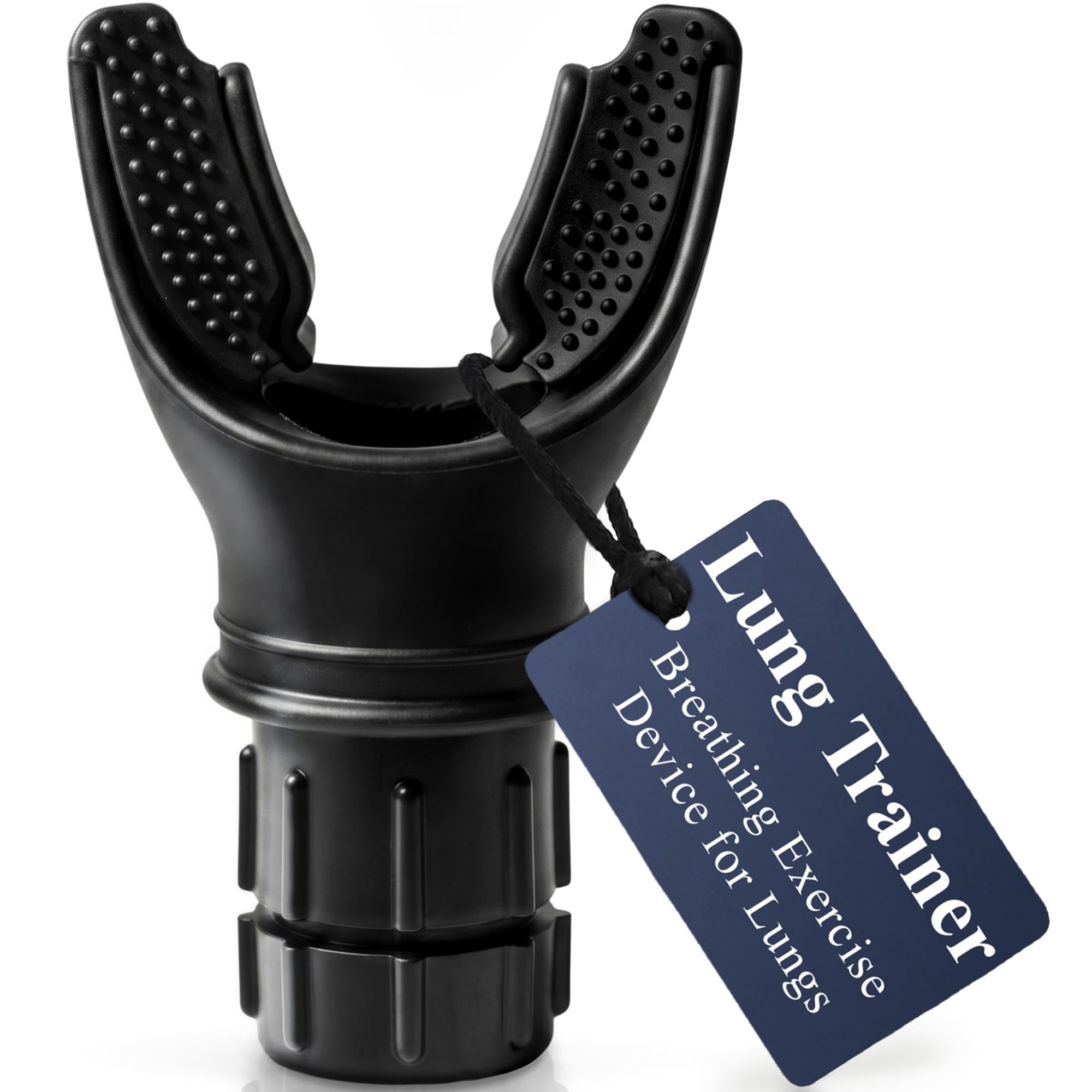
The catch is built into the design. The caps sit on the intake, so you work the breath in and the exhale runs free. For a runner, climber, or fighter chasing inspiratory strength, that's a feature: hard inhale sets with an unrestricted exhale are easier to complete than full two-way resistance, and the silicone body is soft in the mouth and wipes clean. If you also want to load your exhale, this isn't your device — the Breather, Inhale Lung Trainer, and Expand-A-Lung cover that side.

Two practical notes. It collects saliva the way every mouth-held trainer does, so tip it out and rinse the cap you used after a session. And with sixteen small caps, keep the one currently on the device and store the rest together somewhere you won't lose them. No batteries and no app is why this is the one that travels.

Pros

  • Sixteen resistance steps, the finest here
  • Silicone body, no batteries or app
  • Unrestricted exhale keeps hard sets finishable
  • Wipes clean in seconds

Cons

  • Loads the inhale only; exhale is unrestricted
Our verdict

The pick for the smallest resistance jumps here and for anyone who wants the exhale left alone while the inhale does the work.

Check Latest Price
3

Best Value Two-Way Trainer

Inhale Lung Trainer

86 /100
Trail Score Excellent

Key details

Origin
Designed and assembled in USA
Included
Carrying case
Mouthpiece
Removable medical-grade silicone
Resistance
Adjustable dial, both directions
Check Price on Amazon

Budget is where most people should start with these, and the Inhale Lung Trainer is the one we hand to first-timers. It gives you a dial you can turn toward more or less resistance, works in both directions, and finishes with a soft medical-grade silicone mouthpiece that pulls off for washing plus a carrying case — all at the low end of this group's prices.

The mouthpiece is the detail we care about most. It's removable, it rinses clean in seconds, and it's the part that touches you, which is exactly where a cheap trainer usually cuts corners. One dial handles both directions, so there's nothing to coordinate before a session, and the unit is designed and assembled in the U.S. — a detail some buyers look for and one we're glad to see at this price.

It does collect saliva during longer sets, so rinse and shake it after each use, and the dial is best set by feel rather than by a number you write down. What tips it into our value slot is the combination: two-way resistance, a mouthpiece you can actually clean, and a case. If you've never used a trainer before, this is the least risky way to find out whether you'll keep the habit.

Pros

  • Adjustable resistance in both directions
  • Removable medical-grade silicone mouthpiece
  • Carrying case included
  • Budget price for a two-way trainer

Cons

  • No printed guidance on use or cleaning internals
  • Mouthpiece runs long for smaller mouths
Our verdict

The value pick for a first trainer: a two-way dial, a removable silicone mouthpiece, and a case without a premium price.

Check Latest Price
4

Best Pocket Trainer

Expand-A-Lung

85 /100
Trail Score Excellent

Key details

Length
4 in
Mouthpiece
Food-grade silicone
Resistance
Single knob, inhale and exhale
Check Price on Amazon

Four inches long and about the size of a marker, this is the one that genuinely lives in a pocket. It's the least expensive route into two-way training in this group, and the design has been around long enough that the routine is settled: set the knob, breathe through a few sets of ten to fifteen reps, put it back in your bag.

The single knob is the whole control. Turn it one way for more resistance, the other for less, and it loads the inhale and the exhale at once — a simpler arrangement than the Breather's two dials, and one that suits people who don't want to think about which direction they're training. The food-grade silicone mouthpiece is soft and rinses clean, and there's nothing to charge.

The trade-off of the tiny body is that there's no gauge or marking on the knob, so you can't note a setting and return to it next week. You learn the position by feel instead, which works fine once you're in the habit and is mildly annoying before that. Ease of use is where this one earns its keep, not precision.

For the money, we think it's the right second trainer: buy it for the gym bag or the car and leave your main device at home, or start here if you're unsure you'll stick with a routine. It won't track your progress or coach you, but it will make you breathe against resistance twice a day, which is the entire job.

Pros

  • Four inches long, pocketable
  • One knob loads both directions
  • Lowest-cost entry in this group

Cons

  • No markings to record your resistance setting
  • Mouthpiece assembly can work loose with daily use
Our verdict

The pocket trainer: a single knob for both directions, four inches long, and the lowest-cost way to find out if daily breathing work sticks.

Check Latest Price
5

Best for Singers

The Breather Voice

86 /100
Trail Score Excellent

Key details

Controls
Dial
Resistance
Adjustable, inhale and exhale
Suggested Session
5 min, twice daily
Check Price on Amazon

Singers, wind players, and teachers have a different problem from a runner's: they need a long, controlled exhale, not just a stronger pull of air. The Breather Voice is built around that — the same basic format as the Breather, with the resistance and the routine framed around vocal support.

Five minutes, twice a day is the suggested session, and the guided exercises are the part that stops a routine from drifting into nothing. Resistance adjusts in both directions, the build is solid and simple, and there are no moving parts to fuss over. For voice work specifically, that focus is worth more than another resistance level.

The companion app is where our enthusiasm cools. It's iPhone-only, and stepping back through the exercise videos isn't as easy as it should be, so Android users are paying for a feature they can't run. Buy this for the resistance and the five-minute structure; treat the software as a bonus that may not fit your phone.

Pros

  • Resistance adjustable in both directions
  • Routine framed around vocal breath support
  • Solid, simple build

Cons

  • Companion app works on iPhone only
Our verdict

The pick for singers and wind players: two-way adjustable resistance and a short guided routine, provided you're on an iPhone.

Check Latest Price
6

Premium Simplicity

POWERbreathe

84 /100
Trail Score Excellent

Key details

Weight
7.05 oz
Included
Carrying case
Material
Synthetic rubber
Resistance
Medium tension
Check Price on Amazon

Premium money buys the plainest device here, and for some people that's exactly right: a sealed blue unit with an adjustable resistance dial, a carrying case, and a 200-gram body that feels built to be knocked around in a gym bag. It's a mouthpiece, a dial, and a case, and nothing more.

We place it below the dial-based picks for one reason: the resistance range is set by the tension band you order, and this listing is the medium one. If medium is where you sit, that's a non-issue and you'll never think about it again. If you're at either end — a strong athlete or someone rebuilding after illness — a trainer with a wider adjustable range gives you more room without a second purchase.

What you get in return is the least distracting device in this guide. It rinses clean, it packs into its case, and it asks nothing of you but the session itself. For a buy-once, keep-it-in-the-bag purchase, that's a real argument.

Pros

  • Sealed build with adjustable resistance
  • Carrying case included
  • Rinses clean and travels light

Cons

  • Medium tension only, so the range is set at purchase
Our verdict

A sealed, no-frills trainer for someone who wants one adjustable unit and a case, as long as the medium tension band is where they're starting.

Check Latest Price
7

Visible Feedback

TyeinGo 3-Ball Trainer

86 /100
Trail Score Excellent

Key details

Weight
6.74 oz
Training
Inhale and exhale, flip device
Dimensions
6.7 x 2 x 5.5 in
Resistance
Adjustable flow knob
Check Price on Amazon

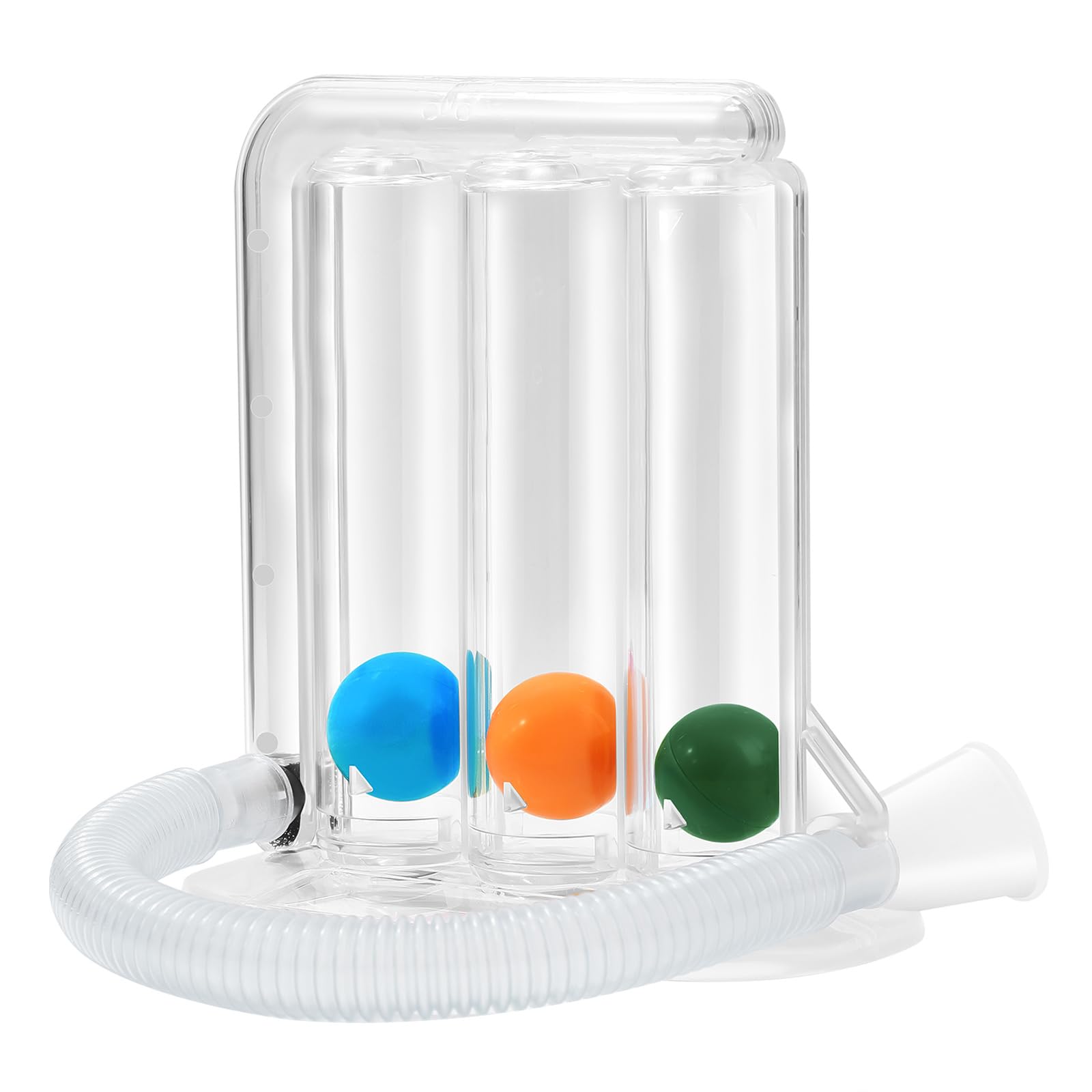
Three balls in three columns, and they do something no dial can: they show you the breath. Pull air in and they rise; the columns are marked so you can see whether you're moving more air than you were a week ago. If you've ever abandoned a trainer because nothing seemed to change, that visible proof is the feature worth paying for.

It's a real trainer rather than just a feedback toy: flip it over for the exhale, and the flow knob on the side adjusts resistance, so you can load both directions. What we don't love is the footprint. It's closer to a small paperback than to the pocket-sized trainers here, so it lives on a desk or a nightstand rather than in a jacket.

Cleaning is easy — it comes apart and the mouthpiece and tube rinse — and it's light enough to move from room to room. As a first trainer for someone rebuilding breath volume, or for a parent who needs to see progress to stay motivated, the balls earn their place.

Pros

  • Balls show each breath at a glance
  • Adjustable flow knob
  • Flips for inhale and exhale
  • Comes apart for cleaning

Cons

  • Too bulky for a pocket
Our verdict

The one to buy if visible progress is what keeps you going: ball feedback on every breath, adjustable resistance, and both directions.

Check Latest Price

How We Tested 12 Respiratory Muscle Trainers

We built our shortlist by reading through customer reviews and spec sheets for trainers with adjustable resistance, clear instructions, and mouthpieces that looked comfortable. We filtered out models with repeated complaints about flimsy parts or confusing setup, then narrowed the field to 12 devices. Each one was used for four months.

Testing happened where breathwork actually happens: at my desk during morning sessions, on the couch after workouts, and in bed before sleep. I timed how long I could hold a steady breath against each resistance setting, noted whether my lungs felt worked or just irritated, and paid attention to how my mouth and jaw felt after five minutes. I also handed each trainer to a colleague who had never used one, to see whether the instructions made sense without a tutorial.

After each week, I cleaned the mouthpieces, dropped each device from counter height, and stuffed them into a gym bag to check durability. We compared what came in the box—carry case, resistance guide, cleaning brush—against the price to judge value. The disappointing ones were usually the same: resistance that jumped from too easy to too hard, a mouthpiece that felt sharp, or instructions that never explained how often to use it.

How to Choose a Respiratory Muscle Trainer

Inhale, Exhale, or Both

Your inspiratory muscles work every time you pull air in, and they're the ones most trainers load; the exhale gets forgotten. For running, cycling, or hiking, an inhale-focused device covers the priority. If you sing, play a wind instrument, or know your exhale is the weak side, choose a two-way trainer.

The Breather, Inhale Lung Trainer, Expand-A-Lung, and TyeinGo all resist both directions. The O2Trainer deliberately lets the exhale run free, which makes hard inhale sets easier to finish — a real advantage for one goal and a dead end for the other.

Resistance in Steps You Can Feel

The number that matters isn't the maximum resistance; it's how small the jumps are between settings. A wide adjustable dial or a set of interchangeable caps lets you creep up as the muscles adapt, and that gradual loading is the entire mechanism.

The trap is buying the hardest setting as if it were the goal. If a session leaves you gasping or dizzy, the resistance is too high, and you'll either shorten the reps or stop using the thing. Start where you can finish ten slow, controlled breaths.

Cleaning Is Not a Detail

You put this in your mouth twice a day, and it collects saliva and condensation every time. A removable silicone mouthpiece, or a body that comes apart, is the difference between a ten-second rinse and a device you start avoiding.

Check that you can reach the internal parts, not just the mouthpiece — several trainers here ship with little or no cleaning guidance, so look before you buy. Rinse after each session, shake it out, and let it air dry open rather than sealed in a case.

Size, Mouth Fit, and Where It Lives

Handheld trainers run from something four inches long that vanishes in a pocket to a boxy ball unit that needs shelf space. Decide where sessions will happen — desk, car, gym bag, bedside — and buy for that spot, because the trainer within arm's reach is the one you'll use.

Mouthpiece fit matters as much. Soft silicone suits most people, but a long or bulky mouthpiece can be uncomfortable in a smaller mouth, and a device you dread putting in is a device that stops. If your gag reflex is strong, prioritize the compact designs.

Guidance and the Routine

A trainer is a load, not a program. Devices that come with a structured protocol are easier to stick with than the ones that leave you to invent a routine, and a few here arrive with almost nothing printed — worth knowing if you've never used one before.

An app can help, but treat it as a bonus rather than a reason to buy, since app support varies by phone. What you actually need is a fixed time of day, a set number of breaths, and a way to remember your resistance setting from one session to the next.

Frequently Asked Questions

Final Verdict

The Breather is our default because it's the only trainer here with a dial for each direction and a body that opens for washing — the two things that keep a device in the routine rather than in a drawer. If the price is hard to justify, the Inhale Lung Trainer does both directions with a removable silicone mouthpiece at the budget end, and it's the sensible first purchase if you're not sure you'll keep the habit.

And if you only want to work the inhale, the O2Trainer's sixteen caps give you finer steps than anything else on this page.