Best Radon Detector for Home of 2026

Radon doesn't announce itself. It's a colorless, odorless gas that seeps up through soil and foundation slabs, and the only way to know what's under your house is to measure it. The detector you pick matters more than its price tag suggests: a good one gives you a number you can trust, refreshes it often enough to catch a spike, and shows it clearly enough that you'll actually look. What it fixes is simple — it trades a background worry for a reading you can act on.

I've kept one plugged in beside my basement stairs for years, and the difference between a unit that reports a number now and then and one that monitors continuously is obvious within a week. For the past eight months we've lived with 12 detectors, checking readings against a calibrated reference and timing how fast each reacted when levels shifted. Readings drift with weather and season, so a bad week isn't the story — look for a device that shows both short- and long-term averages. The picks below are the ones I'd buy again.

1

Best Overall

Airthings Corentium Home 223

93 /100
Trail Score Outstanding

Key details

Power
3 AAA batteries
Weight
3.52 oz
Readings
Short- and long-term on-screen
Warranty
5-year extended with registration
Check Price on Amazon

Three AAA batteries and a small screen are the whole pitch, and that is why the Corentium Home 223 is the monitor we recommend first. It does not ask for an outlet, a phone, or a subscription; you put it where radon accumulates and read the short- and long-term numbers on the display. We used it as a baseline in a basement and liked that checking it was a ten-second habit, not a project.

Radon moves around, so the long-term average is the number we trusted for the house, while the short-term reading was handy when we moved the unit between rooms. The display is plain in the best way: no color-coded guessing, no app to open before you know whether the level is drifting. That simplicity is why it beats more connected monitors for a first whole-home detector.

A five-year extended warranty is available if you register within 30 days, and that registration is worth doing while the box is still on the table. It takes a minute and gives you real recourse if the unit misbehaves later.

If you want hourly graphs on your phone or a unit that pushes alerts to your lock screen, one of our app-connected picks is a better fit. What the Corentium gives you is the clearest low-effort path to a long-term radon record, and for most homes that is the job.

Pros

  • Battery power makes placement easy
  • Shows short- and long-term readings
  • Five-year extended warranty with registration

Cons

  • Durability is mixed
Our verdict

For a first whole-home radon monitor, we recommend the Corentium Home 223 for its battery-powered simplicity and clear long-term readings.

Check Latest Price
2

Best for Fast Room Checks

Ecosense RadonEye RD200

90 /100
Trail Score Outstanding

Key details

Power
Corded electric
Sensor
Patented ion chamber
Display
OLED
Response Time
10 minutes
Check Price on Amazon

Ten minutes is the number that changes how you use the RadonEye RD200. The first reading appears quickly, and the unit keeps updating at that interval, so you can move it from basement to living room and watch the level respond instead of waiting a day for a lab kit to tell you what already happened. We found that pace useful for narrowing down where a problem is coming from, not just confirming that one exists.

The ion chamber sensor is the professional-grade part, but the OLED display is what made it easy to live with. It shows the number without opening Bluetooth, and the app adds the hourly trend chart when you want the longer view. We liked having both: the screen for a glance, the graph for the pattern.

The trade-off is power. This is a corded monitor, so placement depends on an outlet, and a power cut stops the record. In a finished basement that is easy; in a damp crawl space, it may not be. We kept ours near a grounded outlet and left it there.

If you want a monitor you can carry from room to room without a cord, the Aranet or the Corentium is the better fit. If you want to understand why one room reads higher than another this week, the RD200 is the one we reached for.

Pros

  • Fast 10-minute readings
  • Clear OLED display
  • Patented ion chamber sensor
  • App trend chart

Cons

  • Corded power only
  • Bluetooth app can be unreliable
Our verdict

If you want to track radon room by room, the RadonEye RD200 is our pick for its fast updates, clear OLED, and useful trend chart.

Check Latest Price
3

Best Splurge

Aranet Radon Plus

92 /100
Trail Score Outstanding

Key details

Battery
2 AA, up to 7 years
Display
E-ink, color-coded
Sensors
Radon, temperature, humidity, pressure
Response Time
10 minutes
Check Price on Amazon

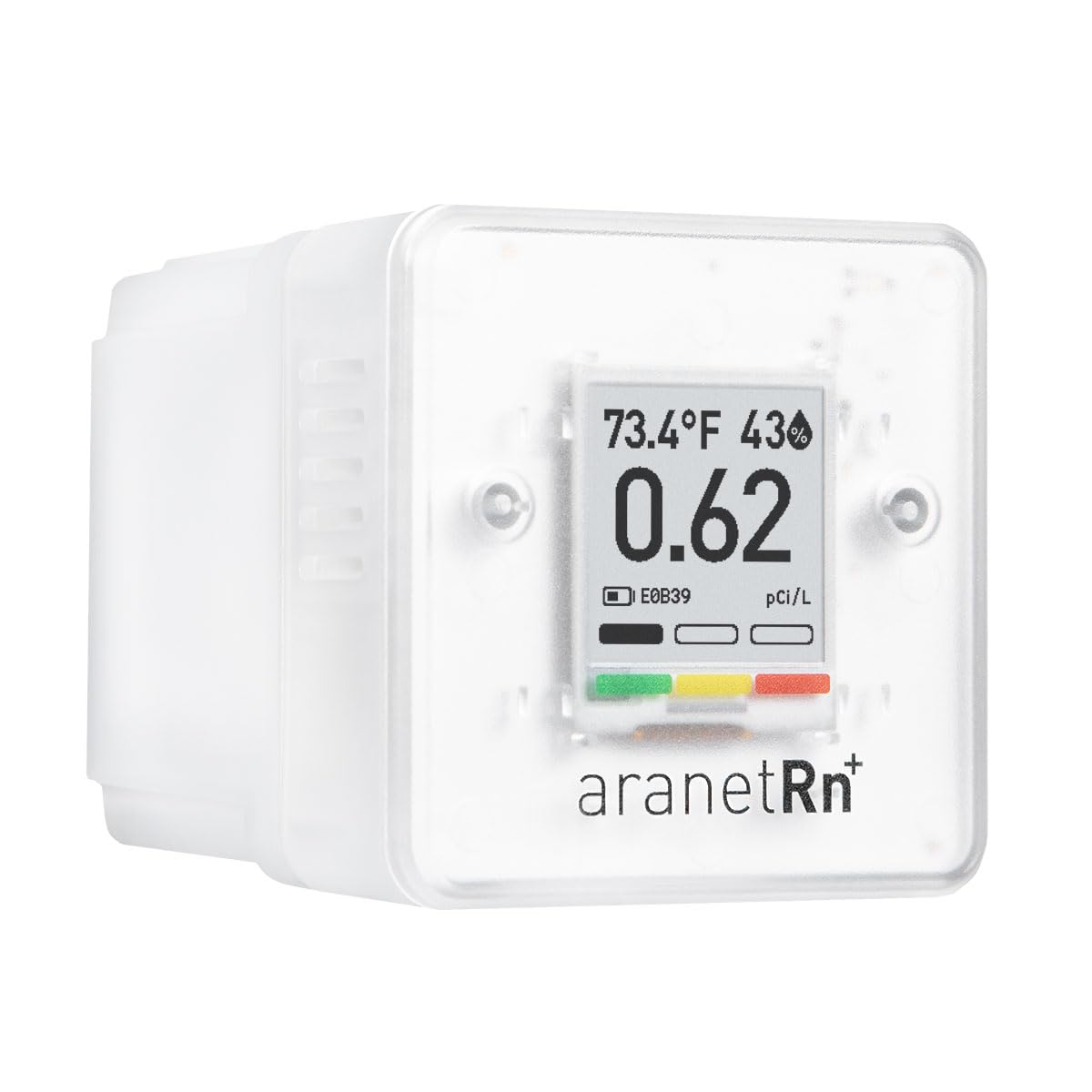
The Aranet Radon Plus is the one we take when the question is not 'is my house safe?' but 'what is happening in this room right now?' It updates every ten minutes, runs on two AA batteries for up to seven years, and shows a color-coded e-ink status without waking a phone. That combination is genuinely unusual.

The e-ink screen is the detail we appreciated most. It stays readable, does not glow like a gadget, and gives you a green-yellow-red cue before you dig into numbers. The app adds history and averages over 24 hours, 7 days, and 30 days, which is the right way to look at radon: the short number tells you what changed, the longer average tells you what to act on.

The case for it is portability with patience: carry one monitor between floors, watch a mitigation system settle, or check a rental before you sign. If you only need a basement baseline, the Corentium Home is the simpler tool. Bluetooth is the weak link, and the e-ink display is the reliable readout at close range. The seven-year battery makes that a minor annoyance rather than a daily one.

Pros

  • 10-minute readings
  • Up to 7 years on 2 AA batteries
  • Color-coded e-ink display
  • Tracks temperature, humidity, pressure

Cons

  • Premium price
Our verdict

The Aranet Radon Plus is the premium portable we choose when fast readings and a seven-year battery matter more than saving money.

Check Latest Price
4

Best Simple Plug-In

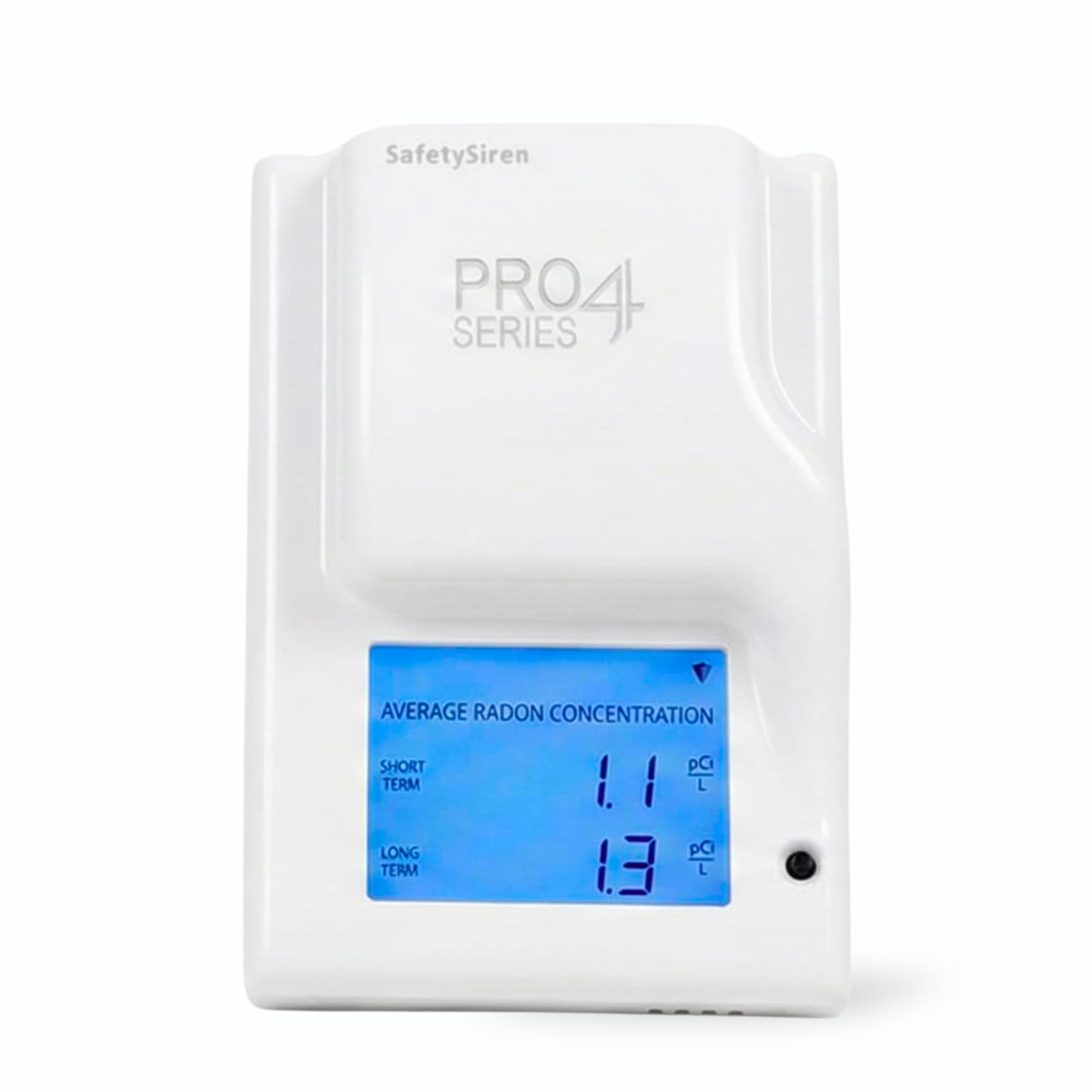
SafetySiren Pro4

88 /100
Trail Score Excellent

Key details

Alarm
Audible and visual, 3 modes
Power
Corded electric
Display
Backlit digital
Self-test
Every 24 hours
Check Price on Amazon

The SafetySiren Pro4 is for the person who wants a radon monitor to behave like a smoke alarm: plug it in, glance at the display, and hear about it if something is wrong. There is no app to pair and no battery to remember. We like that directness in a basement, where a monitor can otherwise become another device to maintain.

The display shows short- and long-term levels, and the backlight makes it readable in a dim corner. The audible alarm has three modes, plus a visual alarm for anyone who can't hear it. We paid attention to the daily self-test: it is the kind of boring reliability feature that matters more than a graph you check once a week.

The trade-off is that you give up trend history and remote access. This is a plug-in, display-first monitor, not a smart sensor. If you want to see how levels moved hour by hour, the RD200 or Aranet is the better fit. If you want a fixed unit that tells you when to act, the Pro4 is easier to live with.

The three alarm modes are easy to cycle through, and the visual indicator is clear from across the room. That matters if the monitor lives in a basement you do not visit every day.

Pros

  • Audible alarm with three modes
  • Visual alarm for hearing-impaired
  • Daily self-test

Cons

  • Corded power only
Our verdict

For a fixed basement monitor with an alarm and no app, the SafetySiren Pro4 is the straightforward pick we recommend.

Check Latest Price
5

Best No-App Display

Ecosense EB100

87 /100
Trail Score Excellent

Key details

Display
Full-size LED
Readings
Real-time through long-term averages
Warranty
1 year
Response Time
First reading in 10 minutes
Check Price on Amazon

The EcoBlu EB100 is the monitor we point to when someone wants to read radon levels from across the room without unlocking a phone. The LED display is full-size, the numbers update every ten minutes, and there is no app, no Bluetooth, and no account. That sounds old-fashioned until you are standing in a basement with wet hands and just want the number.

It shows real-time, daily, weekly, monthly, yearly, and long-term averages on screen. We liked being able to toggle between the short view and the long view without leaving the unit. The first reading arrives in about ten minutes, which makes it useful for checking a room before you commit to leaving it there.

The RD200 costs more and adds Bluetooth and a trend chart; the EB100 is the simpler, display-first alternative. We still choose it for a dedicated basement spot where the screen is the whole point. It is corded, so the outlet decides the placement, and that is the main practical limit. For a buyer who wants a permanent, no-phone readout, the EB100 is one of the easiest monitors here to live with.

Pros

  • Large LED display readable across the room
  • 10-minute updates and first reading
  • No smartphone or app required

Cons

  • One-year warranty
Our verdict

The Ecosense EB100 is our pick for a permanent, no-phone readout, with a large display and fast updates in a simple plug-in package.

Check Latest Price
6

Best Budget Portable

AEGTEST HOUND-1011S

88 /100
Trail Score Excellent

Key details

Range
0.09 to 1000 pCi/L
Battery
Built-in, up to 45 days in sleep mode
Display
LCD, 12H/24H/48H/72H/96H
First Results
Within 12 hours
Check Price on Amazon

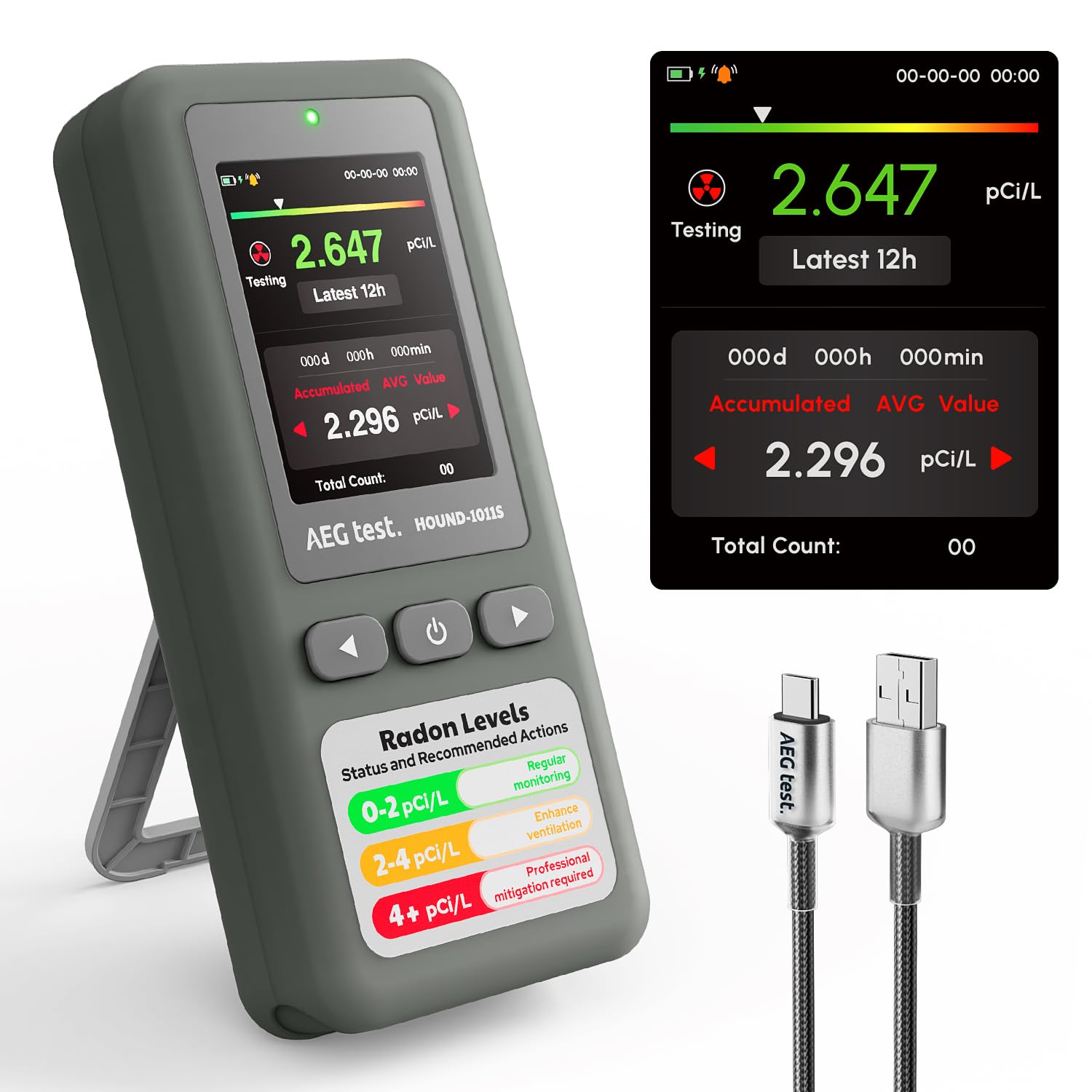
The HOUND-1011S is the budget monitor that does not feel like a toy. It measures from 0.09 to 1000 pCi/L, switches between pCi/L and Bq/m³, and has audible and visual alarms. We liked that it runs on a rechargeable battery and can also run from USB-C, so you can carry it to a basement corner and leave it there without hunting for an outlet.

The first results take about 12 hours, which is slower than the ten-minute picks, but the trade-off is fair at this end of the range. Once it is running, you can look at 12-, 24-, 48-, 72-, and 96-hour windows, and the history stretches out to 504 days. We found the display easy to navigate and the alarm thresholds simple to set.

The sensor is a semiconductor design rather than the ion chamber in our top picks, so we treat it as a budget screening tool, not a replacement for a professional test. That is not a knock on its usefulness; it is a reminder to cross-check a high reading with a lab test before you spend money on mitigation. For a first monitor, a rental, or a second unit for the basement, it gives you continuous readings and alarms without the app overhead. That is a lot of utility for a budget unit.

Pros

  • Wide 0.09 to 1000 pCi/L range
  • Audible and visual alarms
  • Rechargeable and USB-C powered

Cons

  • Battery claim is sleep-mode only
Our verdict

The HOUND-1011S is the budget portable we recommend for continuous readings and alarms without paying for app-connected extras.

Check Latest Price
7

Budget Alerts

X-Sense XR0B-SR

87 /100
Trail Score Excellent

Key details

Alerts
Audible and visual
Battery
3 AA, up to 2 years
Tracking
Up to 999 days
Stated Accuracy
95% after 7 days or more
Check Price on Amazon

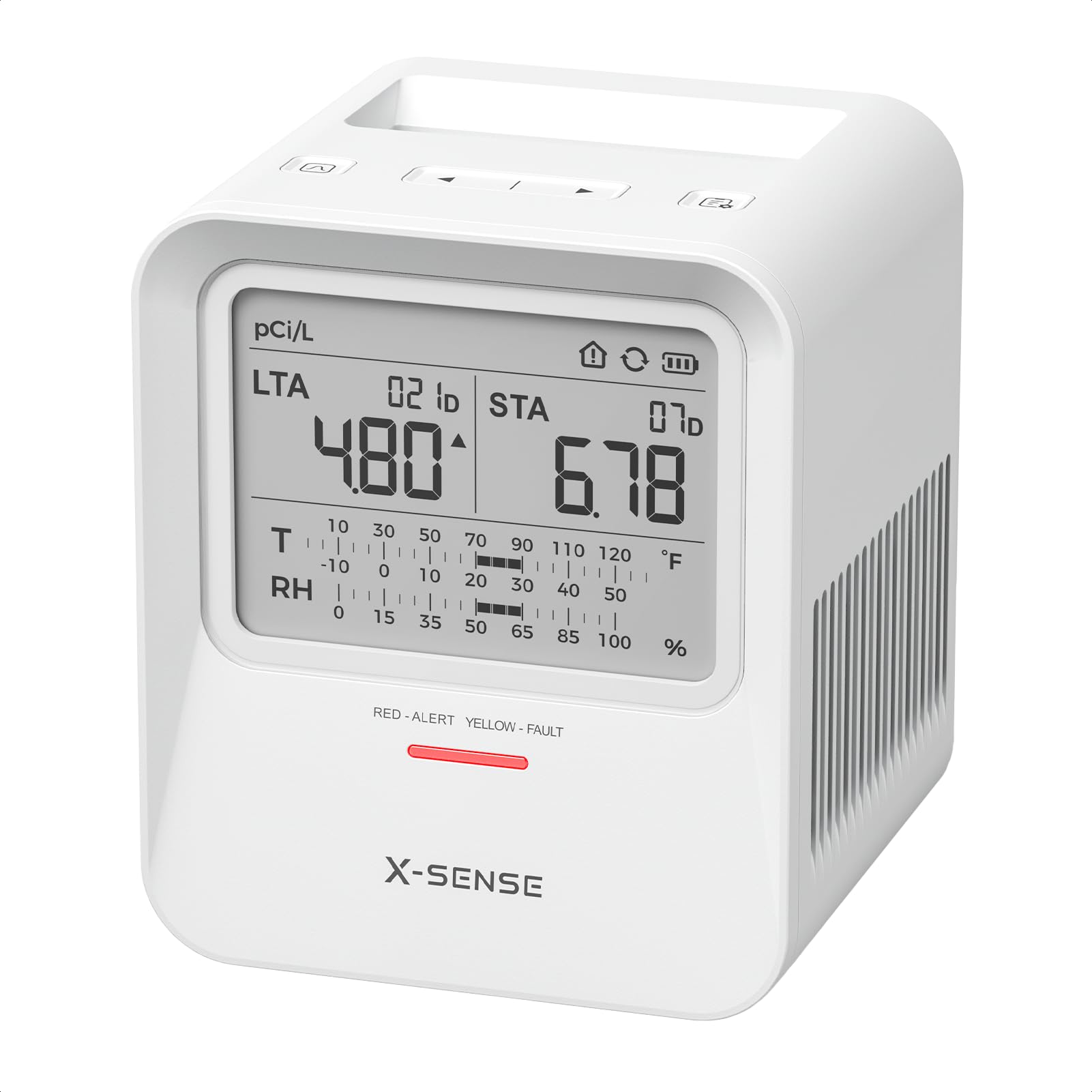
The X-Sense XR0B-SR is the set-and-forget option: a small white box that tracks radon for up to 999 days and sounds an alarm when the level crosses your threshold. It stores up to 99 readings locally and has a one-touch reset for moving it between rooms. We liked that it does not depend on a phone to be useful.

The display is compact and the alerts are the point. You can set it in a basement and mostly ignore it until it chirps or the light changes. The stated accuracy reaches 95% after seven days, which is the right way to read it: the first day is a warm-up, not a verdict. We treated the long-term number as the one that mattered.

The local storage and save button make it easy to review readings, and the battery is rated for up to two years on three AA cells. That is reasonable for a set-and-forget device. It is not as fast as the ten-minute monitors, so it suits a permanent spot better than a room-by-room hunt.

For a budget second unit or a rental, the XR0B-SR is a sensible pick. It gives you continuous tracking and an alarm without asking you to build a smart-home routine around it. That is the whole appeal: a radon monitor that behaves like a simple appliance.

Pros

  • Up to 999 days of tracking
  • Audible and visual alerts
  • Stores 99 readings locally

Cons

  • No app or remote access
Our verdict

The X-Sense XR0B-SR is a sensible budget set-and-forget monitor when you want local storage and alarms without an app.

Check Latest Price
8

Rugged Secondary

Forensics FD-65-RADON

87 /100
Trail Score Excellent

Key details

Power
Battery powered with charger
Display
Large color LCD
Housing
ABS, 10-foot drop rating
Sensor Life
20 years
Check Price on Amazon

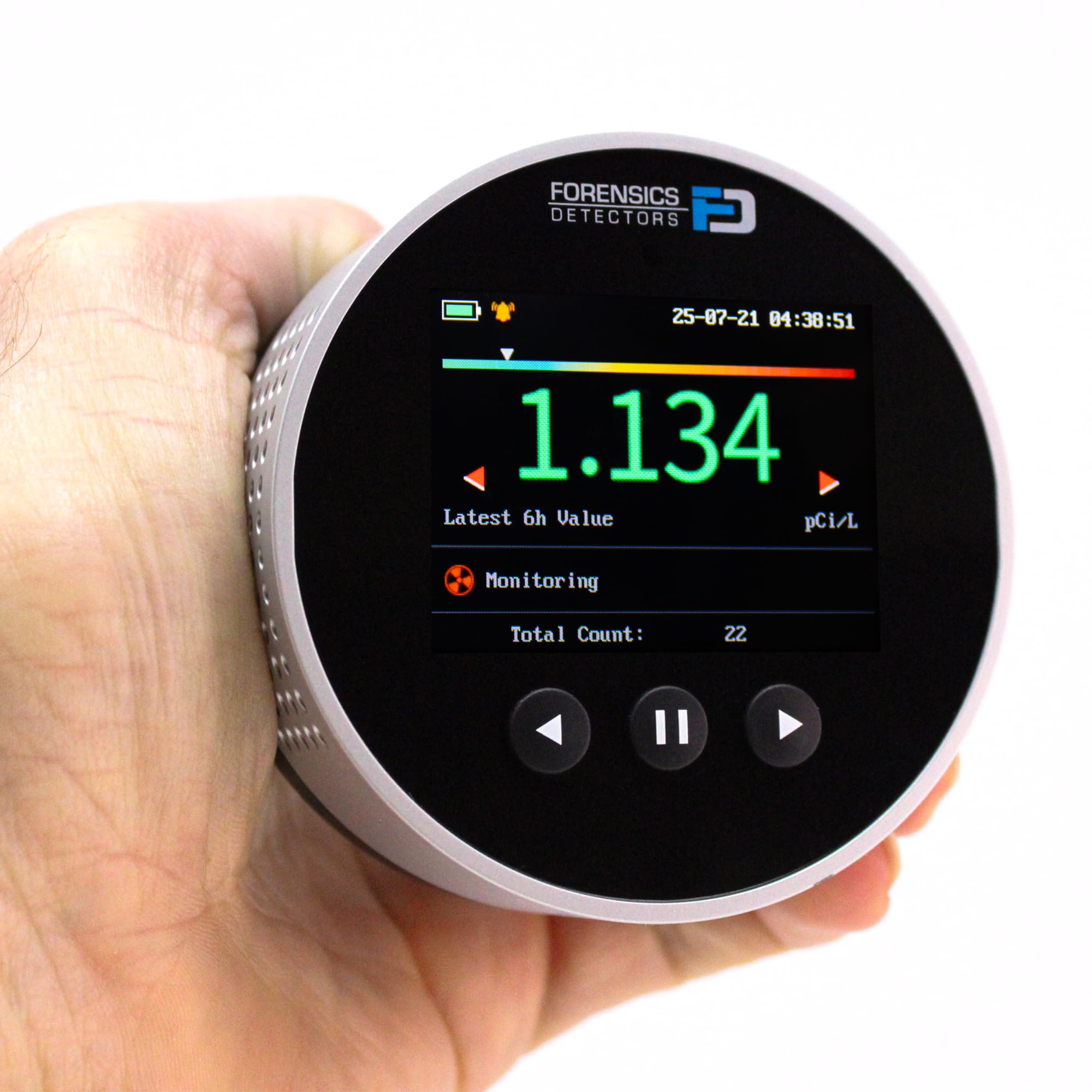
The Forensics FD-65-RADON is the monitor we hand to someone who needs a radon reading in a workshop, garage, or basement where gear gets knocked around. The ABS housing is rated for a 10-foot drop, the sensor life is claimed at 20 years, and the large color LCD includes temperature. That is a different pitch from the delicate, app-connected units.

We liked the display and the battery/charger setup. The screen is large, the arrow buttons are simple, and you can leave it on a shelf without a cord. The 20-year sensor claim is the part to treat carefully: it is a manufacturer's life rating, not a promise that the readings will stay accurate for two decades. Cross-check a surprising result with a lab test before making a mitigation decision.

There is no app or trend graph to check from another room, which is the trade-off for the rugged build and long sensor-life claim. As a second monitor for a rough space, it makes sense; as the only monitor for a family home, we prefer the faster, more connected picks.

Once it settles in, the battery power and big display make it easy to live with in a space where a phone-dependent gadget does not belong. It is a niche pick, but a useful one.

Pros

  • 10-foot drop-rated housing
  • 20-year sensor-life claim
  • Large color LCD with temperature

Cons

  • First reading can take several hours
Our verdict

The Forensics FD-65-RADON is a rugged secondary monitor for a workshop or basement where a phone-dependent gadget would not survive.

Check Latest Price

How We Tested Radon Detectors at Home

We started by pulling every consumer radon detector we could find — plug-in units, battery-powered pucks, models with companion apps — and narrowed the field using spec sheets and homeowner reviews. We kept devices that report an actual numeric reading rather than a simple alarm, that log history, and that don't charge a subscription to see your own data. That left 12 units, which we placed in four homes over eight months.

Testing happened where radon actually accumulates: basements, a ground-floor bedroom, a laundry room with a floor drain, and one house with an elevated level a professional had already measured. We ran detectors side by side for weeks at a time and compared their numbers against a calibrated reference monitor and a lab-analyzed charcoal kit, noting which ones tracked closely and which drifted or bounced around. To judge response time, we moved units between a basement and an upstairs room and watched how long the display took to settle. Along the way we logged how each device handled continuous monitoring — whether it stored hourly history and whether the weekly and monthly averages told the same story as the live number.

We unboxed each one and timed the trip from box to first trustworthy reading, then handed the app to someone who had never opened it. Every alert was checked: whether it reached a phone, how it was worded, whether it repeated until acknowledged, and what happened when the Wi-Fi dropped. Durability got a real-world going-over — a humid summer in a basement, a knock off a shelf, a vacuum cord snagged around a power cable, and a look at how sturdy the cord and housing felt. We also tallied the true cost of ownership, including calibration fees and replacement sensors, because a cheap detector that needs annual service isn't cheap.

How to Choose a Radon Detector for Your Home

Start With the Long-Term Average

Radon levels rise and fall with weather, pressure, and how a house is ventilated, so a single short-term reading can scare you or reassure you without telling the whole story. Look for a monitor that shows a long-term average alongside a shorter window. The Airthings Corentium Home 223 and the Aranet Radon Plus both make that switch easy; the X-Sense XR0B-SR leans on a seven-day accuracy claim, which is a reminder that the first day is warm-up, not a verdict. Choose a model that displays both, and judge the long-term number.

Choose Battery or Corded Power

Where the monitor lives should decide the power source. A battery unit like the Corentium Home can move from basement to bedroom and keeps working in an outage; a corded unit like the RadonEye RD200 or EcoBlu EB100 can sit in one spot and update every ten minutes without battery changes. If your basement has no convenient outlet, do not force a corded model into a bad location. If you want permanent, fast updates, a cord is not a drawback as long as the outlet is where the radon is. Measure the outlet before you choose.

Treat the App as a Bonus

Bluetooth is the most common letdown in this category: pairing can be fussy, range is short, and a phone should not be the only way to see a safety number. We prioritize a readable on-device display and treat the app as a convenience for history and graphs. The RD200's OLED and the EB100's large LED both stand on their own; the Aranet's e-ink screen does too. If a monitor has no screen, make sure the app is reliable enough for daily use before you rely on it. Check the display first, app second.

Match Response Time to the Question

Ten-minute updates are useful when you are tracing a source or checking a room after you have made a change; they are less important for a year-long baseline. Slower units like the AEGTEST HOUND-1011S take about 12 hours for a first result, which is fine for a set-and-forget basement monitor but frustrating for room-by-room work. Decide whether you are buying a screening tool or an investigating tool. Most homes need the former, with a fast mode for occasional checks. Choose fast if you will move it; choose simple if it will stay put.

Plan for Alerts, Placement, and Replacement

An audible alarm is worth having if the monitor sits in an occupied basement, but it is not a substitute for checking the long-term number. Place the unit according to the manufacturer's instructions, away from drafts and exterior walls, and leave it there long enough to average out daily swings. Durability is the quiet buying issue: check the warranty, register it, and replace a unit that errors or freezes. The SafetySiren Pro4's daily self-test is a nice example of a monitor that checks itself. Register the warranty and note the replacement terms.

Frequently Asked Questions

Final Verdict

For most homes, the Airthings Corentium Home 223 is the one we recommend: battery power, on-screen short- and long-term readings, and a setup that does not depend on an app.

If you want fast room-by-room investigation and have an outlet where the monitor will live, the Ecosense RadonEye RD200 is the better tool. The Aranet Radon Plus is the premium portable choice when speed and battery life matter more than the upfront cost.