Best Nipple Cream for Breastfeeding of 2026

The first few weeks of nursing can turn a shower, a bra strap, or a 3 a.m. latch into a wince. A nipple cream won’t fix a shallow latch or replace help from a lactation consultant, but the right one can soothe raw skin, hold moisture in between feeds, and make the whole routine feel less punishing. What separates a good one from a drawer full of half-used tubes usually comes down to texture, staying power, and how much residue it leaves behind.

I’ve tested balms that felt like smearing on candle wax and thinner creams that vanished before the next feed. Over three months, our team tried 15 formulas through night feeds, pump sessions, and the laundry cycle, paying attention to comfort, moisturizing, how each behaved at the next latch, how easily it washed off, whether it left marks on nursing pads or shirts, and how long a tube lasted. The picks below are the ones that earned a place within arm’s reach of the glider—not just the ones that looked good on the label.

1

Best Overall

Lansinoh Nipple Cream

96 /100
Trail Score Outstanding

Key details

Size
1.41 oz, 2-pack
Formula
100% lanolin
Also Used For
Lips and cuticles
Rinse Before Feeding
Not needed
Check Price on Amazon

At 3 a.m., with a newborn rooting and a nipple that has just cracked, the last thing you want is a label to decode. Lansinoh's cream is one ingredient — refined lanolin — and one instruction: put it on, feed whenever. That simplicity is why it's our top pick. No fragrance, no preservatives, nothing to wipe off before the next latch, and no decision to make while half asleep.

In the first weeks, when everything is at its rawest, this is what we kept reaching for. It leaves a sealed film that survives a feed and a change of bra, and a pea-sized amount covers both sides. It's also genuinely thick and tacky straight out of the tube, and dragging cold wax over damaged skin is its own small misery — warm a pearl between your fingertips for a few seconds and it turns slippery enough to glide.

The two-pack earns its place on logistics: one tube at the nursing chair, one in the diaper bag, so you're never hunting through cushions one-handed. A tube outlasts the newborn phase by a wide margin, and what's left has a second life as a lip balm and cuticle salve. Per ounce it's also the better value of the two lanolin picks here.

What it isn't is an option for anyone avoiding animal products, or for anyone whose skin has reacted to wool — lanolin is the entire formula, so there's no version of it that works for that buyer. For everyone else, it's the first tube into the hospital bag.

Pros

  • Single lanolin ingredient, nothing to wipe off
  • Two tubes for bedside and diaper bag
  • Protective film lasts between feeds
  • Doubles as a lip balm and cuticle salve

Cons

  • Lanolin only, so no use if wool bothers you
Our verdict

Our default for the first weeks: one pure ingredient, nothing to wipe off before a feed, and two tubes so one lives wherever you nurse.

Check Latest Price
2

Best Lanolin-Free

Motherlove Nipple Cream

96 /100
Trail Score Outstanding

Key details

Size
2 oz jar
Formula
Organic, lanolin-free
Key Ingredients
Olive oil, beeswax, shea, calendula
Check Price on Amazon

Lanolin sits on the skin like a wax; Motherlove's cream sinks in like soft butter. That difference is the whole reason to pick it. On a nipple that's already cracked, dragging a thick balm across it is the worst part of the routine, and this one spreads in a single pass with almost no pressure.

We think it's the best of the plant-based options here, and the ingredient list is why: extra virgin olive oil, beeswax, shea butter, marshmallow root and calendula, all organic, nothing else. There's no lanolin and no added fragrance, so you don't have to wipe it off before a feed, and it pulls double duty as a pump lubricant — a thin layer inside the flange cuts the friction that makes pumping sore.

One thing to know: the herbal scent is faint but real, and a scent-sensitive baby can pull off at the next latch because of it. A quick wipe with a damp cloth before feeding clears it, and that's the only extra step this one asks for. A jar lasts through the early weeks because you need so little, which takes some of the sting out of the price. It's the pick for anyone who has already had a bad run with lanolin.

Pros

  • Five organic ingredients, no lanolin
  • Spreads like soft butter, no dragging
  • Nothing to wipe off before a feed
  • Doubles as a pump-flange lubricant

Cons

  • Costs more per ounce than the other plant-based picks
Our verdict

The lanolin-free pick we recommend first: five organic ingredients and a butter-soft texture that glides over cracked skin instead of dragging across it.

Check Latest Price
3

Best Lanolin for Easy Spreading

Medela Tender Care Lanolin

96 /100
Trail Score Outstanding

Key details

Size
2 oz tube
Formula
Lanolin, oat beta glucan
Rinse Before Feeding
Not needed
Check Price on Amazon

Lanolin's weakness is that it behaves like a candle: cold, stiff, and a chore to spread on skin that already stings. Medela's Tender Care keeps the lanolin but blends it with caprylic/capric triglycerides and oat beta glucan, which turns it into an actual cream — it squeezes out soft and goes on cool instead of dragging.

It stays where you put it through a feed, and like the other no-rinse formulas here there's nothing to wipe off before your baby latches. The 2-ounce tube is generous; a little goes a long way, and it sat in a bedside drawer for weeks of round-the-clock feeds without running out.

This is the lanolin we reach for when a thick balm has already made a sore nipple worse, and of the two lanolin picks here it's the easier one to apply. The one thing to plan for is marks: it can leave a faint trace on a light-colored bra, so keep a nursing pad on for the first few wears. If waxy lanolin has put you off the ingredient entirely, start here before you write it off.

Pros

  • Creamier than plain lanolin, so it glides on
  • Stays put through a feed
  • Nothing to wipe off before nursing
  • 2-ounce tube goes a long way

Cons

  • Pricier per ounce than the other lanolin pick
Our verdict

The lanolin to buy if thick balms make you wince: a creamier formula that slides over sore skin, with nothing to wipe off before a feed.

Check Latest Price
4

Best Unscented Balm

Tiny Human Nipple Crack

95 /100
Trail Score Outstanding

Key details

Size
1.8 oz jar
Scent
Odorless, tasteless
Formula
Organic coconut, shea, calendula
Check Price on Amazon

If your baby has ever unlatched and fussed the moment you put them back on, the balm may be the reason. Nipple Crack is the one here with no scent and no taste by design, so there's nothing new at the next feed and nothing to rinse off first.

It's also the lightest thing in this group. Coconut oil, sunflower wax, olive oil, shea and calendula melt into a balm that absorbs rather than sitting on the surface, which is what you want if you're pumping several times a day and don't want to feel coated. A small scoop covers both sides, and it works just as well as a flange lubricant.

We keep this one in the pump bag, where the small jar disappears into a pocket and a fingertip of balm does double duty on the flange. It's also the balm we hand to anyone whose baby has started turning their head away mid-feed; changing the balm is a cheap thing to rule out before you start worrying about the latch.

Pros

  • Odorless and tasteless, no wipe needed
  • Lightweight balm absorbs without a greasy film
  • Organic coconut, shea and calendula blend
  • Small jar fits in a pump bag pocket

Cons

  • Can be grainy straight from the jar
Our verdict

When a baby balks at a scented balm, this is the one: odorless, tasteless, and light enough to sink in before the next feed.

Check Latest Price
5

Budget Organic

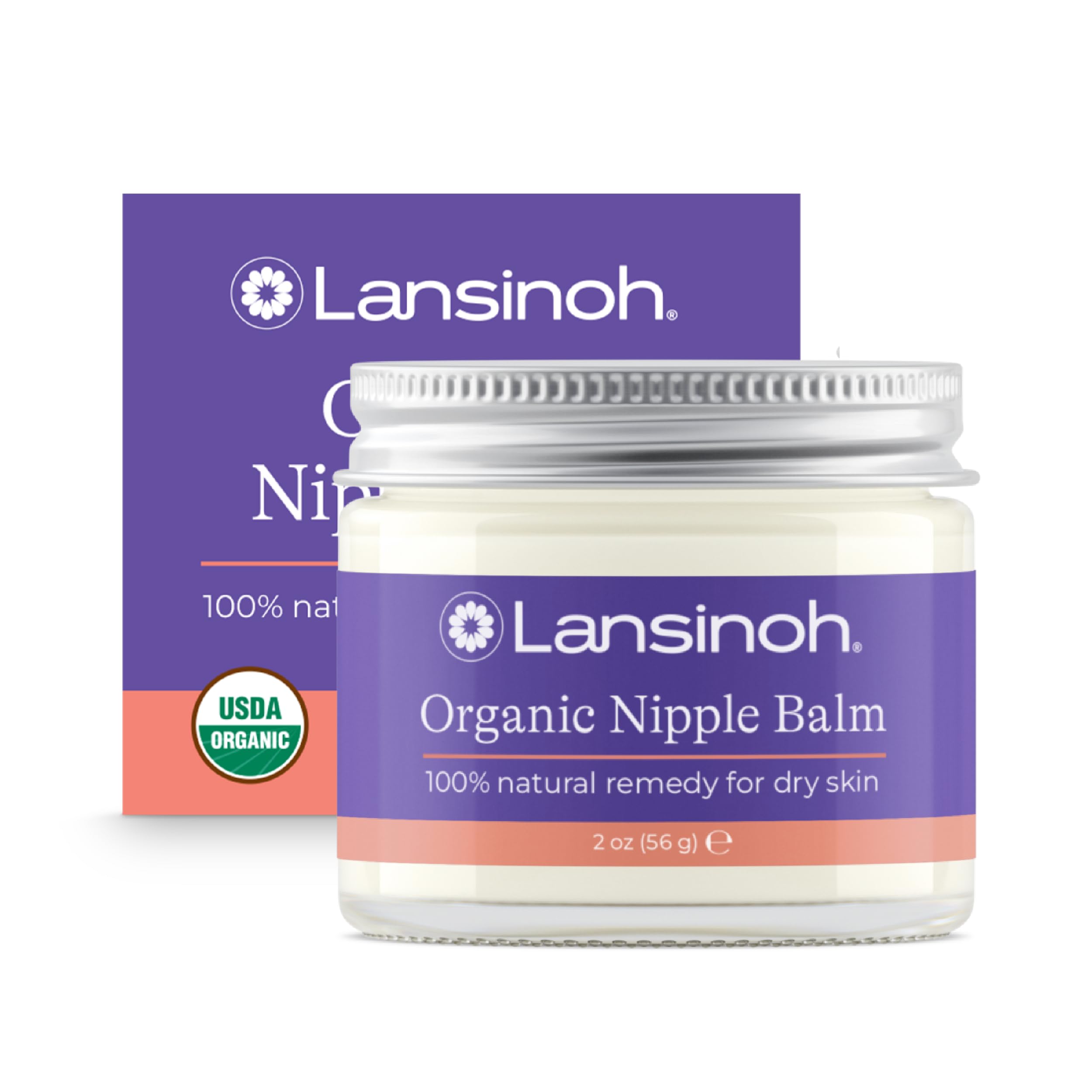
Lansinoh Organic Nipple Butter

95 /100
Trail Score Outstanding

Key details

Size
2 oz jar
Formula
7 organic plant oils and waxes
Certification
USDA Certified Organic
Rinse Before Feeding
Not needed
Check Price on Amazon

Lansinoh's organic butter comes in a small glass jar with a tin lid, and it starts melting the moment it meets your fingers. That's the appeal: one scoop turns to oil and covers the whole areola in a single pass, with no warming tricks and no dragging.

Seven ingredients, all USDA certified organic — sunflower oil, olive oil, beeswax, coconut oil, shea butter, calendula and argan oil — with no petroleum, parabens or preservatives. Like the lanolin version, there's nothing to wipe off before a feed, and the jar has a second life on cuticles and chapped lips.

The catch is that it's thin. In a warm room it slides toward an oil rather than a balm, and if you want a thick seal over a deep crack, this won't hold one. It's an everyday balm for between feeds more than a rescue product for the first week.

Where it wins for us is cost and coverage: it's the least expensive organic pick here, and because it spreads so far, a 2-ounce jar goes further than the size suggests. It's the one for anyone who wants organic and lanolin-free without paying the most in the group.

Pros

  • Seven USDA-certified organic ingredients
  • Melts to an oil, spreads in one pass
  • Nothing to wipe off before a feed
  • Least expensive organic pick here

Cons

No notable drawbacks to flag.

Our verdict

For organic ingredients without the highest price here, this is the one: it melts to an oil and covers a sore areola in one pass.

Check Latest Price
6

Stocking up

Earth Mama Organic Nipple Butter

95 /100
Trail Score Outstanding

Key details

Size
2 fl oz, 6-pack
Formula
Organic herbs and oils, lanolin-free
Certification
Non-GMO Project Verified
Check Price on Amazon

Six jars is the thing to understand about this listing. Earth Mama's butter is organic, lanolin-free, and smooth enough to spread without tugging, and it needs no wiping off — but the version here is a six-pack, which makes it a stock-up purchase rather than a single jar to try. We treat it as the stash: one at the bedside, one in the diaper bag, one at work, a couple left for shower gifts.

Each jar is 2 fluid ounces, the same as most of the singles here, so six of them is a supply measured in months rather than weeks. That's the logic of the whole thing, and it's why we'd frame it as a stash rather than a starter — if you want to try one balm before committing, buy a single jar first and come back to this when you know you like it.

Pros

  • Six jars cover bedside, bag and work
  • Organic and lanolin-free, nothing to wipe off
  • Smooth and silky on sore nipples

Cons

  • Distinct sweet scent some babies refuse
Our verdict

Worth it if you'll use six jars: organic, lanolin-free, smooth on sore skin, and one for every bag you own.

Check Latest Price
7

Diaper-Bag Backup

Honest Company Nipple Balm

91 /100
Trail Score Outstanding

Key details

Size
1.75 fl oz tube
Formula
Coconut oil, beeswax, shea butter
Made Without
Lanolin, petrolatum, synthetic fragrance
Rinse Before Feeding
Not needed
Check Price on Amazon

You can spend a lot on nipple balm, and you don't need to. Honest's balm is the cheapest per ounce of the picks here, and it comes in a tube rather than a jar — which matters more than it sounds like at 2 a.m., when you're squeezing one-handed and don't want to dip fingers into anything.

We keep it as a second balm, the one that lives in the diaper bag, because the ingredient list is short — coconut oil, beeswax, shea butter — nothing needs wiping off, and the tube survives being tossed in a tote. It's also the one to hand to anyone who wants to try a plant-based balm before committing to a jar.

Pros

  • Cheapest per ounce of the picks here
  • Tube is easy to use one-handed
  • Coconut oil, beeswax and shea, nothing to wipe off

Cons

  • Thin, oily texture can mark light clothing
Our verdict

The cheapest way to keep a balm in every bag: a tube of coconut oil, beeswax and shea that needs no wiping off.

Check Latest Price

How We Tested Nipple Creams Through Night Feeds, Pumps, and Laundry

We started by reading ingredient panels and narrowing the field to 15 widely available creams and balms, including lanolin-rich, plant-butter, and oil-based formulas. We ruled out anything with a strong added fragrance or directions that seemed unrealistic for frequent nursing—if a label called for a full wipe before every feed, we wanted to know how that felt at 3 a.m., not just on paper.

For three months, those 15 tubes lived in nursery baskets, pump bags, and bathroom cabinets. Testers used a pea-sized amount after daytime feeds, overnight feeds, and pumping sessions, noting whether it soothed on contact, whether skin felt moisturized by the next feed, and whether discomfort at latch eased over several days. We also spread each one on the back of a hand to judge consistency—thick and waxy, thin and runny, tacky or silky—and checked whether leftover cream made the next latch slippery or required wiping first.

To get at the less glamorous concerns, we rubbed each cream into white cotton nursing pads and a plain T-shirt, let them sit overnight, then washed as usual and looked for stains. We also washed a small patch from skin with warm water and baby wash to see how easily it came off, and tracked how long a sample tube lasted with frequent use so we could compare value. The formulas that scored best were the ones that felt comfortable, stayed put without leaving a heavy film, and didn’t make us dread the next feed.

How to Choose a Nipple Cream for Breastfeeding

Lanolin or Lanolin-Free?

Lanolin is the wax sheep produce to waterproof their fleece, and it's what most hospital nurseries hand out: one ingredient, highly occlusive, and it stays put through a feed. It's also animal-derived, and it's the ingredient that bothers people with a wool sensitivity. Plant-based balms built on olive oil, shea and beeswax spread more easily and often carry a faint natural scent, which some babies notice.

If you have no history either way, start with lanolin — the Lansinoh cream is the plainest version here — and move to Motherlove if your skin objects or you'd rather avoid animal products.

Texture Decides How the First Week Feels

Every balm here soothes; what separates them is how they go on. A stiff wax protects a deep crack but drags across raw skin, so warm a pearl between your fingers before you apply. A soft butter or a melting oil spreads without pressure, which is what you want when everything stings.

If you've already winced through a tube of thick lanolin, Medela's Tender Care is the creamier version of the same ingredient, and Motherlove is the silkiest plant option.

What Your Baby Will Smell and Taste

Nothing on this list needs rinsing, which means a little of whatever you use ends up in your baby's mouth. Most babies don't care. Some do, and they show it by pulling off or fussing at the start of a feed.

If that happens, wipe the breast with a damp cloth before latching or switch to a balm with no scent at all — the Tiny Human balm is odorless and tasteless by design. Earth Mama's butter, by contrast, has a distinct sweet scent that some babies refuse.

Jars, Tubes, and How Much You Actually Need

A pea-sized amount covers both nipples, applied after every feed, so a 2-ounce jar lasts most people through the sorest weeks. That makes pack size a question of convenience rather than supply: a tube is easier one-handed in the dark, a jar is easier to scrape the last of.

Two is the sensible number — one at the bedside, one in the bag. Six, as in Earth Mama's pack, only makes sense if you're stocking a nursery, a pump bag and a gift basket.

When a Balm Isn't the Answer

Nipple cream handles skin. It doesn't fix a latch, and pain that lasts through an entire feed, returns every time, or comes with cracked and bleeding skin is usually a positioning or tongue-tie question.

If soreness hasn't eased within about a week of consistent use, stop shopping for a better balm and have the latch looked at by a lactation consultant or your provider. The right cream makes a hard week easier; it won't make a painful feed painless.

Frequently Asked Questions

Final Verdict

Start with Lansinoh's lanolin cream. One ingredient, nothing to wipe off at 3 a.m., and a two-pack that puts a tube wherever you nurse — nothing else here covers the first weeks so simply for the money.

If you're avoiding lanolin, or your skin has already objected to it, Motherlove's five-ingredient butter is the better buy, and its butter-soft texture is easier on cracked skin. Anyone who finds thick lanolin painful to spread should look at Medela's Tender Care instead of giving up on the ingredient altogether.