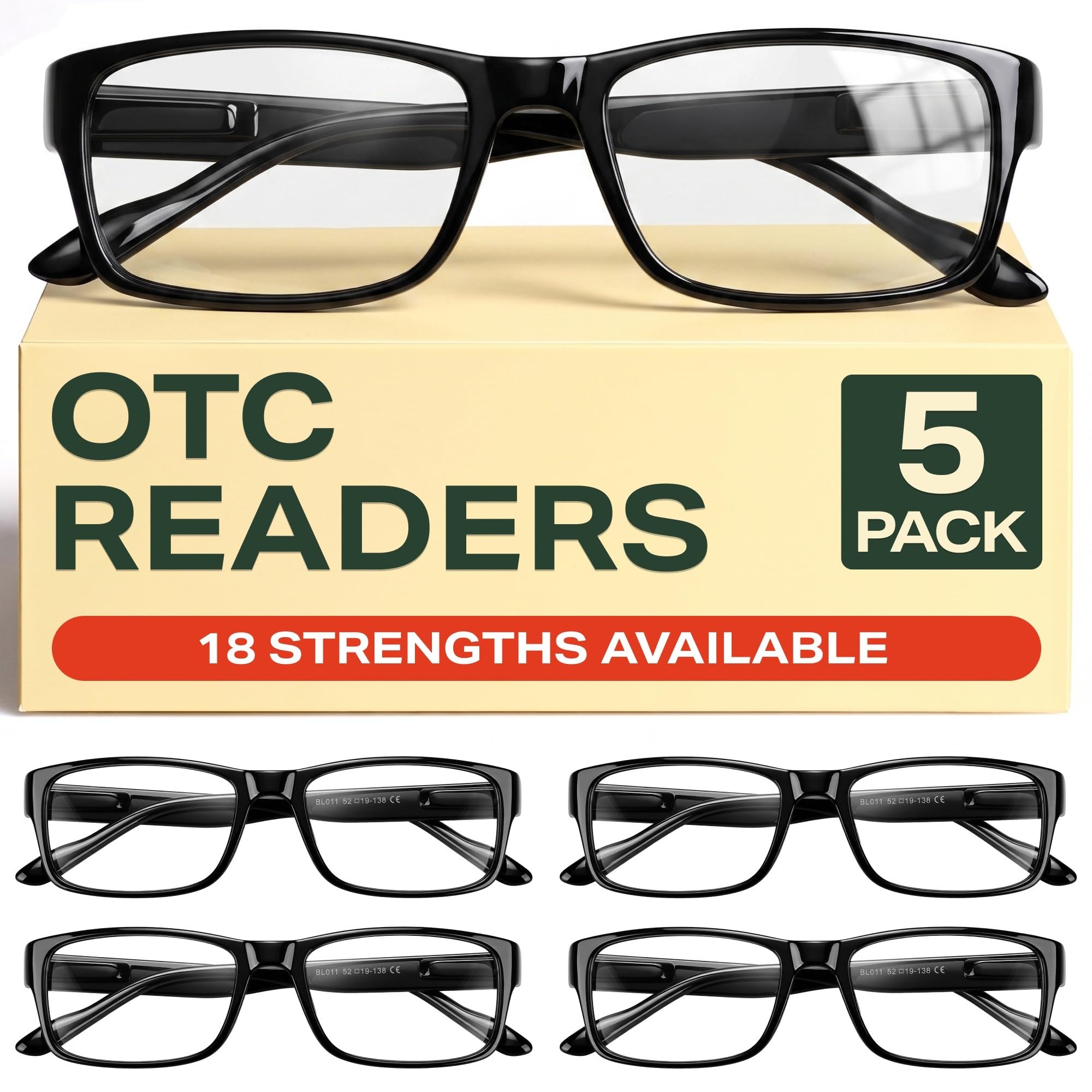
Best Magnifying Reading Glasses of 2026

The tiny print on a pill bottle is usually where it starts: your arm isn't long enough, the light isn't bright enough, and the label still won't come into focus. A good pair of magnifying reading glasses fixes that close-work problem without turning every page into a production. But lens size has to give you a useful field of view, the frame should stay steady, and the pair should feel light enough to forget. The best also look good enough to wear out, cut glare, and filter blue light without muddying the words.

We tested 16 pairs over four months in the places readers actually use them: dim restaurant menus, couch-side phone scrolling, kitchen-table sewing, and long laptop sessions. Flimsy hinges loosened, wide lenses felt great until the frame slid, and some anti-glare coatings made text dimmer rather than cleaner. Magnification matters less than matching lens size and working distance to what you do most.

1

Best Overall

Gaoye 5-Pack Reading Glasses

91 /100
Trail Score Outstanding

Key details

Pack
5 pairs
Hinges
Spring
Lenses
Blue-light filtering, anti-glare
Strength
+1.50
Check Price on Amazon

Nobody who wears readers owns just one pair. They own a trail of them: one by the bed, one at the desk, one in the car, one that vanished into a coat pocket last winter. Gaoye's five-pack answers that problem directly, and it's why we point most people here first. You get five identical pairs in a +1.50 strength with a blue-light coating and spring hinges, and nothing about them feels precious — which is the appeal. You stop treating readers like jewelry and start leaving them wherever you actually read.

The coating earns its place rather than sitting on the spec sheet. The lenses carry a faint tint, most visible against bright white paper and barely there on a monitor, and the anti-glare surface keeps an overhead lamp from turning the page into a mirror. We kept a pair at the desk through several screen-heavy afternoons and stopped noticing the tint by the second day. Spring hinges matter more than they sound, too: the arms flex when you push the frames up onto your head, so the fit doesn't loosen every time the phone rings.

What this set won't do is flatter you. The frames are plain, the plastic is ordinary, and that's the deal — a lost pair costs you a fifth of the box rather than a trip to the optical shop. If you want one pair that looks like eyewear, the metal TruVision set is the better buy. If you want a pair in every room and no anxiety about where they end up, this is the box.

Pros

  • Five pairs to stage around the house
  • Blue-light coating with real anti-glare
  • Spring hinges flex without loosening the fit
  • Light enough to forget you're wearing them

Cons

  • Hinge screws work loose and frames can crack
Our verdict

We recommend the five-pack as the default buy: clear +1.50 lenses, blue-light filtering, spring hinges, and enough pairs that one is always within reach.

Check Latest Price
2

Best for Color Variety

CCVOO Blue-Light Readers

91 /100
Trail Score Outstanding

Key details

Hinges
Spring
Lenses
Blue-light filtering
Strength
+1.50
Frame Colors
Assorted
Check Price on Amazon

The colors are the first thing you notice, and they're the reason to pick this set over a plain one. The frames run from soft neutrals through a light blue that reads more turquoise in person than it does in the listing photos, and having several to rotate means the pair on your face can match what you're wearing.

Optically these are straightforward: +1.50 lenses, a blue-light filter, spring hinges, and frames light enough that they disappear after a few minutes. The tint is subtle, and the set ships with a tiny blue-light test keychain — a gimmick we enjoyed more than we expected to. Where this set separates itself from the cheaper square frames here is the fit: they sit high on the bridge and stay there when you look down at a book.

One quirk to know about: the arms catch hair when you pull the frames off one-handed. Long-haired readers should take them off with both hands and it stops being a problem; cropped hair, or a habit of folding them onto a nightstand, and it never comes up. We rate these near the top of this group on comfort and looks, and they're the pair we hand to someone who wants readers that don't announce themselves.

Pros

  • Wide spread of frame colors
  • Secure fit that stays on the bridge
  • Subtle blue-light tint with spring hinges

Cons

  • Thin frames can break with steady use
Our verdict

If you want readers that look like something you picked out rather than something handed to you at a pharmacy counter, this colorful set is our choice.

Check Latest Price
3

Best Oversize Lens

XVXV Oversize Square Readers

90 /100
Trail Score Outstanding

Key details

Hinges
Spring
Lenses
Anti-glare, blue-light blocking
Lens Shape
Oversize square
Check Price on Amazon

A small lens makes you move your head to read a line; a big one lets your eyes do the work. These are the largest lenses in this group, and that extra coverage is the entire argument: a newspaper column, a spreadsheet, or a recipe card fits in one glance instead of three.

The square shape turned out better than we expected. It reads as a deliberate, slightly fashion-forward frame rather than a drugstore reader, and the anti-glare coating is the practical half of that — it knocks out the reflection of a window or an overhead light that otherwise lands in the middle of the page. There's a keyring screwdriver in the box, small enough to vanish in a drawer and genuinely useful the day a hinge starts to wobble.

Size cuts the other way on a narrow face. These sit low, slide down the nose, and end up being pushed back up every few minutes, so compare the total frame width against a pair you already own before ordering. On a medium or wide face the trade is worth it, and you get a reading window none of the other sets here match.

Pros

  • Largest lens here for wide reading
  • Anti-glare coating kills lamp reflections
  • Several frame colors in one set

Cons

  • One cloth case for the whole set
Our verdict

Reach for these when a small lens is the problem: the widest reading window in this group, in several frame colors.

Check Latest Price
4

Best Everyday Set

NORPERWIS 5-Pair Readers

91 /100
Trail Score Outstanding

Key details

Pack
5 pairs
Hinges
Spring
Included
5 pouches and a cleaning cloth
Strength
+2.00
Check Price on Amazon

Every pair arrives in its own soft pouch with a cleaning cloth, which sounds like packaging filler until you've had a bare pair of readers rattling around a tote bag with keys and a phone. The pouch is the difference between lenses that stay clear and lenses that look sandblasted by spring, and five pouches settle the question of where each pair lives: bag, car, desk, kitchen, bedside.

Strip away the packaging and this is a deliberately unremarkable set, which we mean as praise. The +2.00 lenses run clear rather than yellow, the magnification holds right to the rim instead of blurring at the edge, and the molded frames have no sharp corners to catch on a cheek. Spring hinges, light frames, black on black — nothing here asks for attention, and that's exactly what we want from the pair that lives in the car.

Choosing between this and the Gaoye set comes down to organization rather than optics: same idea, but the individual pouches and the uniform black frames make it easier to keep track of which pair is where. The strength is +2.00 in this variant, so match it against the pair you're replacing before you commit to five of them.

Pros

  • A pouch and cloth with every pair
  • Clear lenses with even magnification
  • Light frames with spring hinges

Cons

  • Arms run loose on narrower heads
Our verdict

The plainest, best-organized set here: five black pairs, each with its own pouch and cloth, in a strength that reads clearly across the whole lens.

Check Latest Price
5

Bold Frames, Screens

AIMISUV Square Readers

88 /100
Trail Score Excellent

Key details

Colors
Assorted
Lenses
Blue-light blocking, anti-glare
Frame Shape
Square
Check Price on Amazon

These are the frames we point to when someone wants readers that look like a choice rather than an admission. The square shape is wider than the small ovals most of us started with, the rim has real thickness to it, and the set comes in several colors you can swap to match what you're wearing.

Blue-light blocking is what this pair is actually selling, and it's the one set here where that's the headline rather than a footnote. The lenses carry a visible warm cast, and the anti-glare surface knocks back the reflection of a screen in a dim room. They also sit high on the bridge and stay there, which is more than some of the lighter frames manage.

Sizing is the thing to check. The square runs wide, so on a smaller face the rim extends past the temples and the frame sits lower than intended — compare the width against a pair you already wear. On a medium or broad face it looks intentional rather than oversized, and it's the set we pick when the readers are meant to be part of the outfit.

Pros

  • Bold square frame that sits high
  • Blue-light blocking is the headline

Cons

  • Heavy enough to mark the nose
  • Ships without a case
Our verdict

Bold square frames with the clearest blue-light pitch here, best for anyone who reads on screens and wants readers to look like a statement.

Check Latest Price
6

Metal Frames

TruVision Metal Frame Readers

89 /100
Trail Score Excellent

Key details

Pack
3 pairs
Frame
Metal
Strengths
+1.00 to +4.00
Check Price on Amazon

These are the only metal frames in this group, and they look it: thinner, closer to the prescription glasses you pick out at an optical shop than to the molded plastic sets that dominate this category. Three pairs come in the box, and the difference in appearance is the first thing anyone will notice.

Strength range is the quieter advantage. The set runs from +1.00 to +4.00, wider than anything else here, and the diopter is marked on the temple arm — useful when three pairs live in the same drawer and someone else in the house wears a different strength. The lenses are clear with even magnification edge to edge, and the frames stay light in a way metal rarely does at this size.

What you're paying for is the material and the range, and for a particular shopper that's a fair trade. If your strength sits in the usual middle, the plastic sets here do the same optical job for less. If you've been hunting for metal frames, or your eyes need +3.00 and up, this is the only set here that gets you there.

Pros

  • Metal frames that read as real eyewear
  • Strengths from +1.00 to +4.00
  • Light for a metal frame

Cons

  • Joints can separate at the weld
Our verdict

Our pick for metal frames and the widest strength range, as long as you're willing to pay the most in this group for both.

Check Latest Price

How We Chose and Tested the Best Magnifying Readers

I built the shortlist from reader recommendations and current best sellers, then filtered by lens size, frame width, magnification range, and whether the coating was described as anti-glare or blue-light blocking. We ended up testing 16 pairs over four months—not in a lab, but in the places reading glasses actually live.

For fit and size, I wore each pair through a full morning of close work, then again at night with a phone; I noted whether the temples pinched, the bridge slipped when I looked down, and whether the lens gave enough coverage for a page of small print. Durability got the pocket-and-nightstand treatment: each pair rode loose in a tote, got set down lens-first more than once, and was folded and unfolded until the hinges showed their true habits. At the table, I checked anti-glare under a bright lamp and blue-light filtering during a two-hour screen session, watching for glare spots, washed-out text, and whether the tint changed colors.

Value was the last filter: I compared what each pair delivered against its cost and noted which ones felt like a false economy once the hinges loosened or the coating smudged. Appearance got a real-world check too—coffee shop, video calls, the kind of errand where you forget you're wearing readers. Quality showed in small things: lens clarity, hinge stiffness, and whether screws stayed tight after a week in a tote. The pairs that survived all of that are the ones below; I still reach for them.

How to Choose Magnifying Reading Glasses

Match the Strength to Your Reading Distance

The number on the box is a fixed magnification for near work, not a prescription, and choosing it badly is the main reason readers end up in a drawer. Start with the weakest strength that makes print crisp at the distance you naturally hold a book, then step up only if you find yourself pushing the page away to focus. Letters that shimmer, or a need to hold the page uncomfortably close, mean you've gone too strong.

If you're unsure, buy a single pair before committing to a set. A five-pack gives you the same strength five times, which is a bargain if you got it right and a drawer full of the wrong thing if you didn't.

Let Lens Size Decide Your Field of View

A small lens is fine for a price tag, a menu, or a phone screen, because you're reading through the middle of it. For a newspaper, a spreadsheet, or a long chapter, a bigger rectangle like the XVXV's lets you take in a line without turning your head.

The trade is fit. An oversize lens hangs lower on a narrow face, rests on the cheeks, and slides when you look down. Measure the total width of a pair you already like and compare it with anything described as oversized before you order.

Check the Fit at the Temples and the Bridge

Spring hinges are worth paying for — they let the arms splay outward instead of clamping your temples, and they survive being pulled off one-handed — but they won't rescue a frame that's the wrong width. The arms should touch your head lightly, and the frame shouldn't move when you look down.

Where the frame meets your nose matters just as much. A bridge that sits high and stays put keeps the lens where it belongs; one that slides leaves you pushing the glasses up all evening. That single point separates the sets here more than any coating does.

Decide How Many Pairs You Actually Need

Five pairs sounds like marketing until you count the places you read: bedside, desk, kitchen, car, and whatever bag you carry. A set like the Gaoye five-pack costs less than buying singles and solves the search problem, but it commits you to one strength in every frame, so get the strength right first.

Cases and pouches matter more than they look. A pair that rides loose in a bag arrives at scratched lenses, and hinges are the first thing to fail on a reader that gets tossed around. The NORPERWIS set gives every pair its own pouch; the square sets here give you one case between several pairs.

Understand What Blue-Light and Anti-Glare Actually Do

Two different things get sold as one. Blue-light filtering tints the lens slightly and, for people who notice it, takes some of the sting out of a backlit screen. Anti-glare is a surface treatment that stops an overhead lamp or a window from reflecting in the middle of the page.

If you read paper under a lamp, anti-glare is the one that changes your evening. If you spend nights on a laptop, the tint is the point. Neither changes your prescription; treat both as comfort features rather than correction.

Frequently Asked Questions

Final Verdict

The Gaoye five-pack is the set we recommend to most people, because most people need readers in more than one room and this is the easiest way to make that happen: clear +1.50 lenses, a blue-light coating, spring hinges, and five chances to have a pair within reach.

If a cramped field of view is what's bothering you, the oversize XVXV frames show you far more of the page at once. If you want metal, or a strength past +2.50, TruVision is the only set here that gets you there.