Best Lumbar Support Pillows of 2026

The telltale sign of a bad lumbar pillow isn't a dramatic ache — it's the constant fidgeting by mid-afternoon. You shift, wedge a hoodie behind your lower back, and promise to sit up straighter, but the support never stays put. Over six months, my team and I tested 12 lumbar support pillows at my desk, in the car, and in a favorite armchair, watching for firmness, fit, stability, back relief, and how easy each was to adjust. The right one should make sitting feel easier without turning your chair into a contraption.

Softness is not the same as support. A plush cushion can feel lovely for ten minutes and then flatten into a decorative lump, while a firmer one may need a few days to win you over. Size matters too: too tall and it pushes you forward, too small and it misses the curve it's meant to fill. Value comes down to whether the cover washes well, the foam keeps its shape, and the pillow stays put through a full workday. The picks below earned their place.

1

Best Overall

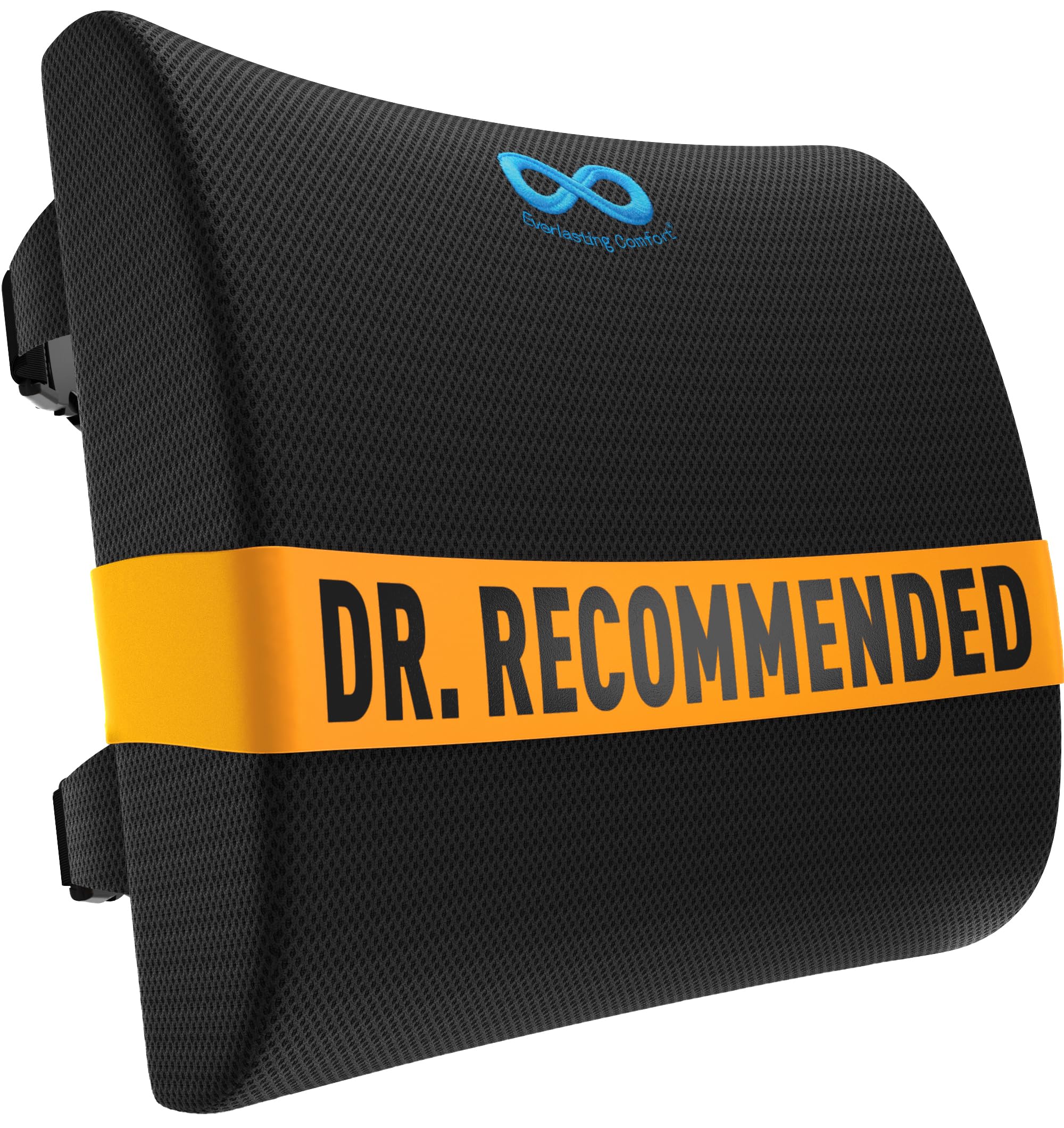
Everlasting Comfort Lumbar Pillow

89 /100
Trail Score Excellent

Key details

Size
13"L x 3.5"W x 12.6"H
Cover
Removable mesh, machine wash
Firmness
Medium
Strap Reach
Chairs up to 32 in
Check Price on Amazon

The foam is what put this at the top of our list. It is medium-firm in the way a good mattress topper is — dense enough to push back when you settle into it, and still holding its shape after a long morning at a desk instead of flattening into a pad. Set against the back of a task chair, the 12.6-inch height lands just above the belt line, right where most office chairs stop offering anything at all.

Two straps with extension pieces are why it stays there. They reach around chair backs up to 32 inches, which covers a mesh task chair, a dining chair, and most car seats, and they are long enough that you are not fighting to thread them behind a headrest. We also rate the cover: breathable mesh that unzips and goes through a cold wash, while the foam stays out of the machine and air-dries.

Maintenance is genuinely easy, and the guarantee backs it up — a lifetime replacement rather than a 30-day return, which is unusual at this level. What that buys you is patience: you can live with the pillow for a month, move it between a desk chair and a car, and still be covered if the foam disappoints.

Pros

  • Medium-firm foam holds through a full workday
  • Straps reach chair backs up to 32 inches
  • Removable mesh cover machine washes cold
  • Lifetime replacement guarantee

Cons

  • Firmness splits by build, so heavier sitters may bottom out
  • Deep 3.5-inch profile crowds a compact car seat
Our verdict

The one we hand people first: firm enough to hold your lower back through a workday, soft enough to forget, and strapped so it stays put.
Check Latest Price
2

Best for Full-Back Support

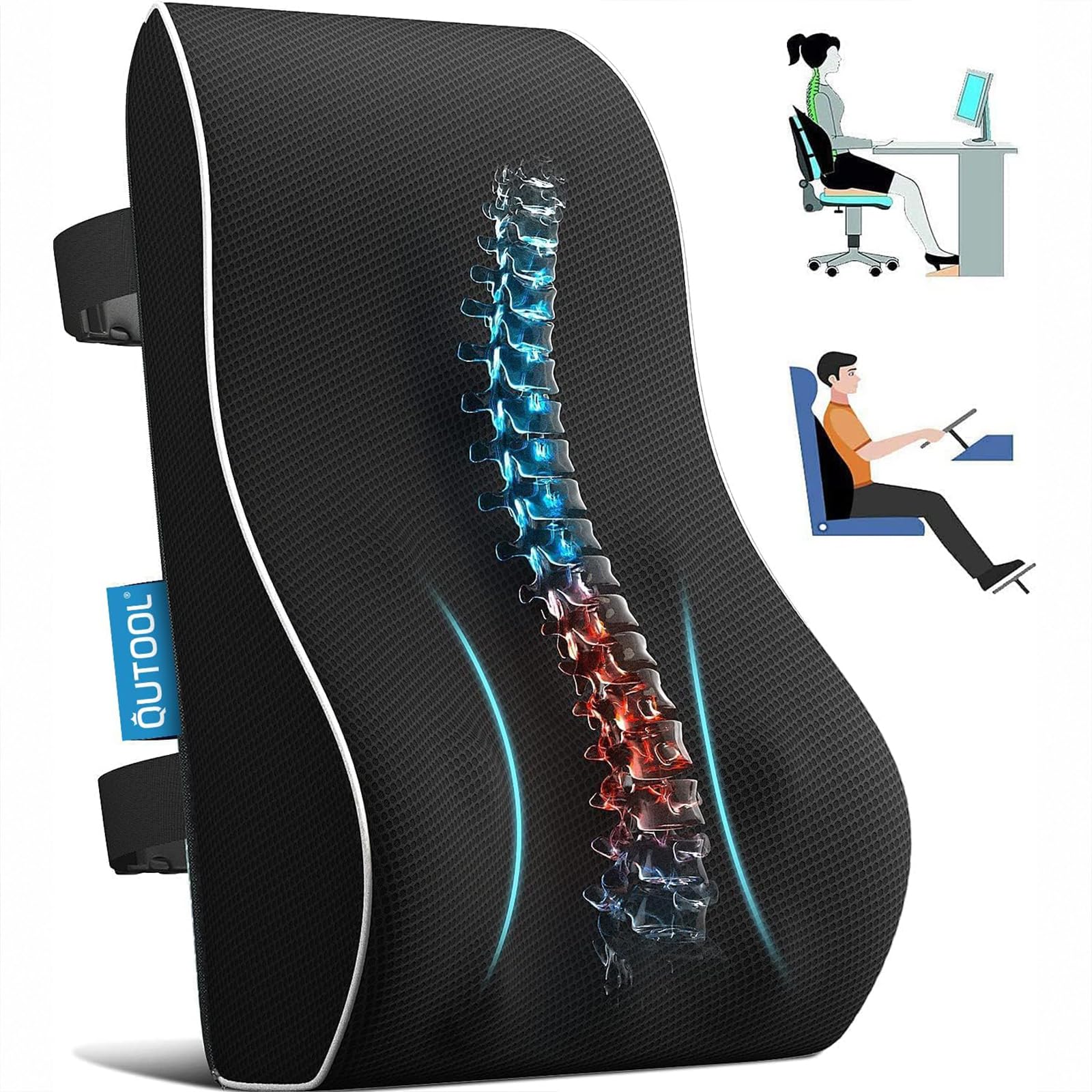
QUTOOL Lumbar Support Pillow

89 /100
Trail Score Excellent

Key details

Size
15.5"L x 4.2"W x 16.9"H
Cover
Removable 3D mesh
Weight
1.7 lb
Firmness
Medium soft
Check Price on Amazon

At 16.9 inches tall and 15.5 inches wide, this is the biggest memory-foam pillow in the group — about four inches more height than our top pick and a little more width. That is the difference between support that stops at the lumbar curve and support that keeps going into the mid-back, which matters on a chair whose own backrest is short and flat.

That extra height is why it earns a spot rather than being a bigger version of the same thing. On a straight-backed panel chair, the top edge lands somewhere useful instead of leaving a hollow you spend the afternoon slouching into. QUTOOL molds the foam into a gentle curve rather than cutting it flat, and grades it medium soft.

Two things worth knowing before you order. The straps are lengthened into the shell rather than added as separate extensions, so there is nothing to lose and nothing to re-thread when you move it. And if you are short through the torso, run a tape from the seat to your shoulder blades first: 17 inches of pillow on a low seat can reach higher than you expect, which feels very different from lumbar support.

Pros

  • Nearly 17 inches of back coverage
  • Molded curve rather than a flat slab
  • Lengthened straps, no separate extensions to lose
  • Removable 3D mesh cover

Cons

  • Medium-soft foam may feel too yielding at a desk
Our verdict

For a chair with a short, flat backrest and an ache that sits above the belt line, the extra four inches of height is the whole reason to choose it.

Check Latest Price
3

Best for Commuting

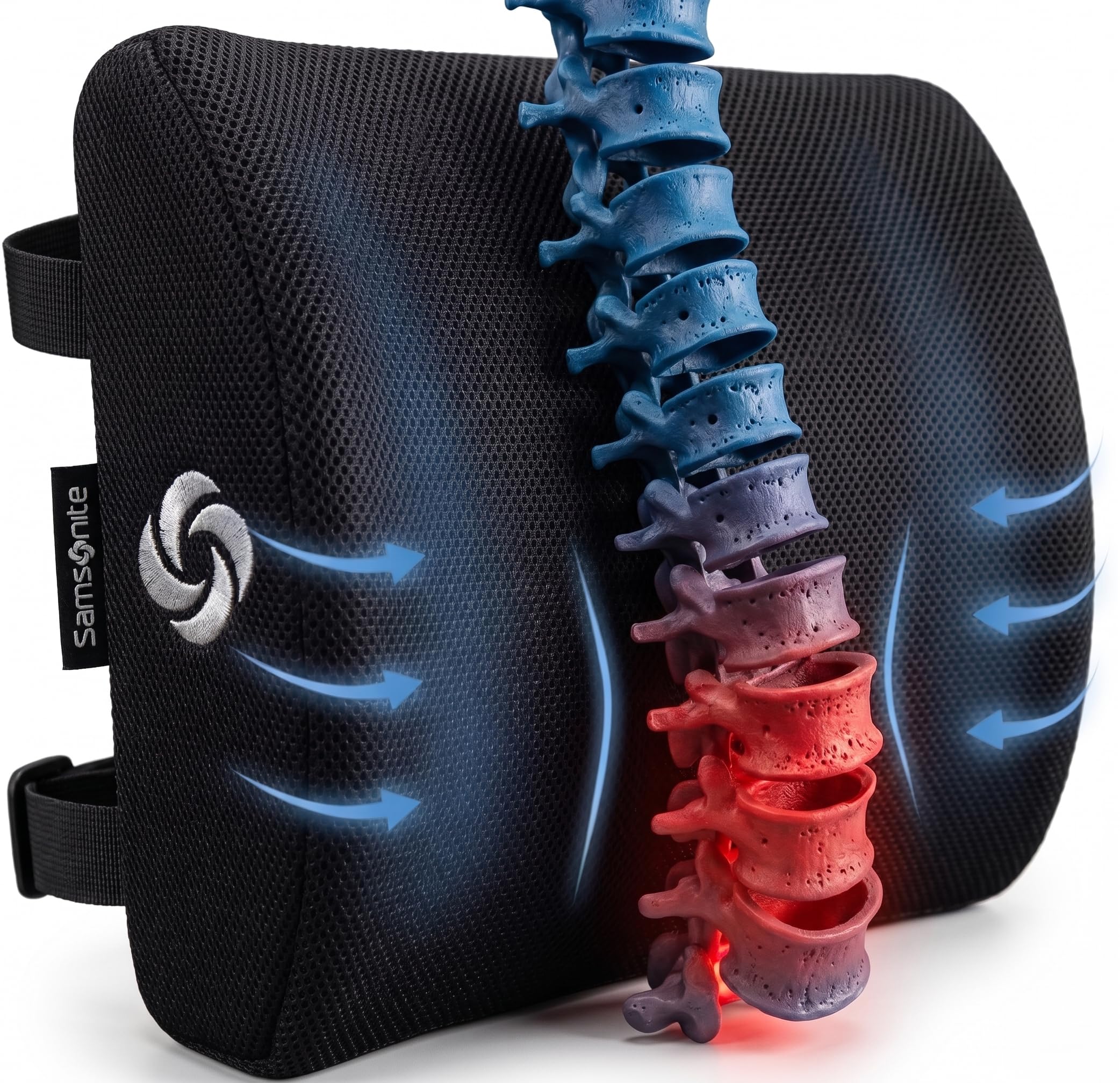
Samsonite Lumbar Support Pillow

89 /100
Trail Score Excellent

Key details

Size
14"L x 4"W x 13.5"H
Cover
Ventilated mesh
Weight
1.3 lb
Firmness
Medium firm
Check Price on Amazon

At 1.3 pounds and 13.5 inches tall, this is the lightest of the memory-foam pillows here. It is the one that goes into a tote beside a laptop and does not get left behind in the car, and the ventilated mesh cover keeps the back of a shirt from going damp on a warm drive.

What earns it a place is the curve rather than the weight. Samsonite's contour is a medium-firm scoop that sits you slightly more upright without feeling like a plank, and it fills the gap a mesh task chair leaves at the base of the spine. We preferred the deeper pillows for a long drive; for a twenty-minute commute or a short flight, this is the one that gets used because it is the one that is actually there.

The straps are the part to watch. They are elastic and they carry the cushion more than they grip the seat, so on a smooth, polished backrest it works its way down over a morning — loop the strap under the seat-back frame rather than over the top and it holds. Coverage is the standard 30-day return rather than a lifetime guarantee, which is worth knowing if you keep a pillow for years rather than months.

Pros

  • 1.3 pounds, easy to carry anywhere
  • Ventilated mesh cover stays cool
  • Contoured medium-firm scoop supports the lumbar curve

Cons

  • Medium-firm foam can feel hard by late afternoon
Our verdict

The pillow that lives in a bag: light, compact, and supportive enough for a commute or a short flight without hauling a full cushion around.

Check Latest Price
4

Best for Couches and Deep Seats

Niceeday Full Back Lumbar Pillow

89 /100
Trail Score Excellent

Key details

Size
16.31"L x 4.69"W x 17.94"H
Cover
Removable 3D mesh
Firmness
Soft
Strap Reach
19 to 50 in
Check Price on Amazon

The straps run from 19 to 50 inches, wider than anything else here, and that is the whole reason this pillow is in a roundup of desk-chair cushions. Fifty inches gets around a sofa back, a recliner, a bench seat, or the thick shell of a gaming chair — places where a shorter strap gives up halfway.

The shell is a full-back wedge: 17.94 inches tall, 16.31 wide and 4.69 deep, so it covers from the base of the spine up past the mid-back. The 3D mesh cover zips off for the wash, and the foam sits on the soft side of the group — closer to a cushion than to a support pad.

It earns its place because the seat being fixed usually is not a desk chair. Set into a recliner or the corner of a couch, the height and the softness work together: you sink in a little and the wedge fills the hollow the furniture leaves behind. At a desk the same softness is a liability — if you want to be held upright for eight hours, our top pick and the DMI both push back harder. And it is a tall panel, so check where 18 inches lands on your own back before you commit; on a low couch seat the top edge can reach your shoulder blades.

Pros

  • Straps adjust from 19 to 50 inches
  • Full-back wedge covers past the mid-back
  • Removable, washable 3D mesh cover

Cons

  • Soft foam bottoms out under a heavier sitter
Our verdict

For couches, recliners, and deep seats with thick backs, the long straps make this the easiest of the group to anchor.

Check Latest Price
5

Best Thin Option for Cars

Dreamer Car Lumbar Support Pillow

89 /100
Trail Score Excellent

Key details

Size
16.9 x 20.9 in
Cover
Removable plush
Straps
Two elastic
Thickness
2.4 in
Check Price on Amazon

Two and a half inches is thin for this category, and that is exactly why we kept it. Most lumbar cushions push you two or three inches forward, which in a car means a shorter reach to the wheel and knees closer to the dash. This one adds support without changing where you sit — the difference between a cushion you notice and one you forget about.

The panel is 20.9 inches wide and 16.9 tall, so it spreads across the whole seat back rather than concentrating at the lumbar curve, and the slow-rebound memory foam softens with body heat. Two elastic straps hold it to a bucket or bench seat, and the plush cover unzips for the wash.

The cover is plush rather than mesh, which is pleasant in winter and warmer than the mesh picks in summer, and at 1.6 pounds it moves between cars without any fuss. If you already know you want more push than memory foam gives, the DMI sits at the other end of this group.

Pros

  • 2.4 inches thick, so your driving position stays put
  • 20.9-inch panel covers the whole seat back
  • Two elastic straps hold it to bucket or bench seats
  • Removable plush cover

Cons

  • Yielding foam suits lighter sitters better
Our verdict

If your car seat already fits you and you just need the lower back filled in, 2.4 inches of foam does it without moving you forward.

Check Latest Price
6

Best Roll-Style

OPTP McKenzie Lumbar Roll

88 /100
Trail Score Excellent

Key details

Size
11 in long, 4.75 in diameter
Cover
Removable, hand wash
Weight
5.5 oz
Firmness
Standard density
Check Price on Amazon

A cylinder behaves differently from a cushion. This one is about 11 inches long and 4.75 in diameter, and it puts a single firm ridge exactly at the lumbar curve while leaving the rest of your back untouched — closer to what a physical therapist does with a rolled towel than to a padded chair back.

At 156 grams it moves between a desk chair and a car without a second thought, and the cover is a moisture-wicking polyester that unzips. The 1.5-inch elastic strap goes around the chair back or around your waist, and the waist is the more reliable of the two: on a smooth office chair the roll will slide down over an hour, and wearing it means it cannot.

Nothing else here lets you find the exact spot that aches and hold pressure there, which is why it stays in the group. Standard density is the softer of OPTP's two foams, so order the firm one if you want real resistance — and because it is a roll rather than a panel, it also works on seats too narrow for a full-width cushion.

Pros

  • Roll shape targets one precise point
  • 156 grams, easy to move between seats
  • Strap works around a chair back or your waist
  • Firm density also available

Cons

  • Cover is hand wash only
Our verdict

For support at one precise spot instead of across the whole back, nothing else in this group works quite like this foam roll.

Check Latest Price
7

Best for Travel

Therm-a-Rest Lumbar Travel Pillow

88 /100
Trail Score Excellent

Key details

Fill
Self-inflating die-cut foam
Size
16"L x 2.4"W x 7"H
Weight
4.23 oz
Firmness
Adjustable valve
Check Price on Amazon

There is a valve at one end, and it changes what kind of product this is. Open it and the die-cut foam pulls air in until the pillow fills out; twist it shut and the shape locks. Bleed a little air out and it softens, which is the one thing none of the foam cushions here can do mid-sitting.

Fully inflated it measures about 16 inches across and 7 inches tall — a lumbar band rather than a full back cushion. That is the right proportion for an airplane seat or a stadium bench, where you want something between you and a hard shell without a panel pushing your shoulders forward.

Packed down it is roughly the size of a water bottle and weighs 120 grams, so it disappears into a laptop bag. Of everything here, this is the one that actually gets carried, and the one whose firmness can be changed in the middle of a flight without standing up.

The cost of that is coverage: it supports the lumbar curve and nothing above it, so if your ache sits higher, a taller foam panel does more. What the valve gives back is tuning — twist it shut firmly, because on a long trip it can lose a little air, and a quarter turn brings it back.

Pros

  • Valve adjusts firmness as you sit
  • Packs to water-bottle size at 120 grams
  • Works on planes, trains and office chairs

Cons

  • Priciest pillow in this group
Our verdict

The one that actually travels: it rolls down small, weighs almost nothing, and lets you dial firmness with a twist of the valve.

Check Latest Price
8

Firm, Rigid Support

DMI Contoured Lumbar Pillow

88 /100
Trail Score Excellent

Key details

Size
14 x 13 x 5 in
Cover
Washable, breathable
Insert
Removable wooden board
Firmness
Firm
Check Price on Amazon

There is a rigid wooden board in the box, and it slides into a pocket behind the foam. Leave it out and you have a firm contoured cushion; put it in and the pillow stops giving almost entirely. Nothing else here lets you change the feel that much without buying a second product.

The foam is contoured and dense — 14 by 13 inches and 5 inches deep, the deepest cushion in this group — with a washable breathable cover and straps for the chair back. The depth is the number to sit with: it means real support, and it means you sit noticeably further forward than you did.

On a soft couch or a worn office chair that is a fair trade, because the extra depth reaches a hollow the chair has stopped filling. On a bucket seat it can be too much, so try it with the board out first and add the board once your back has adjusted to the shape.

What keeps it in the guide is that a group of sitters — the ones who have flattened every soft cushion they have tried — has nothing else here aimed at them. The board is the reason: it turns a pillow into something closer to a chair's own lumbar adjustment, and you can pull it out again on a day when your back wants softness.

Pros

  • Removable board adds rigid support
  • Five-inch depth fills a worn-out chair
  • Washable breathable cover
  • Firm foam that resists collapsing

Cons

  • Strap is short for thick chair backs
Our verdict

The firm end of this group, and the pick to try when every memory-foam pillow has collapsed under you by lunchtime.

Check Latest Price

How We Tested 12 Lumbar Support Pillows

We started by narrowing a long list of lumbar pillows using specs, size ranges, materials, and price, then ordered 12 that represented different firmness levels and shapes. Testing ran for six months. Each pillow went through ordinary sitting: full workdays at a desk, a couple of long drives, evening reading in an armchair, and a few train trips. I noted where the cushion landed against my lower back, whether it stayed there when I leaned or shifted, and how I felt at hour one versus hour six.

Firmness and softness got separate attention. I pressed a palm into each pillow, sat through meetings, and checked whether the foam bottomed out or kept its shape after repeated use. A plush cover could feel nice against a shirt, but if the filling collapsed by lunchtime, it didn't count as supportive.

For fit and size, I measured each pillow against the chair back and noted whether it pushed my shoulders forward, left a gap, or felt bulky in the car. Stability was easy to judge: straps, textured backs, and shaped edges either kept the pillow in place through braking, leaning, and standing up, or they didn't.

Back relief was the final test, and the most personal. I tracked whether discomfort eased over a workday or simply moved to a different spot, and whether I reached for the pillow again the next morning. Quality and value came down to details I could see and feel: seams, cover washability, foam rebound, and whether the adjustments were simple enough to use without reading instructions. The pillows that scored best did not necessarily feel the softest at first touch; they were the ones I stopped noticing because they stayed put and made sitting easier.

How to Choose a Lumbar Support Pillow

Firmness Is the Choice You Live With

Almost every pillow in this category comes in a single firmness, and the gap between medium-soft and firm is bigger than the gap between brands. Soft foam lets you sink until the cushion takes your shape; firmer foam holds you off it and keeps the curve. If you have tried memory foam before and ended up with a flat pad by mid-afternoon, you want the firm end — the DMI's removable board and the OPTP roll's firm density both exist for exactly that reason.

The exception is a pillow you set yourself. The Therm-a-Rest holds its shape with air rather than foam density, so firmness is a twist of the valve each time you sit down, which is worth the fiddling if your back wants something different on a Monday than it does on a Friday.

Depth and Height Change How You Sit

Thickness is the specification that decides whether you will actually use the thing. The picks here run from 2.4 inches on the Dreamer Car to 5 on the DMI, and every extra inch moves you forward on the seat. In an armchair that is fine; in a car it shortens your reach to the wheel and the pedals, so measure before you commit rather than after.

Height is the other half of the decision. A roll or a low band supports the lumbar curve and nothing else, while a 17-inch panel runs into the mid-back. Neither is better in the abstract — a tall panel on a low seat simply ends up pressing somewhere you did not ask it to.

Straps, Grip, and Staying Put

Strap length is the most overlooked number on the listing. Some pillows reach around 32 inches of chair back, which covers a task chair and most car seats; the Niceeday runs 19 to 50, which is what you need for a couch or a recliner. Measure the back you plan to wrap, not the seat.

Elastic straps hold a cushion to a seat but do not grip a polished surface, so if yours keeps sliding, re-route the strap under the seat-back frame instead of over the top. A waist strap, like the one on the OPTP roll, is the surest fix of all: the pillow cannot travel anywhere your body does not.

Match the Pillow to the Seat You Actually Sit In

An office chair wants a strapped panel you can leave in place; a car wants something thin that does not change your driving position; a couch wants long straps and a taller back; a plane wants whatever packs flat. Buying for the wrong seat is the most common way these end up in a closet.

The trap is reading compact or portable as a fit guarantee. Those words describe how a pillow travels, not whether it suits your chair, so compare the pillow's own dimensions against the height and width of your seat back before you order.

Care, Covers, and the Long Run

Foam never goes in a washing machine. Every pick here has a removable cover, and most take a cold machine wash, but the OPTP roll and the Therm-a-Rest are hand wash only — worth knowing before you buy something you plan to use every day.

Temperature matters too. Memory foam stiffens in a cold car and softens in a warm room, so judge firmness after the pillow has sat at room temperature rather than straight out of a winter delivery box.

Frequently Asked Questions

Final Verdict

Start with the Everlasting Comfort. It has the best chance of fitting a chair you have not measured, the foam holds its shape through a workday, and the washable cover keeps it in use rather than in a closet. If your chair's backrest is short and flat, the taller QUTOOL covers ground the Everlasting Comfort leaves open.

For a car seat that already fits you, the thin Dreamer Car panel adds support without shortening your reach to the wheel. And if one precise point of pressure does more for you than a broad cushion, the OPTP roll is the different shape worth trying.