Best Lumbar Support for Car Seats of 2026

A lumbar support is the car accessory you don’t think about until your lower back starts complaining around mile 40. The right one fills the gap between seat and spine so you sit taller, shift less, and get out without that folded-over feeling. The wrong one slides down the seat, pushes you forward, or feels like a rock after 20 minutes. I’ve driven with a rolled-up jacket behind my back; improvisation has a short shelf life.

Over the past three months, my team and I have logged commutes, errands, and weekend road trips with 12 lumbar supports. We paid attention to what changes a drive: how firmly each one presses into the low back, whether it stays put when you get in and out, how easy it is to tune without pulling over, and whether the cover feels decent against a shirt. The best ones disappeared into the seat; the weakest made us want to take them out at the first red light. Here’s what held up.

1

Best Overall

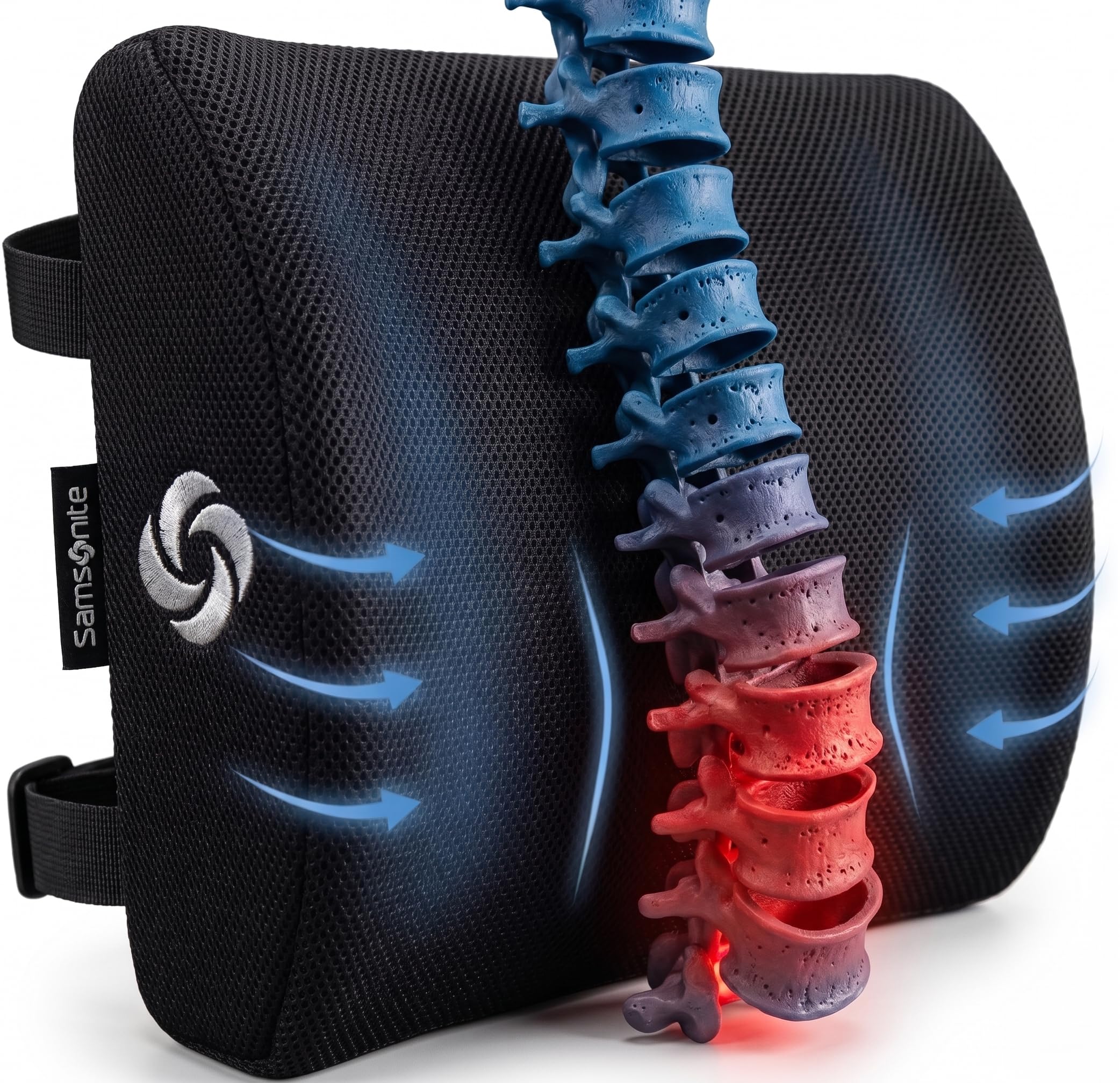
Samsonite Lumbar Support Pillow

89 /100
Trail Score Excellent

Key details

Fill
Contour memory foam
Cover
Ventilated mesh, removable
Weight
1.3 lb
Dimensions
14"L x 4"W x 13.5"H
Check Price on Amazon

Four inches of foam and 1.3 pounds does not sound like much until you have driven an hour with a deeper cushion behind you: the seatback moves away, your knees come up, and you end up perched on the front edge of the seat. The Samsonite is the cushion here that avoids that. It is the lightest of the full-size memory foam options we compared, and its 14-by-13.5-inch face is shaped around a car seat rather than a desk chair.

That restraint is why it is our top pick. The foam is medium firm, with enough resistance to keep your lower back from rounding into the seat and not so much that you feel braced against a board. The ventilated mesh cover makes a difference on a summer commute when the car has been sitting in the sun, and in ordinary driving the two elastic straps kept it where we set it.

The straps are also the weak point. They are elastic and carry little of the cushion's weight, so the pillow can sag or slide down when you get out, and you may find yourself nudging it back up after a week of short trips. Taller drivers and anyone who wants padding above the belt line should look at a taller panel; this one is deliberately low-profile.

Where it earns its keep is the everyday case: a commute, a school run, two hours on the highway, in a car whose seat was built for somebody else's back. The cover unzips and machine-washes cold, and the foam itself should stay well away from the machine, which is worth knowing before the first coffee spill.

Pros

  • Compact shape leaves legroom and seat depth alone
  • Medium-firm foam supports without feeling like a plank
  • Light enough to swap between cars
  • Ventilated mesh cover stays cooler

Cons

  • Elastic straps let it sag when you get out
Our verdict

The one we point most drivers to: medium-firm foam in a compact, light shell that won't shove you forward or eat your legroom.
Check Latest Price
2

Best for Car and Desk

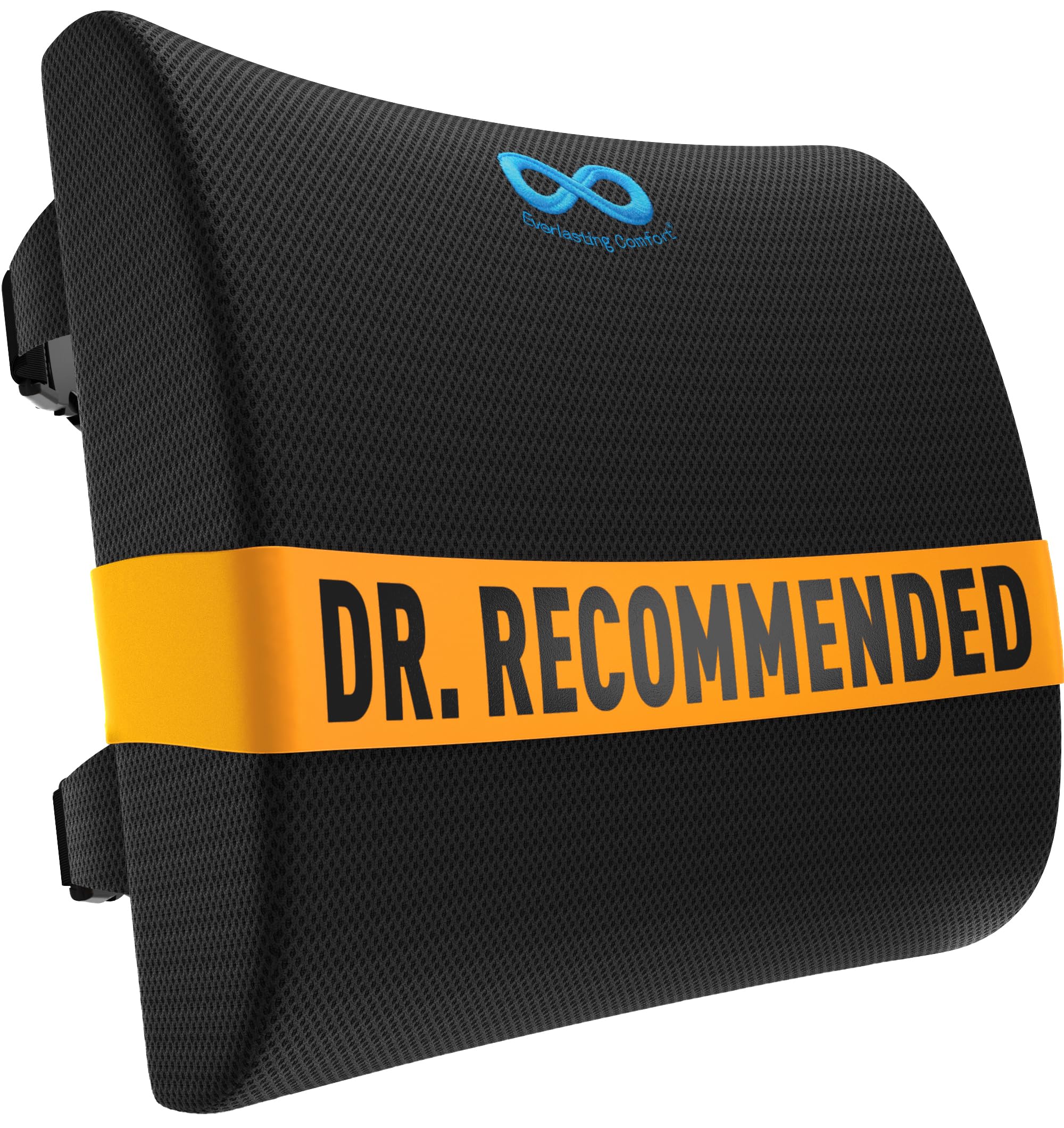
Everlasting Comfort Lumbar Pillow

89 /100
Trail Score Excellent

Key details

Fill
Memory foam, medium
Straps
Dual adjustable with extensions
Weight
1.5 lb
Dimensions
13"L x 3.5"W x 12.6"H
Check Price on Amazon

If your seat is roomy, a truck, a big SUV, a wide captain's chair, this is the one we hand you instead of the Samsonite. The Everlasting Comfort is taller and thicker, with dual straps and extension pieces that reach around seats up to 32 inches, and its contoured memory foam is medium density, so it gives before it pushes back. It is the cushion we choose for a seat that already has some shape rather than a flat bench.

The foam follows the curve of the lower back, and the mesh cover breathes well enough that we stopped noticing it on warm drives. What we appreciate most is the strap setup: two straps plus extensions hold on a wide seat where a single elastic band tends to creep. The lifetime replacement guarantee is unusual in this group and worth knowing about before you buy.

The catch is size. In a compact car, the same bulk that fills a big seat can crowd your hips and push you toward the wheel, and heavier sitters may sink through foam that feels just right to someone lighter. If your cabin is tight, one of the thinner picks here is the better fit; if it is not, this is the most forgiving cushion in the set.

Pros

  • Straps plus extensions reach seats up to 32 inches
  • Contoured memory foam with breathable mesh
  • Cover removes for machine washing
  • Lifetime replacement guarantee

Cons

  • Bulk crowds compact car seats
Our verdict

We recommend it for roomier seats: long straps, breathable mesh, and enough foam to make a wide captain's chair feel properly supported.

Check Latest Price
3

Best for Tall Drivers

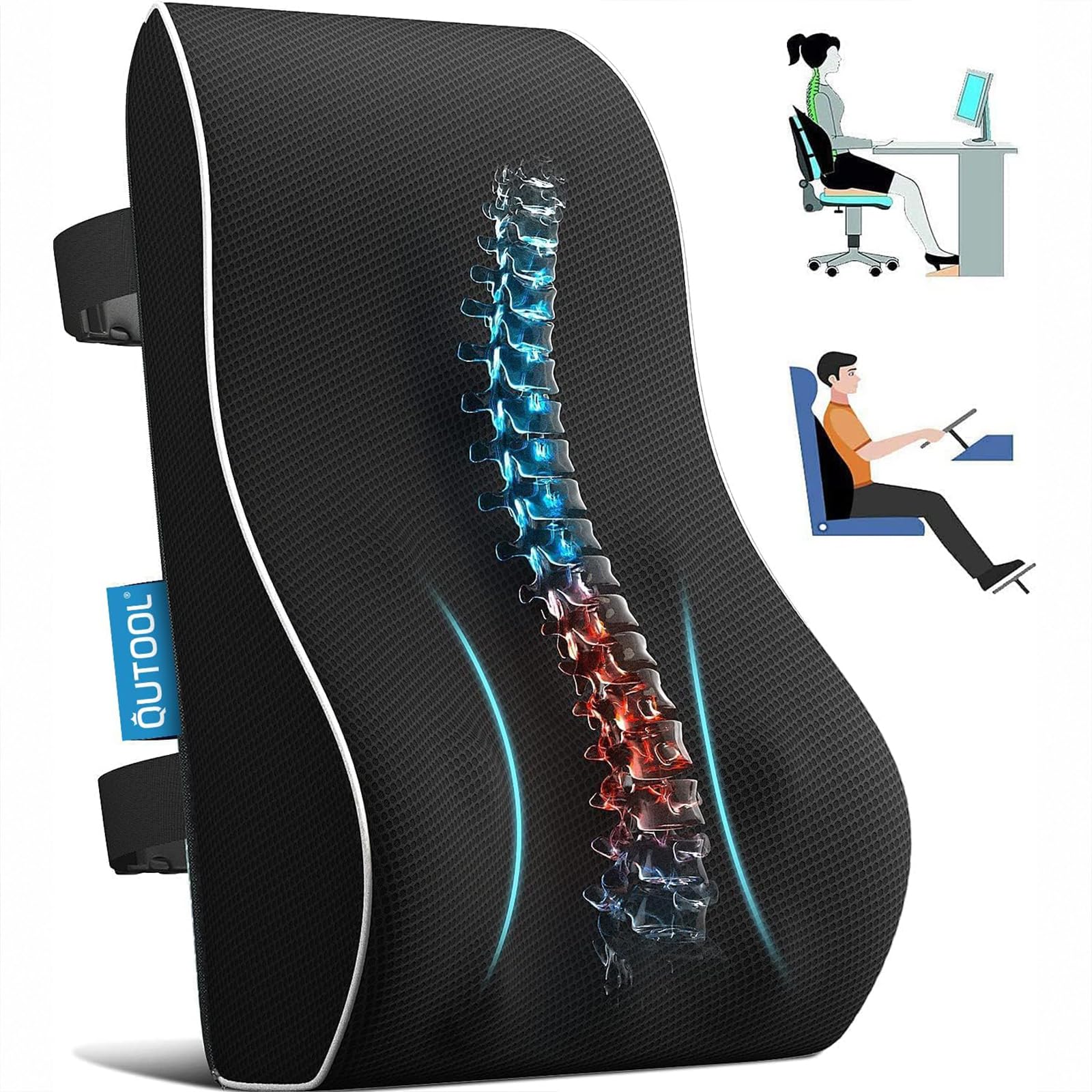
QUTOOL Lumbar Support Pillow

89 /100
Trail Score Excellent

Key details

Fill
High-density memory foam
Weight
1.7 lb
Firmness
Medium soft
Dimensions
15.5"L x 4.2"W x 16.9"H
Check Price on Amazon

If the lumbar bump built into your car seat lands below your actual lower back, a 12- or 13-inch cushion just puts padding in the wrong place. The QUTOOL is 16.9 inches tall, so support runs from your waist up past your belt line, and you can flip the panel to move the shaping higher or lower depending on where you want it.

The fill is a molded high-density block rather than a soft slab, and the 3D mesh cover unzips for washing. QUTOOL lengthened the two straps rather than adding extension pieces, which keeps the back of the seat flatter, a small thing that matters when you are tall enough to feel every ridge through the seatback.

We like it for long-torso drivers and for trucks with a high, upright backrest, and it is the taller cushion we trust most in this group. The trade-off is that length: shorter drivers may find the top of the panel pressing between the shoulder blades, so sit in the seat and check where that top edge lands before you commit.

Pros

  • Tall panel covers more of the back
  • Straps lengthened instead of extended
  • Molded foam holds its shape
  • Washable 3D mesh cover

Cons

  • Firmness draws complaints in both directions
Our verdict

We reach for this one when the seat's built-in lumbar sits too low; the taller panel puts support where your back actually needs it.

Check Latest Price
4

Best for Trucks and SUVs

Niceeday Lumbar Support Pillow

89 /100
Trail Score Excellent

Key details

Cover
3D mesh, removable
Weight
1.6 lb
Dimensions
16.31"L x 4.69"W x 17.94"H
Strap Range
19 to 50 inches
Check Price on Amazon

Nineteen to fifty inches of strap is more than a sedan needs and exactly what a truck bench or an SUV with a thick, power-adjustable backrest calls for. The Niceeday adjusts across that whole span, which is why it is the one we hand to pickup owners first.

It is also the tidiest build in this group. The cover, stitching, and foam feel better finished than the price suggests, and the whole cushion weighs 1.6 pounds, light enough to move between vehicles without thinking about it. The face is a full 16 by 18 inches, so it covers the lower and mid back rather than just the lumbar curve, and the foam sits on the soft side of medium.

Two things to know before you order. At 4.7 inches deep it takes more seat depth than the thin pads here, and drivers who already sit close to the wheel notice that first. The fill is also soft enough to bottom out under a heavier driver, which reads as flat rather than supportive in a seat that already does half the work.

Pros

  • Straps adjust from 19 to 50 inches
  • Full lower and mid-back coverage
  • Light enough to move between vehicles
  • Well-finished removable mesh cover

Cons

  • Deep foam costs seat depth
  • Soft fill can bottom out under heavier drivers
Our verdict

Our pick for trucks and SUVs: the strap range reaches seats nothing else here wraps, and the panel covers the mid back too.

Check Latest Price
5

Best Medium-Firm Feel

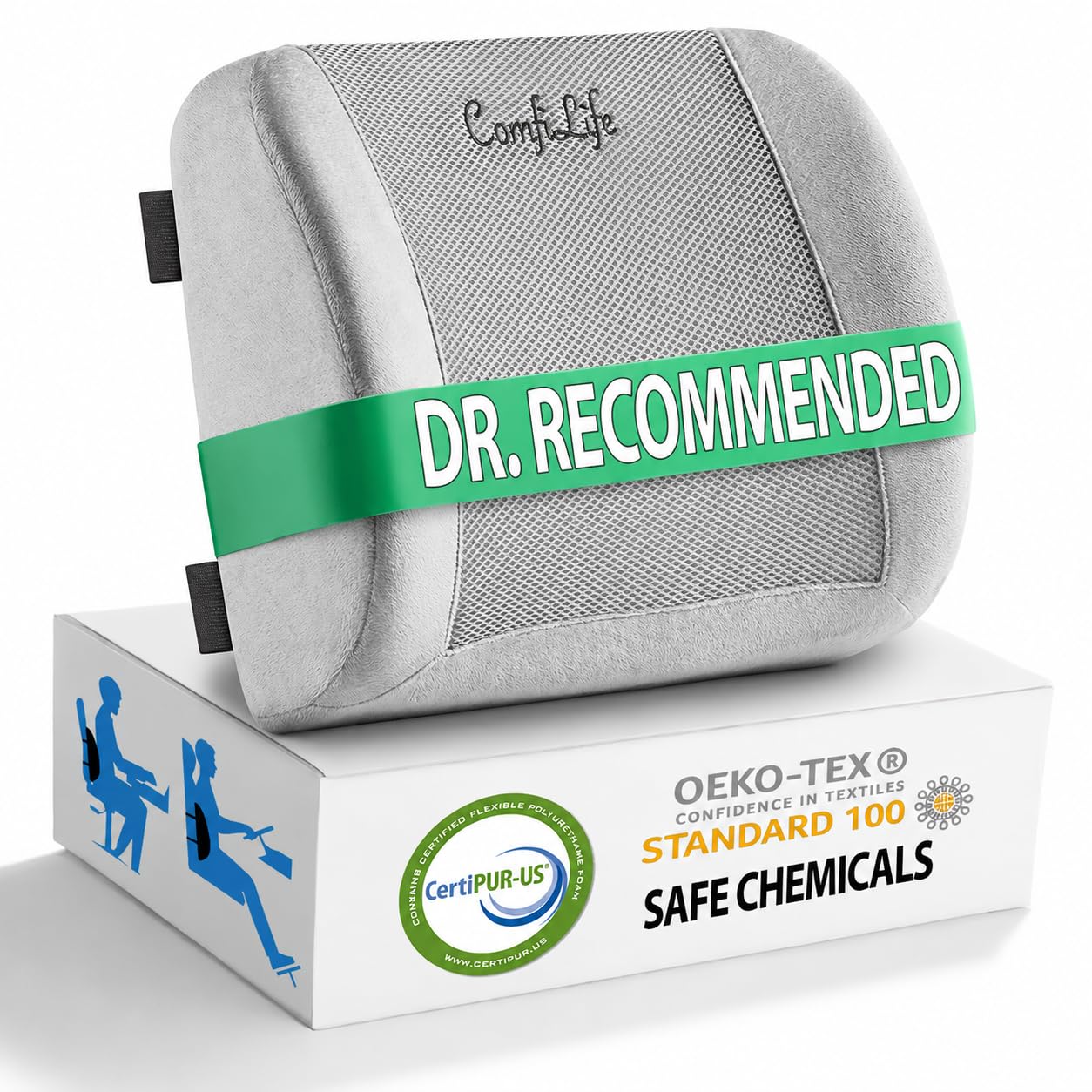
ComfiLife Lumbar Support Pillow

89 /100
Trail Score Excellent

Key details

Fill
Heat-responsive memory foam
Weight
16 oz
Firmness
Medium firm
Dimensions
15"L x 12.5"W
Check Price on Amazon

Memory foam is heat- and weight-responsive, and ComfiLife says so outright: it feels softer in a warm car and firmer on a cold morning. That is not a defect, but it is the thing to know before you buy, because a cold cushion is a firm cushion for the first stretch of a winter commute.

The shape is a classic S-curve panel, 15 by 12.5 inches and about a pound, contoured to fill the gap between the lower back and the seatback. The 3D mesh cover is ventilated and removable, and the single elastic strap adjusts to most seats.

Where it slips is attachment. One strap and no non-slip backing means it can ride up or shift sideways on smooth leather over a long drive, and the fix is to thread the strap tight and low, right at the base of the seatback so your hips pin the bottom edge. The cover is also hand wash only, a nuisance next to the machine-washable covers on most of this list.

In steady use it is the most comfortable of the medium-firm group, and the lifetime warranty backs a cushion we expect to keep in the car for years. It suits a driver who wants one cushion for both the commute and the desk and does not mind re-seating it now and then; if you need something welded to a leather seat, the two-strap picks here are the safer bet.

Pros

  • Contoured S-curve supports the lower back
  • Ventilated removable mesh cover
  • Holds its shape through long sitting
  • Lifetime warranty

Cons

  • Cover must be hand washed
Our verdict

We choose it for long, steady sitting: medium-firm foam that holds its shape and a vented cover that does not turn into a heat pad.

Check Latest Price
6

Best Thin Profile

Dreamer Car Lumbar Support Pillow

89 /100
Trail Score Excellent

Key details

Cover
Removable plush, machine washable
Straps
Two adjustable elastic
Weight
1.6 lb
Thickness
2.4 inches
Check Price on Amazon

Two straps instead of one is the detail that makes this the cushion we reach for on bad roads. The Dreamer Car runs a pair of adjustable elastic straps across the back and adds an anti-slip face, so it stays centered when the car is working, over potholes, through tight turns, up a gravel driveway, rather than creeping toward one hip.

At 2.4 inches it is the thinnest full pad here, and that changes the driving position less than a 4-inch block does: your knees stay where they were, your reach to the wheel stays the same, and the seat under your thighs still supports them. It is a whole-back pad rather than a lumbar roll, covering lower, middle, and upper back in one panel, with a plush removable cover that goes in the machine.

The flip side of covering the whole back is that you get padding where you may not want it. Drivers who only need lumbar support find the upper section pushing their shoulders forward, and the pad can shift inside its cover on hard cornering. If you want pure lumbar and nothing else, a shorter cushion fits better; if you want your whole back held, this is the one.

Pros

  • Two straps and an anti-slip face
  • Thin 2.4-inch profile keeps legroom
  • Whole-back coverage in one panel
  • Machine-washable cover

Cons

  • Upper-back padding pushes some drivers forward
  • Pad can shift inside its cover on turns
Our verdict

We like it for tight cabins: two straps that stay put, and a 2.4-inch pad that does not charge you legroom for the support.

Check Latest Price
7

Best Budget Pick

Lofty Aim Lumbar Support Pillow

87 /100
Trail Score Excellent

Key details

Fill
High-density memory foam
Weight
16 oz
Materials
PU leather and 4D mesh
Dimensions
12.2"L x 16.9"W x 4"H
Check Price on Amazon

This is the least expensive cushion here that was designed for a car first, and it does not feel like a compromise in the hand: a PU leather back panel, a 4D mesh face, and a non-slip base.

The shape is deliberately moderate, 12.2 inches tall, 16.9 wide, 4 deep, and the memory foam is firm enough to hold a curve without bracing you. The non-slip base does real work in a car, where most cushions creep, and the adjustable elastic straps mean you set the height once and leave it.

What you give up is refinement. The straps run short for a deep SUV seat, the pad is thick enough to shorten the seat under your thighs, and the foam is not the dense, slow-rebound kind used on the pricier picks. For a commuter car or a second vehicle, though, it covers the basics better than anything else at this end of the range, and it is the one we suggest when you want to try a lumbar cushion without committing much.

Pros

  • Non-slip base and elastic straps
  • Moderate size fits most seats
  • PU leather back wipes clean
  • Least expensive car-specific cushion here

Cons

  • Straps short for deep SUV seats
  • Thick pad shortens the seat cushion
Our verdict

Our budget recommendation: a car-shaped cushion with a non-slip base that covers the basics without much compromise.

Check Latest Price
8

Firm Support Seekers

C Cushion Lab Lumbar Pillow

88 /100
Trail Score Excellent

Key details

Fill
Hyperfoam, extra dense
Cover
Polyester-rayon, removable
Firmness
Firm
Dimensions
16 x 16 x 4.5 inches
Check Price on Amazon

If you want a cushion that lets you sink back, this is not the one. The C Cushion Lab pillow is the firmest thing in this group, a dense block that holds its shape under a hand press and keeps holding it after an hour, and that is either the whole point or a dealbreaker depending on your back.

It is a butterfly shape, 16 inches square and 4.5 inches deep, with a multi-region profile that gives separate support to the lower, middle, and upper-mid back. The cover is a breathable polyester-rayon blend that comes off for washing, and the single adjustable strap runs around the seatback.

Firm, thick, and 4.5 inches deep adds up: it takes real estate from the seat, so a driver who already sits close to the wheel feels it, and one strap does not always keep it from creeping down. It is also the priciest cushion here, and whether that is justified depends on whether the contour fits you, because the multi-region shape is either exactly right or noticeably wrong with very little middle ground.

We recommend it for the driver who wants to be held upright and has seat depth to spare. The firmness that makes a long highway stint comfortable makes it a poor first cushion if you have never used one, so start with a medium-firm pick and come back to this if you find yourself wanting more resistance.

Pros

  • Extra-dense foam holds its shape
  • Multi-region contour supports three zones
  • Removable breathable cover
  • Holds firm through long drives

Cons

  • Very firm; too hard for some sitters
  • Deep body takes seat room
Our verdict

This is the pick we hand to drivers who want to be held upright rather than cradled, and it is the firmest cushion here.

Check Latest Price

How We Tested Lumbar Supports for the Driver’s Seat

We started with a long list of lumbar supports sold for car seats, then narrowed it by shape, attachment style, cover material, adjustability, and price against materials and hardware. We ruled out anything that looked likely to slide, overinflate, or trap heat, and kept a mix of foam wedges, inflatable cushions, and hybrid designs. The final 12 went into daily drivers, not a lab bench.

For three months, we used each support on morning commutes, school pickups, grocery runs, and longer highway drives, swapping them between sedans and SUVs and among drivers of different heights. We checked fit by sitting all the way back to see whether the cushion filled the gap above the seatback without shoving shoulders forward. Stability got a simple test: mark the starting position with tape, drive for a week, and see whether the support had crept down or sideways when we got out. To judge firmness and softness, we pressed each one by hand, then sat through a 45-minute drive and noted where pressure built up.

Functionality came down to the small moves: changing straps, inflation, and height while parked, then again at red lights to see if it could be done one-handed. Quality showed up in seams, foam recovery, valve hardware, and whether the cover pilled or felt clammy after a warm week. We kept a short log after each drive—low-back ache, fidgeting, and whether we noticed the support at all—because pain relief is easier to feel than describe. At the end, we compared notes on value: what still felt solid after three months, what needed constant re-fiddling, and which ones we’d leave in the car.

How to Choose Lumbar Support for a Car Seat

Thickness and depth decide how the car drives

Every cushion moves you forward by roughly its own depth, and in a car that is a real cost: less legroom, a shorter seat under your thighs, and a longer reach to the wheel. The thin pads here run about 2.4 inches; the deep ones reach 4.5 to 4.7. If you already sit with the seat close, stay near 3 inches. If you have a big cabin and long legs, depth buys you more support.

Fit it before you judge it, then check where your knees and your hands land. A cushion that felt right in the packaging can shorten the seat enough that your thighs lose support at the front edge.

Attachment matters more than foam in a moving car

A cushion that slides down stops supporting you, so look at the straps before the foam. Two straps beat one, a textured or non-slip back beats a smooth one, and a strap threaded low around the seatback holds better than one looped up high near the headrest. On leather, tension matters even more than the strap count.

Cylindrical rolls sold with a thin waist strap are designed to be worn against the body rather than strapped down, and in a car seat they tend to travel. If you want a roll, plan on re-seating it every trip.

Firmness: pick for your body and your seat, not the label

Memory foam softens with heat and compresses under weight, so the same cushion feels different in a sun-warmed car, on a cold morning, and under a heavier driver. Soft foam can bottom out and read as flat; extra-firm foam can feel like a plank on a twenty-minute errand. If you have disliked cushions that felt too soft before, choose firm; if you are chasing pressure relief, medium is the safer middle.

The medium-firm picks here suit the widest range of drivers, which is why we lead with one.

Height and coverage: lumbar only, or the whole back

A 12- to 14-inch cushion lands on the lumbar curve; 17- to 18-inch panels run up the mid back, and whole-back pads cover the shoulder blades too. Sit in the seat and find where your lower back stops touching the seatback. That gap is what you are filling, and the cushion should cover it with an inch or two to spare.

Taller is not automatically better. In a low car, a tall panel can press between the shoulder blades and push you forward, which is the opposite of what you bought it for.

Covers, heat, and washing

A car seat in the sun gets hot, and a solid block of memory foam holds that heat against your back. Mesh covers breathe better than PU leather or plush, and a removable cover is the difference between a cushion you can clean and one you throw out. Check the care instructions before you buy: most covers machine-wash cold and air dry, and the foam itself never goes in the washer.

Frequently Asked Questions

Final Verdict

The Samsonite is the cushion we recommend first: compact, light, medium-firm, and shaped so it doesn't cost you legroom or push you into the wheel, which are the three things that make drivers give up on a lumbar pillow entirely.

If your seat is genuinely roomy, the Everlasting Comfort's longer straps and fuller foam suit it better. If the cabin is tight, the Dreamer Car's 2.4-inch pad adds support without taking space you don't have.