Best Humidifiers for Baby Rooms and Nurseries of 2026

It's 2 a.m., your baby is stuffed up and miserable, and you'd buy just about anything that promises to help them breathe. Which is how a lot of us end up with the pharmacy-shelf humidifier that gurgles all night, leaves a wet ring on the dresser, hogs the nightstand, and grows a pink film by week two. A good one fixes all of that: it pulls a dry nursery into the comfortable 30-to-50-percent range, runs quietly enough that you forget it's there, and comes apart simply enough that you'll actually clean it.

We've spent the past six months running 12 humidifiers in real nurseries through a full stretch of cold season, refilling them one-handed at 3 a.m. and scrubbing tanks on Sunday mornings. Two things I wish every parent knew up front: cool mist is the safer choice around a crib, and no humidifier stays clean without distilled water and a weekly rinse. Some of the priciest models got beat by the plain ones, which is the whole reason the list below exists.

1

Best Overall

Levoit NeoClassic 350

89 /100
Trail Score Excellent

Key details

Runtime
Up to 26 hours
Capacity
3.2 liters
Cleaning
Dishwasher-safe water-contact parts
Noise Level
23 dB or less
Check Price on Amazon

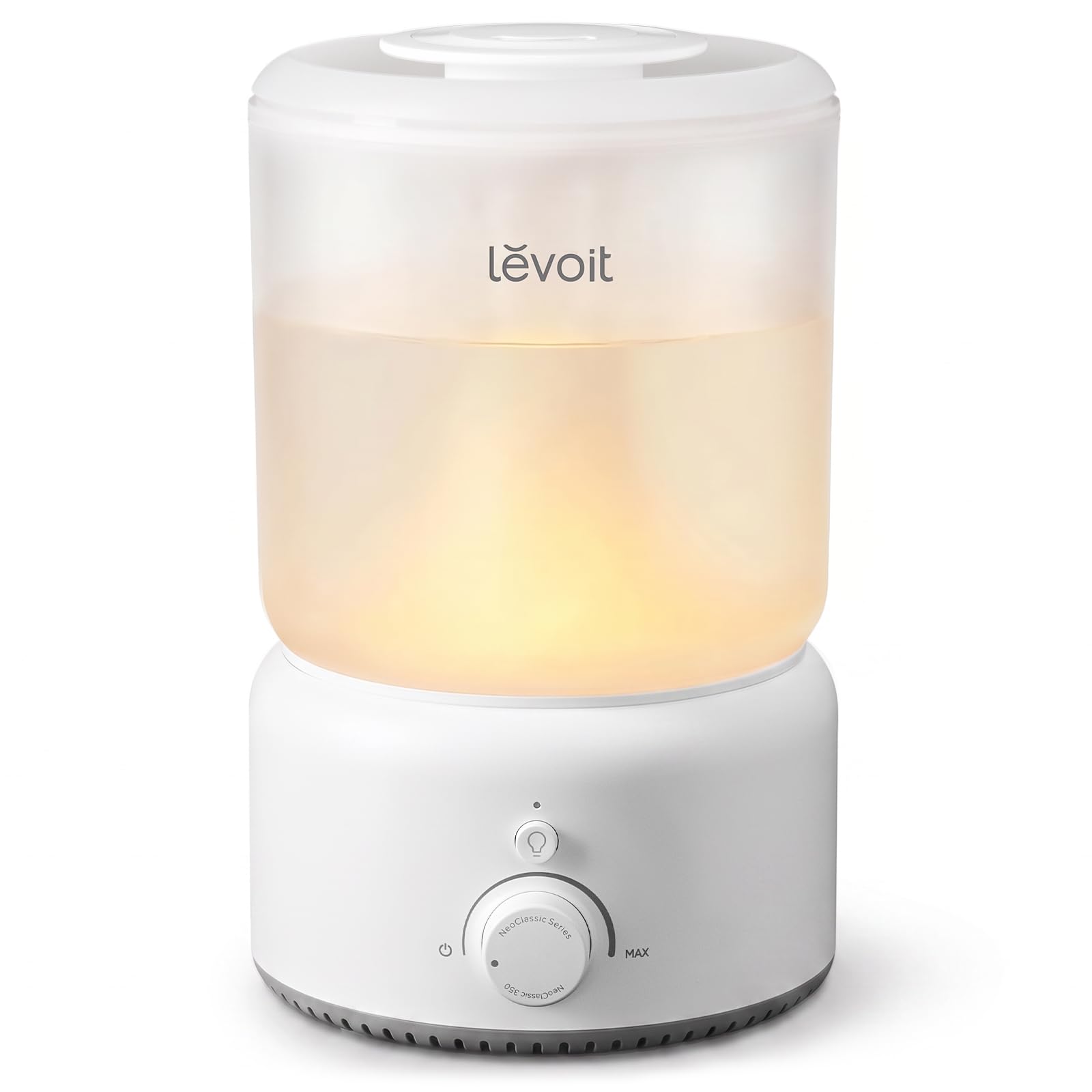
Every water-contact part on the NeoClassic 350 — tank, tray, the lot — is dishwasher-safe, with the manufacturer's caveat: top rack only, mild detergent, no heat dry. That alone puts it ahead of most of this category for nursery duty, where the tank is filled nightly and warm water sits in it until morning. The rest of the brief is covered without drama: 23 dB or less with the display dark, a blue light-free night light carrying an IEC RG0 eye-safety rating, a BPA-free water path, 3.2 liters rated for 26 hours, and 375 square feet of stated coverage.

Top fill matters more than it sounds. The lid lifts off, you pour from a pitcher, and the job is done without unclipping a tank or upending it over the carpet. On a 7.3-inch footprint it tucks into a dresser corner, and across several nights in a small bedroom we stopped noticing it was there, which is the highest compliment a nursery appliance can earn. Coverage is stated at 375 square feet, so it's honest about being a room humidifier rather than a whole-house one.

Two things to weigh. The 26-hour figure is the low-setting number, so on high in a dry room you'll refill most days. And there's an aroma tray, which we leave empty in a baby's room — moisture is the point and fragrance isn't. Against the Sprout below, you trade filtration and a room sensor for a lower price and a tank that goes in the dishwasher.

Pros

  • Water-contact parts are dishwasher-safe
  • 23 dB or less with the display dark
  • Blue light-free night light with an eye-safety rating
  • Top-fill tank on a small 7.3-inch footprint

Cons

  • Runtime figure is the low-setting number
Our verdict

Our pick for most nurseries: it runs at 23 dB with the lights off, and every water-contact part goes in the dishwasher, which is what actually keeps a baby's humidifier clean.
Check Latest Price
2

Best for Hard Water

Levoit Sprout Evaporative

89 /100
Trail Score Excellent

Key details

Runtime
Up to 36 hours
Capacity
3.8 liters
Mist Type
Evaporative, mist-free
Filtration
Dual air and water filters
Check Price on Amazon

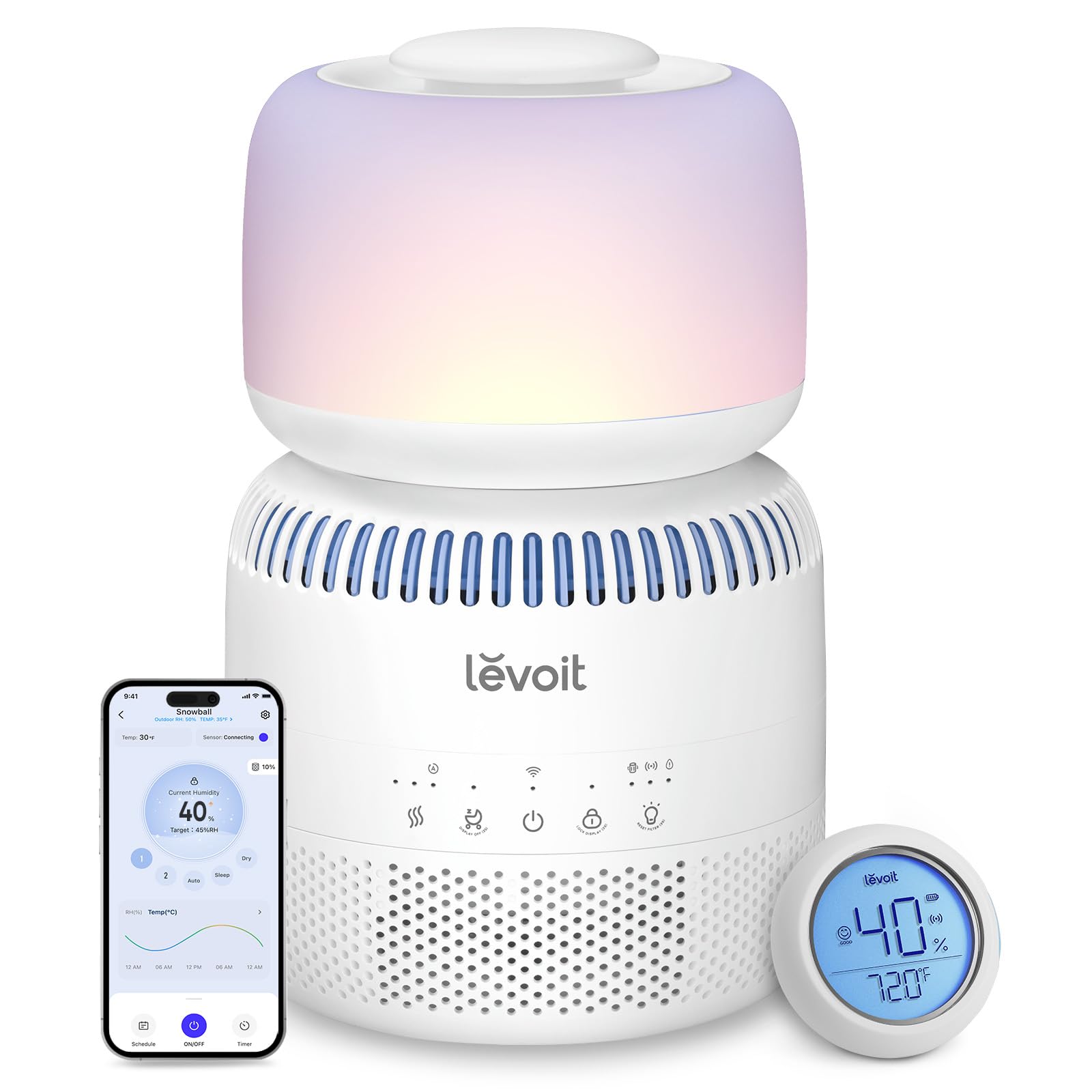
If your tap water leaves a chalky ring in the kettle, start here. The Sprout is evaporative: a wick pulls water up, a fan moves room air across it, and the water joins the air as vapor instead of a cloud of droplets. Nothing visible comes out, and the calcium in your water stays in the wick rather than settling as white dust on the crib rail. It filters both sides of the job, too — a pre-installed air filter and a water filter rated for particles of 0.5 microns and up.

A nursery is clearly what this was designed around. There's a child lock, so a toddler can't turn it into a fountain; an auto-dry cycle that runs the wick dry after shutoff to discourage mold; and a night light that's blue light-free and adjustable between 2000K and 3500K, warm enough to change a diaper by without waking anyone. Our favorite detail is the separate humidity sensor: it sits across the room and reports the air where the baby is, not where the machine is.

The cost is real. This is the most expensive pick here by a wide margin, it tops out at 219 square feet, and the wick is a wear item you'll buy again. Evaporative output is gentler by nature, so it humidifies a closed nursery well and won't billow moisture through an open-plan room.

Pros

  • Evaporative vapor leaves no mineral dust
  • Dual air and water filtration
  • Child lock plus an auto-dry wick cycle
  • Separate sensor reads humidity at the crib

Cons

  • Wick filter is a recurring purchase
  • Covers less area than the cheaper picks
Our verdict

Worth the splurge if your water is hard or you want filtered air: it filters both the water and the room air, and evaporative vapor carries no minerals onto the crib.

Check Latest Price
3

Best Value

Dreo HM311

89 /100
Trail Score Excellent

Key details

Runtime
Up to 36 hours
Capacity
4 liters
Coverage
300 square feet
Noise Level
28 dB
Check Price on Amazon

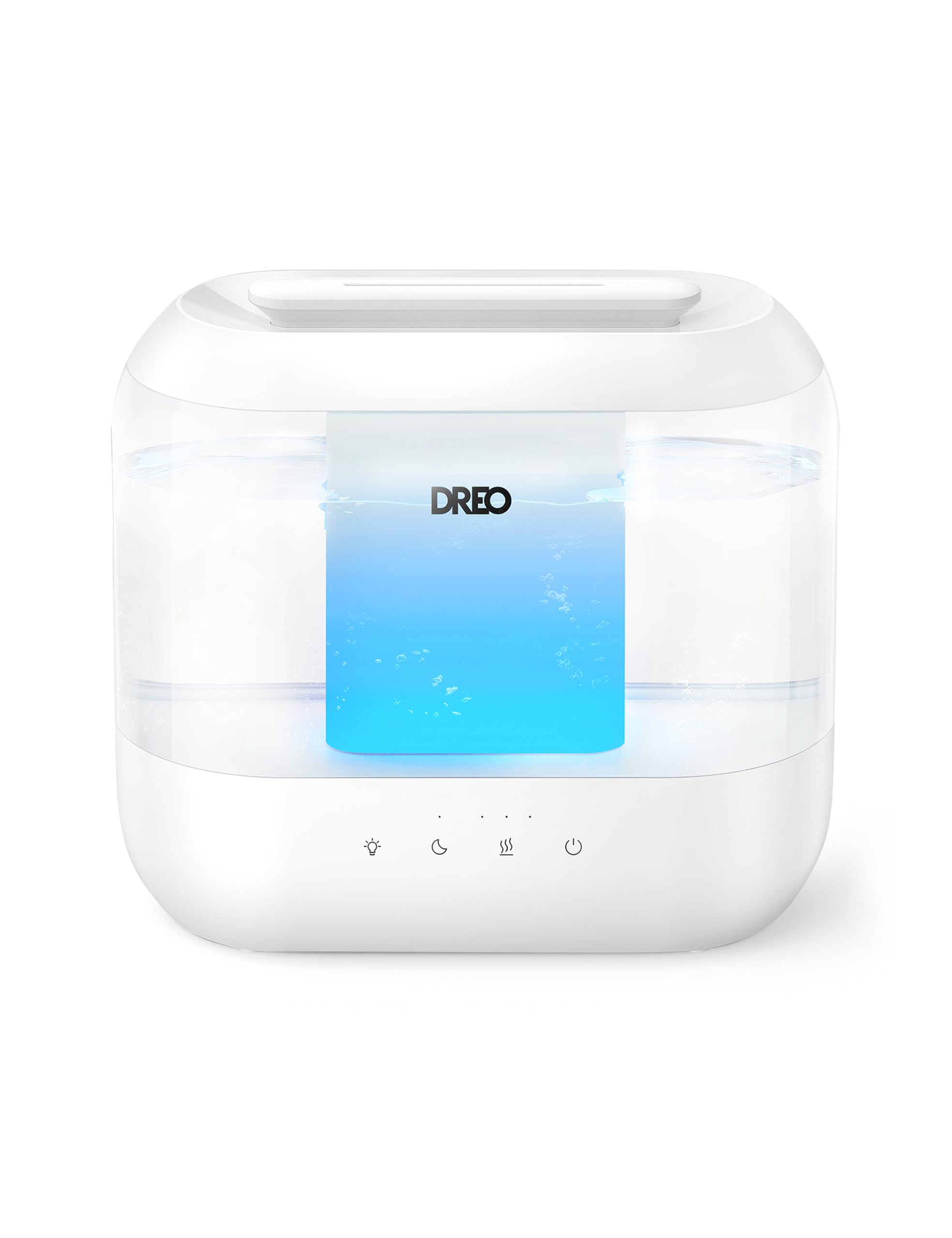
Four liters, 36 hours, 28 dB, and a body narrow enough to sit on a windowsill. The HM311's top-fill lid lifts off so you can pour straight in without flipping the tank, and the combination of a dual intake and a four-inch outlet pushes a wide, five-micron mist that vanishes into the air rather than raining onto the crib sheet. Stated coverage is 300 square feet.

Value is the headline: this is the least expensive of the four and it gives up remarkably little. Overnight, the noise disappeared into the background, and on the low setting it never woke us. The caveat is the seal. Set the tank back slightly off-center and water finds its way out around the base — a slow drip that shows up as a damp ring rather than a flood. Once we pushed the tank down until it seated, it stayed dry. In a nursery, keep it on a hard, level surface rather than carpet and well away from outlets and the crib.

The night light is a soft blue, which is the wrong color for a room you're trying to keep sleepy, and the other picks here are deliberate about avoiding it. It's dim and it switches off, so it's a compromise rather than a dealbreaker — and with this tank at this price, we can live with a blue LED.

Pros

  • Four liters for the lowest price here
  • 28 dB with a 36-hour runtime
  • Top fill without clips or threading

Cons

  • Blue night light rather than a warm one
Our verdict

The value pick, and a genuinely quiet one: four liters, 36 hours, and a wide mist column for the least money here — just seat the tank squarely.

Check Latest Price
4

Large Rooms

Vicks V4600

91 /100
Trail Score Outstanding

Key details

Runtime
Up to 30 hours
Capacity
1.2 gallons
Dimensions
9.45 x 10.87 x 13.46 inches
Filtration
Filter-free
Check Price on Amazon

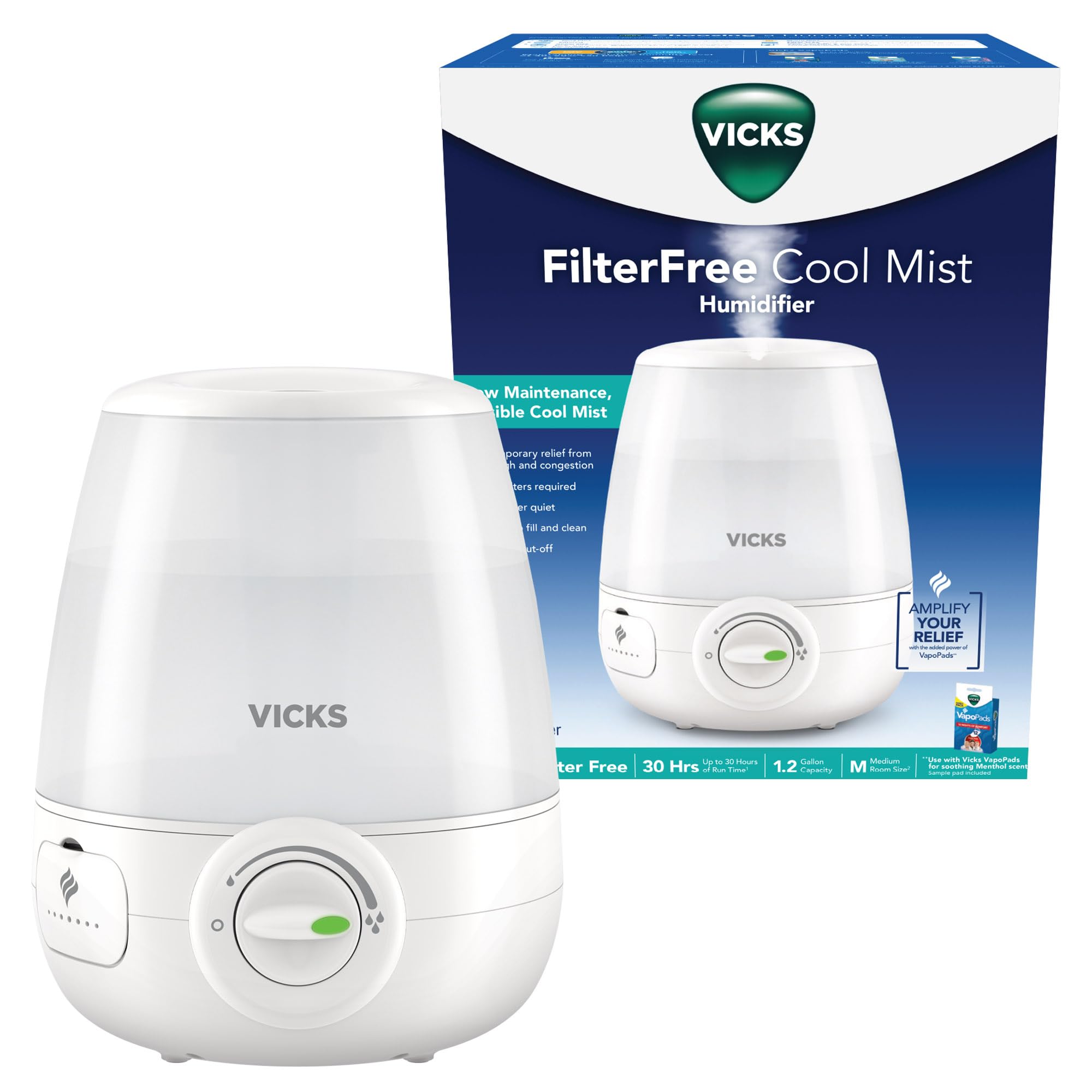
No filter means nothing to buy, nothing to soak, and nothing to forget to replace — and it also means everything dissolved in your tap water goes into the air. That's the trade at the center of the V4600, a filter-free ultrasonic unit with a 1.2-gallon tank rated for 30 hours. Run it on tap water and a fine white film appears on nearby surfaces; distilled water solves it, at a per-gallon cost that adds up over a winter.

Noise is the other thing to think about. This isn't the near-silent unit the others are. The refill trickle is audible, and where you put it decides whether that matters: on a hard floor a few feet from the crib we noticed it, up on a dresser across the room it faded away. That's placement, not a defect.

So who is it for? A big nursery, or a room that doubles as a playroom, where 30 hours between fills is worth more than a whisper-quiet motor — and a household that doesn't want to keep buying filters. The fill opening is wide enough to get a hand and a brush inside, which counts for more on a filter-free unit because there's nothing upstream catching the scale.

Pros

  • Filter-free, so nothing to replace
  • 1.2-gallon tank rated for 30 hours
  • Wide fill opening is easy to brush out

Cons

  • Tap water leaves a white film on surfaces
  • Refill trickle is audible in a quiet room
Our verdict

Buy it for the tank, not the silence — 30 hours between fills and nothing to replace, as long as you feed it distilled water.

Check Latest Price

How We Tested 12 Humidifiers in Real Nurseries

We started by pulling every humidifier sold with a nursery or kids' label from major retailers, plus a handful of general-purpose models parents recommend anyway. We compared tank capacity against how many nights it would cover, whether the night light could be switched off completely, filter versus filter-free designs, and what replacement filters cost over a season. Twelve made the cut and came to live in our homes.

Each one ran overnight in a real nursery with the door closed, a hygrometer a few feet from the crib, and a baby or a very light sleeper standing in for one. We read the humidity before bed and again at 5 a.m. to see whether the room actually held that comfortable range, and whether the mist carried across the room or just left a damp patch on the wall. We took decibel readings from the crib and noted gurgling, clicking, or a fan that cycled on and off. Every unit was filled at bedtime, usually one-handed and in the dark.

After a week of nightly use we emptied and wiped each tank, looking for the pink film that creeps into damp corners and for mineral crust a bottle brush couldn't reach. We deliberately overfilled each one once and set it on a paper towel on a wood nightstand to see what seeped through by morning. Ease of use came down to whether the tank seated back on the base without a flashlight, and size to whether the footprint fit a narrow nightstand and the cord reached the outlet behind the crib. After six months we checked whether mist output had dropped off or the fan had gotten louder, which is how these usually fail.

How to Choose a Humidifier for a Baby's Room

Decide the Mist Type First

Ultrasonic cool mist is what most of the picks here use: a plate vibrates water into a fine visible cloud. It's quiet and inexpensive, but it sends whatever is dissolved in your water into the air, so hard water shows up as white dust on the crib rail and the windowsill. Evaporative units such as the Levoit Sprout blow room air across a wet wick instead, and the minerals stay behind in the filter.

Warm mist doesn't belong in a nursery: it adds heat to a small room and puts hot water within reach of a curious toddler. If your water is hard, or the dust would bother you, pay for evaporative and its filters. Otherwise a filter-free ultrasonic unit plus distilled water gets you most of the way. "Cool mist" is a category, not a promise — an ultrasonic unit still throws minerals.

Match the Tank to the Night

Runtime figures are quoted at the lowest setting, so treat them as a ceiling rather than a promise. Three to four liters roughly covers a night at moderate output; run the same tank on high in a dry winter room and you'll be topping it up daily. In a nursery under about 200 square feet, a three-liter tank is plenty, and anything past four liters buys refill convenience rather than more moisture.

The related number is coverage, and it's the one to check against your actual room. The Dreo HM311 claims 300 square feet, the NeoClassic 350 claims 375, and the evaporative Sprout claims 219 — a figure that reflects how gently an evaporative unit adds moisture, not a shortcoming you'll notice in a closed nursery.

Listen for Quiet, Then Check the Lights

Noise is stated in decibels, and the spread across these four — 23 to 28 dB — is a real difference in a silent room at three in the morning. Below about 30 dB you're hearing the water more than the motor, which is why placement counts as much as the rating: a tank sitting on a hard floor amplifies the refill trickle in a way a dresser doesn't.

Then look at what glows. A night light is useful; a blue one works against the point, and the picks that get this right either skip blue entirely or shift the light warm. Check that the display can go dark, too, because a bright status light is the fastest way for a humidifier to end up exiled to the hallway.

Cleaning Decides How Long You Keep It

A humidifier holds standing water around the clock, so the tank and base need a rinse every few days and a descale once a month. What makes that easy or miserable is access: a top opening you can get a hand into, a base without narrow channels, and parts that survive the dishwasher. The NeoClassic 350 and the Sprout both list dishwasher-safe water-contact parts.

The trap is assuming a wide fill hole means a wide cleaning hole. Check that the opening runs straight down into the tank rather than just through the lid, because the brush in the box is not a substitute for being able to reach the corners.

Frequently Asked Questions

Final Verdict

For most nurseries, the Levoit NeoClassic 350 is the one to buy. It runs at 23 dB with every light off, its water-contact parts go in the dishwasher, and 3.2 liters carries a night without turning the room into a swamp. Nothing else here combines those three things as cleanly.

Change one requirement and the answer changes with it. If your water is hard, or you want filtration and a child lock, the evaporative Sprout earns its higher price. If the budget is the binding constraint, the Dreo gives you four liters and near-silent running for the least money of the four.