Best Hip Thrust Pads of 2026

The first time I slid a loaded barbell across my hips for hip thrusts, I understood why gym bags end up stuffed with folded mats and hoodies. The bar digs into the hip bones, the makeshift padding shifts mid-set, and what should be a focused glute exercise becomes a balancing act. A good hip thrust pad fixes that quietly: it spreads the load, stays put while you drive up, and lets you chase reps instead of readjusting.

Over the past three months, I’ve run a dozen hip thrust pads through the same sessions I actually train—bench thrusts, floor bridges, and barbell work at home and at the gym. The differences show up fast: some pads bottom out under a heavy bar, some straps won’t stay tight, and a few feel flimsy right out of the package. The best ones balance cushioning with stability, so you’re not choosing between comfort and a secure fit. A pad that costs more isn’t automatically better, either—the ones that earned a spot held their shape and stayed put.

1

Best Overall

Gymreapers Barbell Squat Pad

96 /100
Trail Score Outstanding

Key details

Length
17.5 in
Weight
7.37 oz
Diameter
3.5 in
Material
Neoprene
Check Price on Amazon

Dense is the word that decides a hip thrust pad. Gymreapers' pad is dense rather than pillowy — press a thumb in and it gives, then comes back — and that is why it is our top pick. Under a loaded bar it stops compressing before you reach bone, the 17.5-inch body covers both hips with room to shift your stance, and at 7.4 ounces it disappears into a gym bag.

The outer surface is the other half of the story. It has a matte, slightly tacky finish rather than the slick foam you find on cheaper pads, and that is what keeps it from skating along the knurling mid-set. The 3.5-inch diameter is a middle-of-the-road figure: enough to lift the bar clear of the hip crease without pushing your setup so far off the floor that your range of motion changes.

Settle one thing before you order: the straps. They are described as optional, and they do not reliably arrive in the box. The pad holds its seat well without them once it is centered, but if you want a strap at each end, cinched down, confirm the contents or add your own. It is a small annoyance on an otherwise tidy package, and the one-year manufacturer warranty takes some of the sting out.

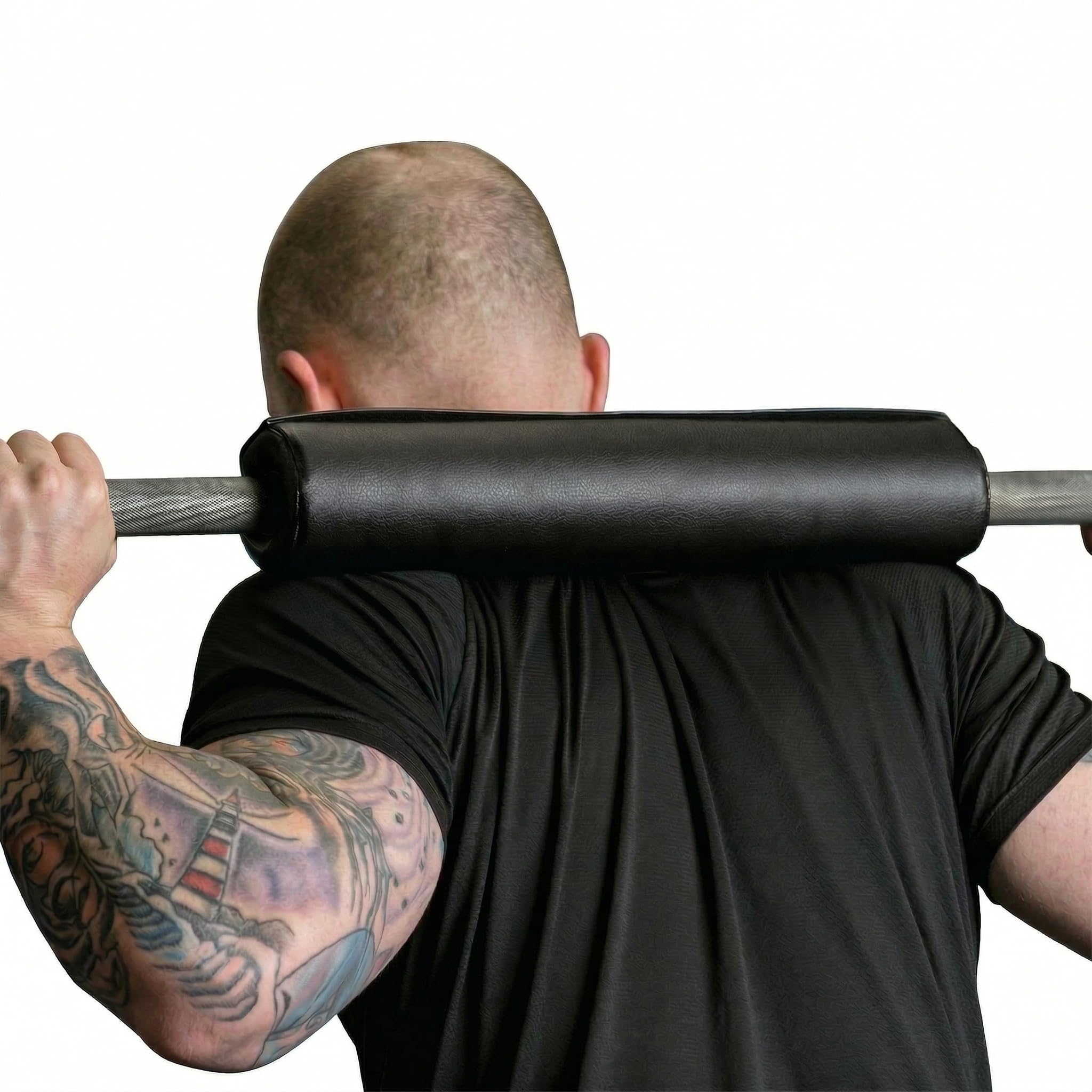
For hip thrusts specifically, the combination earns it: coverage that runs past both hips, foam that does not collapse at the top of a heavy rep, and a surface that grips. Squats are almost a bonus, since the pad is long enough to sit across the traps without the bar finding a gap. If you train legs twice a week with real weight, this is the pad we hand over.

Pros

  • Dense foam resists bottoming out under load
  • 17.5-inch body covers both hips
  • Matte, grippy surface holds the bar
  • One-year manufacturer warranty

Cons

  • Straps may not be in the box
Our verdict

We recommend the Gymreapers pad to anyone loading a bar for hip thrusts: dense foam, 17.5 inches of coverage, and a grip that survives a full set.

Check Latest Price
2

Best Budget

Nuviqo Barbell Pad

95 /100
Trail Score Outstanding

Key details

Length
17.3 in
Weight
8.11 oz
Closure
Two safety straps
Diameter
4 in
Check Price on Amazon

The Nuviqo is the least expensive pad in this guide, and it gives up less than the price suggests. Two safety straps come in the box, the body is 17.3 inches long and 4 inches around — wider than several pads further up this list — and the foam has a matte finish that resists sliding on the bar.

Four inches of diameter is the figure worth noticing. A fatter pad spreads the load across more of the hip, which matters most at the top of a thrust, where the bar presses straight down on the pubic bone. The straps are what keep it honest: cinch both and it holds its line; leave them loose and it will rotate under you as you drive up. That is the one habit this pad asks for.

We have been happy with how it splits the difference between soft and firm. It is comfortable enough on the traps for back squats and dense enough at the hip that a working set does not turn into a bruise, which is a balance cheap pads usually miss in one direction or the other. At 230 grams there is no excuse to leave it at home.

Longevity is where the price shows. The foam is less springy than the midrange picks and the cover is thinner, so it will look tired before a Gymreapers or a Dark Iron does. For a first pad, a spare for a home rack, or one that lives in a gym bag without a second thought, that is a fair trade.

Pros

  • Two safety straps included
  • 4-inch body spreads hip pressure
  • Least expensive pad in this set

Cons

  • Foam loses its spring sooner than midrange pads
Our verdict

The best value here: full-size coverage, two straps, and foam that is comfortable at both the neck and the hip for the least money in this set.

Check Latest Price
3

Best for Women Lifters

FITGIRL Squat and Hip Thrust Pad

96 /100
Trail Score Outstanding

Key details

Length
14 in
Weight
13.7 oz
Closure
Velcro straps
Material
Synthetic rubber
Check Price on Amazon

Fourteen inches is short for a barbell pad, and on a narrower frame that is exactly the point. FITGIRL builds its pads for women, and the shorter sleeve sits centered across the hips instead of bunching past them, with less material to manage while you are setting up under the bar.

Grip is where it wins for us. The synthetic rubber shell is tackier than bare foam, and there is a textured lining inside that bites into the bar rather than sliding over it. With the Velcro straps cinched, it stays where you put it through a full set — the thing that matters most when a loaded bar is trying to roll across your hips.

There is a trade to a thicker, grippier pad: it holds the bar a little further off the hip, and if you have dialed in exactly where you want the bar to sit, that changes your setup. Give it a session or two before you judge your numbers; the position settles once you stop fighting it.

Durability is better than the price suggests — the stitching and the shell hold up — and the leopard print is harder to lose in a gym bag than another black pad. It is a pad with a point of view, and if you are a woman lifting on standard or Olympic bars, that point of view is yours.

Pros

  • Textured inner lining grips the bar
  • 14-inch sleeve suits narrower frames
  • Stitching and shell hold up for the price

Cons

  • Snug on thicker bars at some commercial gyms
Our verdict

Our pick for women lifters: a short, grippy sleeve that stays centered on a smaller frame and comes in prints you will not lose in a gym bag.

Check Latest Price
4

Best Extra-Thick Cushion

Dark Iron Fitness Barbell Pad

95 /100
Trail Score Outstanding

Key details

Length
15 in
Closure
Hook-and-loop
Material
Nylon
Max Load
400 lb
Check Price on Amazon

Wrap it, press the flap, done. The Dark Iron is the one pad here with nothing separate to lose — no strap ends to thread, no buckle to hunt for at the bottom of a bag, no loose tail flicking your shoulder at the top of a squat. As closures go, it is the tidiest in this guide, and that is the reason we like it.

The foam underneath is the thickest here, and that is the whole pitch. It takes the bar off the traps completely on back squats, and it keeps the bar clear of the pubic bone at the top of a heavy thrust in a way the thinner pads do not. If you have ever cut a set short because of pressure rather than weight, this is the pad that fixes it.

Where it gives ground is bar fit. At 15 inches it is the second-shortest pad in this guide, and the wrap is only as snug as the bar allows: on an Olympic bar pulled tight it is solid, but on a thinner fixed bar there is more room for it to turn under you. Match it to the bar you actually train on rather than the one in the photos.

Construction is where the money goes. The stitching is the neatest in the group, the shell wipes down after a session instead of holding sweat, and the 400-pound rating is stated outright rather than implied. It is the pad for someone who wants one good one for both lifts and prefers to overbuy than replace.

Pros

  • Thickest foam in this set
  • Wrap closure has nothing to lose
  • Wipe-clean shell shrugs off sweat

Cons

  • Takes both hands to wrap and close
Our verdict

Worth the premium if you want the thickest cushion here and a wrap closure with no loose parts to lose.

Check Latest Price
5

Best for Smith Machines

DMoose Barbell Pad

94 /100
Trail Score Outstanding

Key details

Length
19 in
Diameter
4 in
Material
High-density EVA foam
Max Load
550 lb
Check Price on Amazon

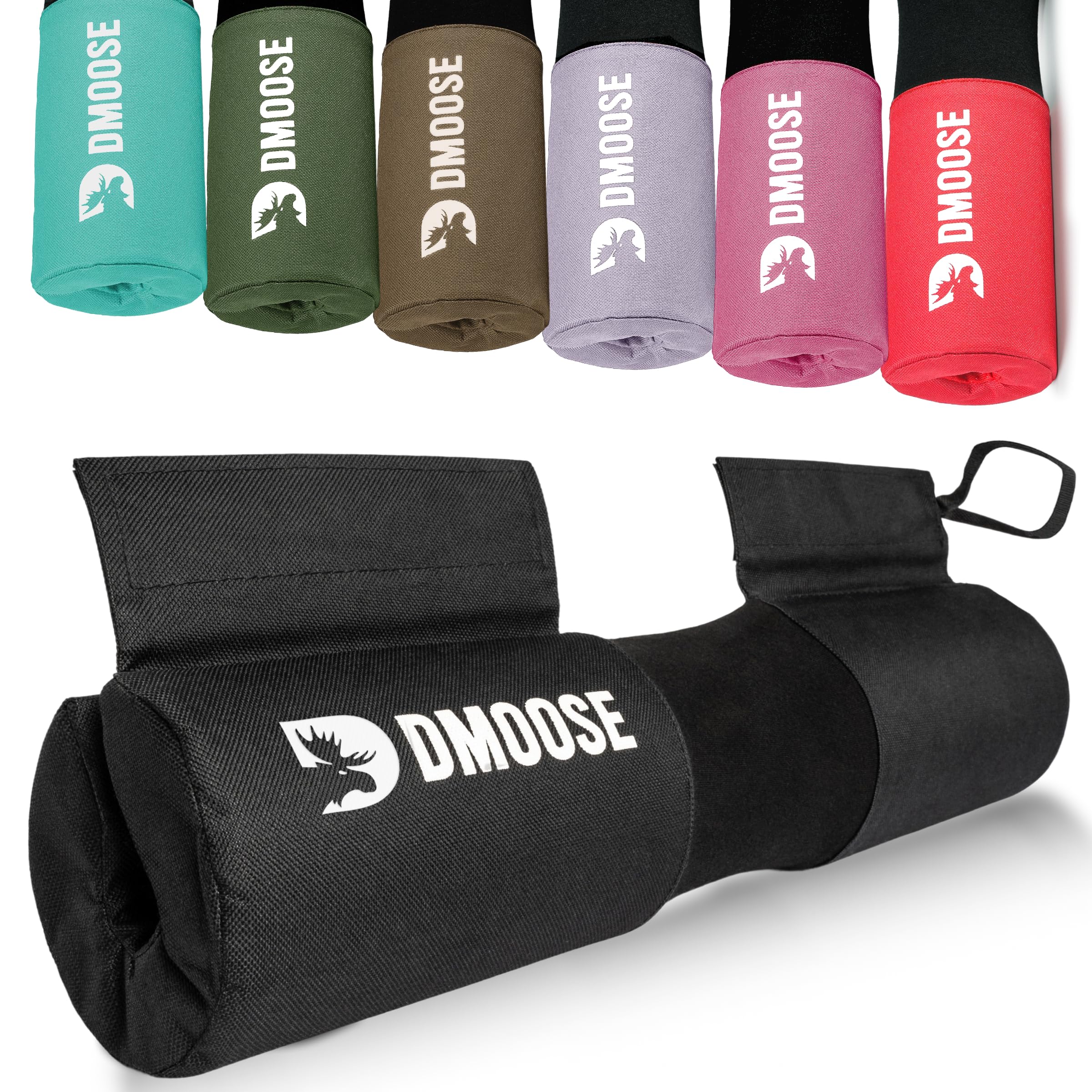
Two inches longer than our top pick and a shade lighter, the DMoose is the pad to look at if you thrust on a Smith machine or any bar where you want padding running past both hips. At 19 inches it is the longest pad here, and on a fixed bar path that extra coverage is worth more than it sounds.

On a Smith machine you cannot shuffle the pad mid-set, so a shorter one leaves an edge digging in whenever you do not land perfectly centered. The DMoose takes that out of play. The 4-inch EVA foam is firm rather than pillowy, so it does not sink through under a heavy set, and the Oxford fabric cover adds a little grip of its own.

The straps are separate pieces, and that is the annoyance: they hold well once fitted, but they are small enough to disappear in a gym bag. Thread them on at home and leave them on the pad between sessions. The cover is the smoothest in this group, which grips a knurled bar nicely and a chrome one less so.

The stated 550-pound maximum is the highest in this guide, and at 200 grams it is nothing to carry. If your gym's bars run long or your leg day is mostly Smith machine work, that is where we point you; if you want the tightest hold on a free bar, the Gymreapers still edges it.

Pros

  • Longest pad here at 19 inches
  • Firm EVA foam resists sinking
  • Highest stated load rating in this set

Cons

  • Loose straps are easy to misplace
Our verdict

For Smith machine work and long bars, this is our pick: 19 inches of firm padding and straps that keep it where you put it.

Check Latest Price
6

Best Washable Cover

Fitgriff Barbell Hip Thrust Pad

95 /100
Trail Score Outstanding

Key details

Length
17.3 in
Weight
9.6 oz
Closure
Fabric cover with Velcro
Diameter
3.7 in
Check Price on Amazon

No straps, no threading, no loose ends: the Fitgriff closes on the bar with a Velcro flap and nothing else. The foam core sits inside a fabric sleeve, and the cover slips off — a detail we did not expect at this price — so it can go in the wash.

At 17.3 inches long and 3.7 inches around it is dimensionally almost a twin of our top pick; the difference is the surface. Fabric feels different against the hip than bare foam, less tacky and far less likely to leave a pattern pressed into your skin after a set, and the EVA core is firm enough that you do not lose the bar in it.

The catch is the closure. With no straps, the Velcro flap does all the work, and a flap that is only half seated will let the pad shift under load. Press the full length of it down before your first rep and it behaves; skip that and you will feel it move. It is a five-second habit rather than a design flaw, but it is the difference between this pad working and not.

Nothing about it is heavy — 9.6 ounces in the bag — and the firm foam means more bar feel on a genuinely heavy set than the thick picks give you. For a shared bar, a sweaty summer, or anyone who has ever sniffed a gym pad and winced, the washable cover settles it.

Pros

  • Removable cover can be washed
  • No straps to thread or lose
  • 17.3 inches of coverage

Cons

  • Firm foam gives more bar feel on heavy sets
Our verdict

A pad you can wash and fit without straps — we like it for shared bars and anyone who sweats through a leg day.

Check Latest Price
7

Best Leg-Day Kit

WALITO Barbell Pad Set

94 /100
Trail Score Outstanding

Key details

Length
16 in
Diameter
3.7 in
Includes
Pad, ankle straps, bands, carry bag
Kit Weight
1.98 lb
Check Price on Amazon

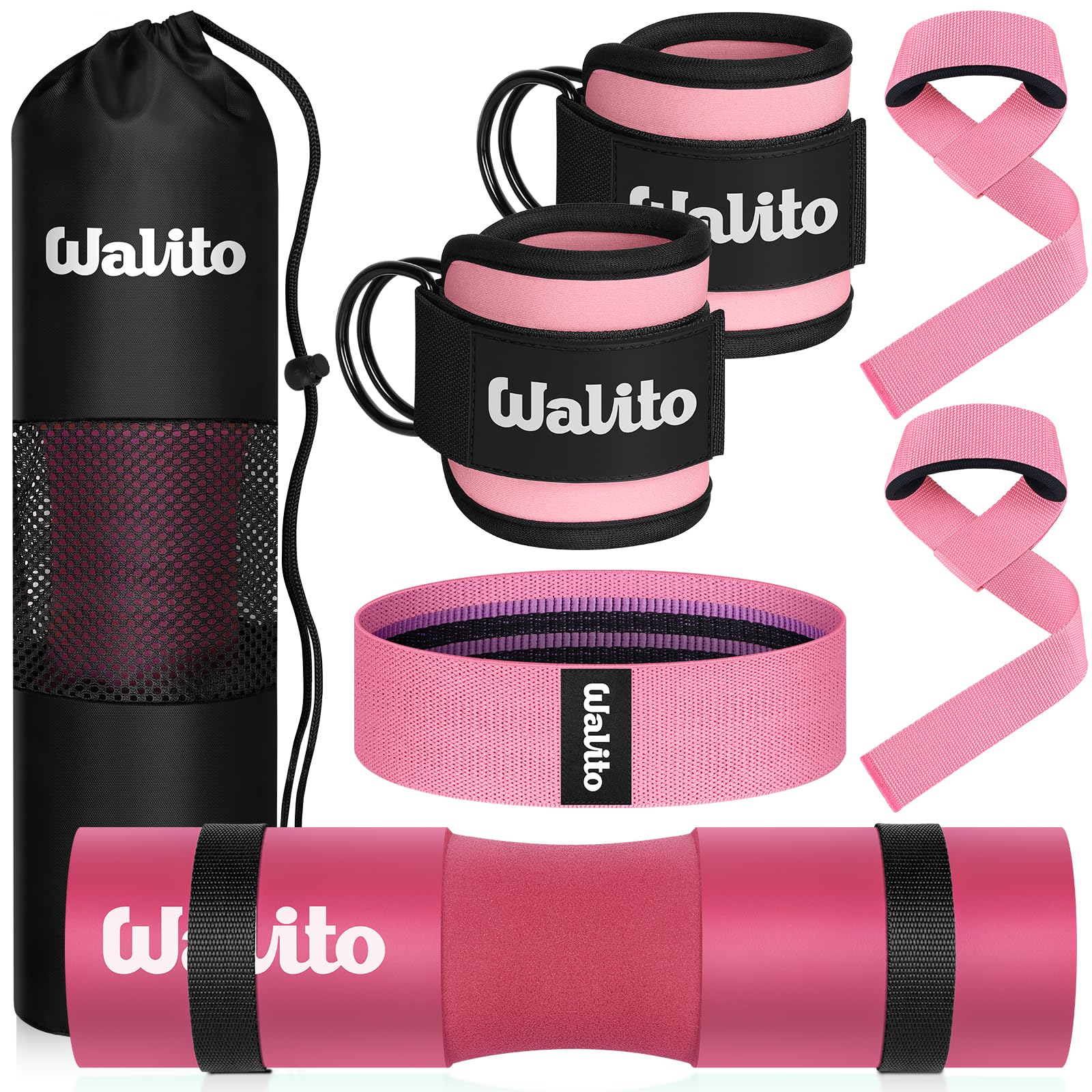
Open the WALITO box and you get more than a pad. There is the barbell pad, a pair of ankle straps, resistance bands and a carry bag in the same pack, which is why it is the set we hand someone building a leg-day bag from nothing. It is the only pick here that outfits more than one exercise.

The pad itself is the plain part: 16 inches long, 3.7 inches around, a PU-covered foam core and two straps. It is shorter than the top pick and a touch softer than the midrange pads, which is fine on squats and moderate thrusts and noticeable once the bar gets heavy. Nothing about it is clever, and nothing about it is fussy.

What the set actually buys you is the bag. Everything lives in one drawstring pack, so the ankle straps and bands go to the gym with you instead of staying in a drawer, and you are not hunting for a strap while someone waits for the rack. That is worth more than the sum of the parts in the first six months of training.

Go in knowing what you are getting: the accessories are basic versions of things you will upgrade eventually, and this will not be the pad you keep when you are chasing a PR. As a starter kit that gets a full leg day into one bag, it earns its place.

Pros

  • Pad, ankle straps, bands and bag together
  • Everything travels in one pack
  • Cover holds up better than the price suggests

Cons

  • Pad is softer than the heavy-lift picks
  • Accessories are basic versions
Our verdict

Buy the WALITO set if you are outfitting a first leg day — a solid pad and the extras, all in one bag.

Check Latest Price
8

First Pad

POWER GUIDANCE Barbell Squat Pad

96 /100
Trail Score Outstanding

Key details

Length
17.32 in
Weight
7.05 oz
Closure
Velcro straps
Diameter
3.74 in
Check Price on Amazon

This is the pad most people meet first — the one that turns up in gym loaner piles and in every thread about hip thrusts. The reason is straightforward: 17.3 inches of foam and two Velcro straps for less than almost anything else here, with a middle groove shaped to sit either side of your spine.

That groove is the detail worth knowing, and it is the part of this pad we rate highest. It is a squat feature rather than a hip thrust one — it lets the bar settle over the spine without pressing on a single vertebra — and it is why the pad feels different on your back than a plain tube does. For back squats and lunges, it is genuinely well thought out.

On thrusts, this is the pad where the experience splits, and it comes down to one habit. Strapped tight and centered on the bar it holds; set down where it lands, or used on a bar it does not fill, it rolls. The two straps are the difference between those two experiences, so use them every set rather than when you remember.

So it lands as a squat pad that also handles thrusts, not the other way around — and at this price, buying it now and adding a dedicated thrust pad later is a perfectly sensible route.

Pros

  • Spine groove helps on back squats
  • Generous 17.3-inch length
  • Two Velcro straps included

Cons

  • Foam compresses more than midrange pads
  • Bare foam cover stains rather than washes
Our verdict

For a first pad or a spare, this is the one we point to: 17.3 inches, two straps, and a groove that makes back squats feel easier.

Check Latest Price

How We Chose and Tested Hip Thrust Pads

We built the shortlist from pads that kept coming up in gym forums, coach recommendations, and retailer best-seller lists, then filtered by size, strap style, padding thickness, and price. The goal was range, not a brand parade: thin foam sleeves, thick molded pads, and strap-on versions with buckles and hook-and-loop closures. We ordered 12 and put each one into the same three-month rotation.

Testing happened where hip thrusts actually happen—on a flat bench at my gym, on the floor in my home setup, and on a padded bench in a friend’s garage. I did sets of 10 to 12 with a loaded barbell, plus single-leg and dumbbell variations, and noted whether the pad stayed centered, whether the strap loosened or dug into my waist, and whether the padding compressed enough that I could feel the bar. I also rotated through different shorts and leggings to see if the surface grabbed or slipped.

Functionality and comfort got judged by whether pressure spread across the hip bones or left me shifting mid-set. For stability, I counted how often I had to re-center the pad between sets. Strap design earned its own notes: buckles that popped open, hook-and-loop that fuzzed, and straps that cut in all got flagged. Durability came down to repeated use—did the foam flatten, the cover crack, or the stitching pull? Value was the whole package: a pad that survives three months of twice-weekly thrusts is a better buy than a pricier one that slips or squashes.

How to Choose a Hip Thrust Pad

Stability comes before cushioning

Among these pads, the ones that cause trouble are the ones that rotate on the bar, not the ones that feel thin. A pad stays put for two reasons: a tacky outer surface that grips the knurling, and a closure that holds it against the bar. Two hook-and-loop straps at either end are the most reliable version; a full wrap flap is the tidiest. If you buy a strapless design, expect to press the closure down properly every set. Check the pad's inner diameter against your bar too — a pad sized for an Olympic bar will feel loose on a lighter fixed bar.

Match the padding depth to the lift

Deep foam is a hip thrust feature. The bar presses straight down on the pubic bone at the top of the rep, and a thick pad is the difference between finishing the set and cutting it short. The same thickness is a mixed blessing on squats, where a deep pad lifts the bar off your traps and can change where it settles. If thrusts are the priority, err thicker. If you are chasing a precise bar position on back squats, the thinner pads here hold the setup you give them.

Fit the pad to the bar you actually use

Pads here run from 14 to 19 inches. Length is about coverage, not quality: a shorter sleeve suits a narrower frame, and a longer one suits a wide stance or a Smith machine, where you cannot shuffle mid-set. Diameter works the same way — 3.5 to 4 inches is the range, and the bigger figure spreads pressure across more of the hip. The trap is the phrase fits all bars. A pad that is snug on the Olympic bar at your gym can be loose on the lighter bars in a group class, so measure the one you use.

What the extra money buys

Every pad here is foam in a cover, so the difference is the foam. The least expensive use a softer foam that feels good on the first rep and compresses over months, which shows up first at the hip. The midrange pads use denser foam that holds its shape and a tougher outer surface that resists tearing at the seam. Above that you are paying for a wrap closure, a removable cover, or a stated load rating. If you thrust once a week, the bottom of the range is fine; if leg day is non-negotiable, the middle is where the value sits.

Frequently Asked Questions

Final Verdict

The Gymreapers pad is the one we tell people to buy. Dense foam, 17.5 inches of coverage, and a surface that grips the bar are the three things that decide whether a pad is pleasant or annoying, and it is the pick here that gets all three without asking you to compromise elsewhere.

If the budget is tight, the Nuviqo covers the same ground for less and gives up only some foam density. If maximum cushion matters more than anything else, the Dark Iron is the step up — just check it against the bar you actually train on.