Best Hand Grip Strengtheners of 2026

A hand grip strengthener is a deceptively simple thing: a spring, two handles, and a number printed on the side. The trouble is that number tells you almost nothing — a heavy coil and an adjustable model rated the same can feel nothing alike in your hand, and plenty of cheap ones start squeaking or stop snapping back within a month. I keep one in my desk drawer for the minutes I spend waiting on files to load and another in my gym bag for warm-ups, and the gap between a solid one and a throwaway became obvious fast. What you're actually buying is a more reliable grip for the things that test it — stubborn jar lids, loaded grocery bags, the last few reps of a deadlift.

Over three months, my team and I worked through 16 models, from classic coil squeezers to adjustable dial units to silicone rings, squeezing each one daily until our hands gave us a verdict. What surprised me most is how badly the printed resistance ratings hold up — two units labeled the same felt wildly different, which is why adjustability turned out to be worth paying for rather than a nice extra. Sweaty hands change everything too: a handle that feels fine dry can turn into a bar of soap ten minutes into a workout. The picks below are the ones that held their tension, stayed comfortable for a full set, and didn't need replacing — start at a level you can actually close today, not the one you hope to close in a month.

1

Best Overall

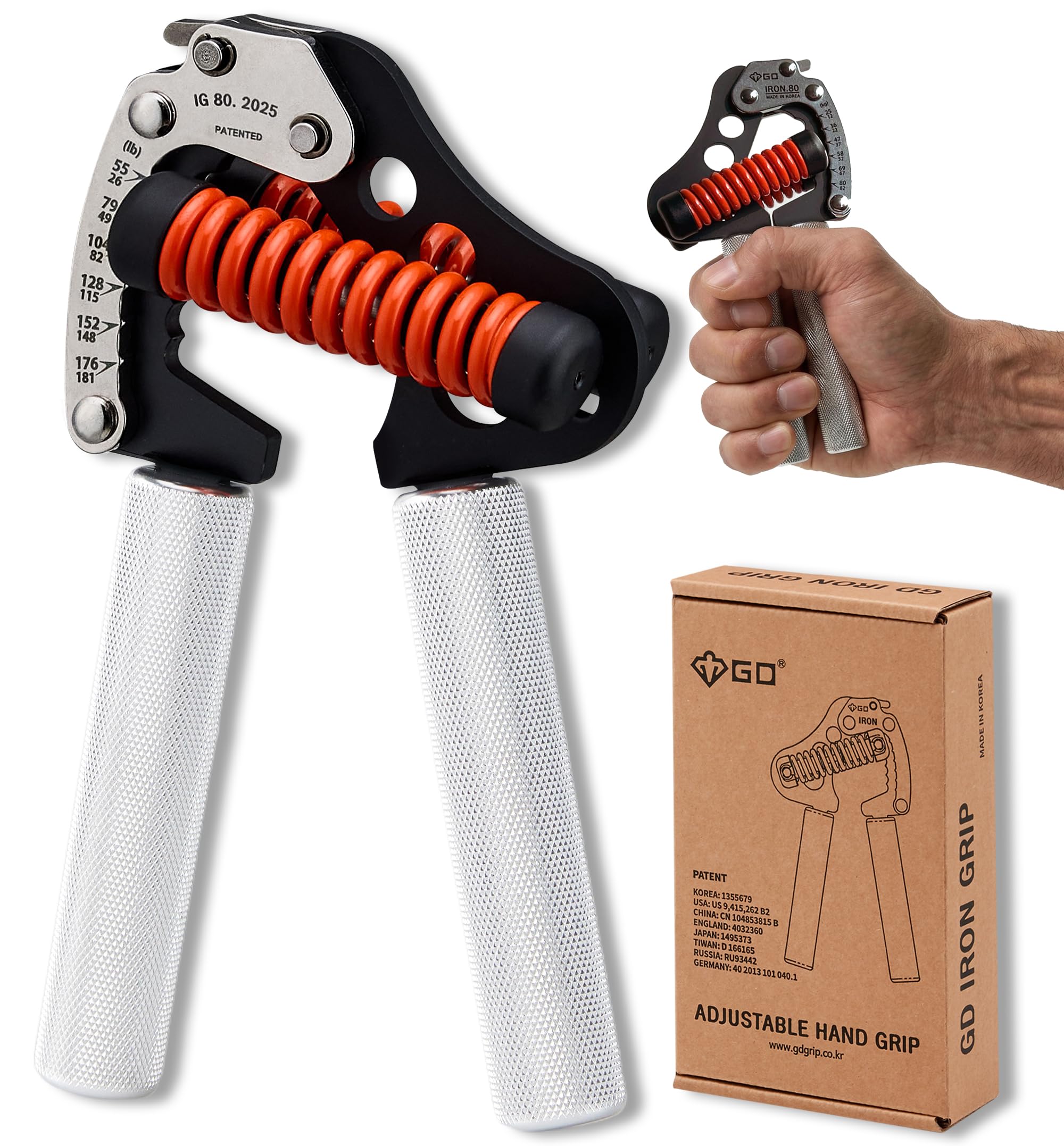
GD Iron Grip Adjustable Gripper

96 /100
Trail Score Outstanding

Key details

Frame
Aluminum handles, 4T steel frame
Weight
1.08 lb
Resistance
26-181 lb (12-82 kg)
Handle Width
3 positions
Check Price on Amazon

Handle width is the specification almost nobody prints, and the Iron Grip is the only gripper here that lets you change it: the handles move through three positions, so the same tool sits deep in a large palm and still fits a smaller one. Pair that with twelve resistance steps between 26 and 181 pounds and you have the widest usable range in this group, from a warm-up squeeze to a hard single. That combination is why it's our top pick.

The frame is what you're paying for. Aluminum handles, a reinforced steel body, stainless pins, and a spring that moves smoothly and almost silently, which matters more than it sounds: a quiet gripper is one you can use at a desk without announcing it to the room. Of everything here, this is the piece that feels like a tool rather than a gadget, and the adjustment collar clicks into its notches instead of creeping.

Two things to know before you order. The knurling is sharp, great for chalked gym hands and unforgiving on soft ones, and a strip of athletic tape is the usual fix if you plan long sets. And at 489 grams it's a bag-or-desk tool, not a pocket one. The weight is the price of the steel, and a gripper that lives where you can see it is a gripper you actually use.

Pros

  • Three handle widths fit small and large hands
  • Widest resistance range in this set
  • Steel frame and smooth spring feel solid under load

Cons

  • Premium price for a single gripper
  • Bag or desk only at 489 grams
Our verdict

Our pick for most people: a gripper that fits your hand width, spans warm-up to near-max, and doesn't flex under load.

Check Latest Price
2

Best Budget

NIYIKOW Adjustable Grip Strengthener

93 /100
Trail Score Outstanding

Key details

Weight
4.94 oz
Dimensions
6.1"L x 3.93"W
Resistance
22 lbs (10 kg) to 132 lbs (60 kg)
Check Price on Amazon

You don't have to spend much to find out whether grip training sticks, and this is the cheapest adjustable gripper in the group. The dial runs from 22 pounds to 132, a broader span than most of the single-tool options here, and it's small enough to live in a glovebox without taking up the space a steel gripper wants.

The bottom of that range is why it earns a place. Plenty of budget grippers start at a resistance a beginner can't close cleanly ten times, and this one can. We worked it in the middle of the dial for sets of ten and found the resistance smooth and the handle comfortable in average hands. The markings are the weak point, small and hard to read at the in-between positions, so you end up counting turns rather than trusting the scale.

Then there's the plastic body. A steel spring in a plastic frame is a known compromise, and the highest settings are where the load lands hardest. Keep your working sets around the middle, use the top of the dial for occasional singles, and it will last long enough to tell you whether you want to spend more. If you already know you do, skip straight to the steel.

Pros

  • Light 22-pound starting resistance for beginners
  • Adjustable up to 132 pounds
  • Smallest outlay of the adjustable grippers here

Cons

  • Dial markings hard to read between settings
Our verdict

The least expensive way to find out whether grip training sticks, with a light enough start for beginners and room to grow.

Check Latest Price
3

Best for Musicians

D'Addario Varigrip Hand Exerciser

95 /100
Trail Score Outstanding

Key details

Weight
2.56 oz
Tension
Adjustable per finger
Material
Silicone
Dimensions
2.36"L x 2.76"W
Check Price on Amazon

Four spring-loaded pads, four tension screws, and one detail that explains a lot of its following: pop off the molded grip and there's a simulated guitar string underneath, there for building fingertip calluses. Nothing else in this set is designed quite so specifically for players.

The per-finger adjustment is the real feature. You can back the ring finger and pinky screws off and leave the index and middle firm, which is exactly the imbalance that makes barre chords and fast runs fall apart. We ran it with all four pads even at first, and the small fingers quit long before the big ones did. One habit worth forming: set each screw with the washer seated at the bottom of its slot before you start, because a screw that isn't seated won't hold its tension through a set.

What you trade for that control is pace. This is deliberate, one-finger-at-a-time work rather than something you mash while the kettle boils, and the pinky will complain first. For a guitarist, a bassist, or anyone bringing a single weak finger back, that's a fair trade: it's the only tool here that isolates one finger without asking you to buy a second device.

Pros

  • Independent tension for each finger
  • Simulated string builds fingertip calluses
  • Pocketable and quiet enough for a desk

Cons

  • Pads pinch the smallest fingers
  • Lightest setting still firm at first
Our verdict

Guitarists and anyone chasing one weak finger get more from this than from any gripper here, because each finger carries its own tension.

Check Latest Price
4

Best Heavy-Duty Set

Logest Metal Hand Grip Set

94 /100
Trail Score Outstanding

Key details

Pieces
7
Weight
4.17 lb
Material
Alloy steel
Resistance
50-350 lb
Check Price on Amazon

Once a dial gripper stops being hard, you need heavier springs. This is the set for that stage: seven all-steel grippers stepped from 50 to 350 pounds, each one fixed and none of them adjustable.

That's the trade. A fifty-pound jump between grippers is a big one, and two or three of the seven will do the real work while the rest sit in the box, the 50 and 100 early, then the 150 and 200 once you're closing reps. What you get in exchange is the most confidence-inspiring construction in this group: thick springs, tight tolerances, no plastic anywhere in the load path, and nothing that can drift out of adjustment mid-set.

Handles will divide people. The knurled steel is rough, and longer sessions can leave hot spots; tape or gloves sort that out. The coarse steps are harder to work around, and there will be a stretch where the 150 feels easy and the 200 feels impossible with nothing between them. We still think a ladder like this beats a dial for anyone training toward a specific close, because the target doesn't move.

Pros

  • Seven steel grippers from 50 to 350 pounds
  • Tight, solid construction with no plastic in the load path
  • Fixed resistance that can't drift mid-set

Cons

  • Fifty-pound gaps between resistance levels
Our verdict

Buy this once you can close a dial gripper's top settings and want steel steps you can't fudge.

Check Latest Price
5

Best Low-Resistance Kit

roygra 8-Piece Hand Strengthening Kit

91 /100
Trail Score Outstanding

Key details

Weight
10.2 oz
Contents
8 pieces: 3 balls, 2 rings, 3 finger stretchers
Resistance
2 or 3 levels
Ring Diameter
2.75 in
Check Price on Amazon

The parts are small, the squeeze balls measuring about two inches across and the finger stretchers sized for slim fingers, so this isn't the kit for a large-handed lifter. It is the kit we point people toward for gentle, frequent hand and finger work: three balls, two rings, three stretchers, two or three resistance levels, and a bag that holds all of it.

Variety is the point. You can squeeze, pinch, and extend in one short session, and the stretchers work the muscles that open the hand, the half of grip training a gripper never touches. For someone keeping fingers mobile through the day, or working back from a weak stretch, that mix does more than a heavier single tool would.

The resistance steps aren't subtle. The firmest ball and the stiffest stretcher take real effort, while the softer pieces can feel like nothing if you already train. Sizing is the bigger obstacle: the rings and egg-shaped balls run small, and the stretchers are tight for anyone with thick fingers.

Pros

  • Balls, rings and stretchers cover squeeze and extension
  • Two or three resistance levels in one kit
  • Storage bag keeps the pieces together

Cons

  • Balls and stretchers run small
  • Firmness varies from piece to piece
Our verdict

Best for gentle, varied hand and finger work, provided your hands aren't large.

Check Latest Price
6

Finger Isolation

Prohands Gripmaster Hand Exerciser

92 /100
Trail Score Outstanding

Key details

Weight
2.47 oz
Tension
9 lbs (Heavy)
Warranty
2 years
Dimensions
3.63"L x 2.88"W
Check Price on Amazon

This is the one that ended up on a desk rather than in a gym bag. Four spring-loaded pistons sit under individual finger pads, so you press one finger or all four, and the whole thing weighs 70 grams, light enough to forget in a jacket pocket.

Tension is fixed at purchase. This Heavy version is rated at 9 pounds, right for average hands and light for anyone who already trains, and there's no dial, so more resistance means buying another unit. What you do get is even resistance across all four fingers, which makes it easy to spot the one that's lagging.

Between this and the Varigrip, we take the Gripmaster for desk work, travel, and mindless repetition and the Varigrip when a specific finger needs targeted work. The spring decides how long it lasts, and it's a more trustworthy spring than the budget adjustable grippers here, though not in the same league as the steel sets.

Pros

  • Isolates each finger individually
  • 70 grams and pocketable
  • Even resistance across all four fingers

Cons

  • Fixed tension means buying another unit to progress
Our verdict

The pocketable choice for desk-side dexterity work, provided 9 pounds of fixed tension suits your hands.

Check Latest Price
7

Travel and Variety

IMENSEAS 7-Piece Grip Strengthener Kit

91 /100
Trail Score Outstanding

Key details

Pieces
7
Dimensions
6.3"L x 3.93"W
Finger Bands
6.6, 8.8 and 11 lbs
Gripper Resistance
22 to 88 lbs
Check Price on Amazon

Twenty-two to 88 pounds is a narrow dial for a gripper, and that number tells you most of what this kit is for: light daily work, variety, and travel rather than heavy strength.

Seven pieces go some way to making up for it. The adjustable gripper is the anchor, with three finger stretchers graded at 6.6, 8.8, and 11 pounds per finger, plus a ring and a stress ball. We got more out of the included booklet than expected, since it lays out exercise variations for each tool instead of leaving you to guess what the little blue ring is for.

The graded bands are the sleeper feature. Finger extension is the part of grip training people skip, and having three levels lets you add it without buying anything else. Nothing here feels premium, though: the silicone is serviceable rather than dense, and the small pieces are the ones most likely to go missing.

So treat it as a second kit, for a gym bag, a desk drawer, or a suitcase. If you want one purchase that covers extension work as well as crushing, this does it. If you want to close a heavy gripper, put the money into a metal one and add this alongside.

Pros

  • Adjustable gripper plus three graded finger bands
  • Booklet shows exercises for each tool
  • Compact enough for a gym bag or desk

Cons

  • Gripper tops out at 88 pounds
  • Finger stretchers run small
Our verdict

A varied, portable kit for light daily work and finger extension; buy it alongside a heavier gripper, not instead of one.

Check Latest Price
8

Budget Steel Set

ZEAGUS Metal Hand Grip Kit

92 /100
Trail Score Outstanding

Key details

Pieces
4
Weight
12.8 oz
Material
Knurled aluminum
Resistance Levels
50, 100, 150 and 200 lb
Check Price on Amazon

Same idea as the Logest set, one rung shorter: four steel grippers at 50, 100, 150, and 200 pounds, with knurled aluminum handles and no plastic in the load path.

Four steps cover more ground than they sound like they do. A full close on a 200-pound steel gripper is a serious squeeze, and most people training alone will spend a long while between the 100 and the 150. If you have a competition in mind, the bigger set is the better buy; if you're building a home routine, this is enough ladder.

Read the stamps as an order rather than a measurement. The pound ratings on fixed steel sets aren't calibrated the way a competition gripper is, and the gap between two neighboring grippers can feel wider or narrower than the labels suggest. The way we use them is as rungs, tracking reps rather than pounds.

The handles are the other thing to know: sharp knurling, fine for short sets, unpleasant for volume without tape or gloves. Even so, this is the cheapest steel in the group, four tools with a sensible spread and a good way to find out whether a bigger set is worth it.

Pros

  • Four steel grippers from 50 to 200 pounds
  • Cheapest steel set here
  • Knurled handles stay put in sweaty hands

Cons

  • Pound stamps are approximate, not calibrated
Our verdict

The cheapest steel here, and enough ladder for most home trainees; read the stamps as rungs, not measurements.

Check Latest Price

How We Tested Hand Grip Strengtheners

We began by comparing specs and customer feedback across more than 60 models, looking at resistance ranges, handle materials, and adjustment mechanisms, then cut anything with recurring complaints about cracked plastic collars or springs that went soft. That left 16 units — basic coil squeezers, adjustable dial models, silicone rings, and a couple of forearm-style handles. Every one came out of the box and went into a real routine rather than onto a lab bench.

One lived on my desk and got squeezed through conference calls; another tester kept hers in the car for red lights and a third in a gym bag for warm-ups before lifting. Two testers with noticeably small hands and one with very large hands tried every unit, so we could feel exactly where a handle dug into the palm or a width was too wide to close cleanly. After a workout, with hands damp, we squeezed each one again and noted which textures went slick and which stayed grippy.

We kept counts: how many full squeezes each unit allowed before our grip quit, recorded on day one and again at the four-week mark, which told us whether a tool was building anything or just tiring us out. Adjustable models got cycled through every setting, and we watched for tension drifting mid-set or a dial creeping under a hard squeeze. Durability was less scientific — each one was dropped on a concrete floor, buried in a gym bag, and left in a hot car for an afternoon to see whether the spring or the handle came back the same.

How to Choose a Hand Grip Strengthener

Look at the Bottom of the Range First

Most shoppers chase the top of the dial, but the bottom is what decides whether you'll use the thing. A gripper whose lightest setting you can't close for a clean set of ten becomes a drawer ornament. If you're new to this, look for an adjustable model that starts near 20 pounds; the NIYIKOW's 22-pound floor is exactly why it works as a first tool.

There's a trap in the numbers. Pound ratings aren't standardized between makers, so a 100-pound gripper from one brand is not the same squeeze as another's, and a heavier rating is not automatically the better product. Judge your progress by clean reps at a given setting, not by the number printed beside it.

Decide Which Grip You're Training

A hand gripper trains one movement: closing the hand. That's what most people mean by grip strength, and it's the part that carries over to carries, rows, and deadlifts. It doesn't train the muscles that open the fingers, and it can't make one lagging finger work harder than its neighbors.

That's why kits include stretchers and rings, and why piston-style tools like the Varigrip and the Gripmaster let you load a single finger. If you buy one thing, buy a gripper. If your problem is lopsided or slow fingers, buy the finger tool first and let the gripper follow.

Fit the Handles to Your Hand Before the Resistance

Span matters more than tension. A gripper you can't wrap your fingers around forces a bad hand position and limits how hard you can squeeze, which is why the Iron Grip's three handle widths are worth paying for. Small-handed buyers should handle a fixed steel gripper before committing, and the balls and stretchers in budget kits tend to run small with no adjustment at all.

Grip surface is the other half of fit. Knurled aluminum holds without chalk but is unforgiving on soft hands; silicone and rubber are gentler and collect lint. Neither is better in the abstract, so match it to what your hands already tolerate.

Pay for the Spring, Not the Paint

Every gripper here is a spring in a frame, and the frame is what fails first on cheaper models, usually at the highest resistance where the load is greatest. Metal-bodied grippers with reinforced springs cost more and shrug off years of use. Plastic-bodied adjustable grippers are fine at moderate settings and become a gamble at the top of their range.

So if you plan to train hard, put the money into the body and the spring and skip the extras. A single well-built tool you'll still own in two years beats three cheap ones that snap.

Choose Between a Dial and a Ladder

Adjustable grippers give fine increments in one tool, which makes progression easy to see and easy to carry. Fixed sets give you steps you can't fudge and steel that won't drift, but the jumps are coarse; fifty pounds between grippers leaves a real gap where the next one feels impossible.

Our advice is to start adjustable and buy a fixed set once you're consistently closing the top third of the dial. If you travel or train at a desk, the single adjuster wins. If you already keep a rack of dumbbells, the ladder suits the habit.

Frequently Asked Questions

Final Verdict

Start with the GD Iron Grip if you want one tool that covers warm-up through heavy closing and fits your hand width while it does it. It's the most expensive gripper here, and it's the one we keep reaching for, because the range and the handle adjustment mean you won't outgrow it in a month.

If that spend isn't right yet, the NIYIKOW is the sensible first purchase; just keep your working sets away from the top of its dial. And if your goal is musical rather than athletic, the Varigrip answers a question none of the others can.