Best Gua Sha Tools for the Body of 2026

A good body gua sha turns a few minutes of lotion into something closer to a real massage—especially on calves that have been walking all day and shoulders hunched over a laptop. I learned the difference the hard way with a palm-sized facial stone that kept slipping out of my oily hand mid-stroke. Body tools are not just bigger facial tools: the longer edge, stone thickness, and weight in your hand change how much pressure you can apply comfortably. Over four months, I tested 14 body gua sha tools, and the gaps in quality and effectiveness showed up immediately.

The best ones made steady pressure easy without digging in; the worst felt like dragging a cold tile across my skin and left me bracing my wrist. I paid attention to value, too—not the tag, but whether a tool stayed comfortable through a full leg-and-shoulder session, held up to washing, and felt worth reaching for again. The picks below passed those everyday tests, with enough variety in size, thickness, and grip for different hands and different aches.

1

Best Overall

H-Brotaco Stainless Steel Gua Sha Muscle Scraper

94 /100
Trail Score Outstanding

Key details

Length
7.8 in
Weight
5.61 oz
Material
Medical-grade stainless steel
Edge Profile
Double-beveled, mirror polished
Check Price on Amazon

Length is the whole argument here. At 7.8 inches this blade covers a thigh or a lat in two or three strokes, and at 5.61 ounces it presses for you — on a calf or an IT band the weight carries through the stroke while your hand just steers. That combination is why we keep reaching for it when a session has to be quick.

Both long edges are double-beveled and polished to a mirror, so the same tool lies flat across a hamstring and rolls onto a narrower curve for the ridge beside a shoulder blade. Stainless also turned out to be the easiest material in this guide to live with: a warm cloth and it is clean, with no oil soaked into anything and no grain to keep dry.

It ships in a hard case, which matters more than it sounds once the alternative is a steel edge loose in a gym bag. The rounded spine sits in the palm without much of a grip at all — we noticed our forearm doing the work rather than our hand, which is the entire point of a tool like this.

Pros

  • Covers back, thighs, and calves in fewer strokes
  • 5.61-ounce heft does the pressing
  • Double bevel works flat and curved areas
  • Hard case protects the edge in a bag

Cons

  • Long blade is awkward on knees and ankles
Our verdict

If you want one tool for back, thighs, and calves, this is it — the long beveled blade and real heft make a full session easy on your hands.

Check Latest Price
2

Best Value

BYYDDIY S-Shaped Stainless Gua Sha Scraper

93 /100
Trail Score Outstanding

Key details

Length
7.1 in
Weight
5.64 oz
Material
304 stainless steel
Thickness
0.16 in
Check Price on Amazon

The cheapest steel tool in this guide is also one of the two best. What separates it from our top pick is an inch of length and a pointed tip: the tip slots into the dip beside the shin, works the ridge along a shoulder blade, and gets under the edge of a kneecap where a long flat blade skates straight over.

At 5.64 ounces it carries as much heft as the top pick, and the shorter 7.1-inch body turned out easier for us to control one-handed on a forearm or a calf. The S curve gives you a long flat run, a broad arc, and that point without changing tools, and the mirror polish glides on a smear of oil. We have not found another tool here that does this much for so little.

The 0.16-inch blade is the other thing worth knowing: thin enough to feel the surface underneath, which we liked on a shin and minded less than expected on a thigh. Keep your pressure moderate over bony spots and it stays comfortable. It travels in a stitched leather sleeve, which is lovely in a drawer and not much protection in a duffel.

Pros

  • Pointed tip reaches joints and scar tissue
  • Matches the top pick's weight at 5.64 ounces
  • S-curve gives three working edges
  • Least expensive stainless tool in this guide

Cons

  • Soft leather sleeve instead of a hard case
Our verdict

Buy this one if your problem spots are shins, kneecaps, and shoulder-blade ridges: the pointed tip does what a long flat blade cannot, for very little money.

Check Latest Price
3

Best for Reaching Your Own Back

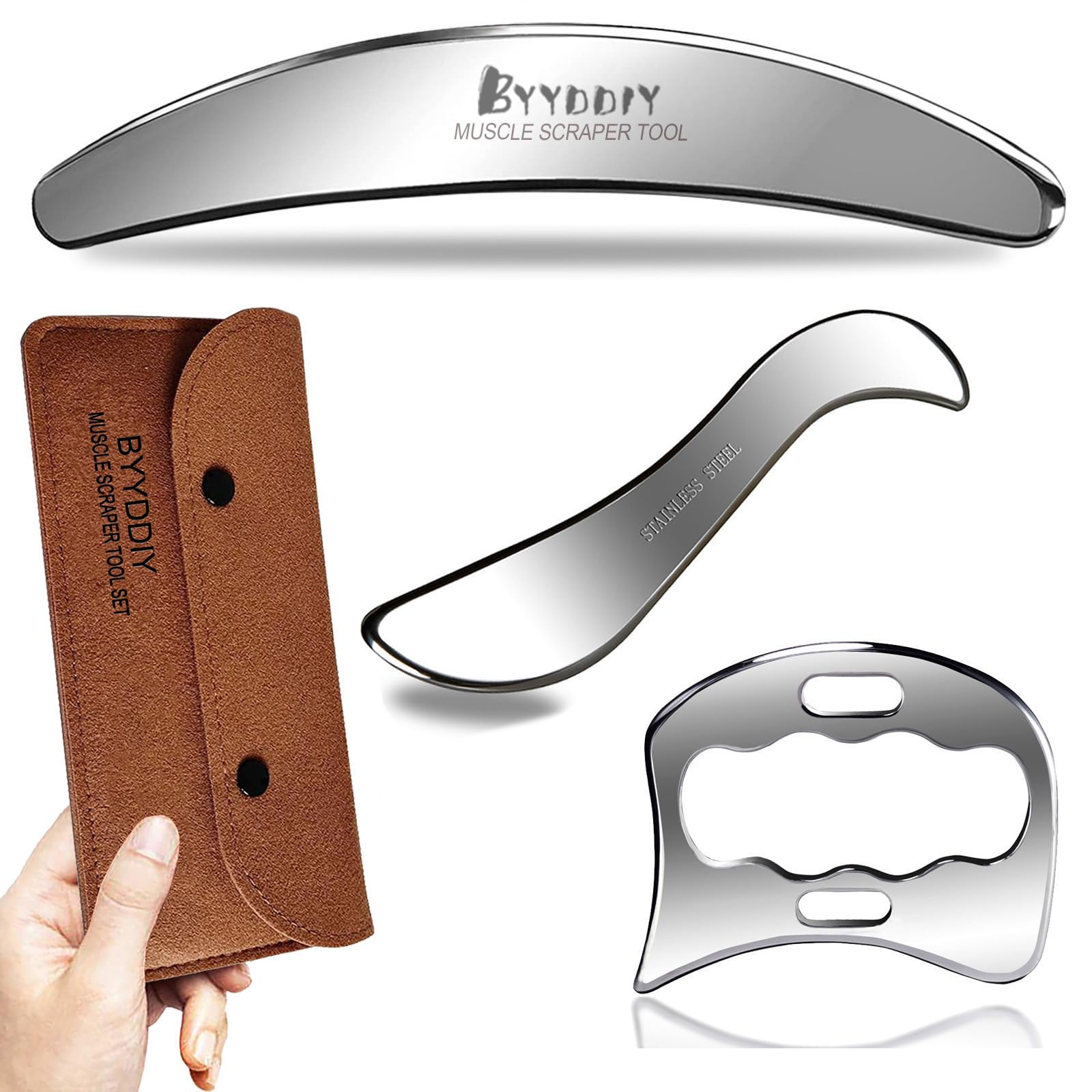
BYYDDIY 3-in-1 Stainless Scraper Set

93 /100
Trail Score Outstanding

Key details

Storage
Felt protective bag
Material
Medical-grade stainless steel
Set Weight
1.15 lb
Shapes Included
C, S, and D
Check Price on Amazon

If the knot is between your shoulder blades and there is nobody around to lean on, this is the set that solves it. The C-shaped tool is the reason: you grip both ends and pull it down your own back, which is the one motion a single-handled scraper cannot manage without your arm giving out halfway.

The other two shapes are not filler. The S tool handles flat work on a thigh or calf, and the D tool's curved edge hugs the arc of a shin or the top of a foot. All three are medical-grade stainless with a mirror polish and the same double bevel, and the set comes in a felt bag that keeps them from knocking together — useful, because 1.15 pounds of loose steel in a gym bag is a bad idea.

What you give up is speed. Three tools mean a decision before every pass, and the C shape takes a couple of tries before the angle stops fighting you. If your problem lives in one place, a single blade is quicker. This set is for the person whose tight spots move around.

Pros

  • C-shape lets you work your own upper back
  • Three shapes cover flat muscle and curved joints
  • Felt bag keeps the set protected and together
  • Medical-grade stainless wipes clean

Cons

  • Costs more and takes more room than one blade
Our verdict

This is the set to buy if the knot you cannot shift sits between your shoulder blades, where only a two-handed tool reaches.

Check Latest Price
4

Best Wooden Paddle

Komogir Wood Therapy Massage Tool

91 /100
Trail Score Outstanding

Key details

Size
11 x 6 in
Weight
5.61 oz
Material
Solid wood
Manual Included
Direction guide
Check Price on Amazon

Every other tool in this guide is metal or resin. This one is a single piece of wood, roughly 11 by 6 inches, finished smooth enough to run a thumb along the edge without catching, and it arrives with a small manual showing which direction to sweep.

Wood changes the experience in ways we did not expect to care about. There is no cold shock on a winter morning, it sits warm in the hand at 5.61 ounces, and the broad face covers a thigh or a glute in one pass. The reward is a slower, more spa-like few minutes than a steel blade gives you, which is exactly what some people are after.

Where it earns its place is legs and flanks, especially in long upward sweeps. Where it gives ground is precision: a knot in the calf wants a narrow edge and firm, local pressure, and this paddle spreads the same force over a much larger patch. We treat it as the second tool in a routine rather than the only one.

Pros

  • Warm, splinter-free finish that glides on oil
  • Broad face covers a thigh in one pass
  • Comes with a direction guide for beginners
  • Lighter than it looks at 5.61 ounces

Cons

  • Needs more oil than steel to keep from dragging
Our verdict

For oiled sweeping on legs, glutes, and flanks, this warm wooden paddle is the most pleasant tool here — just do not expect it to dig out a single knot.

Check Latest Price
5

Best for Beginners

Scienlodic Resin Body Gua Sha

90 /100
Trail Score Outstanding

Key details

Grip
Hollow finger handle
Length
7.09 in
Storage
Storage bag
Material
Resin
Check Price on Amazon

This one is resin, not stone and not steel, and it says so. What you get for that is a 7.09-inch body with a hollow handle your fingers pass through, so a long stroke up a thigh does not leave your hand pinched around a plate.

We like it best as a first tool. The grip does most of the work — your fingers sit inside the opening rather than clamping a thin edge, so you can hold steady pressure through a whole leg without your hand cramping. The edge is smooth and slightly rounded, forgiving when your angle wanders, and the body has enough substance that it does not skitter when you press.

The rounded edge is the other half of the trade: it will not slide under a tight fascia band or a scar the way a beveled steel tip does, so it stays a surface tool. For gentle daily sweeping, and for anyone who tenses at the idea of steel on skin, that is a fair exchange.

Pros

  • Finger-through handle prevents hand cramping
  • Smooth, rounded edge is forgiving for beginners
  • Covers thighs and torso in broad strokes
  • Storage bag included for drawer or travel

Cons

  • Resin mutes the feel of tight tissue
Our verdict

Start here if steel feels intimidating: the finger-through handle keeps pressure even over a whole leg, and the rounded edge forgives a wandering angle.

Check Latest Price
6

Feet and Forearms

FeelFree Sport Muscle Scraper

94 /100
Trail Score Outstanding

Key details

Grip
Center finger opening
Size
5 x 2 in
Weight
4.97 oz
Material
Stainless steel
Check Price on Amazon

Fifteen minutes into a calf session, the thing we noticed was our hand, not the muscle. The 5-by-2-inch plate has an opening through the middle that your fingers close around, so the pressure comes from your arm rather than a pinch — and we got through a whole lower leg without regripping.

It is the shortest steel blade in this guide, which is the point. On feet, shins, and forearms, five inches is plenty, and the compact shape gets into the arch and around the ankle without barking against bone. It weighs 4.97 ounces, the polish is genuinely mirror-grade, and it glides on the same smear of oil as the bigger tools.

Press hard for ten minutes and the rim of the opening makes itself known against the webbing of your hand; keep the passes short and you will not think about it. What we did not expect is how often we reached for it on feet — plantar fascia work is fiddly with a long blade, and this one has the control.

Pros

  • Center opening puts pressure in your arm
  • Five-inch plate fits arches and ankles
  • Mirror polish glides on oiled skin
  • Solid steel at a budget price

Cons

  • Grip opening digs in during long, hard passes
Our verdict

The one we pick up for feet, shins, and forearms: five inches of steel with a grip opening that puts the pressure in your arm instead of your fingers.

Check Latest Price
7

Broad, Flat Muscles

STICKON Stainless Steel Gua Sha Scraper

91 /100
Trail Score Outstanding

Key details

Width
4 in
Weight
7.05 oz
Material
Medical-grade stainless steel
Thickness
0.14 in
Check Price on Amazon

Four inches across at its widest, 0.14 inch thin, and 7.05 ounces: this is the flattest, broadest tool in the guide, and it behaves like a plate rather than a blade. Set it down on a pectoral or a thigh and it covers the whole muscle in one sweep.

That width is the appeal for large, flat areas. The thin plate reads the surface underneath it — you feel the ridges and the little catches — and the double bevel means you can roll it onto an edge for narrower work. It is also the only tool here with two grip openings, so you can shift hand position mid-session instead of shaking out a cramp.

The trade-off shows up on curves. A flat plate does not wrap a calf or a forearm the way the S-shaped tools do, and 7.05 ounces is the heaviest single tool here, which you notice when you hold it overhead to reach a shoulder.

It is also the most expensive single tool in this guide, and the polish is no finer than on tools that cost far less — what you are paying for is that wide face. Buy it to work big flat muscles; as an only tool, the top pick covers more ground.

Pros

  • Four-inch face covers a pectoral in one pass
  • Thin plate transmits the feel of the tissue
  • Two grip openings allow hand changes
  • Heavy 7.05 ounces presses with little effort

Cons

  • Highest price of the single tools here
  • Flat face does not wrap a curved calf
Our verdict

A specialist's tool: the widest, flattest plate here is excellent across a quad or a pectoral and mediocre everywhere a curve is involved.

Check Latest Price

How We Tested 14 Body Gua Sha Tools

I built the shortlist by reading reviews and spec sheets for body-specific shapes—longer edges, thicker stones, and grips that could survive lotion or oil—then ruled out tools that looked like facial stones scaled up. Fourteen tools made it into the test, and I used them for four months in the places they actually belong: the bathroom after a shower, the living-room floor after a run or long walk, and at my desk after too many hours hunched over a keyboard.

Each tool got the same run: a 10-minute session on calves, thighs, shoulders, and upper back, using lotion on one side and oil on the other so I could feel how the surface handled drag. I weighed each on a kitchen scale and measured length, width, and thickness with calipers, then noted whether the size covered a calf comfortably or felt clumsy in my hand. I watched for edges that caught, skipped, or turned pressure sharp, and for handles or curves that got slippery. For pain relief, I rated tightness in my calves and shoulders before and after each session, paying attention to whether I could keep a gentle, steady stroke without bracing my wrist.

Quality and durability came down to finish: whether edges were polished evenly, seams were clean, and the surface still felt smooth after every wash. I cleaned each tool with mild soap and water after use, stored it dry, and checked for chips, cracks, cloudiness, and loose handles at the end of four months. Value was judged by how often I reached for a tool, how comfortable it stayed through a full session, and whether it still performed like it did on day one. The strongest tools were not the heaviest or the most elaborate—they were the ones that made steady pressure feel natural and held up without fuss.

How to Choose a Body Gua Sha Tool

Match the Tool to the Area You Will Work

Longer means more coverage and less control. A blade around seven to eight inches sweeps a thigh or a lat in two passes, which is why our top pick and value pick both land there. A five-inch plate is better on feet, shins, and forearms, where a long edge barks against bone.

The trap is the word compact: in a listing it usually means face-sized, and a palm-length jade board will not cover a hamstring however the bullet points read. Put a ruler against the muscle you want to work and buy a working edge at least that long, or accept that you are buying a joint tool.

Decide How Much the Material Matters

Steel glides with the least oil, wipes clean, and lets the tool's own weight do the pressing — which is why most of this guide is stainless. Resin gives up some feel in exchange for being forgiving and hard to chip. Wood is warm and broad but wants more oil. Stone is the fragile option: a body-sized stone tool is a heavy thing to trust to a bathroom shelf. If you drop things, buy steel or resin.

Test the Grip Before You Commit to a Long Session

Ten minutes on your own quad is a grip-endurance test. Finger openings and hollow handles let you hold pressure with your arm instead of a pinch, while thin flat plates are the ones that leave a red line across your hand.

If your tight spots sit between the shoulder blades, a two-handed shape is not a luxury — it is the only way to reach the middle of your back with any real force. Buy for that first and for everything else second.

Plan for Oil, Pressure, and Clean-Up

Every tool here needs a lubricant; dry steel drags and leaves marks. A couple of pumps of body oil is enough, and light-to-moderate pressure does more than a hard press — redness that fades in minutes is normal, a bruise means you went too hard.

Stainless and resin wipe clean with warm soapy water; wood wants a damp cloth and no soaking. Keep blades in the case or sleeve they came with so the edges are not knocking against everything else in the drawer.

Frequently Asked Questions

Final Verdict

If you want one tool that handles back, thighs, and calves, the H-Brotaco is the one we recommend without a caveat: long enough to cover ground, heavy enough to spare your hand, and beveled on both edges.

Add the BYYDDIY S-shaped scraper if you want a pointed tip for shins, joints, and scar tissue. If your tight spots sit in the middle of your back, skip both and buy the three-piece set — only the C-shaped tool reaches there with any force behind it.