Best Food Scales for Weight Loss of 2026

A food scale only earns its counter space if you trust the number it gives you. Weigh the same chicken breast twice, get two different readings, and you'll quietly stop bothering by week two — which is how portion tracking usually falls apart. What a good scale actually fixes is the guesswork: accurate to the gram, wide enough to hold a dinner plate, and simple enough that taring a bowl takes one thumb.

I've logged meals on and off for years, and the scales that survive daily use are rarely the flashiest — though the one parked on your counter does have to look like it belongs there. My team and I spent six months weighing food on 14 of them, from palm-size models to wide glass-topped ones, and the spread in accuracy, footprint, and everyday ease was wider than I expected. Watch how fast the display times out; a scale that sleeps while you're still spooning yogurt into a bowl is one you'll stop reaching for. The picks below kept reading true right through month six.

1

Best Overall

INEVIFIT Digital Kitchen Scale

95 /100
Trail Score Outstanding

Key details

Units
Grams, ounces, pounds, fluid ounces
Display
Backlit LCD
Increments
0.04 oz
Maximum Capacity
13 lb (6 kg)
Check Price on Amazon

Accuracy is the only thing a weight-loss scale truly has to get right, and on that one measure this was the strongest scale in our group. It reads in 1-gram steps up to 13 pounds, switches between grams, ounces, pounds, and fluid ounces, and does the small thing that matters every morning: put a bowl down, press tare, and the numbers start from zero. The backlit display is bright enough to read before the kitchen lights are fully on, which sounds trivial until you are weighing oats at six in the morning.

Nothing about it is fussy. The brushed stainless platform wipes clean with a damp cloth, the digits are large rather than crammed into a dot-matrix strip, and the whole scale weighs about as much as a coffee mug, so moving it between counter and cabinet is a one-hand job. The three AAA batteries come in the box, so it works the moment you unbox it, a courtesy we have stopped taking for granted.

Where it gives ground is size. The platform is compact, so a full dinner plate overhangs the edges and you will want a bowl or a smaller plate for a tidy weigh. That is no obstacle to portioning chicken or rice, and the 13-pound capacity still takes a mixing bowl of batter. But if you like to weigh straight onto the plate you will eat from, one of the wider scales here suits you better.

Pros

  • Steadiest gram readings in this set
  • Backlit LCD is easy to read in dim light
  • 13-pound capacity takes a full mixing bowl
  • Tare and unit switching cover layered meals

Cons

  • Costs more than the budget picks here
Our verdict

For everyday portioning, this is the scale we point people to: the steadiest gram readings in our set, in a compact body that earns its counter space.

Check Latest Price
2

Best for Meal Prep

Etekcity Food Scale with Bowl

95 /100
Trail Score Outstanding

Key details

Bowl
Detachable, doubles as a cover
Units
oz, lb:oz, g, mL, fl oz
Increments
1 g / 0.1 oz
Maximum Capacity
11 lb (5 kg)
Check Price on Amazon

Breakfast is where a scale like this earns its keep, and the bowl is the reason to choose it. Set the bowl on the platform, press tare, spoon in the yogurt, tare again, add the berries: you get a running total without dirtying a second dish, and the bowl lifts off afterward for the sink. The readings hold steady at portion sizes, which is the whole job.

The rest is unremarkable in the right way. It measures in 1-gram steps up to 11 pounds and handles ounces, pounds, milliliters, and fluid ounces, including separate water and milk volume modes, a feature we used less than we expected, since zeroing a jug and pouring is quicker than switching modes. The backlit screen stays visible with the bowl loaded, and the stainless deck wipes clean in one pass.

The bowl has a second life, by the way. It snaps over the platform as a cover, which keeps the deck dust-free between uses and lets the whole thing slide into a drawer without a protective corner. That is the kind of detail we notice because we have stored a lot of scales badly.

Pros

  • Detachable bowl goes straight to the sink
  • Tare handles layered breakfasts in one bowl
  • 1-gram steps up to 11 pounds
  • Bowl doubles as a cover between uses

Cons

  • Additions under 5 grams may not register
Our verdict

If your meals start in a bowl, yogurt, oats, cereal, soup, this is the pick: the bowl comes off for washing and the gram readings hold steady.

Check Latest Price
3

Best Display

OXO Good Grips Digital Scale

95 /100
Trail Score Outstanding

Key details

Display
Slides out from the base
Platform
Removable stainless steel
Increments
1 g / 1/8 oz
Maximum Capacity
11 lb
Check Price on Amazon

Most scales put the screen at the back of the platform, which is fine until a mixing bowl covers it and you are leaning sideways to read your own breakfast. OXO's answer is a display that slides out from the base, so the numbers sit clear of whatever you have loaded. We think it is the best single idea in this group, and it is most of what you are paying for.

The rest is built to be lived with. The stainless platform lifts off for washing, a genuine rarity among these, so you can rinse the part the food touches without waving a wet cloth at the electronics. There is a capacity meter that shows how much of the 11-pound limit you have used, an optional backlight, and readings in 1-gram or 1/8-ounce steps.

Accuracy is the one place it gives ground: readings are good rather than exceptional, a step behind our top pick. On a plate of chicken and rice that gap disappears; on anything fussier it might not. What you are buying here is the view of the number, and if a big bowl is part of your daily routine, that is worth more than a decimal place.

Pros

  • Display pulls out past a loaded bowl
  • Stainless platform lifts off for washing
  • Capacity meter shows remaining headroom
  • Large digits with an optional backlight

Cons

  • Most expensive scale in this guide
Our verdict

If you weigh into wide bowls or onto dinner plates, this is the one: a display that slides out past the rim, so the number is never hidden.

Check Latest Price
4

Best for Batch Cooking

Cooking Master' 22-Pound Scale

95 /100
Trail Score Outstanding

Key details

Units
kg, g, lb:oz, fl oz, ml
Platform
Tempered glass and stainless steel
Increments
1 g / 0.1 oz
Maximum Capacity
22.04 lb (10 kg)
Check Price on Amazon

Twenty-two pounds of capacity is far more than a chicken breast needs, and that is exactly the argument for it: this scale never asks you to weigh in stages. The platform is large, with room for a family-size mixing bowl, and the tempered glass and stainless top wipe down in one pass.

Meal prep is where it makes sense. A pot of chili or a tray of chicken portions goes on in one go, then a couple of taps switches to ounces for a recipe written in cups. Six units, 1-gram or 0.1-ounce steps, tare, a backlit display: the list is complete without being fussy, and there is nothing here you will never touch.

The detail we did not expect to like is the surface itself. Turmeric, tomato sauce, and coffee all wiped off without staining, and the glass looks tidy enough to stay out between uses. It earns its place on the counter of anyone who preps in bulk, and small as that sounds, it is the reason this one went back on the counter after testing instead of into the cupboard.

Pros

  • 22-pound capacity takes a full stockpot
  • Wide platform fits a family-size bowl
  • Glass and stainless wipe clean without staining
  • Six units including pounds-and-ounces

Cons

  • More capacity than single servings need
Our verdict

If you cook in bulk, this is the one: a wide platform, 22 pounds of capacity, and steady readings, so you never split a batch.

Check Latest Price
5

Messy Kitchens

Escali Primo Digital Scale

93 /100
Trail Score Outstanding

Key details

Warranty
5 years limited
Dimensions
8.5 x 6 x 1.5 in
Increments
1 g / 0.05 oz
Maximum Capacity
11 lb (5 kg)
Check Price on Amazon

No backlight, no pull-out screen, no app: the Primo has two buttons and a display, and that is the entire interface. What it does have is a control panel sealed under a protective shield, so a splash of pasta water or a dusting of flour wipes off instead of working its way toward the electronics. In a kitchen where things spill, that counts for more than any feature on this list.

We found the two-button operation genuinely restful next to the five-button scales here. One button powers on and tares, the other cycles grams, ounces, and pounds-and-ounces; there is nothing to configure and nothing to reset by accident halfway through a recipe. Readings come in 1-gram or 0.05-ounce steps up to 11 pounds, and it runs on AA batteries, a small mercy if your drawer is full of AAAs.

The five-year limited warranty is the longest stated coverage in this guide, and it says something about how the thing is expected to hold up. Buy it, wipe it down when you are done, and stop thinking about it, which is more or less the highest compliment a kitchen scale can earn.

Pros

  • Sealed control panel shrugs off splashes
  • Two-button operation, nothing to configure
  • Reads in 1 g or 0.05 oz to 11 lb
  • Five-year limited warranty

Cons

  • Small platform; a dinner plate overhangs
Our verdict

A sealed two-button panel makes this the easiest scale here to live with in a messy kitchen, and the five-year warranty backs it up.

Check Latest Price
6

High Capacity

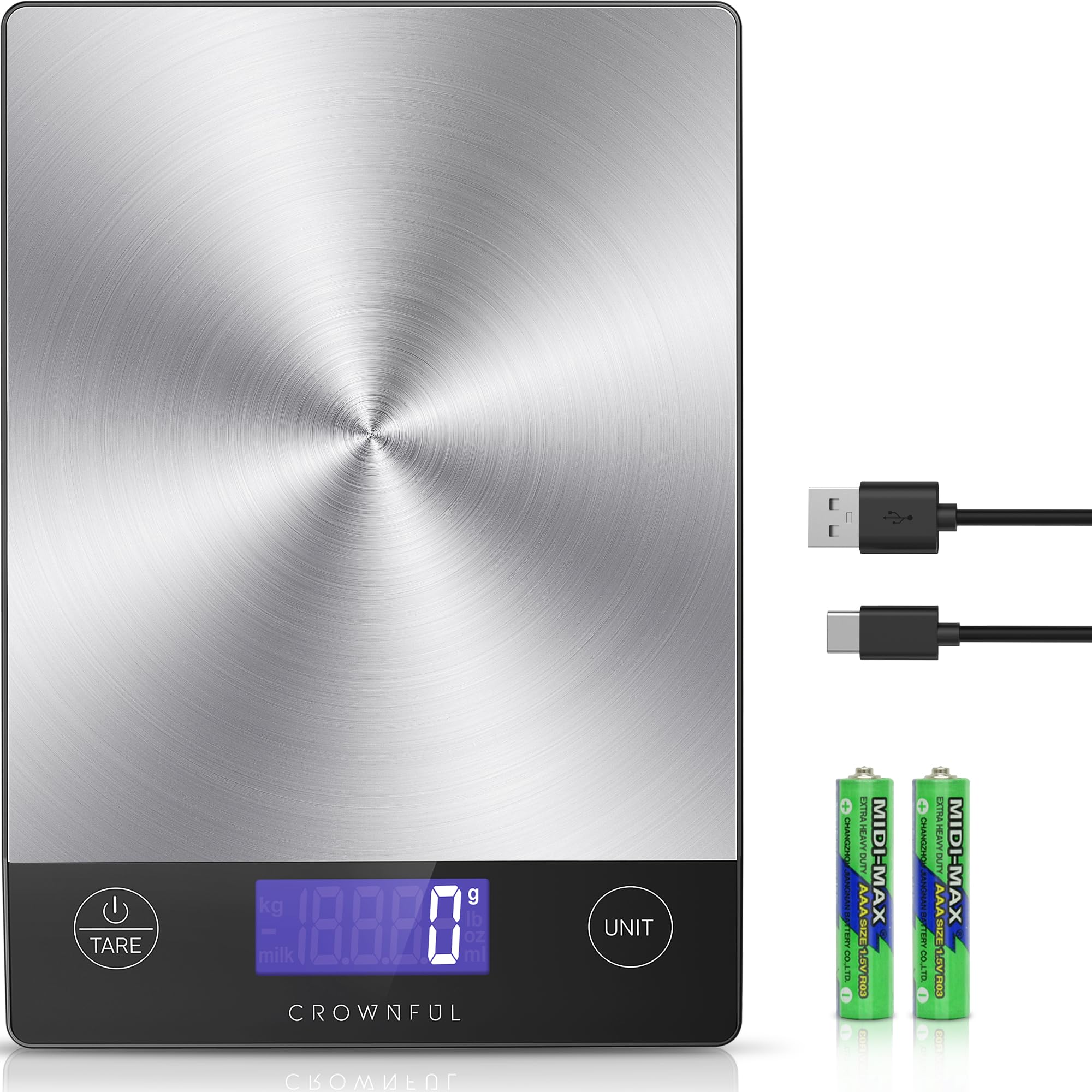
CROWNFUL 33-Pound Rechargeable Scale

93 /100
Trail Score Outstanding

Key details

Power
USB-C rechargeable or 2 AAA
Units
g, kg, lb, oz, ml, milk ml
Increments
0.04 oz
Maximum Capacity
33 lb (15 kg)
Check Price on Amazon

The screen is the first thing you notice. It sits at an angle on the front edge instead of lying flat at the back, so a bowl on the platform does not hide the numbers, a small piece of design we appreciated more the longer we used it, because you stop leaning over the counter to check a reading.

Then there is the range: 33 pounds, more than any kitchen task asks for and just right if the same scale also handles a stockpot, a bag of dog food, or a parcel. It charges over USB-C and will run on two AAA batteries as well, so a flat battery never sidelines it. Six units, 1-gram steps, and a tare button cover the basics.

The thing to plan around is power. The built-in cell is convenient, but keeping a spare pair of AAAs in the drawer is the difference between a scale that always works and one that quits on a Sunday. Do that, and it earns its place as the high-capacity option here, especially for anyone who wants one scale for the kitchen and the mail pile.

Pros

  • 33-pound capacity handles pots and parcels
  • Slanted screen stays visible with a bowl loaded
  • USB-C charging or two AAA batteries
  • Six units and a one-tap tare

Cons

  • Readings drift more than our other picks
Our verdict

For big capacity on a small budget, this is the pick: 33 pounds, a slanted screen you can read past a bowl, and two ways to power it.

Check Latest Price

How We Tested 14 Food Scales Over Six Months

To build the shortlist, I sorted through spec sheets and customer reviews for more than 40 scales and cut anything with a platform too small for a dinner plate, a weight limit under 5 pounds, or a cluster of reviews describing readings that drifted. That left 14, spanning plain plastic models to glass-topped ones with app pairing, and each one lived on a real kitchen counter for six months.

Accuracy came first. Every scale had to pass the same check: a 100-gram calibration weight, then a nickel, which should read 5 grams, then the same block of butter weighed five times in a row and again after being slid to a different spot on the counter. We repeated those checks at the beginning, middle, and end of the testing window, which is how we caught the two units that slowly drifted and the one that read light on anything under 10 grams.

Then the unglamorous part — living with them. We tared bowls of oats, weighed raw chicken straight on the platform and wiped it down afterward, switched between grams and ounces mid-recipe, and counted how many presses it took to get from zero to a tared reading. We noted footprint on a crowded counter, how each one looked sitting out between meals, and how long the batteries actually held up, including whether auto-off cut the display while a bowl was still being filled. Value, in the end, came down to price measured against all of that rather than price alone.

How to Choose a Food Scale for Weight Loss

Start With Grams, Then Decide How Fine

Every scale here reads in 1-gram steps, and that is the right resolution for a portion of rice, chicken, or yogurt. Finer increments belong to coffee and supplement powders, not meals. What separates these scales more is the minimum weight they register: the Etekcity bowl model asks for at least 5 grams, while the wide Cooking Master platform starts around 2 to 3.

If you are weighing 150 grams of rice, that difference is academic. If you count calories from oil, nut butter, or seeds, where a small slip is expensive, buy a scale that states a low minimum rather than assuming the display will move for a teaspoon.

Tare Is the Button You Will Wear Out

Tare zeroes the platform, and it is how you weigh food without doing arithmetic. Bowl on, tare, add yogurt, tare again, add berries: each addition reads on its own and the bowl never leaves the platform. All six picks have it, so the real differences are whether you can reach the button with a loaded bowl in place and whether the display stays visible while you do.

Run the sequence once with an empty bowl before you trust your first breakfast to it. It takes thirty seconds and it is the whole technique.

Where the Display Sits

A scale is a flat slab with a screen at one end, and a dinner plate covers most of it. That is the most common daily annoyance in this category, and the fixes differ: OXO slides the display out on an arm, CROWNFUL angles it up at the front, and the Etekcity bowl model sets the screen beside the weighing area rather than behind it.

Compact in a listing describes how a scale stores, not whether your plate fits on it. Check the platform against the bowl you actually eat from, and check where the number lands once that bowl is loaded.

Pay for Longevity, Not for Features

Among the scales we looked at, the least expensive were also the ones with the most consistent pattern of quitting within a few months, which is why our picks sit in the middle of the range and above rather than at the bottom. A sealed control panel and a platform that lifts off both help keep liquid away from the electronics.

If you want to buy once, a stated multi-year warranty is worth more than an extra unit mode you will never touch. The Escali's five-year coverage buys more peace of mind than a seventh measurement option.

Do You Need a Nutrition App Built In?

A scale weighs; an app counts. Scales with a built-in nutrition database can log a food as you weigh it, which saves a step if you will genuinely use that company's database and its daily summaries.

Most people do better with a plain scale and the tracker already on their phone: the food database is bigger, the barcode scanner works, and you are not tied to one manufacturer. Decide by which app you already open every day. If the answer is none, start there before you pay extra for it.

Frequently Asked Questions

Final Verdict

Buy the INEVIFIT if you want one accurate scale for everyday portioning. Its gram readings were the steadiest of the six we are recommending, and the compact body means it actually stays on the counter instead of migrating to a drawer.

Weigh into wide bowls or onto dinner plates and the OXO's pull-out display is worth the premium. Start every meal in a bowl and the Etekcity with the detachable bowl handles that for far less. Only a stockpot calls for the Cooking Master'.