Best EMS Muscle Stimulators of 2026

An EMS stimulator is bought out of frustration: a shoulder that won't loosen, a lower back that aches after a long day at a desk, a calf that tightens every time you run. The pitch is simple—a small unit sends gentle electrical pulses into the muscle, and with the right settings and pads, it can feel like someone finally worked out the knot. What first-time buyers don't expect is that pad adhesion and clear instructions often separate a useful unit from a drawer ornament. I've been zapping a stubborn shoulder for months, and our team has now lived with 12 stimulators for six months—after workouts, at my desk, and on the couch—to see which ones deliver.

The top picks weren't the ones with the longest menu. They held a charge through a week of daily sessions, made their programs easy to read, and kept their pads sticky after repeated use. A few lost their grip by week three. The ones I'd hand to a friend with a knot and no patience for a manual are below.

1

Best Overall

Belifu Dual Channel TENS EMS

91 /100
Trail Score Outstanding

Key details

Modes
24
Channels
2
Pads Included
10
Intensity Levels
20
Check Price on Amazon

Two independent channels, 24 modes, and 20 intensity levels are the right foundation for a first EMS unit, and the Belifu fits them into a body that disappears in a drawer. That combination is why it is our top pick. We ran one channel on a shoulder and the other on a lower-back muscle during testing, and having separate controls meant we did not have to compromise the setting on either area.

The rechargeable lithium battery is a practical upgrade over 9-volt units: it charges from a wall adapter, power bank, or laptop USB port, so a session does not depend on a fresh battery. The box also includes ten reusable pads and a drawstring bag, which makes the whole kit easier to keep together than a loose remote and wires.

The instruction booklet is the weak link. The 24 modes are not self-explanatory, and the first pass through the menu can feel like guesswork. Start at the lowest intensity, change one variable at a time, and give each mode a minute before deciding. That habit matters more on a unit with this much range than on a simpler device.

For a first EMS device, the Belifu leaves little reason to spend more. It is small, strong enough to feel the muscle working, and complete enough to use on day one.

Pros

  • Two independently adjustable channels
  • 24 modes and 20 intensity levels
  • Rechargeable battery and 10-pad kit
  • Compact body with storage bag

Cons

  • Pad adhesion fades with repeated use
Our verdict

We recommend the Belifu as the default EMS unit for most homes: two independent channels, 24 modes, and a complete pad kit make at-home sessions easy to start.

Check Latest Price
2

Best for First-Time Users

TechCare PLUS24 TENS EMS

93 /100
Trail Score Outstanding

Key details

Modes
24
Battery
Up to 20 hours
Channels
2
Intensity Levels
20
Check Price on Amazon

The TechCare's large LCD is the feature that changes daily use. Instead of decoding a mode number from a tiny icon, you see the mode, intensity, and channel on a screen that is easy to read from arm's length. The kit also includes three pad sizes and a Type-C charging cable, so the first session does not require a trip to the store.

That readability is why we recommend it for first-time users. We found the controls take only a few minutes to understand, and the independent channels let you adjust one area without resetting the other. The battery is rated for up to 20 hours of continuous use, which is more than enough for a week of short sessions between charges.

The pads are the part to watch. They hold well on clean, dry skin, but oils and repeated use shorten their grip, so keep the plastic backing and store them flat. A spare set is worth having on hand before a long session.

The screen is the difference. It lowers the chance that you will set the wrong channel, give up, and leave the unit in a drawer.

Pros

  • Large LCD is easy to read
  • Up to 20 hours per charge
  • Three pad sizes in the box
  • Independent dual channels

Cons

  • Mode menu requires a lot of scrolling
Our verdict

We reach for the TechCare when we want the clearest screen and simplest setup; it is the unit we hand to someone using EMS for the first time.

Check Latest Price
3

Best Budget

AVCOO 30-Mode TENS EMS

93 /100
Trail Score Outstanding

Key details

Modes
30
Battery
Up to 30 hours
Channels
2
Intensity Levels
30
Check Price on Amazon

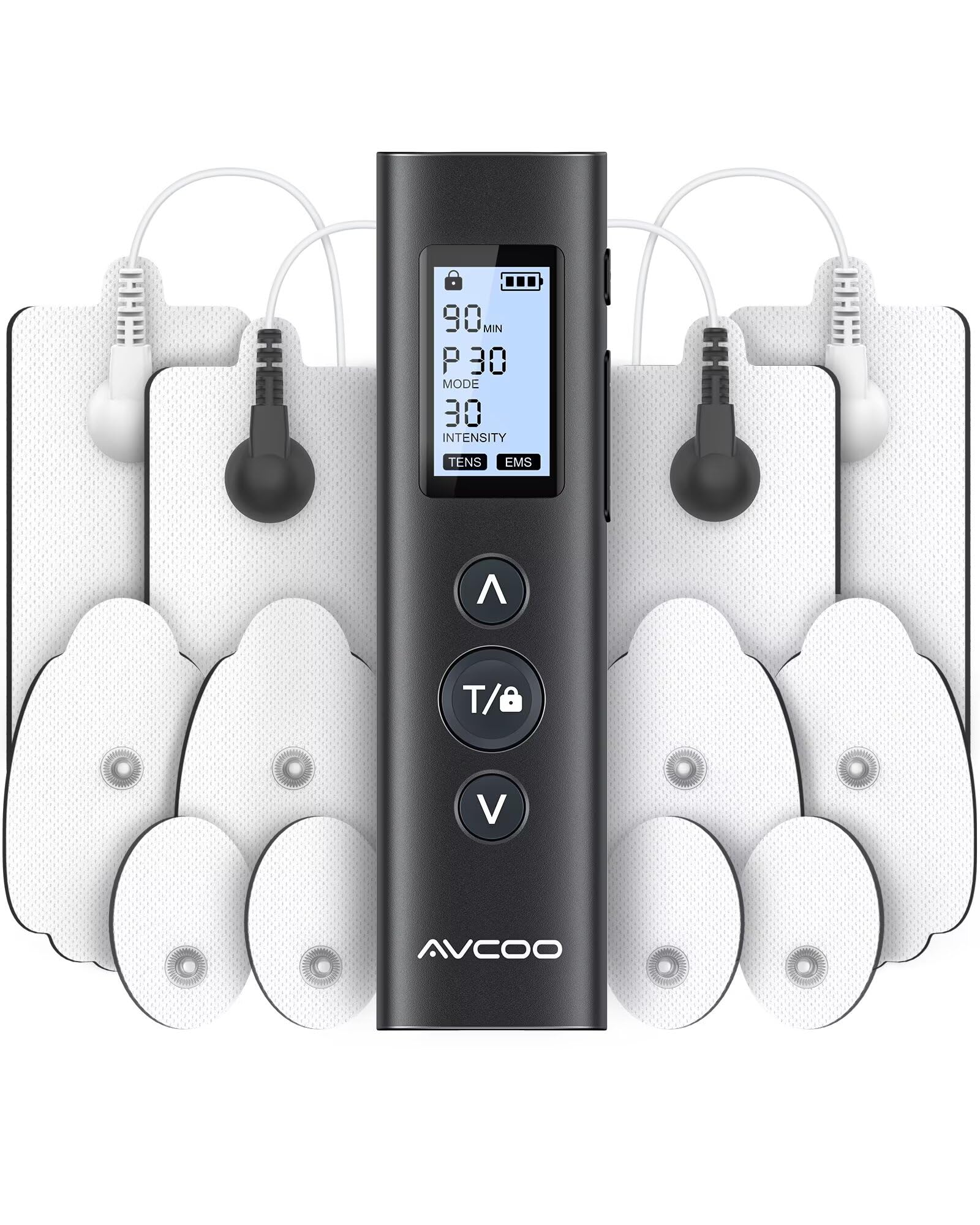
The AVCOO 30-mode is the budget pick we keep coming back to, and it does not feel like a penalty box. At 0.09 pound and roughly the size of a slim phone, it slides into a pocket or purse, and the memory function picks up where you left off. That matters when you are setting up a session in a cramped bathroom or at a desk.

Thirty modes and 30 intensity levels are more than most people will use, but the range is there for sensitive days and stubborn spots. The battery is rated for up to 30 hours of use, and USB charging means you can top it up from a laptop or power bank rather than hunting for a special dock. We liked that freedom.

The accessory kit is generous: 12 pads in three shapes and a 12-month warranty. That is the right place to spend on a budget unit: pads are the part you will replace first, and having spares keeps a session from ending early.

It is the unit we leave in a gym bag, where its light body and long charge matter more than a polished screen.

Pros

  • Very slim and light
  • 30 modes and 30 intensity levels
  • Up to 30 hours per charge
  • 12 pads included

Cons

  • No travel case included
Our verdict

We keep the AVCOO 30-mode unit as the budget choice because it covers the essentials in a body small enough to forget in a bag.

Check Latest Price
4

Best for Visibility

CESLIFF 24-Mode TENS EMS

92 /100
Trail Score Outstanding

Key details

Modes
24
Display
Large LCD
Channels
2
Intensity Levels
36
Check Price on Amazon

The CESLIFF's oversized LCD is the reason to look at it. The mode, intensity, and channel readouts are big enough to see without leaning in, and the physical buttons are spaced far enough apart to press deliberately. If you have ever turned a TENS unit into a guessing game, this is the remedy.

The 24 modes and 36 intensity levels give you a lot of room, but the useful part is the independent A/B channels. We set one channel lower for a sensitive shoulder and kept the other stronger on the low back; that flexibility is what separates a dual-channel unit from a single-channel one.

We recommend it for low-vision users, shared households, and anyone who adjusts settings mid-session. The belt clip keeps it on your waist while you move around, and the rechargeable battery avoids a drawer full of AA batteries.

Pros

  • Large LCD with clear readouts
  • 36 intensity levels
  • Independent A/B channels
  • Belt clip for hands-free use

Cons

  • Pads lose grip after several uses
Our verdict

We like the CESLIFF for anyone who needs to read settings at a glance: the large screen and 36 intensity steps make adjustment less fiddly.

Check Latest Price
5

Best for Multi-Area Sessions

iSTIM EV-805 TENS EMS

90 /100
Trail Score Outstanding

Key details

Display
Backlit
Channels
4
Programs
24
Pads Included
24
Check Price on Amazon

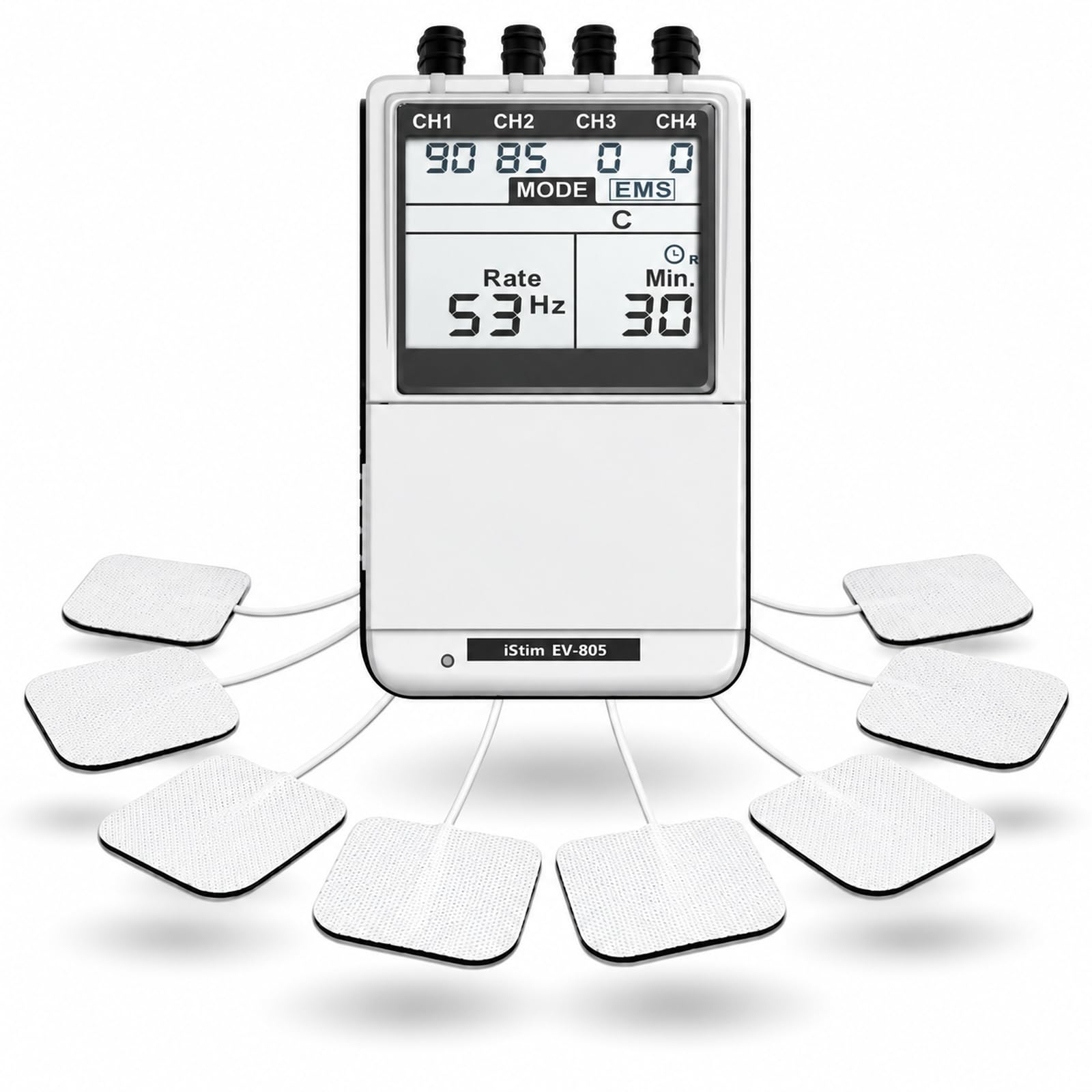
Four channels is more than a spec-sheet flex. On the EV-805 it means you can keep pads on both shoulders and both quadriceps and control each pair without moving leads. For a long recovery session, that is a different kind of convenience from a pocket unit with two channels.

We recommend it for multi-area treatment, not for someone who wants a one-button remote. The 24 preset programs include 5 TENS modes and 3 EMS modes, and the backlit display is easy to read in a dim room. The interface asks you to learn its logic; the first few sessions are slower than they are on the Belifu or TechCare.

The pad kit helps justify the price. You get 24 Japanese gel pads in multiple sizes, which is enough to experiment with placement without rationing your sessions to a handful of pads. The unit is also heavier and more deliberate in the hand than the pocket units here, which we read as reassuring rather than cumbersome.

If you mainly treat one area at a time, the extra channels are overhead. If your sessions regularly cover both sides of the back, shoulders plus knees, or a broad area that needs eight pads, the EV-805 is the unit that makes a complicated session feel organized rather than improvised.

Pros

  • Four independent channels
  • 24 preset programs
  • 24 electrode pads included
  • Backlit display

Cons

  • Larger and heavier than pocket units
Our verdict

The iSTIM EV-805 earns its premium price when one session has to cover several body areas, thanks to four independently controlled channels.

Check Latest Price
6

Best with Heat Therapy

Beurer EM59 TENS EMS

86 /100
Trail Score Excellent

Key details

Heat
Yes
Timer
5–100 minutes
Channels
2
Programs
64
Check Price on Amazon

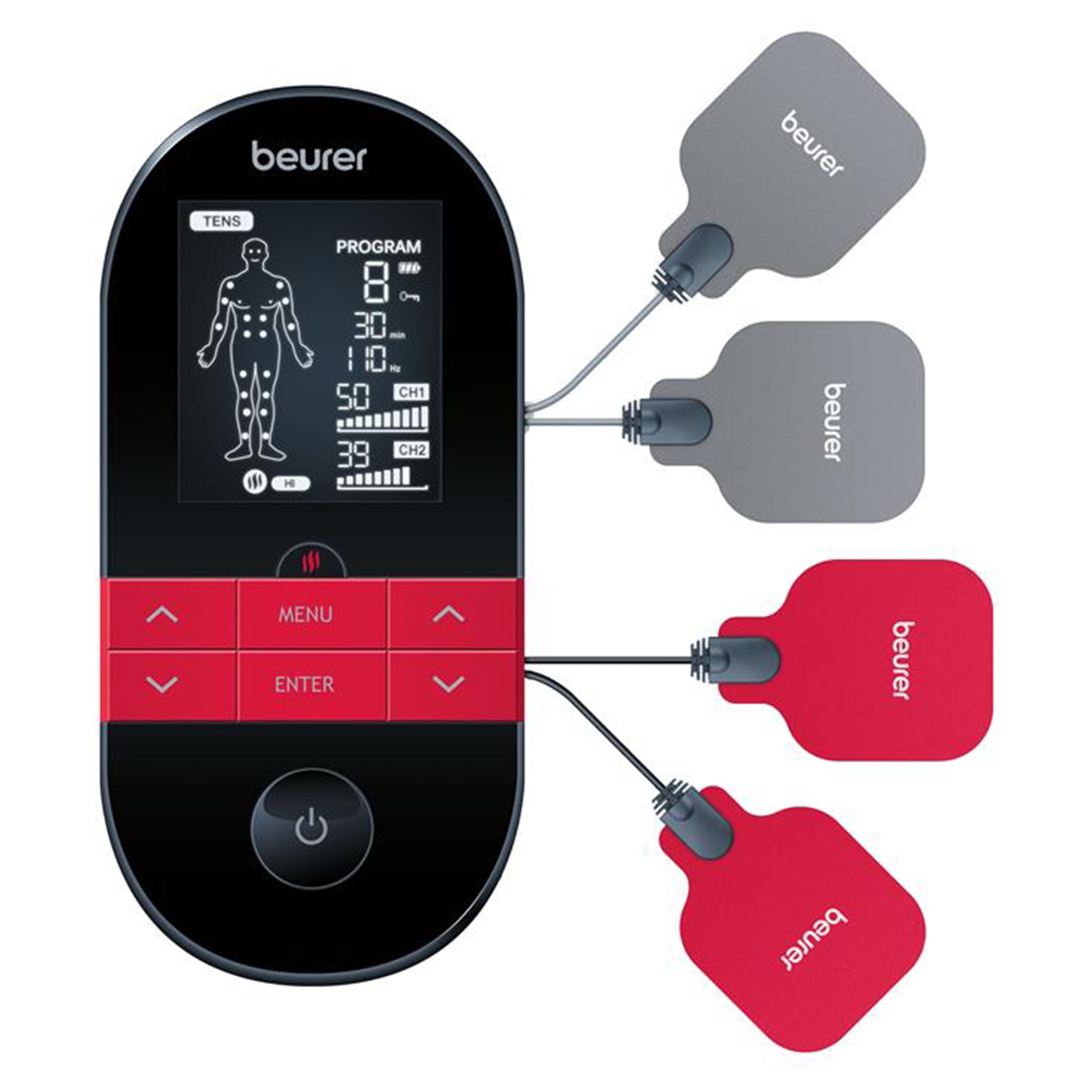
Heat is the reason to consider the Beurer EM59. It combines TENS, EMS, and a warming function in one handset, so a stiff shoulder can get electrical stimulation and gentle warmth without a separate heating pad. That is a real convenience on a cold morning or after a workout when you want to relax a muscle before you stretch it.

The rest of the package is built for deliberate use. There are 64 preset programs, six customizable settings, two independent channels, and a timer that runs from 5 to 100 minutes. We liked the belt clip and the clear inverse LCD; the controls feel more like a small medical device than a gadget, which suits the price.

The included pads are the weak link. They can lose grip before the device itself gives you trouble, especially if you reuse them on oily skin. Clean and dry the area first, press the pads down for a few seconds, and keep the backing between sessions. A spare set of pads is a sensible add-on.

The EM59 is the one we choose when a session is as much about relaxation as recovery. If you want the simplest possible unit, the TechCare is easier; if you want heat, this is the pick.

Pros

  • Built-in heat therapy
  • 64 preset programs
  • Two independent channels
  • 5–100 minute timer

Cons

  • Instructions take time to decode
Our verdict

We recommend the Beurer EM59 when heat therapy matters: it pairs TENS and EMS with a warming function no other pick here has.

Check Latest Price
7

Travel and Storage

AVCOO 32-Mode TENS EMS

93 /100
Trail Score Outstanding

Key details

Modes
32
Channels
2
Carry Case
EVA
Intensity Levels
40
Check Price on Amazon

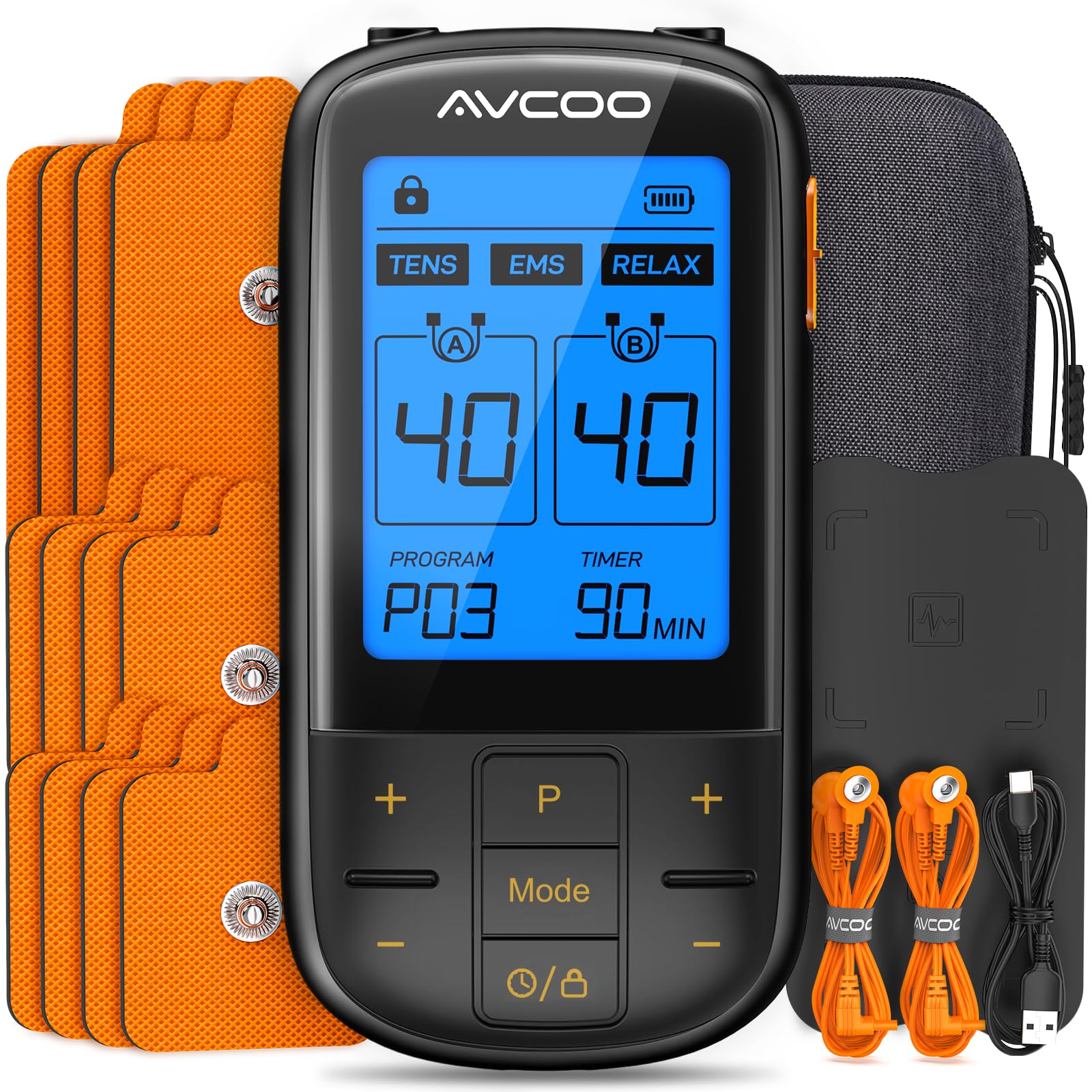
The EVA case is what makes this AVCOO the travel pick. The unit itself is pocket-size, but the case gives the leads, pads, and charging cable a place to live, so nothing ends up tangled at the bottom of a bag. We appreciated that more than we expected; a stimulator is only convenient if the pieces are together when you need them.

The device adds a RELAX mode alongside TENS and EMS, for 32 modes and 40 intensity levels across two channels. The 20-hour battery and USB-C charging make it easy to top up from a laptop or power bank, and the 12 pads include both square and rectangular shapes for joints and broader areas.

We recommend it for commuters, travelers, and anyone who has lost a lead behind a desk drawer. The case does add bulk to a pocket-size device, so it is a bag accessory rather than something you carry in a trouser pocket. That is the trade: a little more space for a lot less searching.

For a kit that stays packed and ready, the case is not an accessory; it is the reason the unit gets used.

Pros

  • Hard EVA case keeps kit organized
  • 32 modes and 40 intensities
  • Up to 20 hours per charge
  • USB-C charging

Cons

  • Durability can be inconsistent
Our verdict

We like the AVCOO 32-mode kit for travel because the hard EVA case keeps the unit, leads, and pads together.

Check Latest Price
8

Gradual Intensity

AUVON 3-in-1 TENS EMS

91 /100
Trail Score Outstanding

Key details

Modes
24
Channels
2
Pads Included
12
Intensity Levels
40
Check Price on Amazon

The AUVON's 40 current levels are the reason to pick it. If you have ever turned on a stimulator and felt the first setting jump straight to a sharp zap, the finer steps here make it easier to find a level that contracts the muscle without making you flinch. We paid close attention to that ramp-up, because it is the difference between a device you use and one you avoid.

The 24 modes cover TENS, EMS, and a RELAX setting, with two independent channels and 12 pads in two sizes. The square pads suit smaller joints, while the larger rectangles cover a back or thigh. Type-C charging and a pad holder keep the kit manageable, though the holder is not a full travel case.

The weak spot is long-term durability. Some units have stopped working after a few months, so keep the receipt and check the return window before you rely on it. The device feels solid enough in hand, but that is not the same as a guarantee.

For a sensitive first session, the AUVON is the gentler introduction. It is not the most polished unit here, but the fine control is worth the compromise.

Pros

  • 40 intensity levels for gradual ramp-up
  • 24 modes with TENS, EMS, and RELAX
  • 12 pads in two sizes
  • USB-C charging

Cons

  • Pad adhesion can fade after a few uses
Our verdict

We recommend the AUVON for anyone who finds other units too abrupt; its 40 intensity levels let you step up gradually.

Check Latest Price

How We Tested 12 EMS Stimulators at Home, at Work, and After Workouts

We started by pulling together the units that show up most often in physical-therapy forums and retail best-seller lists, then narrowed the field by adjustable intensity, rechargeable batteries, and whether replacement pads are easy to find. That left 12 stimulators, which we rotated through the same six-month window.

Each unit went into the same three routines: a desk workday for lower-back and shoulder tension, the living room after runs and gym sessions for calves and quads, and a weeknight couch session when a knot needed twenty minutes of attention. We timed how long it took to unpack, read the instructions, place the pads, and find a program without the manual. We noted whether the contraction felt targeted or just buzzy, whether the jump from level three to four felt like a warning shot or a useful step up, and whether the preset programs matched the body part they claimed to target.

After every session we checked whether the pads still stuck after a sweat, whether they curled at the edges, and how many sessions they lasted before we had to swap them. We charged each unit to full and counted sessions per charge, noting any that died mid-session or lost power faster after a month. We also compared replacement pad costs and watched for buttons that mushed, wires that frayed, and cases that cracked. The units that made the final cut didn't just relieve a sore shoulder in the moment; by month six they were still sticky, still charged, and still easy to operate.

How to Choose an Ems Muscle Stimulator

Start with channels, then count modes

Two channels are the practical baseline: they let you run four pads at once and set each side independently, which is enough for a back plus a shoulder or both knees. Four channels, as on the iSTIM EV-805, are worth the extra expense only if your sessions regularly cover several areas at once. Mode counts are less useful than a clear menu. Most people settle on two or three programs, so a well-labeled 20-mode unit beats a 40-mode unit that makes you scroll through every option.

Look for fine intensity control, not just high output

A unit that can go very high is not automatically better; the low end is where most first sessions live. Twenty levels are enough for many people, but 36 or 40 give you smaller jumps and a better chance of finding a contraction that feels strong rather than sharp. The CESLIFF and AUVON are the easier units to creep up on in this group. Whatever you choose, start below what you think you need and increase one step at a time.

Treat pads as a consumable

The unit is a one-time purchase; the pads are not. Adhesion falls when skin is oily or pads are stored on a dusty shelf, and replacement pads vary by connector. Keep the backing, store pads flat, and buy spares with the same snap or pigtail fitting. The multi-size kits here, like the 12-pad sets from AVCOO and AUVON, are useful because small pads fit joints and large pads cover a back.

Match the display, power, and heat to your routine

If you adjust settings mid-session, a large LCD such as the ones on the TechCare and CESLIFF saves fiddling. If you travel, the AVCOO's EVA case keeps leads and pads together. Heat is a separate purchase decision: only the Beurer EM59 offers it here. Rechargeable power is the norm in this group, and a USB connection makes topping up easier than hunting for a 9-volt battery. Choose the feature you will use weekly, not the longest specification list.

Frequently Asked Questions

Final Verdict

Most people should start with the Belifu Dual Channel TENS EMS. It has the two channels, 24 modes, and complete pad kit that make at-home EMS practical, and it is simple enough to use without a manual marathon. If you need a bigger screen, the TechCare is the easier unit to read; if you routinely treat several areas at once, the iSTIM EV-805's four channels justify the step up. For heat, choose the Beurer EM59.