Best Electric Callus Removers of 2026

Sandals season announces itself before you're ready — a heel that snags the bedsheet, a sock that catches on the way out the door. An electric callus remover handles that faster than any pumice stone: a motorized roller of abrasive grit spins against hard skin and buffs it down in a few passes, no soaking and no elbow grease. My team and I have spent the past three months using 14 of them, passing them around so the same pair of feet wasn't the only one on the line, and the gap between a good one and a bad one showed up within a week.

The mistake first-time buyers make is assuming more power means better results. A single-speed roller spinning fast will take off more than you wanted on a dry heel; the models that felt best had two or three speeds and a fine roller for finishing. Battery life matters just as much — a fading charge turns a smooth glide into a stuttering drag halfway through a heel. The ones that earned a permanent spot in the cabinet are below.

1

Best Overall

Elmchee Callus Remover Kit

93 /100
Trail Score Outstanding

Key details

Speeds
1,700 and 2,000 per minute
Battery
1,200 mAh, rechargeable
Waterproof
IPX7
Grinding Heads
3 (rough, medium, fine)
Check Price on Amazon

The detail we keep coming back to is the charge readout on the front: you can see what is left before you start, so a session doesn't die halfway through the second heel. That is a small thing on a tool this simple, and it is one of the reasons this is the one we point people to first. Three quartz-sand heads, rough, medium and fine, mean the same device takes a ridge down and then polishes what is left.

It is light in the hand and short enough to reach the outer edge of a heel without contorting your wrist. Two speeds, 1,700 and 2,000 turns a minute, and the low one is plenty for upkeep between longer sessions. We also like that the whole body is IPX7: hold it under the tap, shake it out, and the dust is gone instead of collecting in the seams. The listing carries a one-year warranty, which is worth noting in a category where motors give up.

The body is plastic rather than metal and won't win any design awards, though that hasn't mattered in use. If you want a grit for every eventuality or a longer handle, look at the others; if you want a straightforward file that grinds, rinses and tells you its charge, this is the buy.

Pros

  • Three grits cover rough heels through finishing
  • IPX7 body rinses clean under the tap
  • Charge readout shows battery before you start
  • Two speeds for grinding and upkeep

Cons

  • Only one head of each grit in the box
Our verdict

For most people with rough heels, this is the one: three grits, a rinseable body and a charge readout for less than the premium picks here.

Check Latest Price
2

Most Roller Heads

IWEEL Electric Foot File

93 /100
Trail Score Outstanding

Key details

Speeds
1,700 and 2,000 per minute
Display
LCD battery readout
Waterproof
IPX7
Roller Heads
5 (1 fine, 2 regular, 2 coarse)
Check Price on Amazon

Five roller heads in one box is unusual, and for a household it is the whole argument: one fine, two regular and two coarse means the person with the cracked heel gets a coarse head and the person doing upkeep doesn't have to share it.

In use it grinds like the top pick: the same two speeds, 1,700 and 2,000 turns a minute, and the same IPX7 body that rinses under the tap. What we ended up valuing most was the two-stage routine the extra heads allow, a coarse pass followed by a regular head to level it, which does more for a hard heel than leaning on one grit. The LCD shows charge left, and the heads press on and pull off without a tool.

IWEEL's own instructions ask you not to soak the unit repeatedly even though it carries the higher rating, so rinse it and move on rather than leaving it in the basin. If grit variety is what you are after, two people with two very different pairs of feet, nothing else in this set matches the box.

Pros

  • Five heads: one fine, two regular, two coarse
  • LCD readout shows remaining charge
  • IPX7 body rinses under the tap
  • Two speeds, same as the top pick

Cons

  • Some units quit after a few months of use
Our verdict

Buy this if you want a grit for every foot in the house; five heads and a rinseable body make it the most flexible kit here.

Check Latest Price
3

Best for Long Sessions

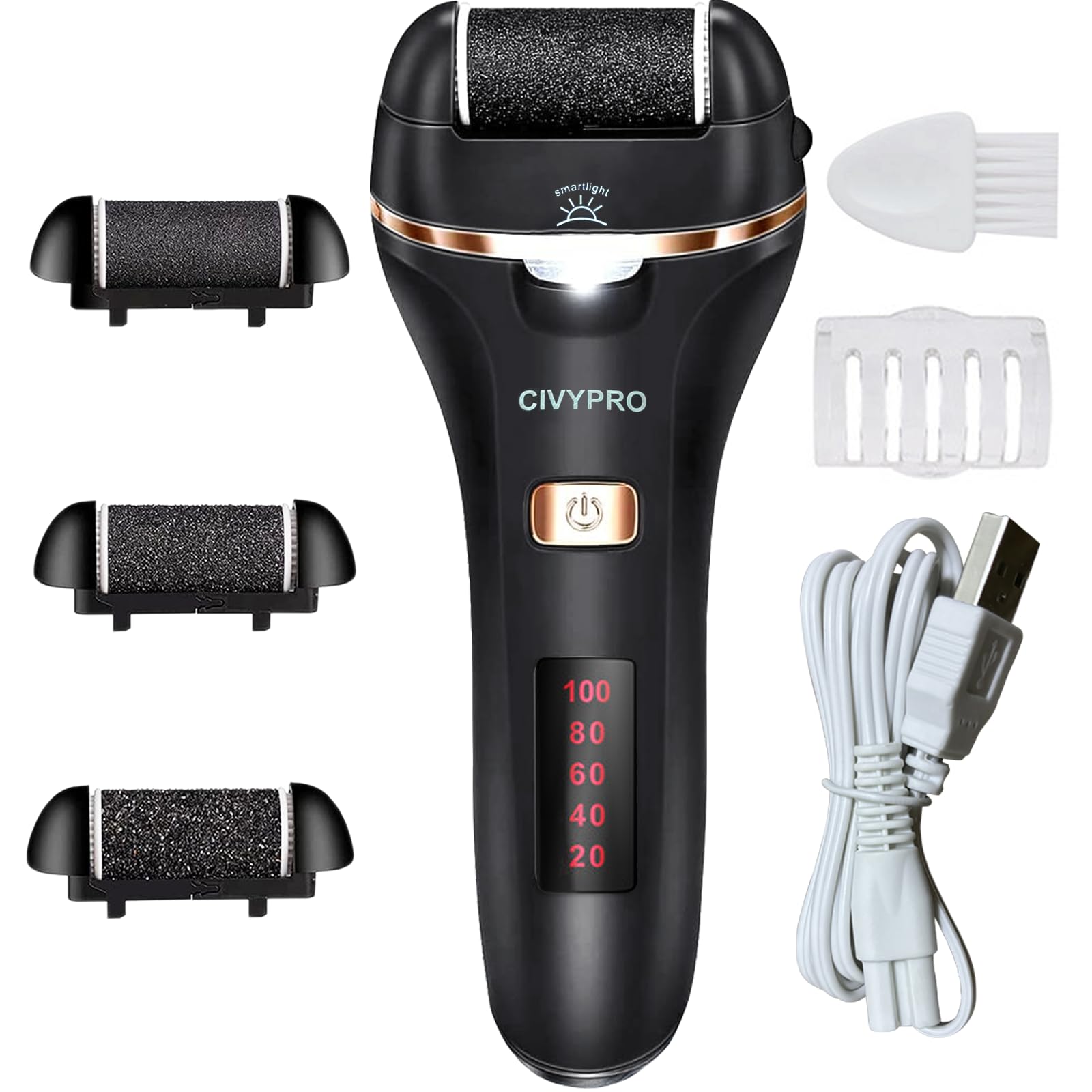
CIVYPRO Electric Foot File

92 /100
Trail Score Outstanding

Key details

Power
Rechargeable, usable while charging
Speeds
1,900 and 2,200 rpm
Waterproof
IPX7
Roller Heads
3 (1 fitted, 2 spare)
Check Price on Amazon

Cordless tools have a habit of running out mid-heel, and this one has an answer: it works while it is plugged in. The listing calls it plug-and-play, which means you can finish a session on the cord instead of waiting for a recharge. It also quotes the highest top speed of the models here that state one, 2,200 rpm, with a slower 1,900 setting underneath.

We noticed that speed most on thick, dry heel skin, where the extra rpm takes material off in fewer passes than the 1,700-rpm tools here. The body is IPX7 and rinses clean, and the kit adds two spare rollers to the one fitted at the factory, which covers you once the first head loads up. The handle is longer than the smallest files here, so reaching the back of a heel takes less wrist work.

It is the priciest of the rechargeable picks, and what you are paying for is speed and the cord option. If your heels have years of hard skin built up and the gentler tools have felt slow, this is the one that gets through it fastest; if you only want maintenance, spend less and take the Elmchee.

Pros

  • Runs on the cord while it charges
  • Highest stated top speed here at 2,200 rpm
  • IPX7 body rinses under the tap
  • Two spare rollers in the kit

Cons

  • Mixed feedback on how long the motor lasts
Our verdict

For thick, stubborn heel skin, the extra speed and the option to run on the cord make this the strongest grinder in the set.

Check Latest Price
4

Best Budget

Dr. Scholl's Electric Callus Remover

91 /100
Trail Score Outstanding

Key details

Size
Compact, travel-friendly
Power
4 AAA batteries (included)
Roller Head
360-degree rotating
Check Price on Amazon

This is the cheapest way into the category, and the simplest tool here: one rotating roller, one button, four AAA batteries in the box, so it works the moment it comes out of the package. If you are not sure a powered file suits your feet, that is the lowest-stakes way to find out.

We used it mostly for spot work, the edge of a heel or the side of a big toe, and the compact body is genuinely good at that; the 360-degree roller reaches angles where a longer handle gets in the way. On a normal heel it leaves a decent finish in a couple of minutes. What it doesn't give you is a speed choice, and the motor is gentler than the rechargeable picks, so a thick ridge takes patience rather than pressure.

For a travel bag it makes a lot of sense: nothing to charge, nothing to remember, and it will still work after months in a drawer. As a main tool for heavy calluses it will frustrate you. Judge it as the low-commitment option and it is easy to like.

Pros

  • Cheapest option in this set
  • Batteries included, nothing to charge
  • Compact body reaches awkward spots
  • 360-degree rotating roller head

Cons

  • Four AAA batteries to keep replacing
Our verdict

The low-cost, low-drama pick: batteries included, compact enough for a carry-on, and easy to steer onto spots a bigger file can't reach.

Check Latest Price
5

Light Maintenance

Amopé Pedi Perfect

89 /100
Trail Score Excellent

Key details

Power
4 AA batteries (included)
Roller
Extra-coarse diamond crystal
Speeds
Dual speed
Water Resistance
Splashproof
Check Price on Amazon

Press this one and it stops. That isn't a fault, since Amopé builds in a safety stop so you can't bear down on the roller, but it defines the tool: it removes hard skin by going over the area again rather than by grinding harder. The extra-coarse diamond-crystal roller and the dual-speed switch are set up around the same idea, slow and controlled.

We found it comfortable around the ball of the foot and the softer edges of a callus, and less convincing on a hard heel ridge, where the stop cuts in and progress slows to a crawl. It is the only pick here listed for use on wet or dry skin, though the body is splashproof rather than rinseable, so it can follow a soak but shouldn't go under the tap.

Where it earns its place is upkeep. Ten minutes a week keeps heels from getting away from you, and because the tool removes less per pass, it is hard to take off too much. For feet that are already in reasonable shape, that gentleness is the feature; for a heel that is cracked and built up, it is the reason to choose something else.

Pros

  • Safety stop guards against over-pressing
  • Diamond-crystal roller for hard skin
  • Listed for wet or dry use

Cons

  • AA batteries need replacing
Our verdict

Buy it for upkeep rather than a rebuild: the safety stop keeps it gentle, and the diamond roller leaves skin smooth without much risk of overdoing it.

Check Latest Price

How We Tested 14 Electric Callus Removers

To build the shortlist, I started with the models shoppers actually click on — corded and cordless, single-speed and multi-speed, coarse and fine grit rollers — then cut anything with a roller that couldn't be replaced or a battery that couldn't survive a full discharge. That left 14, spread across the price range most people browse in.

We didn't test these on a lab bench; we used them where they live. On a towel at the edge of the tub on a Sunday morning, standing on one leg in the shower, and bone dry right before pulling on socks. Two testers came in with thick heel calluses from distance running and one with a single stubborn spot from wearing heels daily, so we could compare how each device handled light upkeep versus serious buildup. We counted passes — how many sweeps it took to go from rough to smooth — and watched whether the roller stalled when pressed or kept spinning at the same rate.

Each device also ran from a full charge until it died on its highest setting, and we noted both the minutes and whether the last few were noticeably weaker. For durability, every remover went into a gym bag with keys and a water bottle, had its roller pulled and rinsed after each use, and got checked for worn-down grit after a month. We paid attention to how they felt in the hand, too — one was top-heavy and loud enough that two minutes of use felt like a chore, which is the sort of thing that sends a device to the back of a drawer regardless of results. Value came down to rollers: a modest device that needs expensive replacements twice a season is not the bargain it looks like on the shelf.

How to Choose an Electric Callus Remover

What the Motor Has to Do

Most of these quote their speed in turns per minute, from a single-speed file with no figure at all to a 2,200-rpm grinder. The number matters less than whether the head keeps turning when it meets a hard heel. A tool that stalls under light pressure, whether because the motor is small or because a safety stop is cutting in, will take far longer on thick skin than one that holds its speed.

Our advice is the same whichever you buy: light pressure, several passes, let the grit cut rather than leaning in. If your heels are genuinely built up, look for two speeds, so you have torque for the first pass and control for the finish.

Grit, Heads and Replacements

Coarse heads take the ridge down, and regular or fine heads smooth what is left. The difference between a good result and a raw heel is usually which head you used, not how hard you pressed.

Kits here run from three heads, one of each grit, to five with two coarse and two regular. A household with two very different pairs of feet gets real value from the bigger set, because nobody has to share a loaded head. Heads are the one part that wears, so check that replacements are easy to find for whichever model you choose.

Batteries, Rechargeable or Corded

Rechargeable is the sensible default at home: no cells to buy, and on the better models a readout showing what is left before you start. A disposable-battery model earns its place in a travel bag, where it can sit for months and still work, and replacing cells is simpler than hunting for the right cable abroad.

Corded tools never run flat but tie you to an outlet. On a rechargeable, one feature is worth checking before you commit: whether it runs while charging, which spares you waiting for a top-up between feet.

Waterproofing and Cleanup

An IPX7 body can be rinsed under the tap, which is often the difference between a two-minute cleanup and picking dust out of a roller with a brush. A splashproof model needs a wipe instead, and it cannot follow you into the shower.

Whichever you buy, rinse or brush the head after every session and let it dry before it goes back in a drawer. A head that is packed with powder cuts poorly the next time, and that gets blamed on the motor more often than it should.

Frequently Asked Questions

Final Verdict

The Elmchee is the one we point most people to: three grits, a body you can rinse, and a charge readout that stops a session dying halfway through the second heel. It is also the pick here with no durability cloud over it, which counts for a lot in a category where motors quit.

If you want a grit for every foot in the house, the IWEEL's five heads are worth the step up. If you are working on years of hard skin, the CIVYPRO's extra speed and cord option get through it fastest, and if you want to spend as little as possible or need something for a carry-on, the Dr. Scholl's does the same job more slowly on batteries.