Best Foot Files for Calluses of 2026

A pumice stone lived in my shower for years and never earned its spot — it went smooth and useless while my heels stayed rough. A good foot file works differently: it takes off dead skin in controlled passes, so lotion sinks in instead of sitting on top and socks stop snagging on the way out the door. The catch is matching tool to job. A rasp that bites through years of buildup is a bad idea on a thin, tender heel, and a dainty buffer won't touch a deep crack.

Over four months, my team and I worked through 14 files — full-length stainless rasps, glass ones, pocket-size versions — and the gaps between them came down to how the surface is cut, how the handle behaves in a steamy bathroom, and whether it still had bite by month three, which is what you're actually paying for. I also learned the hard way that most of us over-file: two or three slow passes twice a week beats one aggressive session that leaves you stinging. The picks below are the ones that made that easy to stick with.

1

Best Overall

Microplane Colossal Foot File

96 /100
Trail Score Outstanding

Key details

Use
Wet or dry
Weight
2.88 oz
Material
Photo-etched stainless steel
Filing Surface
5.25 x 2.25 in
Check Price on Amazon

Over 400 tiny blades are photo-etched into a 5.25-by-2.25-inch steel plate, which is a fussier way to make a foot file than stamping one out of sheet metal, and it is the reason this is the one we recommend first. The teeth are shallow and set close together, so the tool skims dead skin away in fine dust instead of gouging out a trench. On a dry heel we could work a full pass and then stop to check, rather than watching a pale patch turn pink and hoping we caught it in time.

The size is the other half of it. A plate that wide covers most of a heel in one stroke, so a proper file-down takes a couple of minutes rather than ten, and 2.88 ounces is light enough to hold at the angle you want. The soft-grip handle pulls off, which makes the plate easy to rinse and lets the two pieces pack flat.

Where it gives ground is patience. Keep working one spot out of frustration and even this file leaves a heel sore for a day or two, so the rhythm is short strokes, lift off, look, go again. It also costs more than the bargain rasps here, and that is the trade for an edge that does not chew.

What keeps it at the top of this set is the edge height. The teeth sit low enough that the plate slides across the curve of a heel instead of catching it, so the awkward places — the rim of the heel, the side of a big toe — do not become the places you have to be careful with. That is the difference between a tool you use every week and one you keep postponing.

Pros

  • Skims dead skin in dust, not trenches
  • Wide 5.25-inch plate covers a heel fast
  • Removable handle rinses clean and packs flat
  • Works on dry skin or in the shower

Cons

  • Costs more than the budget rasps here
Our verdict

The file we recommend to most people: the etched plate clears a heel in a couple of minutes and is much harder to cut yourself with than a coarse grater.

Check Latest Price
2

Best Budget

Rikans Colossal Foot File

95 /100
Trail Score Outstanding

Key details

Use
Wet or dry
Length
10.78 in
Weight
3.2 oz
Check Price on Amazon

The least expensive file here is also the most aggressive one: a 10.78-inch rasp that takes off more per stroke than anything else in this guide. On a genuinely thick heel, a few light passes leave a drift of powder in the tub and skin you can feel the floor through again. That is the whole pitch, and it holds up.

We reach for it when a heel has gone hard and cracked and we want the job done this week rather than this month. The 3.2 ounces of steel does most of the work, and the mistake is helping it — press down and the same teeth that clear callus will happily open a nick in the skin beside it. Light strokes, lift off after every couple, and it goes through buildup that a glass file would need a month of showers to touch.

Two things to know before ordering. The finish is flat rather than polished, because this is a reduction tool and not a buffer, so a moisturizer afterward does the rest. And at nearly 11 inches long it is a bathroom-shelf tool that will not disappear into a travel bag. Neither is a dealbreaker at this end of the price range.

Pros

  • Removes thick callus faster than anything else here
  • Light pressure is all it needs
  • Works on wet or dry feet
  • Least expensive file in this guide

Cons

  • Long handle does not travel well
Our verdict

For hard, cracked heels that need real reduction, we hand people this rasp first — as long as they let its weight do the work instead of pushing.

Check Latest Price
3

Best for Sensitive Skin

Dr. Scholl's Nano Glass Foot File

93 /100
Trail Score Outstanding

Key details

Use
Wet or dry
Handle
Soft-touch
Weight
3.88 oz
Material
Nano glass
Check Price on Amazon

If the thought of a cheese-grater rasp against your heel makes you wince, start here. The Dr. Scholl's file is a plate of nano glass on a soft-touch handle, and it works more like a very fine emery board than a blade: long strokes, light pressure, no dust storm and no sting.

We used it in the shower and rinsed it under the tap afterward, which is most of the appeal. It is waterproof and rustproof, so it can live where you will actually remember to use it, and the surface rinses clear in seconds instead of needing to be picked clean. It is glass, though, so it wants a shelf rather than the shower floor, where a drop onto tile can finish it.

The trade is speed. On thick, rock-hard callus, glass takes several sessions to make the progress a coarse rasp makes in one, and that is the honest reason we do not hand it to everyone. What it buys is confidence: you can file a little, check, and file again with very little risk of taking live skin, which is exactly what someone recovering from a bad rasp wants.

Pros

  • Gentle enough to file without watching for blood
  • Waterproof and rustproof for shower storage
  • Soft-touch handle stays comfortable
  • Rinses clean in seconds

Cons

  • Slower on thick, hard calluses
Our verdict

The pick for anyone who has nicked themselves with a rasp: this glass surface buffs hard skin away slowly and safely, and it is happy living in the shower.

Check Latest Price
4

Best Electric

Elmchee Electric Callus Remover

93 /100
Trail Score Outstanding

Key details

Heads
Three quartz-sand grinding heads
Speed
Two speeds, 1,700 and 2,000 rpm
Battery
1,200 mAh, rechargeable
Waterproof
IPX7
Check Price on Amazon

The first pass on a rough heel is the tell. With a manual rasp you are doing the work and judging depth by feel; with the Elmchee you set the roller down, let it spin, and watch skin come off in a fine powder while your wrist does almost nothing. We noticed it most on the second heel, when the manual approach starts to feel like a chore.

That is why this is the pick for anyone with hand or grip trouble, and for anyone who has priced a pedicure and decided to do it at home instead. Two speeds, 1,700 and 2,000 rpm, and three quartz-sand heads let you take buildup down with the rough one and finish with the fine one. The motor also cuts out when you press too hard — a feature we came to like more than we expected, because pressing is exactly what a stubborn callus invites.

The rest is convenience. It is IPX7, so the head rinses under the tap, and the rechargeable battery has a display so you are not guessing at the charge. The whole thing is small enough to keep in a drawer rather than on the edge of the tub.

One thing to weigh: it costs more than every manual file here, and what that buys is speed and less wrist work rather than a better finish. A patient hand with the Microplane gets a heel just as smooth.

Pros

  • Roller does the work, so hands do not tire
  • Cuts out when you press too hard
  • Three grits from rough to finishing
  • Waterproof body rinses under the tap

Cons

  • The three heads are grits, not spares
Our verdict

If gripping a rasp hurts, or you want the job over in five minutes, this rechargeable roller does the scrubbing and stops before you overdo it.

Check Latest Price
5

Best Two-Step

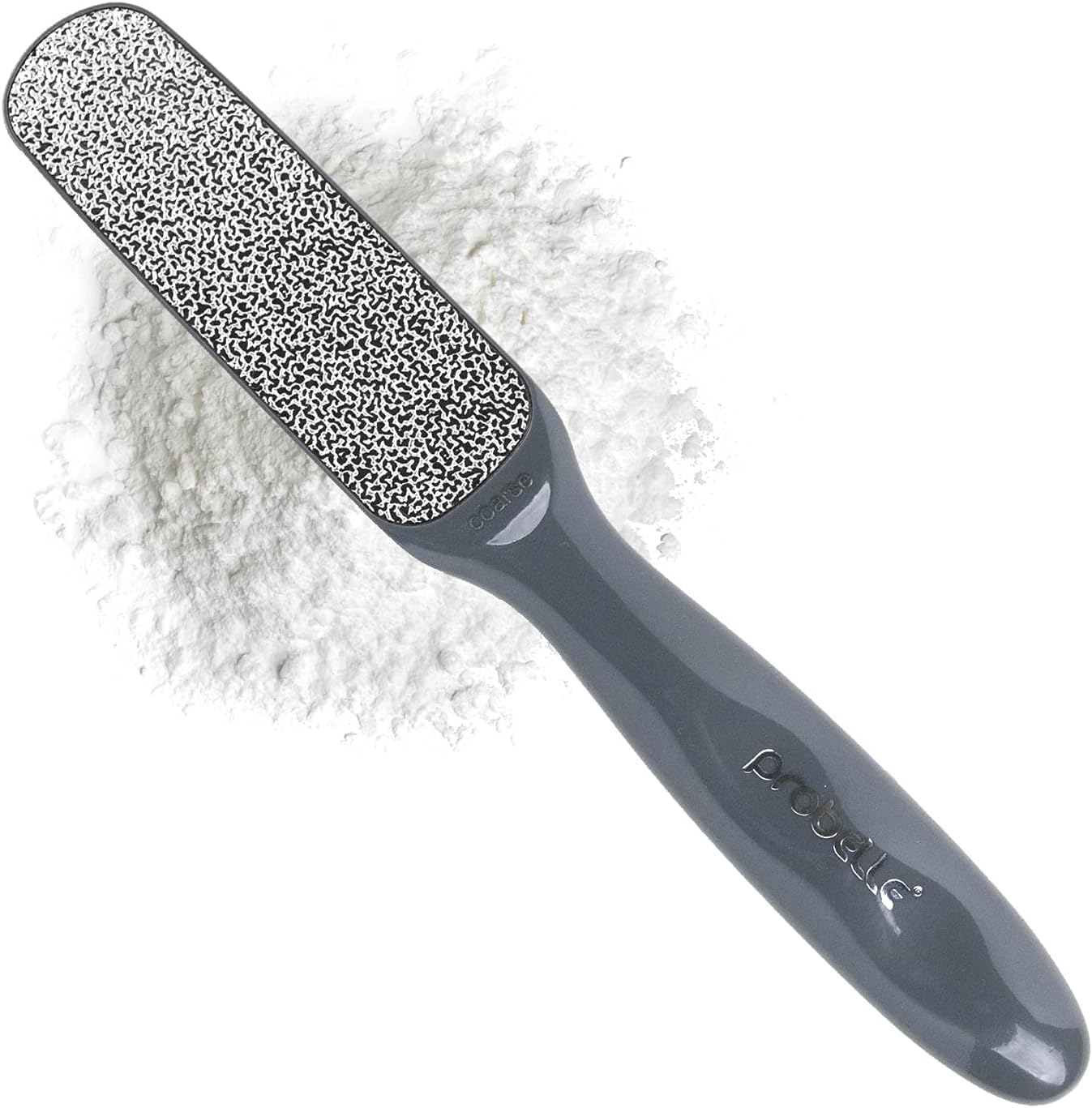
Probelle Double Sided Foot File

95 /100
Trail Score Outstanding

Key details

Sides
Coarse and medium
Length
11 in
Weight
2.2 oz
Surface
Nickel
Check Price on Amazon

Two nickel surfaces on one 11-inch handle: a coarse side for heavy callus and a medium side for the smoothing pass. In practice that is the closest thing here to how a pedicure actually works — take the bulk down, then refine what is left so the heel does not feel like a filed-down plank.

The nickel is the part we appreciated. It is a gentler abrasive than the stamped stainless graters, which means more strokes for the same removal but far fewer of those heart-stopping moments where a rasp catches a fold of skin. At 2.2 ounces it is light, and the handle is long enough to reach a heel with your leg crossed rather than folded up.

Where it gives ground is heavy work: the gentle nickel needs more passes than a stamped grater to move the same amount of hard skin, so if your heels are thick and cracked this is the second tool rather than the first. For maintenance it is the one that stays in the bathroom cabinet — one tool, two grits, and a finish that does not need a separate buffing file afterward.

Pros

  • Coarse and medium sides in one tool
  • Nickel surface is gentle beside live skin
  • Long handle reaches heels comfortably
  • Light 2.2-ounce body

Cons

  • Narrow surface means more passes
  • Pricier than the other manual files here
Our verdict

Our choice for upkeep and finishing: two nickel grits take callus down and smooth what is left in one sitting, with far less risk of catching an edge.

Check Latest Price
6

Full Routine

BTYMS 3-Piece Foot File Kit

93 /100
Trail Score Outstanding

Key details

Use
Wet or dry
Files
Three graduated rasps
Weight
5.57 oz
Material
Stainless steel
Check Price on Amazon

Most rasps here do one thing. This kit splits the job across three tools: an ultra-coarse grater for thick buildup, a medium-coarse file for everyday dead skin, and a fine file for the smoothing pass. That is closer to how you actually work through a bad heel — heavy first, lighter next, finish last.

We noticed the difference at the finish. A single coarse rasp leaves a heel that is flat but not smooth, and the fine file in this set fixes that without a second purchase. All three share the same rust-proof stainless construction and the same non-slip grip, so moving between them is quick rather than fiddly.

The set is built for pre-soaked feet, and it works dry as well if you would rather not sit at the edge of the tub. Three handles do take up more room than one rasp, and the package is bulky — this is a drawer or shower caddy set, not something that slips into a wash bag.

What this set does better than any single file here is the landing. The coarse grater takes the buildup down and the fine file turns what is left into something that does not snag a sock — the step most people skip when they only own one rasp. In a household with more than one pair of rough feet, that is the difference between a tool and a routine.

Pros

  • Three grits cover removal through finishing
  • Stainless construction rinses clean
  • Works on soaked or dry feet
  • Costs less than most single rasps here

Cons

  • Coarse grater is unforgiving on thin skin
Our verdict

Three graduated files for about the price of one: start coarse, finish fine, and you get a smoother heel than any single rasp here leaves — if you respect the big grater.

Check Latest Price
7

Shower Use

Easkep Stainless Foot File

95 /100
Trail Score Outstanding

Key details

Length
11.42 in
Weight
3.67 oz
Material
Laser-plated stainless steel
Check Price on Amazon

It arrives looking too big to be useful: 11.42 inches overall, with a grate wider than most rasps here. Two minutes on a heel and you stop worrying about the size, because the width is what lets you cover the whole heel in a few strokes instead of chasing it around.

The grate is laser-plated stainless with large holes, which matters more than it sounds. Fine perforations clog with damp skin and then stop cutting, and these do not — you can rinse it under the tap mid-session and carry on. The frame and handle are one piece of steel with an anti-slip grip, so there is no joint to loosen under pressure, and it dries without rusting.

It is a workhorse rather than a finishing tool. You will not get the refined feel of a glass file or the two-stage landing of a nickel one, but you will get a heel down to smooth in a couple of minutes. We kept ours in the shower as the weekly reset and reached for a finer file afterward when we wanted the surface polished.

Pros

  • Wide grate covers a heel in a few strokes
  • Large holes do not clog with damp skin
  • One-piece steel frame feels solid
  • Rinses clean and dries without rusting

Cons

  • Grate catches skin if you press hard
Our verdict

A fast, inexpensive workhorse for thick callus: the wide grate clears a heel in a couple of minutes and the one-piece frame shrugs off shower duty.

Check Latest Price
8

Heel-Only Callus

ALOCKMA Stainless Foot File 2-Pack

95 /100
Trail Score Outstanding

Key details

Use
Wet or dry
Pieces
Two
Weight
7.76 oz
Surface
Contoured stainless arch
Check Price on Amazon

Two files in the box is the practical part. One lives in the shower and one goes in a gym bag or a partner's bathroom, which solves the small problem of a tool that only works where you happen to keep it. Both are the same heavy stainless rasp, bent into an arch.

The curve is what we noticed first. Instead of a flat plate, the filing surface follows the shape of a heel, so the whole width makes contact at once rather than rocking on the high spot. Around the rim of a heel, which is usually where the cracking starts, that is a real difference in how much of the surface you get to in a pass.

Build is substantial: 7.76 ounces for the pair, surgical-grade stainless, and an ergonomic non-slip handle that stays put with soapy hands. It works on dry feet and in the shower, and it is rust-resistant enough to live somewhere damp between uses.

The size cuts both ways. On a wide adult heel the arch is exactly right; on a smaller foot, or around toes, the head is bigger than the job and awkward to aim. If your callus sits on the heel and nowhere else, this is the most comfortable of the flat-out rasps to use. If you are chasing hard skin around toes and the ball of the foot, something narrower or finer will serve you better.

Pros

  • Curved arch sits flush against a heel
  • Two files for shower and bag
  • Non-slip handle holds up with wet hands
  • Rinses clean and resists rust

Cons

  • Head is bulky on small feet and toes
Our verdict

For heel callus and nothing else, the curved plate is the most comfortable rasp here to use, and you get two of them — one for the shower, one for everywhere else.

Check Latest Price

How We Picked and Tested Foot Files

We started by gathering every foot file with a genuine following, from etched stainless rasps and glass files to ceramic paddles and folding travel versions, and read through hundreds of reviews looking for the complaints that repeat: edges that go dull in a month, handles that slip, surfaces that scrape instead of shave. From roughly 30 candidates we narrowed by material, grit, handle shape, overall length, and price, then put 14 of them into rotation for four months.

A foot file gets used on the edge of the tub with wet hands and one foot braced against the porcelain, so that's where ours lived. Each one came out twice a week — Saturday morning after a shower, and once midweek on dry skin, the way most people actually do it — and one compact model went into a toiletry bag for two weekend trips. We counted passes until the heel felt smooth to the back of a hand, watched whether the surface skipped or dragged rather than cutting, and noted how evenly the skin came down instead of in patches. Size mattered more than expected: long rasps felt steadier across a wide heel but crowded a dopp kit, while palm-sized ones were easier to angle and easier to drop.

Sharpness got the closest attention, since it's the difference between a tool and a scrape. After each session we logged stinging, hot spots, or tenderness the next morning, and noted which files cut on a light touch versus the ones that needed real pressure to do anything at all. We brushed out the dust the way anyone would and checked at the end of every month whether the surface was still biting or had gone slick — the plainest measure of value we could think of.

How to Choose a Foot File for Calluses

Match the grit to the callus

Run a fingernail across the callus. If it catches and the skin has gone shiny and hard, you want a coarse rasp — the Rikans or the BTYMS kit — that moves a real amount of skin in a few strokes. If the heel is soft, slightly rough, or already under control, a fine abrasive does the job with far less risk: the Microplane plate or the Dr. Scholl's glass file.

The mistake is buying the coarsest tool you can find and using it forever. A coarse grate is a reduction tool; it leaves skin flat rather than smooth, and it stays in the drawer once the callus is gone. Two stages, coarse then fine, is what actually keeps a heel comfortable.

Sharper is not the same as better

The cuts happen because of pressure, not because of grit. Every aggressive rasp in this guide works on the weight of the tool alone; the people who get nicked are the ones bearing down to finish faster. Two or three strokes, lift off, run a thumb over the spot, and go again tomorrow if it needs it.

This is where an electric model earns its place. The Elmchee cuts out when you press, which is a built-in version of the rule the rest of these tools ask you to remember. With a manual file, that discipline is yours to supply.

Wet or dry

Every file here works either way, and the two give different feedback. Dry filing produces visible dust and lets you feel the surface change immediately, which makes it easier to stop in time. Filing after a soak takes softer skin, and softer skin gives way faster than you expect, so keep the passes shorter and check more often.

If you plan to file in the shower, buy for it: the Dr. Scholl's, Easkep, and Elmchee are all happy under running water, and a stainless rasp that lives wet needs to be rust-resistant rather than merely washable.

Manual or electric

Manual files cost less, never need charging, and last for years if you rinse them. They suit anyone with a steady hand and enough grip strength to work a handle back and forth for a couple of minutes per foot.

Electric earns its price if your hands tire, if reaching your heels is awkward, or if you want the job done in five minutes. The trade is moving parts: heads wear, batteries age, and a motor is one more thing that can stop working. We treat an electric roller as the convenience option rather than the more capable one.

Handles, reach, and storage

Long handles are underrated. An 11-inch rasp lets you work a heel with your leg crossed instead of folded up against the tub, which matters more as your back and hips get less cooperative. The cost is portability — a long file does not disappear into a toiletry bag, and the ALOCKMA pair weighs enough that you notice it packed.

Glass and coated abrasives also want a little care. Nano glass belongs on a shelf rather than the shower floor, where a drop onto tile can finish it, and any file with a removable handle is easier to rinse and dry if you take it apart after use.

Frequently Asked Questions

Final Verdict

If you are buying one file and you do not yet know how your heels behave, buy the Microplane Colossal. It removes a real amount of skin, it has the most forgiving edge in this guide, and at 2.88 ounces with a removable handle it is easy to hold, rinse, and put away.

Change the pick if your hands cannot manage the back-and-forth — the Elmchee does the scrubbing for you. And if you have cut yourself with a rasp before, start with the Dr. Scholl's glass file and move up to something coarser once you trust your own touch.