Best Earplugs for Noise Sensitivity of 2026

The room is finally dark and you're about to drop off — then the upstairs neighbor moves a chair, your partner starts snoring, or the garbage truck arrives three hours early. If you register every sound, that isn't a minor annoyance; it's the difference between six hours of sleep and four. Earplugs fix it, but the ones worth buying disappear once they're in: soft enough to sleep on your side, snug enough to stay put until morning, and quiet enough to take the edge off without sealing you in a bubble.

I've spent four months sleeping, flying, commuting, and working my way through 16 pairs, from foam classics to moldable silicone to filtered plugs. The surprise was that the most noise-blocking pair isn't automatically the best — block everything out and your own heartbeat becomes the loudest thing in the room, and a plug a size too big will work itself loose by 2 a.m. Fit and staying power matter as much as material, and the picks below are grouped by what each one is actually good at.

1

Best Overall

Howard Leight Laser Lite

93 /100
Trail Score Outstanding

Key details

Count
50 pairs
Reuse
Disposable, a few nights each
Shape
Contoured T-shape foam
Noise Reduction
NRR 32 dB
Check Price on Amazon

Yellow and magenta is not a subtle look, but this is the plug that beat everything else here at the job that actually matters: taking the level down. We wore them against a street-facing window at night and beside an open-plan kitchen during the day, and both times they cut more of the noise than the reusable pairs did. That is why they are our top pick rather than the fancier, more engineered options.

The stated NRR of 32 dB sits near the top of this group, but the shape is what sells it. Small, contoured and coated in a smooth closed-cell skin, it rolls down tight, slides into a narrower canal, and expands without the scratchy edges that cheap foam leaves against the ear. Each pair comes individually wrapped, which sounds like a small detail until you are packing a bag in the dark.

Canal size is the one thing to weigh. A slim plug that seats beautifully in a small ear can leave a gap in a wide one, and a gap is exactly where noise gets in. If yours run wide, or if foam routinely works loose by three in the morning, the moldable putty is the safer route. Everyone else can start here and stop looking.

Pros

  • Dependable noise cut for sleep and focus
  • Slim shape that seats in narrow canals
  • Soft foam with no hard edges
  • Pairs wrapped separately for bags and pockets

Cons

  • Foam loses its spring after a few nights
Our verdict

If you want the most reliable quiet with the least fuss, start here: these are the foam plugs we keep coming back to for sleep and for focus.

Check Latest Price
2

Best Reusable for Sleep

Loop Quiet 2

84 /100
Trail Score Excellent

Key details

Case
Included
Reuse
Reusable silicone
Ear Tips
4 sizes, XS to L
Noise Reduction
Up to 24 dB (SNR)
Check Price on Amazon

We expected Loop's sleep plug to retire our foam stash for good. It did not, but it came closer than any other reusable pair here, and on the nights it worked the difference showed up in our ears rather than in the room.

The body is soft, flexible silicone, and it sits flush enough that lying on your side does not jam it into the pillow, which is the thing we kept coming back to. Four tip sizes, XS through L, mean a small canal gets a real seal instead of a compromise, and a pair rinses clean in seconds. We also liked that they read as earbuds rather than hearing protection, so wearing them at a front counter does not invite questions.

Sizing does more work here than it does with foam. The wrong tip feels like a plug that simply does not fit; the right one disappears. If your canals are generous, start with the largest tip rather than the medium that comes installed. A small hard case is included, and we used it more than expected, because loose earplugs in a bag pick up grit fast.

Pros

  • Comfortable enough to sleep on your side
  • Four tip sizes for a proper seal
  • Washable and reusable night after night
  • Discreet enough to wear in public

Cons

  • Quiets rather than silences a snoring partner
Our verdict

Buy these if you want one reusable pair for the whole night and dislike the pressure of foam, as long as you accept that they mute rather than silence.

Check Latest Price
3

Best for Noise Around People

Loop Engage 2

89 /100
Trail Score Excellent

Key details

Case
Included
Reuse
Reusable silicone
Filter
Acoustic channel and mesh
Ear Tips
4 sizes, XS to L
Check Price on Amazon

Not everyone who is bothered by noise wants silence. If you still need to hear the barista, your kid or the person across the table, this is the pair to buy: Engage 2 turns a room down a notch and leaves speech where it was.

The mechanism is an acoustic channel behind a mesh filter, which takes the roar out of a crowded room without the blocked-ear feeling of foam. We wore them through a grocery run and a busy café and held conversations at normal volume in both, which is not something we can say for the muffling picks here. Four tip sizes and a small carry case that clips to a keyring make them the easiest pair to keep with you.

Comfort matters more than usual for something you wear an hour at a time in public, and the silicone tips held up through a long dinner without pressure. The look helps too: they pass as jewellery or earbuds, so nobody asks what is in your ears. We kept a pair in a jacket pocket for a fortnight and reached for them at a train station, at school pickup and at one very loud birthday party.

Pros

  • Cuts background noise while keeping speech clear
  • Comfortable for hours in public
  • Four tip sizes and a keyring case
  • Discreet, jewellery-like design

Cons

  • Not enough attenuation for sleep or power tools
Our verdict

For noise sensitivity that flares in shops, offices and family dinners rather than at bedtime, this is the pair we recommend first.

Check Latest Price
4

Best for Side Sleepers and Small Ears

Mack's Pillow Soft Silicone

93 /100
Trail Score Outstanding

Key details

Fit
Seals over the ear opening
Count
12 pairs
Reuse
Reusable until tacky
Material
Moldable silicone putty
Check Price on Amazon

Rather than rolling foam and pushing it into the canal, this is soft silicone putty you press over the ear opening until it flattens into a seal. If your ears ache after an hour of foam, or your canals are simply too small for a standard plug, that difference changes everything.

Twelve pairs come in a flat pack, and a blob is good for several nights before it turns tacky. We wore ours through a run of side-sleeping nights and the seal held; nothing protrudes, so there is no pressure point and no blocked-ear throb. It is also the easiest plug here to wear if your ears reject anything inside the canal.

Where it earns its place is the seal. The putty flattens against the outer ear, stays put through a night of rolling over, and mutes a snoring partner about as well as anything here that is not foam. It is fiddly, though: you reshape it every night, and it wants a rinse before it goes back in the pack.

Pros

  • Sits outside the canal, so no pressure or ache
  • Molds to small or awkwardly shaped ears
  • Holds a seal for side sleepers
  • Reusable for several nights per pair

Cons

  • Picks up hair and lint between uses
Our verdict

The answer for small, awkward or sore ear canals: this putty seals over the opening instead of sitting inside it, and side sleepers get on with it.

Check Latest Price
5

Best for On-And-Off Wear

3M Corded Reusable

91 /100
Trail Score Outstanding

Key details

Count
3 pairs with case
Reuse
Washable and reusable
Design
Tri-flange, no roll-down
Check Price on Amazon

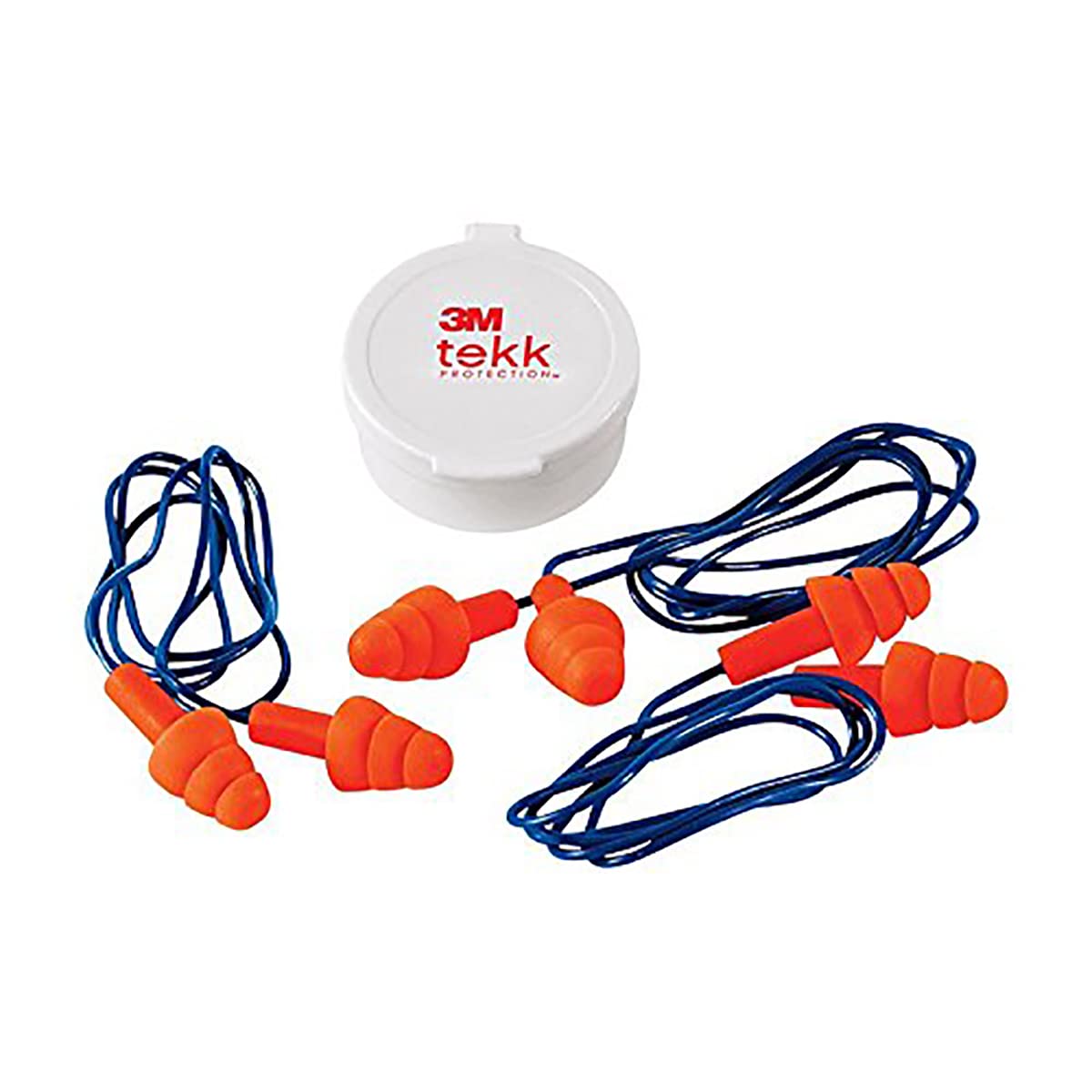
Most of the plugs here live by a bed. This one lives in a desk drawer or around your neck, because it is built for the on-and-off rhythm of a working day rather than eight uninterrupted hours.

There is no rolling and no waiting for foam to expand. The tri-flange tip pushes in, seats with a small twist, and comes out the moment someone walks over to talk. We found that genuinely useful at a shared desk, where you want the room muffled through a stretch of concentration and then need to hear a colleague without excavating your ear. The soft synthetic material washes clean, so one pair covers weeks of this.

How much they take off is the compromise. They knock the harsh top off machinery and background chatter while letting low-level sound through, which is why they suit a workshop, a commute or a lawn mower and not a light sleeper. Three pairs come with a small case, and the cord means you can drop them around your neck between tasks instead of pocketing them.

Pros

  • In and out in seconds, no rolling
  • Washable and reusable, cord keeps them handy
  • Blocks harsh noise while you stay aware
  • Three pairs with a carry case

Cons

  • Flanges too wide for narrow ear canals
Our verdict

For quiet you put in and take out all day, in a shared office or a workshop, these washable flanged plugs are the practical pair to keep nearby.

Check Latest Price
6

Best Soft Foam

Mack's Ultra Soft Foam

91 /100
Trail Score Outstanding

Key details

Foam
Slow-release, low-pressure
Count
50 pairs in a jar
Noise Reduction
NRR 33 dB
Check Price on Amazon

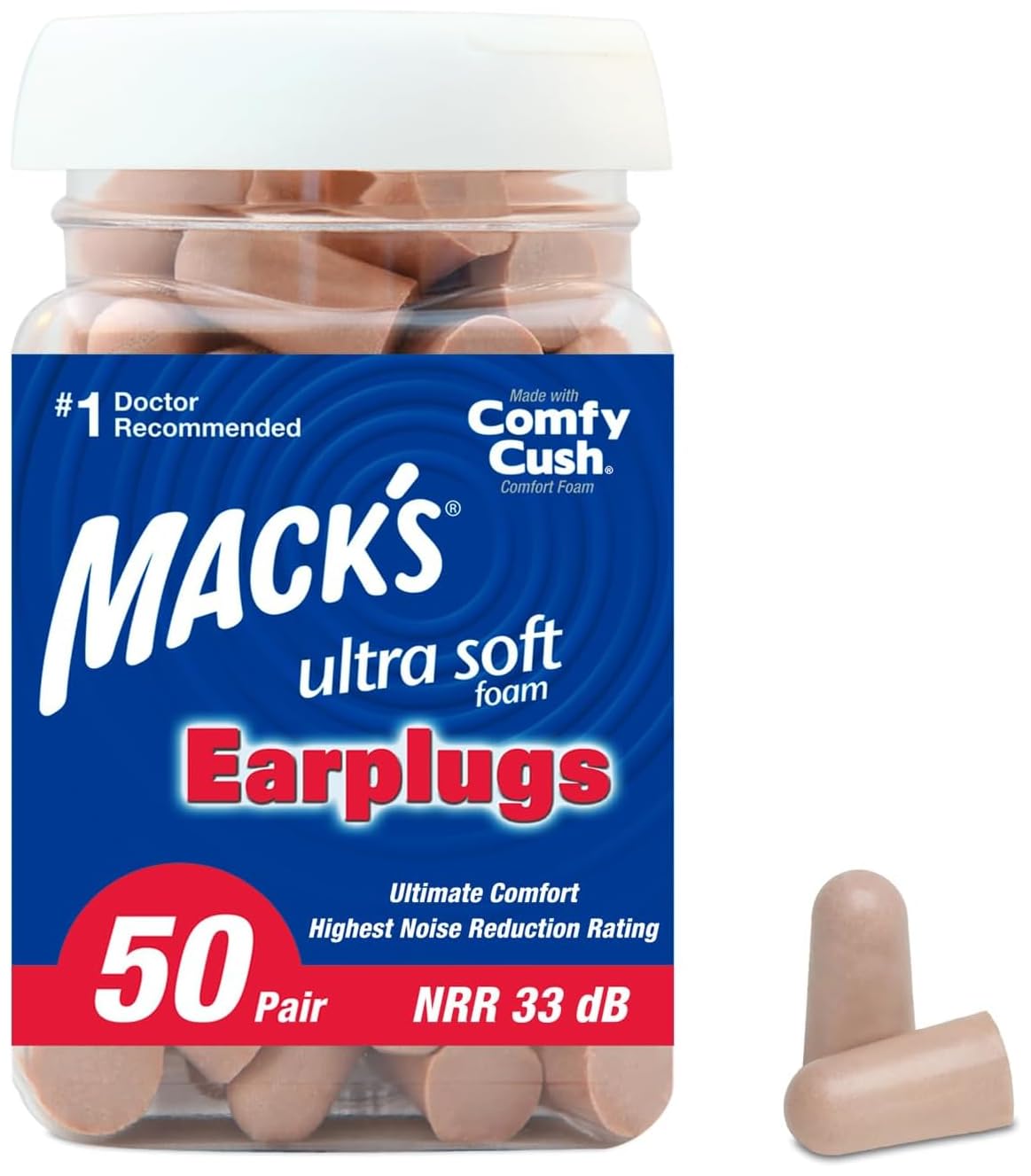
Fifty pairs arrive loose in a flip-top jar that dispenses one plug at a time. It sounds trivial. It is the reason we kept reaching for these instead of the boxed foam in the drawer.

The foam is the softest here: a slow-release, low-pressure cushion that rolls down small and expands gently instead of pushing back. Over a long night that gentleness is the whole point, with no throbbing against the canal wall and no itch by morning. The stated NRR of 33 dB is the highest figure in this group, though the gap between 33 and 29 is smaller in a real ear than the numbers suggest.

Two practical notes. The jar is a drawer item rather than a travel one, and new plugs carry a noticeable foam smell that fades after a day of airing out.

For anyone who has given up on foam because it leaves their ears tender by four in the morning, this is the pair to try, and the jar means you are never hunting for a spare in the dark. We kept ours on a nightstand for a month and never once had to open a drawer at two in the morning.

Pros

  • Softest, lowest-pressure foam here
  • Highest stated NRR in this group
  • Flip-top jar keeps pairs within reach
  • Gentle enough to wear all night

Cons

  • Works loose in wider ear canals
Our verdict

For ears that find ordinary foam too firm, this is the pair to try: soft, slow to expand, and always within reach in its flip-top jar.

Check Latest Price
7

On-And-Off Wear

AZEN Silicone Corded

91 /100
Trail Score Outstanding

Key details

Count
55 pairs, individually wrapped
Reuse
Washable and reusable
Material
Silicone, corded
Noise Reduction
25 dB NRR
Check Price on Amazon

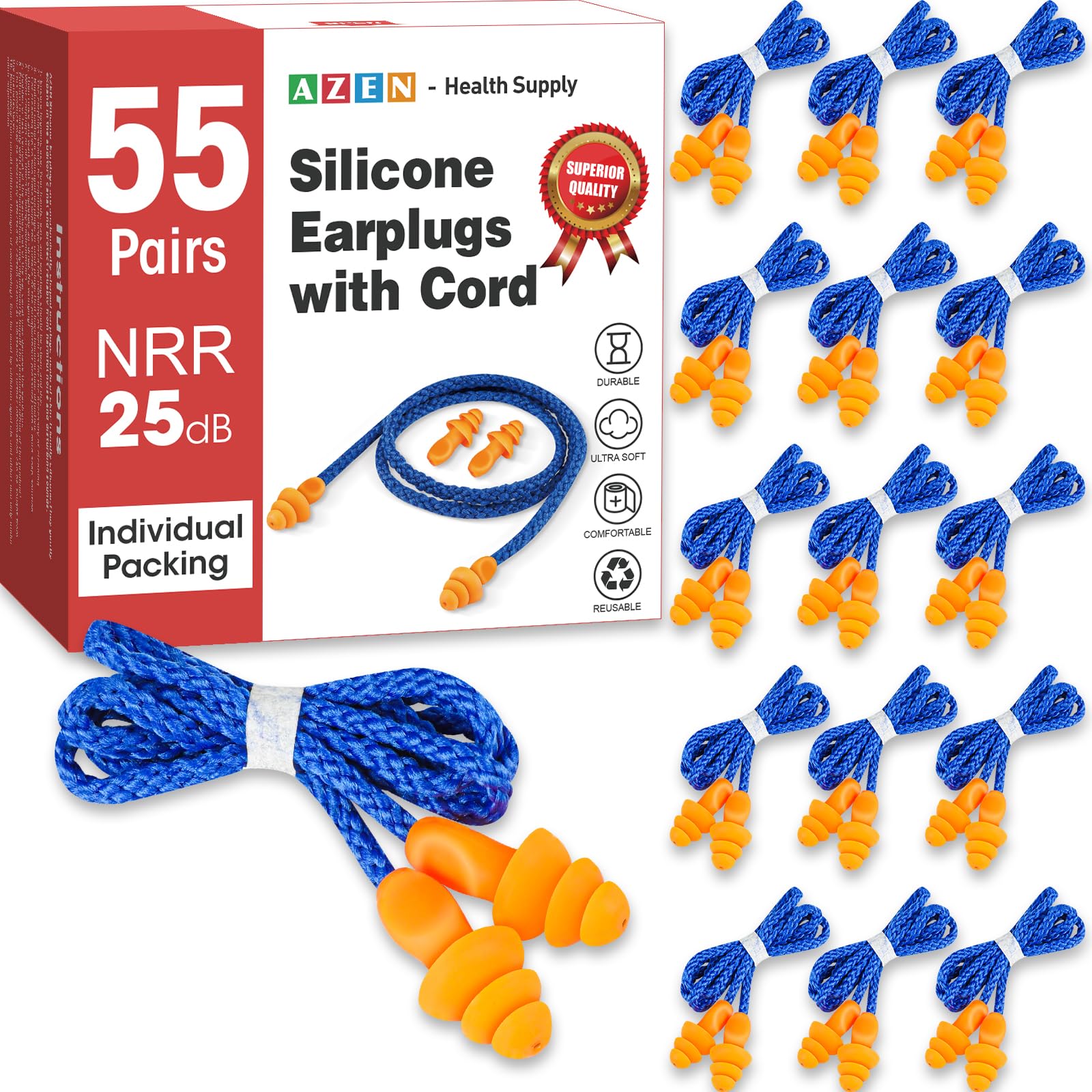
Fifty-five pairs, each sealed in its own bag with a cord attached, is an odd amount of earplugs to own until you start leaving them everywhere: glovebox, tool bag, jacket pocket, the drawer at a friend's place.

The plugs are soft push-in silicone on a short string, which makes them the easiest pair here to keep track of, since pulling one out leaves it dangling instead of dropping into gravel. They are washable, so a pair keeps going, and the individual wrapping keeps the spares clean until you need them.

At 25 dB this is the gentlest filter in the group, and on a mower or in a workshop that is a feature: you still catch a warning shout or a car pulling in. It is also why we do not recommend them for sleep or for a genuinely loud neighbour. What they are is the pair you can keep in six places and hand to someone else without thinking twice.

Pros

  • Every pair individually wrapped and corded
  • Washable silicone that keeps going
  • Lets warnings through while you work
  • Easy to stash in bags and drawers

Cons

  • Fit runs small to medium, not wide canals
Our verdict

The pair to buy in bulk and scatter everywhere, best for workshops, mowing and errands rather than for a quiet night's sleep.

Check Latest Price
8

Small Ear Canals

3M E-A-R Classic

92 /100
Trail Score Outstanding

Key details

Foam
Slow-recovery, low-pressure
Shape
Cylindrical foam
Moisture
Sweat and humidity resistant
Noise Reduction
NRR 29 dB
Check Price on Amazon

A 29 dB rating is the lowest on this page, and on paper that should put this plug at the back of the queue. In an ear it is a different story: the Classic is the one that stayed where we put it while bell-shaped foam crept loose.

The difference is the shape. It is a straight cylinder of slow-recovery foam, firm when you first roll it and softening once it is seated, so it fills a narrow canal evenly instead of bulging in the middle and levering itself out. The surface resists moisture, which matters if you run warm or sleep in a humid room.

Insertion is straightforward: roll it tight, reach over the top of the ear to open the canal, and it holds while it expands. Small ears get on with it particularly well, because the cylinder does not need the flare that makes other foam plugs feel bulky in a tight canal.

If you have narrow canals and have watched other foam plugs migrate out by morning, try this one before you give up on foam altogether. The lower rating buys you nothing in theory and a better seal in practice.

Pros

  • Holds a seal in narrow ear canals
  • Moisture-resistant foam surface
  • Firm enough to insert without collapsing
  • Low pressure once it warms in the ear

Cons

  • Firmer feel than the soft foams here
  • Single use, with little life on a second night
Our verdict

Worth trying if every other foam plug migrates out of your ears overnight, because this straight cylinder holds a narrow canal.

Check Latest Price

How We Tested Earplugs for Noise Sensitivity

We started by reading customer reviews of earplugs marketed for sensitivity, paying more attention to complaints than praise — canals that ached after an hour, plugs too small to seal, foam that went tacky within a week. From there we filtered by decibel rating, material, whether a pair was washable and reusable, and price per pair, then ordered 16 to test over four months.

Every pair went into real nights: a bedroom beside a hallway door that slams, a partner who snores, a street-facing apartment on a bus route, plus a few red-eyes, train commutes, and one open-plan office. We wore each for full nights and noted what time, if ever, we pulled it out, whether we woke with sore ears, and whether the plug was still seated at 6 a.m. after sleeping on our sides.

For fit we recruited testers with different ear canal sizes, including one who had never found a foam plug that didn't ache. For noise we listened for two separate things — low rumble like traffic and HVAC hum, and sharp sounds like a bark or a dropped pan — because plenty of plugs handle one and fail the other. Softness got checked by hand and by ear: whether the surface felt smooth or tacky against the canal, and whether it left residue. We also counted nights of use against price per pair, since a cheap plug that stops re-expanding after a week costs more than a pricier pair that lasts a year.

How to Choose Earplugs for Noise Sensitivity

What a Noise Reduction Rating Actually Tells You

NRR is measured in a lab with the plug seated perfectly, so it describes ideal attenuation rather than the relief you feel. A 33 dB plug seated badly lets in more than a 29 dB plug seated well. Treat anything in the low thirties as roughly the same and spend your effort on insertion instead.

Roll foam tight and narrow, reach over the top of the ear to open the canal, and hold the plug while it expands. If it feels loose after a minute, the rating on the box is irrelevant.

Match the Plug to the Job

Sleep, deep focus and being in a loud room ask for different things. For sleep you want maximum occlusion and nothing protruding into the pillow: foam or moldable putty. For focus at a desk, a washable flanged plug you can pull out when the phone rings beats one you have to re-roll. For a noisy café or a family gathering, a filtered pair keeps speech intelligible while trimming the room.

Buying one type and expecting it to do all three is the commonest mistake we see.

Fit Decides More Than Any Specification

Canal size varies enormously, which is why two people can wear the same plug and get opposite results. Foam expands to fill the space, silicone putty molds over the opening without entering the canal, and flanged plugs need a canal wide enough to take the flange.

If you have been disappointed before, buy one set with several tip sizes or a small pack rather than a bulk box, and check the return policy before committing. Side sleepers should also rule out anything that sits proud of the ear, because a pillow will press it sideways all night.

Comfort Over Eight Hours Is Its Own Specification

A plug that is fine for a twenty-minute meeting can be unbearable at three in the morning. Pressure against the canal wall, trapped moisture and itch are what wake people up, not noise. Low-pressure slow-release foams and moldable putty are the two designs that bother people least overnight; firmer cylinders and flanged plugs suit shorter wear.

If you wake sore, treat it as a fit problem rather than a technique problem and try a smaller plug or a different material before you give up.

Replacement Cost and the Bulk-Box Trap

Foam is a consumable: reckon on a pair every few nights, more if you sleep hot or reinsert them. Reusable silicone and flanged plugs cost more once and then rinse clean, though the soft parts are what wear out.

The trap is buying a hundred pairs of something you have never worn. A bulk box of the wrong shape is just a hundred uncomfortable nights. Confirm the fit with a small pack, then buy bulk in the model that worked.

Frequently Asked Questions

Final Verdict

Most people with noise sensitivity need two things rather than one: a plug that reliably takes the level down at night, and something quick for the daytime. Our default stays the Howard Leight Laser Lite, because it cut more noise with less fuss than anything else we tried, provided your canals are not wide.

If they are, or if foam leaves your ears sore, go with Mack's Pillow Soft Silicone instead. And if the problem is a loud room rather than a loud night, the Loop Engage 2 is the pair to buy.