Best Dehumidifier for Basement of 2026

The giveaway was a box of holiday ornaments — the cardboard gone soft, the photo albums inside stuck together at the corners. That's how a damp basement works: nothing dramatic happens, it just quietly ruins whatever you store down there and pushes a musty smell up through the floorboards. A dehumidifier stops that, but only if it's sized for a cold, below-grade space and you're willing to keep the tank from filling up every eight hours.

The pint rating on the box is measured at 80 degrees and 60 percent humidity, which describes my basement for maybe three weeks a year. Over the past six months my team has run seven dehumidifiers in finished and unfinished basements, watching how much water they pulled at 60 degrees, how loud they got on a quiet Sunday morning, and whether a full tank was easy to carry up the stairs. The picks below are the ones that made those spaces usable rather than just slightly less damp.

1

Best Overall

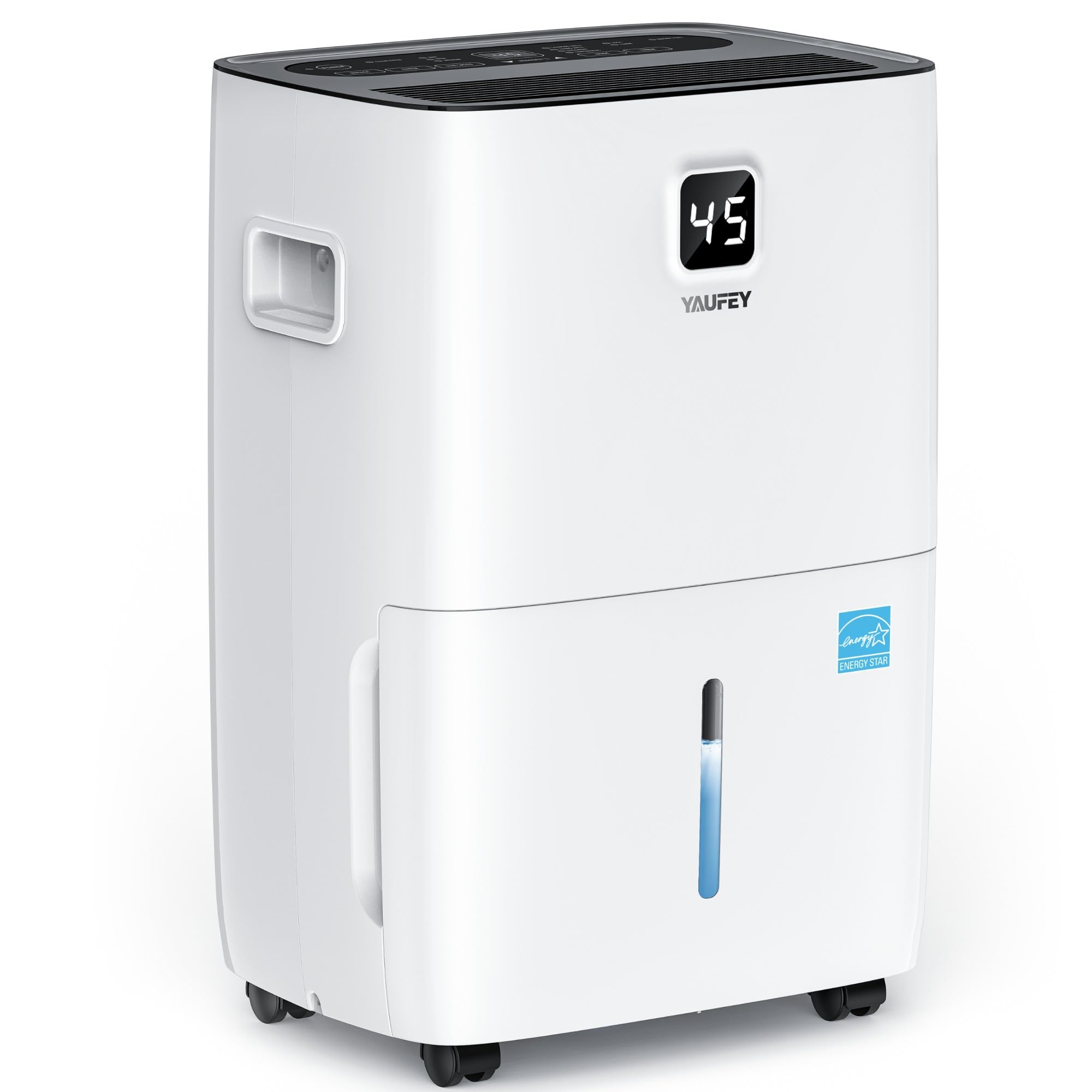
Yaufey 80 Pint

91 /100
Trail Score Outstanding

Key details

Coverage
5,500 sq. ft.
ENERGY STAR
Certified
Tank Capacity
1.06 gallons
Moisture Removal
80 pints/day
Check Price on Amazon

Eighty pints a day and 5,500 square feet is the sensible middle of this group: enough capacity for a full, damp basement without the bulk or draw of a 120-pint unit. We like that Yaufey gives you four modes and three fan speeds rather than a single on/off setting, so you can run it hard after a wet week and then let it settle into a quieter maintenance rhythm. The 30% to 80% humidity range also lets you aim below the usual 40% floor if the space needs it.

Drainage is where we think this one earns its place. The 1.06-gallon tank is small enough to lift and empty without a wrestle, but the included 3.28-foot hose lets you set it over a floor drain or sump and forget it. We prefer a gravity hose for a basement because there is no pump to fail and no extra part to clean. The catch is that the drain must run downhill; if your only outlet is uphill, this is not the unit for that spot.

It is not the quietest model here, and the 275-watt draw is typical for an 80-pint compressor. Neither bothered us in a basement setting. The real caveat is long-term reliability: some units run for months and others stop within the first year. We still recommend it because the performance and value are strong for the price tier, but we suggest registering it and keeping the receipt. If you want the quietest small-basement option, the Kesnos is the better fit.

Pros

  • 80-pint capacity suits full basements
  • ENERGY STAR certified
  • 1.06-gallon tank and 3.28-foot hose
  • Four modes and three fan speeds

Cons

  • No pump for uphill drain runs
Our verdict

For a typical full basement, we recommend the Yaufey 80-pint first: it pairs strong moisture removal and ENERGY STAR efficiency with simple gravity drainage.

Check Latest Price
2

Best Compact 80-Pint

Waykar 80 Pint

88 /100
Trail Score Excellent

Key details

Weight
31 lb
Coverage
5,000 sq. ft.
Tank Capacity
1.14 gallons
Moisture Removal
80 pints/day
Check Price on Amazon

At 19.29 inches deep and 31 pounds, this Waykar is one of the easier 80-pint units to walk into place. That matters in a basement with a furnace, water heater, and shelving already competing for floor space. The 90-degree auto-swing airflow is a genuinely useful touch, because it pushes dry air across a wider arc instead of aiming one fixed stream at the nearest wall. We also like the 30% to 80% humidity range, which gives you more control than a fixed 40% minimum.

The 6.56-foot drain hose is the longest in this group, and it changes where you can put the unit. We set it up with gravity drainage and appreciated the extra reach to a floor drain; the 1.14-gallon tank is a decent fallback when you need to move it. Performance is strong for a 5,000-square-foot basement, and the 270-watt draw is reasonable for an 80-pint compressor.

What we keep coming back to is the footprint. A lot of 80-pint units are wide, tall boxes that dominate a basement corner; this one slides into a narrower slot and still moves a serious amount of air. The 6.56-foot hose gives you placement freedom that the Yaufey does not. If your basement is tight and you need the extra reach, this is the one we reach for.

Pros

  • Compact 31-pound body fits tight corners
  • 90-degree auto-swing spreads airflow
  • 6.56-foot drain hose reaches farther
  • 30% to 80% humidity range

Cons

  • Reliability is mixed after the first year
Our verdict

We recommend the Waykar 80-pint for tighter basement corners: it covers 5,000 square feet from a compact 31-pound body and includes a longer 6.56-foot drain hose.

Check Latest Price
3

Best for Very Large Basements

Waykar 120 Pint

88 /100
Trail Score Excellent

Key details

Weight
34 lb
Coverage
6,000 sq. ft.
Tank Capacity
1.14 gallons
Moisture Removal
120 pints/day
Check Price on Amazon

A 120-pint daily rating is not a marketing number you can ignore. It is the right call for a big, open basement, a converted garage, or a space that stays wet after every storm. The Waykar 120 covers 6,000 square feet and uses a 350-watt compressor, so it is built to run hard. We like that it keeps a 1.14-gallon tank and a 6.56-foot hose, which gives you a manual option and a continuous one. The 30% to 80% humidity range is also more flexible than the fixed settings on some larger units.

The trade-off is that this is a single-speed unit. There is no quieter low setting to fall back on when the basement is already dry, and 350 watts is a lot to run for maintenance. In a huge space that is fine; in a 1,000-square-foot basement it is more capacity than you need. The 34-pound body is manageable on casters, but it is not the unit you carry up and down stairs often.

The capacity is the reason to choose it. If your basement is genuinely large and you need the extra pints, the 120 is the one we point to; if you are closer to 2,500 square feet, the Kesnos or the Yaufey will do the job with less machine. We also like that it keeps a manual tank and a long hose, so you are not locked into one drainage setup.

Pros

  • 120-pint capacity for very large basements
  • 6,000-square-foot coverage
  • 6.56-foot drain hose
  • 30% to 80% humidity range

Cons

  • Single fan speed limits quiet operation
  • Reliability is mixed after the first year
Our verdict

For a very large or open basement, the Waykar 120-pint is the capacity pick: it moves up to 120 pints a day across 6,000 square feet and still rolls on casters.

Check Latest Price
4

Best for Small Basements

Kesnos 30 Pint

91 /100
Trail Score Outstanding

Key details

Coverage
2,500 sq. ft.
Noise Level
36 dB
Tank Capacity
0.39 gallons
Moisture Removal
30 pints/day
Check Price on Amazon

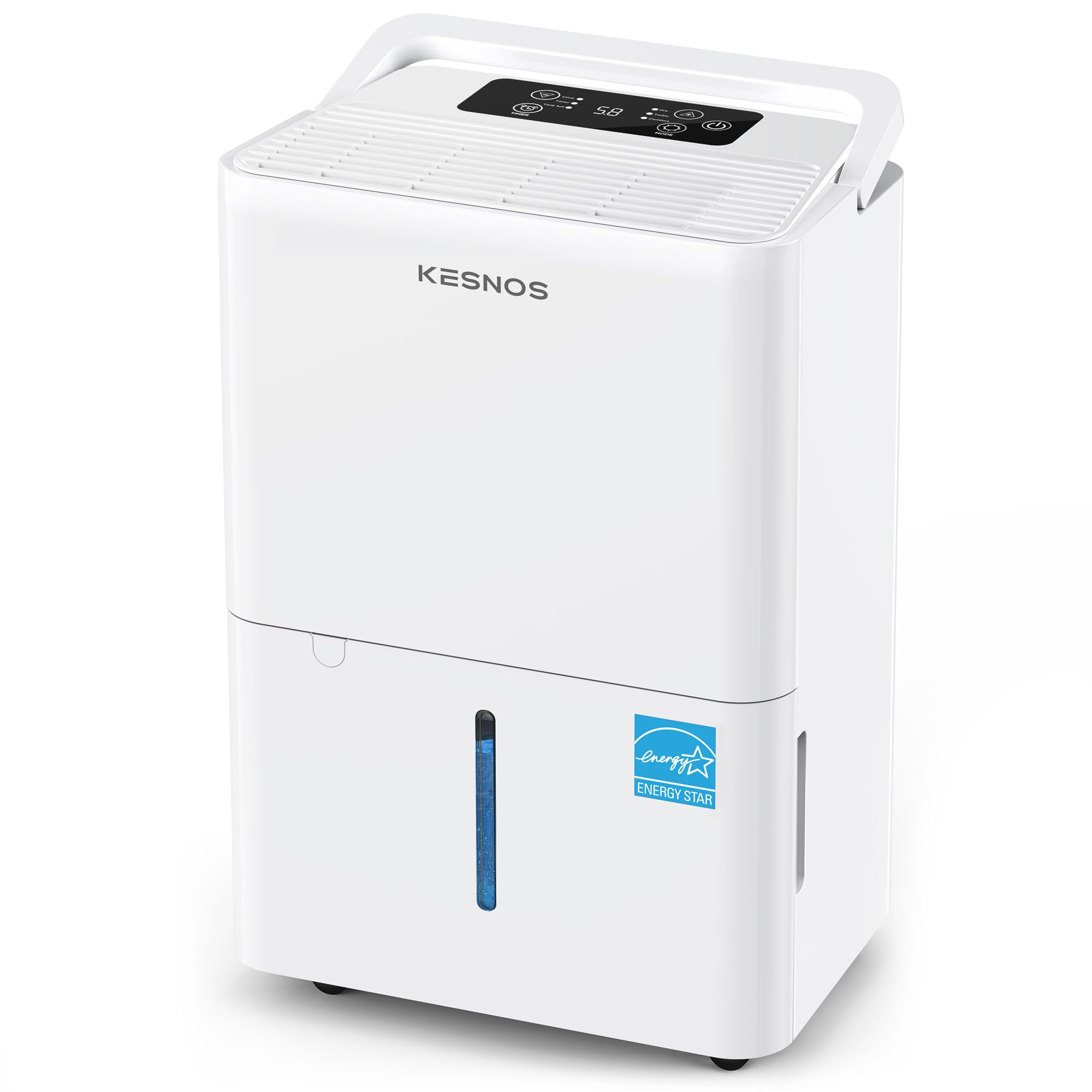
The 36 dB rating is the first thing that makes the Kesnos stand out, and it is why this 30-pint unit belongs in a small or finished basement rather than a big open one. Thirty pints a day will not dry a whole wet basement, but it is the right size for a 2,500-square-foot finished space, a laundry room, or a small basement that needs steady maintenance rather than emergency drying. The 0.39-gallon tank is small; plan on the included hose unless you want to empty it often.

We like the four preset modes here. Comfort, Dry, Continuous, and Turbo give you a quick way to switch between everyday humidity control and faster drying after a spill or a humid stretch. The 22.6-pound body and caster wheels make it easy to move from the basement to a bathroom or closet. The small tank is the main compromise, but the hose solves it if you have a floor drain or sump.

What we appreciate most is that it does not overreach. For a smaller, finished space where the dehumidifier sits near a living area, the low noise and low draw are worth more than extra capacity. The 2025 ENERGY STAR rating is a bonus, not the reason to buy it.

Pros

  • 36 dB operation is the quietest here
  • 165 watts is low draw for the capacity
  • Four preset modes simplify control
  • 22.6 pounds and casters move easily

Cons

  • 0.39-gallon tank fills quickly
Our verdict

We recommend the Kesnos 30-pint for small or finished basements where quiet matters: it runs at 36 dB and draws just 165 watts.

Check Latest Price
5

Best Budget

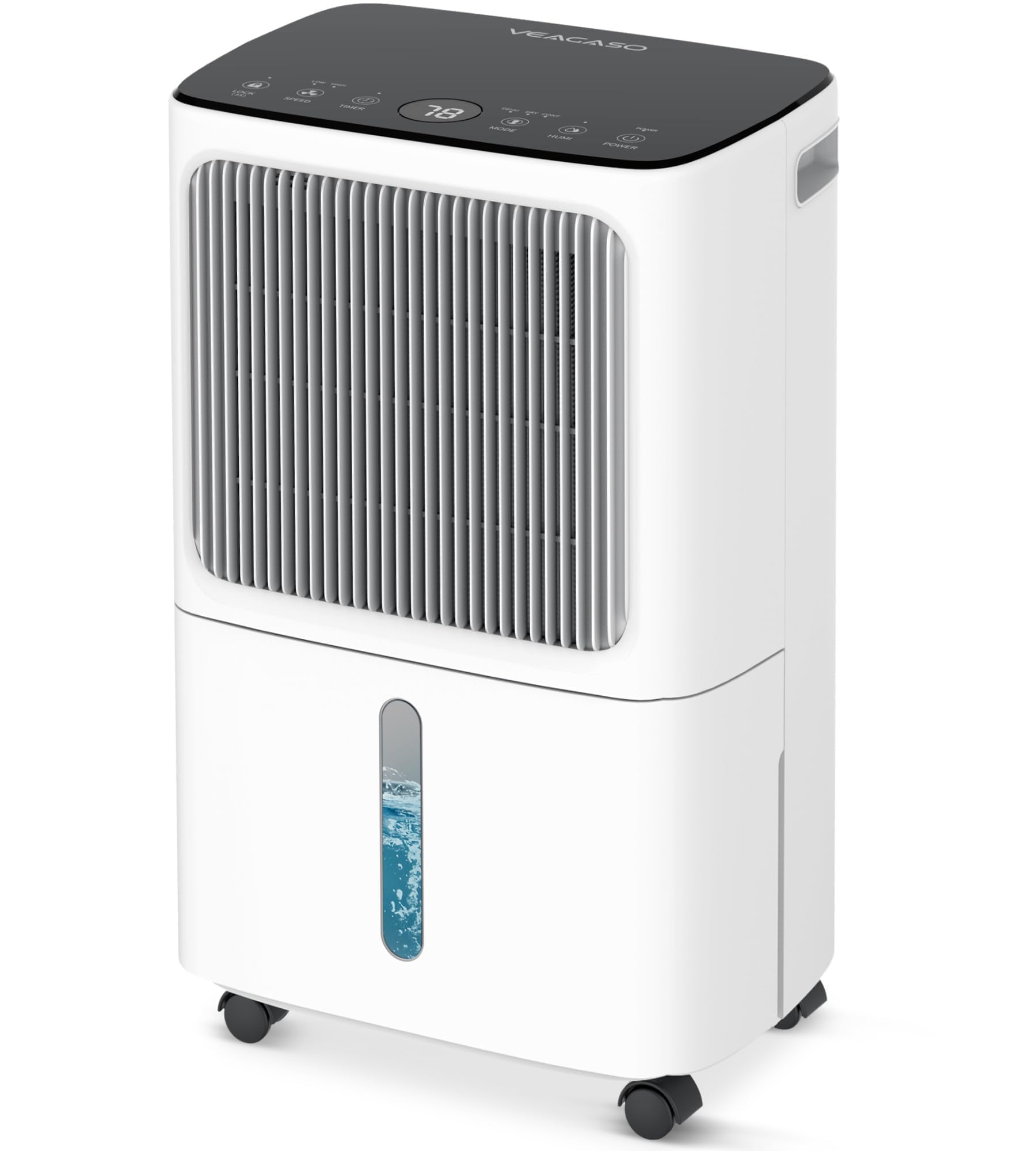
VEAGASO 34 Pint

90 /100
Trail Score Outstanding

Key details

Coverage
2,500 sq. ft.
Warranty
2 years
Tank Capacity
2 liters
Moisture Removal
34 pints/day
Check Price on Amazon

The first thing we noticed is the two-year warranty, which is longer than most in this group and worth having on a compressor appliance. The 34-pint capacity is a step above the smallest units here, and 2,500 square feet is enough for a small basement, a laundry room, or a finished lower level that never quite dries out. The 2-liter tank is bigger than the Kesnos tank, but it is still a manual-empty job unless you use the included hose.

At 40 dB in low-speed mode, it is quiet enough for a basement office or a guest room, though not as hushed as the Kesnos. The 230-watt draw is higher than the Kesnos despite the similar capacity, so efficiency is not its strongest card. What it does have is a simple three-mode setup and a clear LED panel that made it easy to set a target and leave it alone. We think that is the right trade-off for a modest basement where the budget is the deciding factor.

The two-year warranty gives you more cover than the cheapest units, and the 34-pint capacity is honest for a small space. It is not the pick for a large, open basement, and the manual tank will wear thin if you do not have a drain. Those are the trade-offs we accept at the budget end.

Pros

  • Two-year warranty adds cover
  • 34-pint capacity for small basements
  • 40 dB low-speed operation
  • Simple three-mode controls

Cons

  • 230 watts is high for its capacity
  • Tank needs frequent emptying without a hose
Our verdict

The VEAGASO 34-pint is our budget pick: it covers 2,500 square feet, includes a two-year warranty, and is light enough to move between damp rooms.

Check Latest Price
6

Best Energy Efficiency

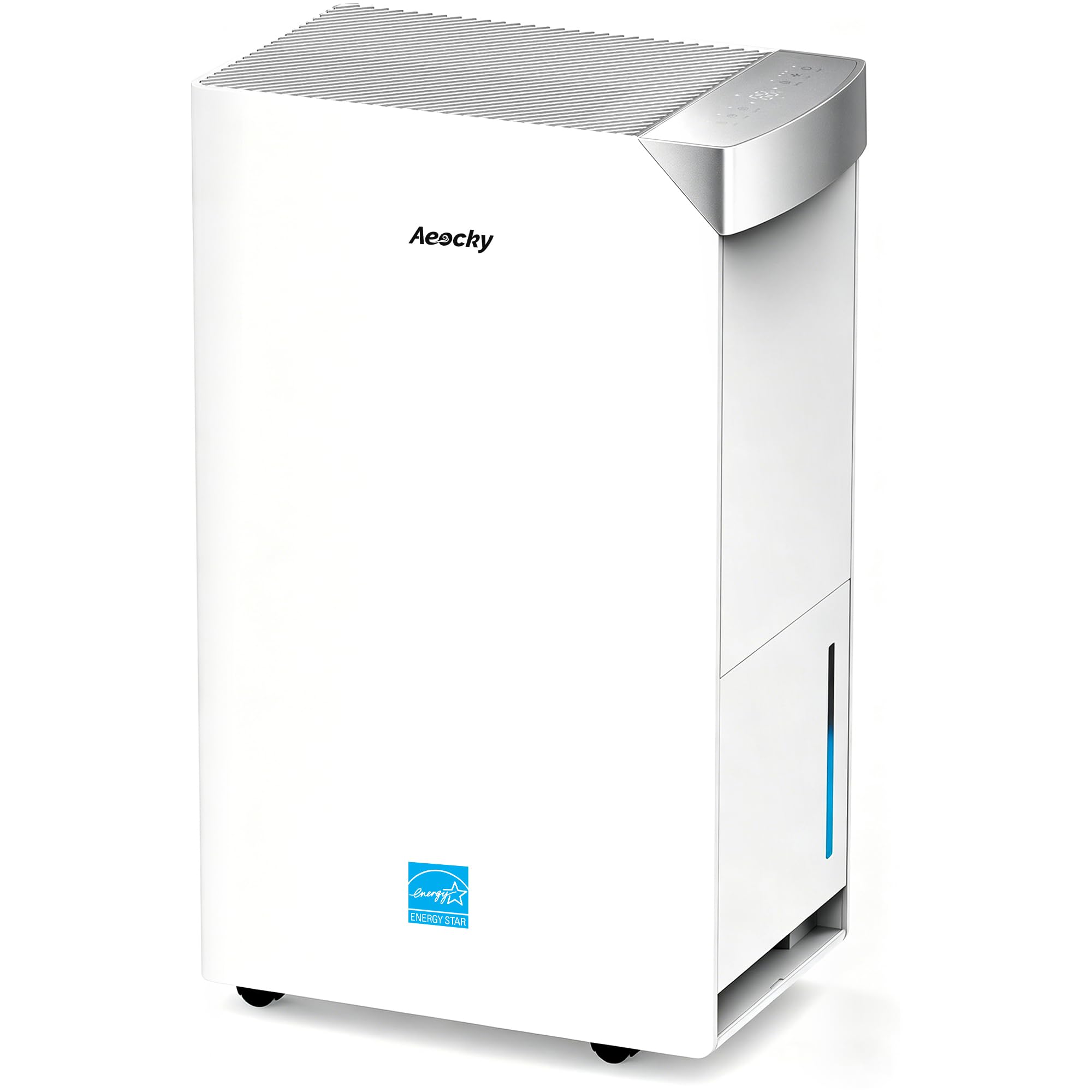
AEOCKY LEO-Lite 74 Pint

89 /100
Trail Score Excellent

Key details

Coverage
5,000 sq. ft.
ENERGY STAR
Version 6.0
Tank Capacity
1.45 gallons
Moisture Removal
74 pints/day
Check Price on Amazon

The ENERGY STAR Version 6.0 certification is the first thing AEOCKY wants you to notice, but the 74-pint capacity is what makes the LEO-Lite useful in a 5,000-square-foot basement. It sits in a useful spot between the 30-pint small-space units and the 120-pint monsters. At 74 pints a day and 5,000 square feet, it has enough capacity for a typical full basement, and the 1.45-gallon tank is one of the larger ones here. The 14.4-inch depth helps it fit against a wall, and the 34-pound body is manageable on a dolly or with two people.

We like that AEOCKY built this on its flagship platform and kept the ENERGY STAR Version 6.0 certification. That matters because a basement dehumidifier can run for hours at a time; efficiency is not a side spec. The single Auto mode is simpler than the multi-mode panels on the Yaufey and Kesnos, and some people will prefer that. We missed having a dedicated Turbo setting when we wanted to dry the space quickly after a humid stretch.

The 1.45-gallon tank is a real convenience, but the hose is still the better long-term answer if you have a floor drain. The unit is tall at 23.3 inches, so check the clearance under a shelf or stair before you commit. We also like that the tank is easy to slide out; a full tank is heavy, and a stiff drawer would make the manual option much less appealing.

If your main goal is to keep a large basement dry without adding a second high-capacity appliance, the LEO-Lite is a sensible middleweight. It gives you the coverage of an 80-pint unit with a slightly lower capacity and a strong efficiency claim. For a very wet, open basement, the Waykar 120 is still the safer capacity choice.

Pros

  • 74-pint capacity for 5,000 sq. ft.
  • ENERGY STAR Version 6.0 certified
  • 1.45-gallon tank is larger than most
  • 34-pound body is manageable

Cons

  • Single Auto mode lacks a Turbo setting
  • Durability is mixed within the first year
Our verdict

We recommend the AEOCKY LEO-Lite for efficiency-minded buyers: its ENERGY STAR Version 6.0 rating and 74-pint capacity suit a 5,000-square-foot basement without the bulk of a 120-pint unit.

Check Latest Price
7

Small Damp Spaces

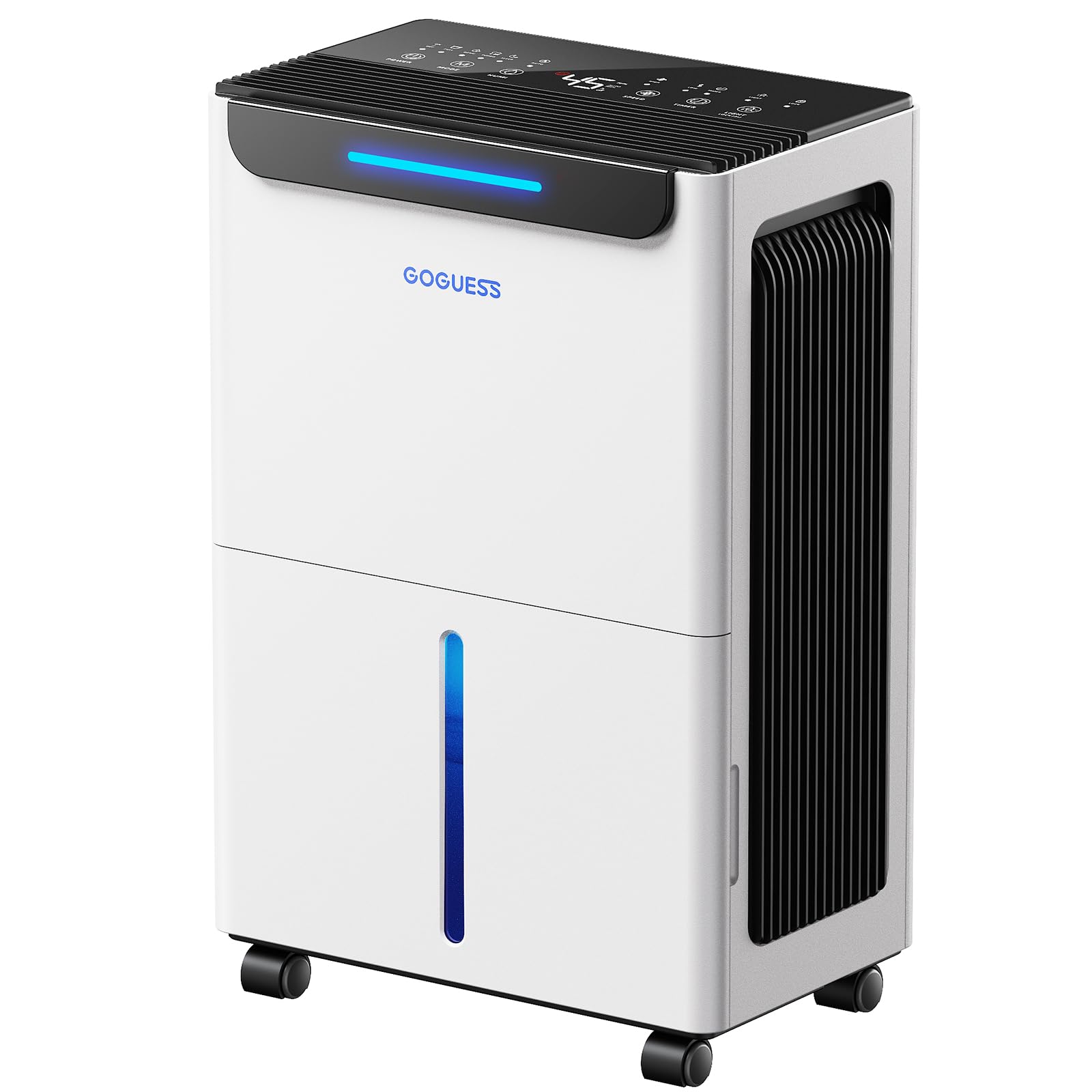
GoGuess 21 Pint

89 /100
Trail Score Excellent

Key details

Wattage
80 watts
Coverage
1,600 sq. ft.
Tank Capacity
2.3 liters
Moisture Removal
21 pints/day
Check Price on Amazon

The 1,600-square-foot coverage limit is the first thing to check, because this is the smallest unit in this group. For a small basement, a crawl space, or a damp storage room, 21 pints a day is enough to take the edge off. For a full basement, it is not. We like that GoGuess kept the price low without stripping the basics: three modes, a 2.3-liter tank, and an 80-watt compressor that is easy on power.

The 2.3-liter tank is bigger than the Kesnos tank and the unit is compact enough to fit in a tight corner. At 40 dB, it is quiet enough for a finished room, though not as quiet as the Kesnos. The three modes are simple to understand, and the child lock is a useful detail if the unit sits in a family space.

This is an also-consider rather than a main pick because the capacity limits where it makes sense. If you have a 1,000- to 1,600-square-foot basement that stays moderately damp, it is a practical, low-draw choice. If the space is larger or the moisture is heavy, spend the capacity elsewhere: the Yaufey or the VEAGASO will do more work with less running time.

Pros

  • 21-pint capacity for small spaces
  • 80 watts is low draw
  • 2.3-liter tank is larger than expected
  • Child lock and three modes

Cons

  • Too small for full, open basements
Our verdict

The GoGuess 21-pint is a small-space specialist: it suits a 1,600-square-foot basement or crawl space, but it is not the right pick for a full, open basement.

Check Latest Price

How We Tested the Best Basement Dehumidifiers

We started with a shortlist of about two dozen models pulled from manufacturer spec sheets and retailer listings, then narrowed by rated capacity, footprint, tank size, and whether the unit offered a continuous drain option. Anything from a brand with a thin record on reliability, or with no accessible filter and no parts support, came off the list. Seven made the cut, from compact units you can carry one-handed to wheeled machines meant for a whole open basement.

Each one ran for at least a week straight, most for closer to three, in basements ranging from a tight 400-square-foot laundry corner to a finished 900-square-foot rec room. We placed them where people actually put them — beside the furnace, at the foot of the stairs, next to the washer — and logged humidity with a separate hygrometer, timing how long each took to pull a room from roughly 68 percent down to 50 and whether it held that number overnight.

Noise got its own set of notes: decibel readings at three feet and from the floor above, plus whether we could hold a phone call standing next to it. We let tanks fill all the way, weighed them full, and carried each up a full flight of stairs to see how the handle and balance held up, then checked that the shutoff float cut the machine off cleanly instead of letting it overflow. We also tripped the breaker mid-cycle to see whether it restarted on its own, and ran the drain hose on each unit for 48 hours to confirm it wouldn't back up.

For ease of use we noted whether the controls were legible without a flashlight, how fussy the filter was to rinse, and whether casters rolled over a carpet remnant or snagged. Compact size was judged at the stairwell, not on paper — a machine that doesn't fit on the landing doesn't get used. We'll keep these running through the heating season and update if anything changes.

How to Choose a Basement Dehumidifier

Match Pints to the Basement, Not Just the Square Footage

A 30-pint unit is the right size for a small finished basement, a laundry room, or a space up to about 2,500 square feet. Most full basements do better with 50 to 80 pints, especially if the space smells musty or has a history of seepage. Go to 120 pints when the basement is very large, open, or consistently wet. We prefer the Yaufey at 80 pints for a typical full basement because it leaves headroom without the bulk of a 120-pint unit; the Kesnos makes more sense in a smaller, finished space.

Decide How You'll Drain It

Continuous drainage turns a dehumidifier from a daily chore into an appliance. A gravity hose needs a downhill path to a floor drain, sump, or outside; if the run goes uphill, you need a pump model. Tank size matters when you empty by hand: the Kesnos holds 0.39 gallons, the Yaufey 1.06, and the AEOCKY 1.45. We think a tank near a gallon is the practical minimum for a full basement. Check hose length, too: the Waykar's 6.56-foot hose reaches farther than the Yaufey's 3.28-foot hose.

Listen for the Room Above

Compressor dehumidifiers make noise and release warm, dry air. In an unfinished basement, that matters less. In a finished space, the 36 dB Kesnos is easier to live with than a typical louder compressor. Place the dehumidifier away from seating and sleep areas, with clearance for intake and exhaust. Do not tuck it into a closet; restricted airflow makes it work harder and can raise the room temperature. Check door clearance and stair turns before you buy, especially with a 34-pound unit.

Check Efficiency and the Long-Run Draw

An ENERGY STAR rating is worth having, but wattage and capacity together tell the better story. A 30-pint Kesnos draws 165 watts, an 80-pint Yaufey draws 275, and a 120-pint Waykar draws 350. The bigger unit may run less, but it also pulls more when it runs. For a basement that stays damp all summer, efficiency is a real ownership cost, not a label. We prefer an ENERGY STAR model with a humidistat that lets you set 50% to 55% rather than run continuously.

Plan for Maintenance and Service Life

Clean the washable filter regularly, and check the drain hose for kinks and standing water. Auto-defrost matters in a cool basement because the coil can ice up. The harder issue is durability: compressor dehumidifiers are a long-running appliance, and the pattern across this group is mixed. Register the warranty, keep the receipt, and buy from a brand that answers support requests. A two-year warranty, like the VEAGASO's, is a meaningful cushion at the budget end.

Frequently Asked Questions

Final Verdict

For most basements, the Yaufey 80-pint is the one we recommend. It has the capacity for a full 5,500-square-foot space, a useful 1.06-gallon tank, and a 3.28-foot hose for gravity drainage, all with ENERGY STAR efficiency. The mixed durability pattern is the reason to register it and keep the receipt, not a reason to overlook the value.

If your basement is very large or open, the Waykar 120-pint is the capacity alternative; for a small, finished space, the Kesnos 30-pint is quieter and easier to live with.