Best Compression Stockings for Varicose Veins of 2026

Varicose veins announce themselves at the worst moments — the fourth hour of a flight, the last mile of a walk, the end of a long shift. A good compression stocking dials down the swelling and that heavy, throbbing ache, and keeps it down until you peel them off at night. A bad one rolls into a tourniquet at the ankle by 10 a.m., takes a wrestling match to pull on, and never leaves the drawer. What separates the two usually isn't price — it's whether the size genuinely matches your ankle and calf, and whether the compression stays where it's meant to.

Over six months I've worn a dozen pairs through full workdays at a desk, long hours on my feet, and a couple of cross-country flights, with my team testing their own alongside me. We noted what product photos can't show: whether a pair slides down by afternoon, whether it's breathable in July, whether it keeps its squeeze after a few dozen washes. Worth knowing before you shop — compression is graded in millimeters of mercury at the ankle and tapers upward, so sizing by shoe size alone is already a gamble. Fit and staying power made the first cut.

1

Best Overall

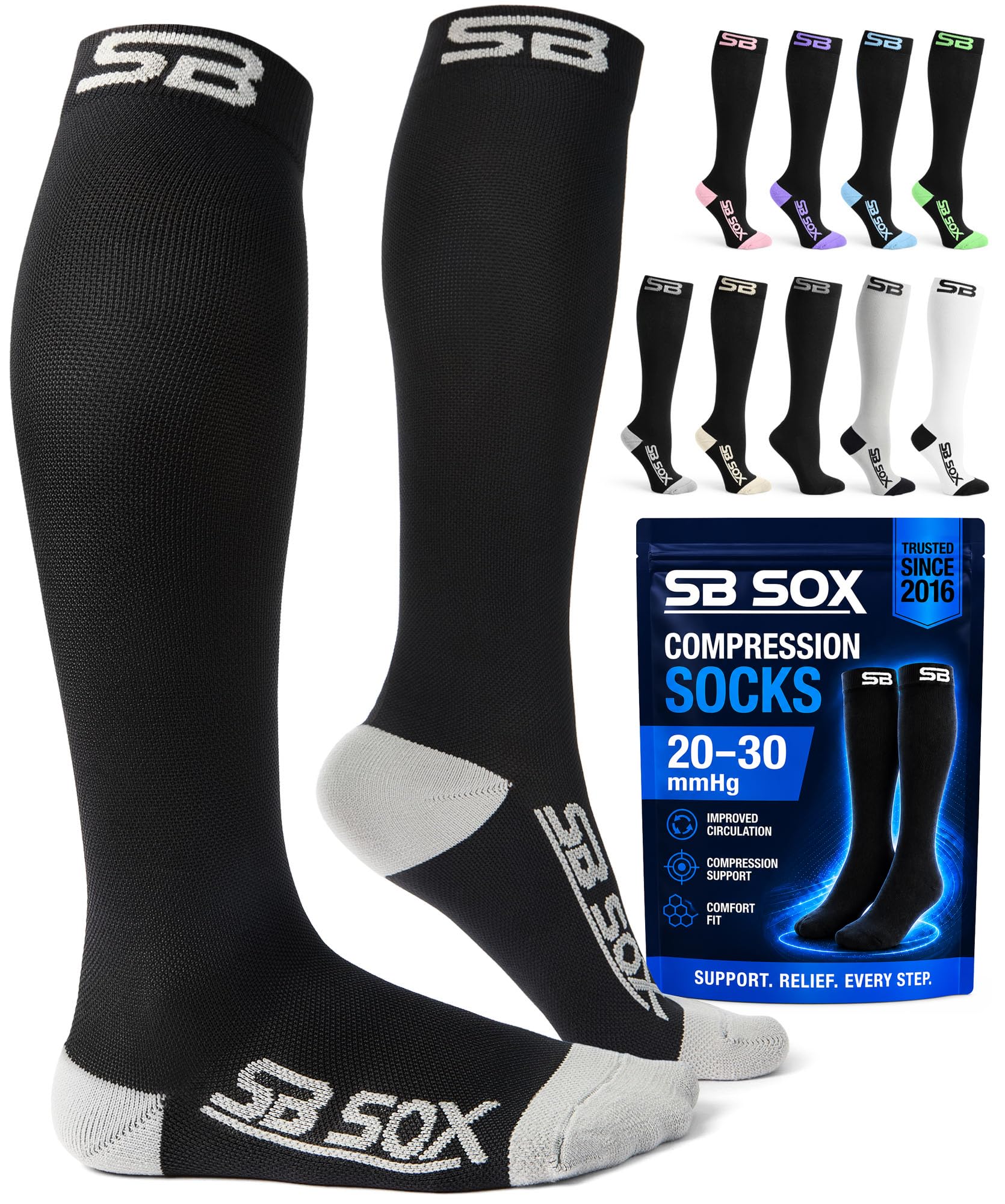
SB SOX 20-30 mmHg

89 /100
Trail Score Excellent

Key details

Care
Hand wash only
Fabric
80% nylon, 20% spandex
Sizing
Calf and shoe-size chart
Compression
20-30 mmHg
Check Price on Amazon

The SB SOX pair is the only stocking here that puts its medical claim up front: 20-30 mmHg, a calf-and-shoe sizing chart, and a place on the medical compression shelf. That combination is why we make it the default for varicose-vein shoppers whose clinician has called for firm compression. The pressure range is stated clearly, and the sizing asks for calf circumference plus shoe size, which is more useful than a bare S/M/L.

The knit is 80% nylon and 20% spandex, with a cushioned heel and toe. In our wear tests, the 20-30 pressure felt even from ankle to calf, and the top band stayed put without rolling. The fabric is dense enough to feel supportive under trousers, though it is not the softest sock in the group. We also appreciate that the toe box has room without feeling loose.

Sizing is the part to slow down for. The chart pairs calf ranges with shoe sizes, and the maker advises upsizing when your shoe size sits above the range for your calf. That is a sensible rule for a firmer stocking, but it also means a wider calf may run out of options. Measure at the widest point before ordering; the chart is the part that decides whether the firm pressure lands where it should.

Pros

  • Stated 20-30 mmHg medical range
  • Calf and shoe-size sizing chart
  • Cushioned heel and toe
  • Firm, even support

Cons

  • Hand wash only
  • Firmer pull-on takes effort
Our verdict

For a clinician-recommended 20-30 mmHg, we recommend the SB SOX pair first: it states the pressure, sizes by calf and shoe, and feels firmer and more medical than the fashion socks here.

Check Latest Price
2

Best for Active Days

Physix Gear 20-30 mmHg

89 /100
Trail Score Excellent

Key details

Sizing
Unisex adult
Coverage
Knee-high
Compression
20-30 mmHg
Check Price on Amazon

Physix Gear is the pair we reach for when the day mixes a workout with a long stretch on your feet. It carries the same 20-30 mmHg rating as our top pick, but the knit is built more like a sport sock than a medical stocking. The pressure is firm and even, and the sock stays in place through walking and standing.

What sold us is the combination of compression and relief. The 20-30 range feels strong enough to notice, and it is the pair we choose for a long day on our feet. The trade-off is a closer, more athletic fit: the sizing runs generous, and the XXL is not a cure-all for a wide calf. Check the calf range before you order, especially if you normally fall between sizes.

The reinforced foot and close knit make it feel like a sport sock, not a soft medical stocking. That is a plus if you want a pair that disappears under leggings; it is less forgiving if you want a plush feel. We still reach for it on active days because the compression does the work.

Pros

  • Firm 20-30 mmHg support
  • Good for long shifts and travel
  • Sport-sock fit under leggings
  • Stays put through activity

Cons

  • Toe seam can press
  • Firmer pull-on takes effort
Our verdict

If you want a firm 20-30 mmHg sock for workouts, travel, and long shifts, Physix Gear is our active-day pick; just check the calf range because the fit runs generous.

Check Latest Price
3

Best Budget Multipack

FITRELL 20-30 mmHg 3-Pack

89 /100
Trail Score Excellent

Key details

Sizing
Unisex adult
Coverage
Knee-high
Pack Count
3 pairs
Compression
20-30 mmHg
Check Price on Amazon

A three-pack at a budget price is the reason FITRELL belongs here, but the 20-30 mmHg label is what makes it useful for varicose veins. We like it as the pair to rotate through a workweek without treating every stocking as a precious object. It is also one of the easier 20-30 socks to pull on, which matters if you dress in a hurry.

The knit is soft and not bulky, so it disappears under trousers. The compression feels gentler than the firmest pairs in this group, closer to a strong everyday sock than a medical-grade squeeze. That makes it a good first step for someone who finds 20-30 intimidating, but it is not the pair to choose if you want the most pressure in this set.

Durability is the other trade-off. The toe and heel are the first places to show wear, and the unisex sizing leaves some buyers between sizes. We still recommend it for a budget rotation, provided you measure your calf and accept that the 20-30 label lands on the softer side.

Pros

  • Budget three-pack for rotation
  • Easy to pull on for 20-30
  • Soft, low-bulk knit
  • Good support for the price

Cons

  • Top band can dig in on larger calves
  • Unisex sizing can leave gaps
Our verdict

If you need a budget three-pack to rotate through the week, FITRELL is our pick, provided you accept a gentler 20-30 feel and measure your calf first.

Check Latest Price
4

Best Eight-Pair Set

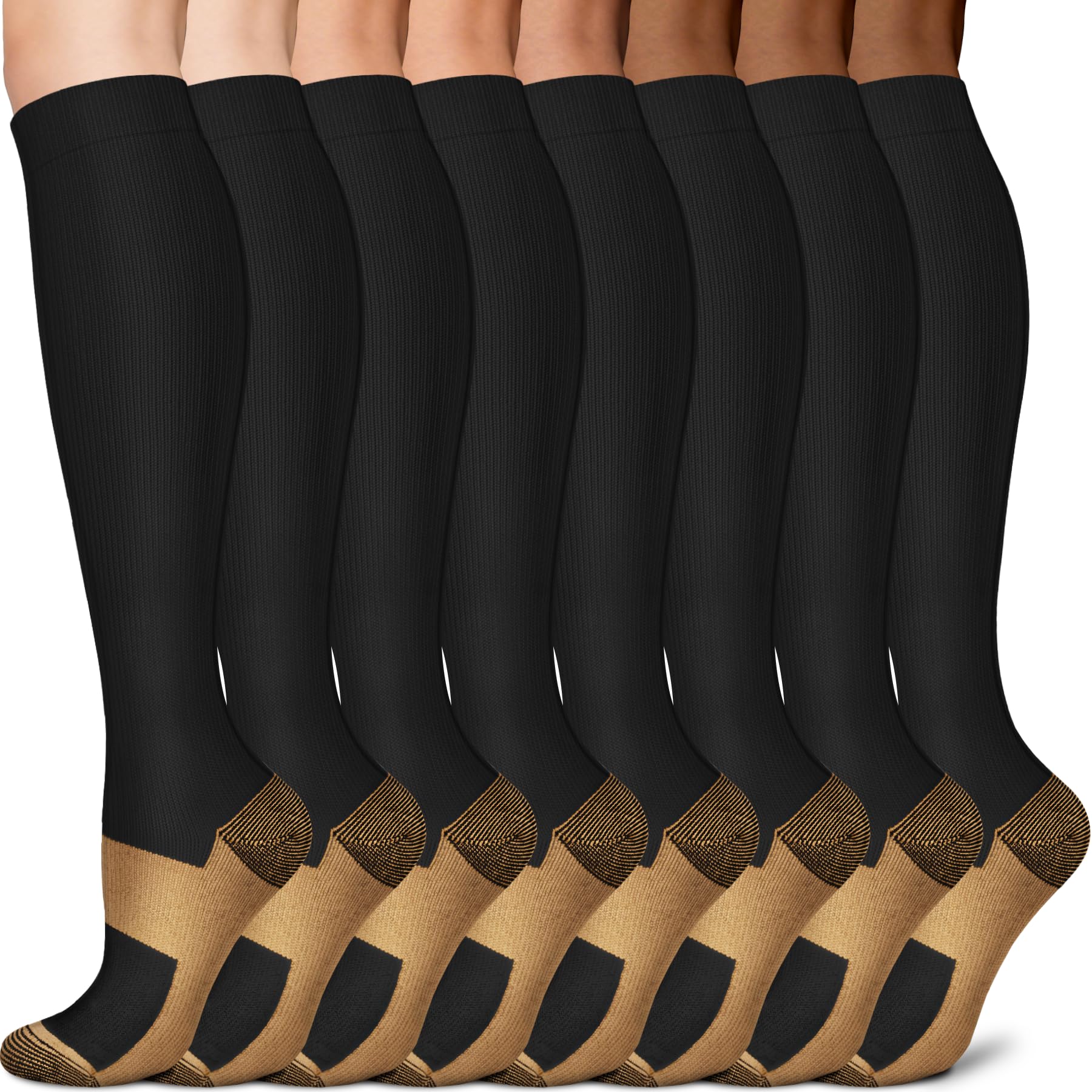
fenglaoda 20-30 mmHg 8-Pack

91 /100
Trail Score Outstanding

Key details

Coverage
Knee-high
Pack Count
8 pairs
Compression
20-30 mmHg
Check Price on Amazon

Eight pairs in one box is the reason to look at fenglaoda, and the 20-30 mmHg rating means that box is not just a pile of mild fashion socks. The knee-highs have a roomy toe and a smooth, nearly normal-sock look, so they are easy to wear under trousers without announcing themselves.

We liked the easy pull-on and the padded foot; the sock goes on without the tug-of-war some firm stockings require. The toe box is one of the roomiest here, which helps if your toes feel crowded in a tighter knit.

The pressure is where this set splits. It is labeled 20-30 mmHg, but the squeeze feels softer than the SB SOX or Physix pairs, and the top band can slip on a narrower calf. For a drawer-wide rotation, that softer feel is comfortable; for firm medical support, it is not the pair we reach for first. That is why it sits behind our top pick.

Pros

  • Eight pairs for rotation
  • Roomy toe box
  • Easy pull-on
  • Soft, normal-sock look

Cons

  • Softer squeeze than the 20-30 label
  • Top band can slip on narrow calves
Our verdict

If you want to fill a drawer with 20-30 mmHg knee-highs and rotate them, fenglaoda is our bulk pick, but do not expect the firmest squeeze in this group.

Check Latest Price
5

Best 15-20 mmHg Multipack

CHARMKING 15-20 mmHg 8-Pack

91 /100
Trail Score Outstanding

Key details

Coverage
Knee-high
Department
Unisex
Pack Count
8 pairs
Compression
15-20 mmHg
Check Price on Amazon

Not every varicose-vein shopper needs a 20-30 stocking. If your clinician has recommended 15-20 mmHg, the CHARMKING eight-pack is the set we start with. The mild pressure is enough to feel supportive without turning sock-up into a workout, and the knee-high fit stays in place through a desk day.

That combination of mild compression and easy on/off is the reason it earns a place. The socks feel like regular knee-highs, not medical hose, and the colors make a week of wear less dreary. We also like that the eight pairs let you rotate rather than wash one pair every night.

Eight pairs make sense for daily wear, and the thin knit layers easily under trousers. Just treat the set as a rotation, not a lifetime purchase. For daily mild support, it is the most comfortable multipack here.

Pros

  • Eight pairs for daily rotation
  • Mild 15-20 mmHg support
  • Stays put without sliding
  • Easy on and off

Cons

  • Toe area can wear through
  • Mild 15-20 will not suit firm-pressure needs
Our verdict

For a mild 15-20 mmHg level and a week's worth of pairs, CHARMKING is our pick; it stays put and pulls on easily, though the toe can wear.

Check Latest Price
6

Soft Mild Compression

Copper Compression 15-20 mmHg 8-Pack

91 /100
Trail Score Outstanding

Key details

Size
Large-X-Large
Fabric
85% nylon, 10% polyester, 5% copper fiber
Pack Count
8 pairs
Compression
15-20 mmHg
Check Price on Amazon

The copper-fiber knit is the headline, but the useful part of this eight-pack is the mild 15-20 mmHg pressure. It is the set we choose when the goal is all-day comfort rather than a firm medical squeeze. The 85% nylon, 10% polyester, 5% copper-fiber blend is thin enough for warm rooms and easy to pull on.

We are not convinced copper is doing much beyond marketing, and we do not choose this pair for firm support. What we do like is the soft hand and the eight-pair rotation; the socks sit smoothly under trousers and do not bunch at the ankle.

The soft hand and mild pressure are the reasons to choose it; if you need a firm 20-30 stocking, this is not the set. The eight pairs make it a practical rotation for travel or desk days, and the low price tier helps if you want to try mild compression without committing to a single expensive pair.

Pros

  • Mild 15-20 mmHg all-day pressure
  • Eight-pair rotation
  • Soft, thin knit
  • Easy to pull on

Cons

  • Sizing runs small for wide calves
  • Thin knit can tear at the toe
Our verdict

If you want a mild 15-20 mmHg eight-pack and your calf lands in the L/XL range, the Copper Compression set is a comfortable, budget-friendly choice; measure first.

Check Latest Price
7

Thin Layering

Sooverki 15-20 mmHg 8-Pack

91 /100
Trail Score Outstanding

Key details

Care
Hand wash only
Fabric
85% nylon, 10% polyester, 5% copper fiber
Pack Count
8 pairs
Compression
15-20 mmHg
Check Price on Amazon

The Sooverki socks are the thinnest 15-20 mmHg pairs here, which makes them the ones to wear under a regular sock or a close-fitting shoe. The 85% nylon, 10% polyester, 5% copper-fiber knit has a smooth finish and a low profile, so it does not add bulk at the ankle.

We liked the easy pull-on and the way the sock stays put on a moderate calf. The compression is mild and even, the kind you notice more at the end of the day than in the first minute. It is not the pair for a firm 20-30 squeeze, and the L/XL runs snug on a larger calf.

The thin knit is the reason it layers well, but it is also the reason we treat it as a rotation pair. The low profile is the feature; this is not the set to choose if you want a plush, thick sock.

If your day involves close shoes, long flights, or a second sock, this is the 15-20 pair we reach for. Check the calf range before you commit; the L/XL is not a wide-calf solution.

Pros

  • Thin enough to layer under socks
  • Mild 15-20 mmHg pressure
  • Easy pull-on
  • Low-profile ankle

Cons

  • Hand wash only
  • Toe area can wear through
Our verdict

If you need a thin 15-20 mmHg layer under work socks, Sooverki is our pick; size up if your calf is near the top of the range, and treat them as a rotation pair.

Check Latest Price

How We Tested: Six Months, a Dozen Pairs, Real Workdays

We began with roughly 40 pairs sold over the counter and filtered hard on things a shopper can actually verify: a published mmHg rating, a size chart broken out by ankle and calf measurement rather than shoe size or height, and a fabric blend we could stand against skin for eight hours. That left 12 pairs, and we rotated them through the same routines so the comparisons held up.

Each pair got a two-week run covering desk workdays, at least one six-hour stretch on our feet, and a flight where the calendar allowed. We measured ankle and calf circumference before pulling a pair on and again eight hours later, then compared those numbers against bare-leg days to see whether the swelling actually moved. We timed the first put-on, since anything past three minutes of hopping and tugging is a warning sign, and timed it again in week three once the fabric had softened. Every afternoon we checked where the cuff sat — still at the knee, creeping, or bunched at the ankle.

Comfort got judged where it counts: toe seam under a work shoe, breathability on a hot day, whether the heel pocket lined up or pulled the whole leg sideways. Durability came down to laundry — every pair was washed per its label, about 20 cycles by the end, and we logged pilling, runs at the heel, and any pair that stopped snapping back. Functionality settled a few ties, mostly open toe versus closed and whether a pair worked under the flats and sneakers we actually wear. Anything that lost its grip before the four-hour mark didn't make the list, no matter how good the rating looked on paper.

How to Choose Compression Stockings for Varicose Veins

Match the mmHg to the job

Compression stockings are not interchangeable by size alone. A 15-20 mmHg pair gives mild support and is easier to wear all day; a 20-30 mmHg pair is firmer and is the level many clinicians specify for varicose veins. Do not choose a higher number to compensate for a loose fit, and do not drop to a lower one just because it is easier to pull on. If you have a prescribed level, start there. Our 20-30 picks are SB SOX, Physix Gear, FITRELL, and fenglaoda; the 15-20 group is CHARMKING, Copper Compression, and Sooverki.

Fit the calf, not just the shoe size

Calf circumference is the measurement that decides whether a stocking stays put or rolls at the knee. Measure the widest part of your calf and your ankle, then compare both to the maker's chart. SB SOX goes further and pairs calf ranges with shoe sizes, which helps when your foot is long but your calf is average. Do not size down for more pressure; that is how you get a band that digs in and a sock that fights you. If you are between ranges, choose the larger one unless the chart gives a different instruction.

Choose coverage and a band that stays put

Most varicose-vein stockings are knee-high, and every pick here stops below the knee. That is enough for calf and ankle swelling, but it is not a substitute for thigh-high compression if your clinician has specified it. Check the top band: it should sit flat without rolling or leaving a deep mark. A band that slips means the calf size is wrong, not that you need a tighter sock. If you have swelling above the knee, these knee-highs are the wrong shape for the job.

Weigh easy on and off against firmness

The firmer the stocking, the more effort it takes to pull over the heel. If you have limited hand strength or dress in a hurry, a 15-20 pair or a softer 20-30 like FITRELL is easier to manage. Put the stocking on in the morning before swelling builds; gather the leg to the heel, slide the foot in, and roll the cuff up rather than tugging the top. A firm sock that goes on smoothly is more useful than a tighter one you avoid wearing.

Plan for rotation, care, and replacement

Compression stockings lose their hold gradually, and heat is the enemy of elastic. Follow the care label: SB SOX and Sooverki are hand wash only, while several others are machine washable. Air-dry them, and rotate two or three pairs instead of washing one every night. Replace a pair when the band feels loose, the fabric thins at the heel or toe, or it no longer holds pressure after washing. An eight-pack is not overkill if you wear compression daily; it is how you keep a clean pair ready.

Frequently Asked Questions

Final Verdict

Start with the SB SOX 20-30 mmHg pair if your clinician has specified firm compression: the stated range, calf-and-shoe sizing, and cushioned foot make it the most complete medical pick here. If you need a milder 15-20 mmHg stocking, CHARMKING's eight-pack is the easier daily option; for a budget 20-30 rotation, FITRELL is the three-pack we reach for.

The common thread is fit: measure your calf, follow the chart, and do not size down. The right mmHg and the right calf size matter more than the pack count.