Best Commercial Cold Press Juicers of 2026

The morning rush is the wrong time to find out your juicer can't keep up. A commercial cold press juicer is supposed to turn cases of produce into consistent, high-yield juice without babysitting—but the wrong machine will clog on fibrous greens, rattle loud enough to hear over the espresso grinder, and eat up an hour of staff time in cleanup. What you're really buying is uptime: steady performance, predictable output, and a machine that's still running strong after months of daily service.

Here's what first-time buyers miss: the real cost of a juicer isn't the sticker price—it's the labor and produce it wastes. A machine that yields a little more per pound and cleans in ten minutes instead of thirty pays for itself in a season. We put six commercial cold press juicers through nine months of daily service—morning rushes, leafy greens, root-heavy blends, end-of-night cleanups—and paid close attention to noise, clogging, and how the parts held up. The picks below are the ones we'd put behind our own counter.

1

Best Overall

Nama J2

91 /100
Trail Score Outstanding

Key details

Motor
200W
Weight
12.1 lb
Dimensions
9 x 9.8 x 17.7 in
Auger Speed
50 RPM
Check Price on Amazon

The first thing to understand about the J2 is that you stop feeding it. Load a full recipe into the hopper, walk away, and the auger works through it at 50 RPM while you get on with something else. That is the whole argument for this machine: batch loading is the difference between a juicing habit you keep and one you abandon in February.

We put roots, celery, and greens through it and kept coming back to the pulp. It comes out dry enough that a second pass yields almost nothing, which is the practical version of a high-yield claim. The 200-watt motor is quiet — a low hum rather than a whine — and it never sounded strained, even with beets. The trade is pace: 50 RPM is deliberate, so a full hopper takes minutes rather than seconds, and since you are not standing there watching it, that hardly registers.

Cleaning is quicker than the part count suggests, but there is a sequence to learn. A pin on the lid has to be unlocked in a set order before the top comes off, and get that wrong and the machine feels jammed when it is not. Once we had it down, the parts came apart fast and the strainer rinsed clean without much brushing.

Pros

  • Hopper takes a full recipe at once
  • Dry pulp leaves little juice behind
  • Runs quietly at 50 RPM
  • Quick to break down for washing

Cons

  • Every part is hand wash only
  • Plastic pitchers at a premium price
Our verdict

For most kitchens this is the cold press juicer to buy: load a full recipe once and the J2 delivers dry pulp and clean juice without demanding your attention.
Check Latest Price
2

Best for Continuous Juicing

Kuvings AUTO10

85 /100
Trail Score Excellent

Key details

Motor
240W
Capacity
3 liters
Dimensions
8 x 9.01 x 17.5 in
Continuous Run
30 minutes
Check Price on Amazon

Thirty minutes of continuous running is the number that separates the AUTO10 from everything else in this set. Most cold press machines want a rest between batches so the motor does not heat soak; this one is rated to keep going for half an hour at 50 RPM, which covers a serious Sunday session without a pause.

We treated that rating as the whole point of the machine, and it held. Roots, greens, and a second pass of pulp went through without stopping, and the 3-liter chamber meant far fewer interruptions to empty the pulp. The 240-watt motor is quieter than its size suggests, and the juice comes out with very little suspended pulp — the kind you drink without straining. If you juice for a family, or bottle several days ahead, that duty cycle is worth more than any extra feature here.

Two practical notes before you commit. Cleaning takes longer than on the Nama, because the strainer holds onto fiber and wants a brush rather than a rinse, and this is the most expensive machine on the page. The warranty is also written for the U.S. and Canada only, so buyers elsewhere are on their own if something goes wrong.

Pros

  • Rated for 30 minutes continuous
  • 3-liter chamber cuts emptying stops
  • Very low pulp in the juice
  • Quiet for a 240-watt motor

Cons

  • Strainer needs brushing at cleanup
  • Warranty covers only the U.S. and Canada
Our verdict

If you juice in long sittings, the AUTO10 is the one: a half-hour duty cycle and a 3-liter chamber turn a week of juicing into a single session.

Check Latest Price
3

Best Midrange Batch Juicer

Canoly C16

89 /100
Trail Score Excellent

Key details

Motor
250W
Hopper
90 oz
Weight
12.6 lb
Feed Chute
6 in
Check Price on Amazon

Think of the C16 as the batch-juicing idea at a fraction of our top pick's price: a 90-ounce hopper, a 6-inch chute, and a 250-watt brushless motor turning slowly enough to keep heat out of the juice. For a household that wants to load once and walk away without paying premium money, this is the machine we point to first.

In use it is the least fussy of the midrange group. The three strainers swap without tools, the detachable pulp outlet means fiber does not pack into a corner you cannot reach, and every removable part is dishwasher safe — which is why it beats the Nama on cleanup in our book. Juice comes out clean with a modest amount of pulp, and it runs quietly enough to use while someone is on a call in the next room.

The 6-inch chute is generous but not a no-prep promise. We still halved apples and broke celery down, which is a minute of knife work rather than a chopping session. The main cylinder also takes a deliberate wiggle to seat before the lock engages; rush it and the machine can work loose mid-run.

Pros

  • 90-ounce hopper holds a full batch
  • Dishwasher-safe removable parts
  • Three strainers swap without tools
  • Clean juice with modest pulp

Cons

  • Cylinder needs a wiggle to seat and lock
Our verdict

The C16 delivers hopper-fed batch juicing and dishwasher-safe parts for a fraction of premium money — our pick for most families.

Check Latest Price
4

Best for Hard Produce

AMZCHEF ZM1939

88 /100
Trail Score Excellent

Key details

Motor
600W max
Dimensions
16.14 x 7.75 x 12 in
Feed Chute
6.5 in
Speed Settings
2
Check Price on Amazon

Six hundred watts is the biggest motor number here, and it exists for one job: roots. Carrots, beets, and turmeric go through the AMZCHEF without the auger bogging down, and the cutting blades built into the 6.5-inch chute break produce down before it reaches the auger.

The shape is the other thing you notice. At 16 inches deep and 12 inches tall it lies low and long, so it slides under a cabinet but eats counter depth — measure the spot before you commit to it. There are two speeds and a reverse function for the usual jams, and three strainers cover juice, sorbet, and nut milk.

For dense produce at a midrange price, this is our pick in this set. The compromise is maintenance. Every part is hand wash only, and a wide chute reduces prep rather than eliminating it — plan on halving anything bigger than a tennis ball. Neither is a dealbreaker if you juice roots a few times a week; both are worth knowing before the first session.

Pros

  • 600W motor handles dense roots
  • Built-in cutting blades in the chute
  • Low profile slides under cabinets
  • Reverse function clears jams

Cons

  • Hand wash only, every part
  • Deep body needs counter depth
Our verdict

For carrots, beets, and other dense produce, the 600-watt AMZCHEF does the work without complaint — just budget the sink time afterward.

Check Latest Price
5

Best Budget

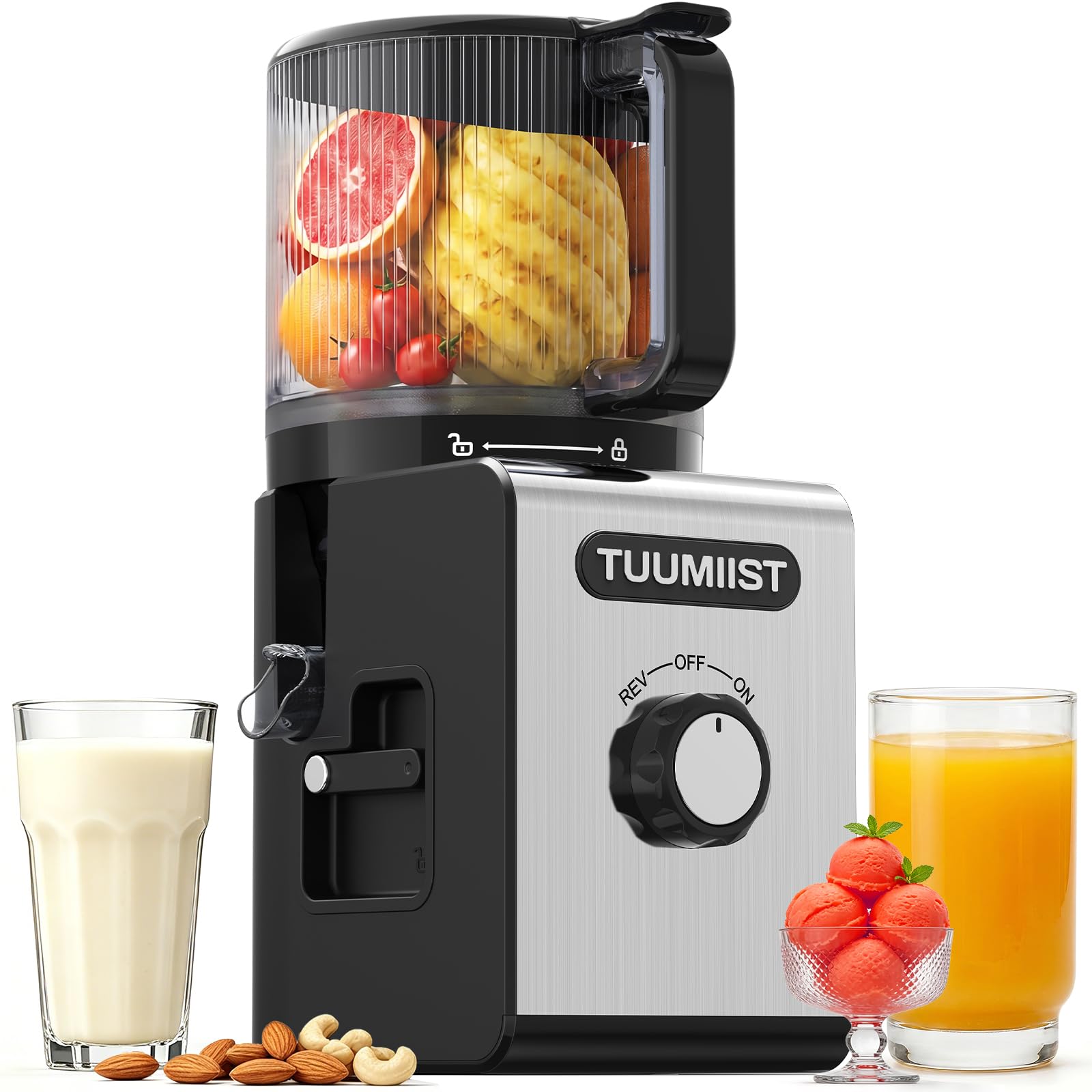
TUUMIIST TM-780SJ

89 /100
Trail Score Excellent

Key details

Motor
350W
Hopper
100 oz
Weight
7 lb
Auger Speed
60 RPM
Check Price on Amazon

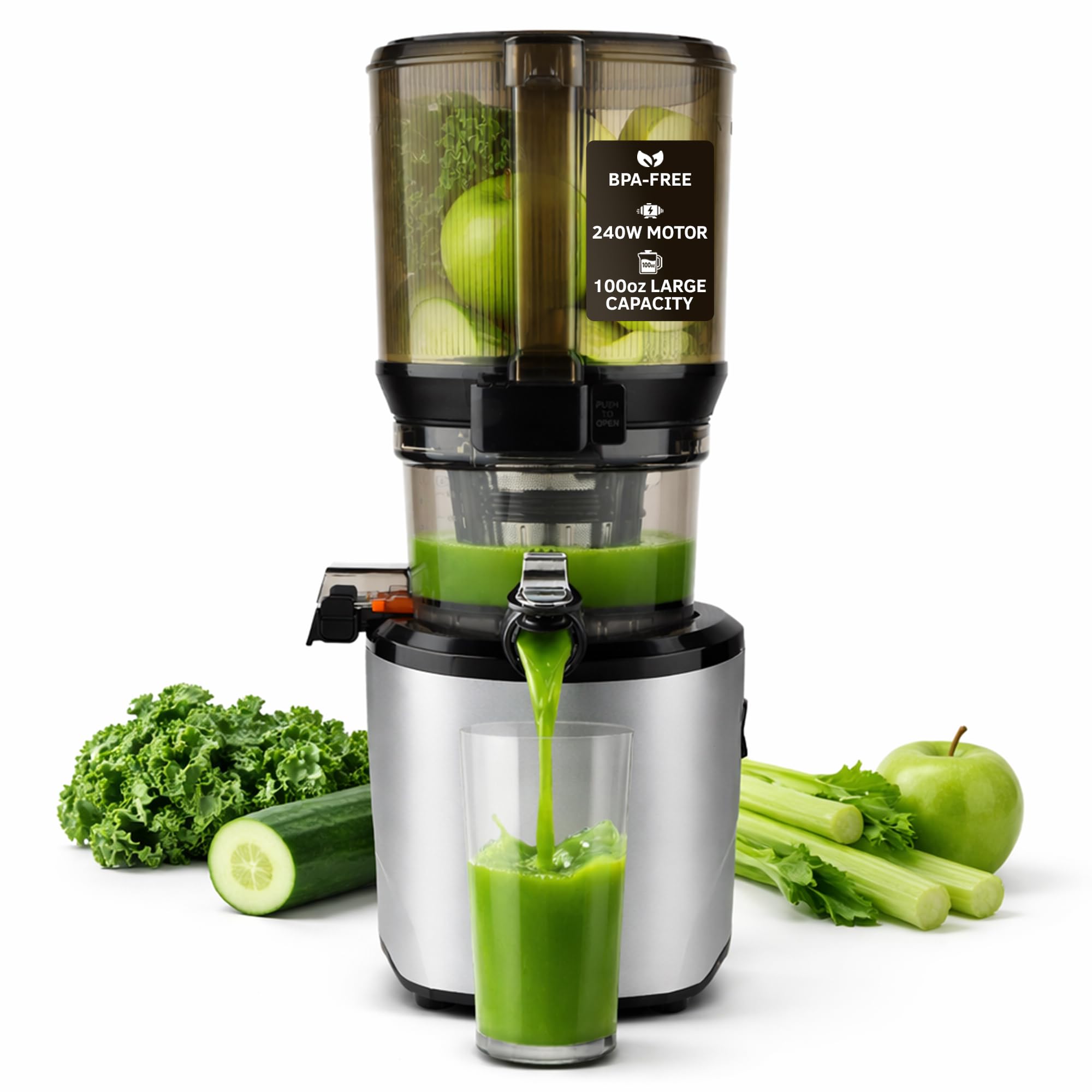
This is the least expensive way onto this page with a real batch hopper: 100 ounces of produce capacity, a 6.5-inch chute, and a 350-watt motor at 60 RPM, all in a 7-pound body you can lift off the counter with one hand.

Mostly it delivers. Juice yield came out high and the pulp came out dry, the single strainer really does juice, nut milk, and sorbet without swapping parts, and it is quiet enough to run before the rest of the house is up. What you give up is refinement. One strainer means no way to tune texture the way a two- or three-strainer machine allows, and the small plastic parts are the weak point — handles and fittings can crack.

Treat it as a first machine, or a second one for a small kitchen. The 30-day satisfaction window and the overheat protection take some of the risk out of trying it, and dishwasher-safe parts make daily use realistic rather than a chore.

Pros

  • 100-ounce hopper at a budget price
  • High yield with dry pulp
  • One strainer covers juice, nut milk, sorbet
  • Dishwasher safe and light to move

Cons

  • Small plastic parts can crack
  • Single strainer limits texture control
Our verdict

The cheapest route to hands-free batch juicing here, and a good one — provided plastic fittings and a single strainer do not put you off.

Check Latest Price
6

Best Compact Wide-Chute

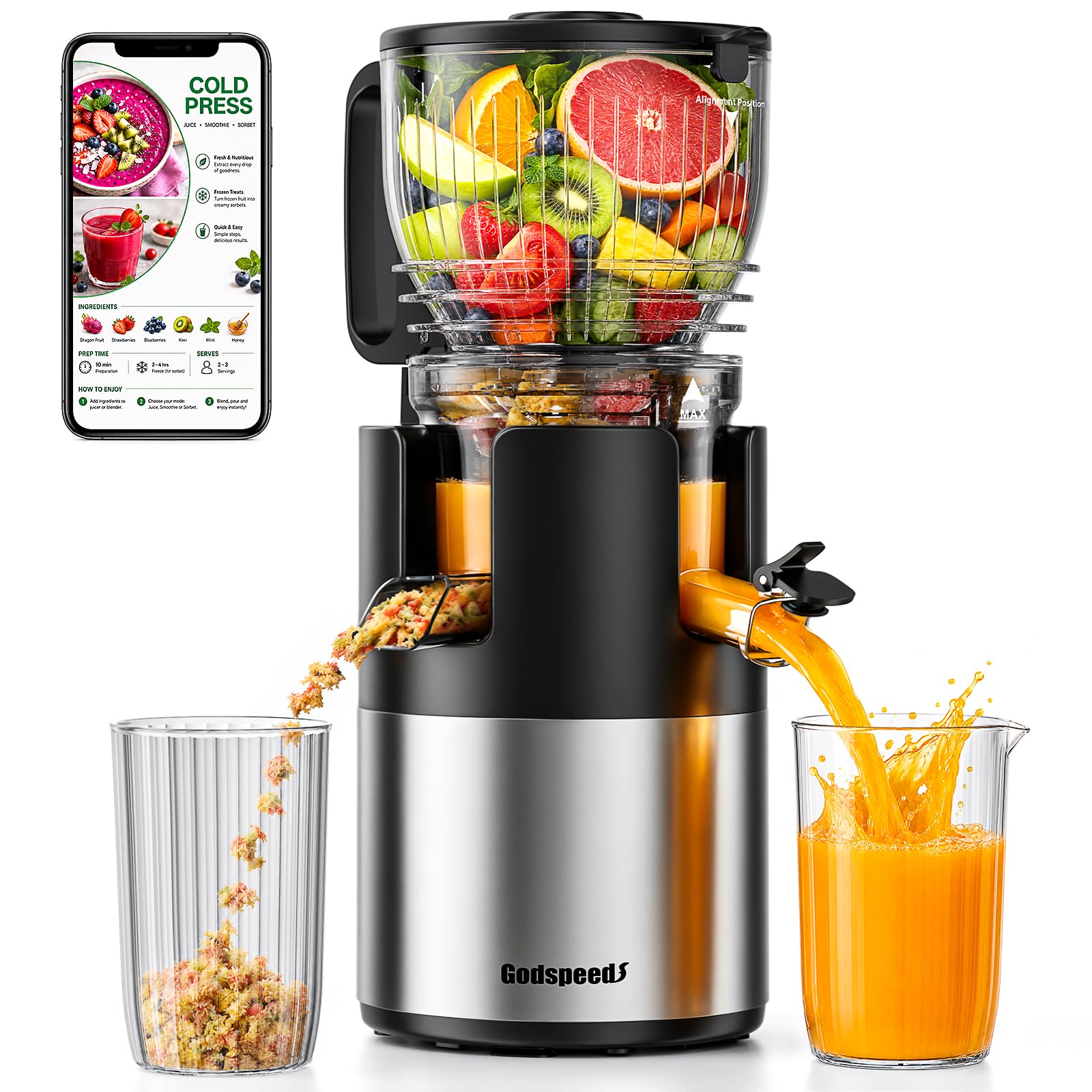
Godspeeds MP-802Q

88 /100
Trail Score Excellent

Key details

Motor
300W
Capacity
473 ml
Feed Chute
6 in
Auger Speed
58 RPM
Check Price on Amazon

The 473 ml cup is the first thing to get straight about this one. This is a small-batch machine wearing wide-chute clothes: a 6-inch feed opening, a 300-watt motor at 58 RPM, and a body only 6 inches square, with a juice cup you will empty more than once during a family session.

What it does well is the everyday single glass. Apples, cucumber, and citrus go through with dry pulp and very little foam, the toothed filter pops out and rinses clean under the tap, and the whole thing snaps apart without tools. At just under eight pounds it is easy to move, and it runs quietly enough to use before the house is awake.

Where it runs out is volume. The 10-year warranty is the longest promise on this page, which tells you the maker expects it to last, but a small cup and a chute that still wants big apples halved keep it a two-person machine. For a couple with limited counter space that is a fair trade. For a family putting away a pitcher a day, it is not.

Pros

  • 10-year warranty, longest here
  • Snaps apart without tools
  • Dry pulp with little foam
  • 6-inch-square footprint

Cons

  • 473 ml cup fills quickly
  • Large apples still need halving
Our verdict

A compact, quiet juicer for one or two people, with the longest warranty here — just do not expect it to keep up with a family.

Check Latest Price
7

App-Controlled Juicing

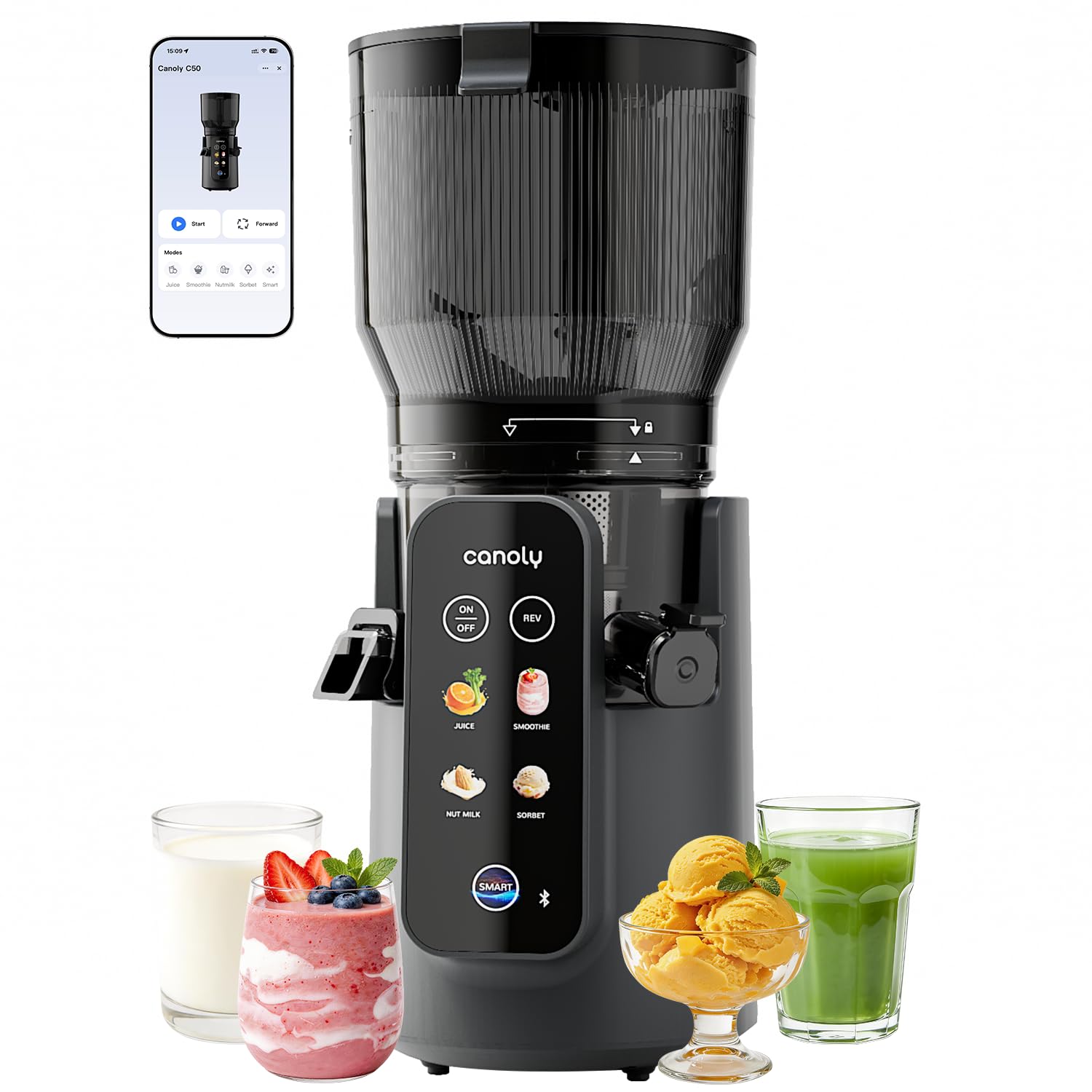
Canoly C50

82 /100
Trail Score Excellent

Key details

Motor
250W
Weight
13.2 lb
Capacity
3.25 liters
Feed Chute
7.1 in
Check Price on Amazon

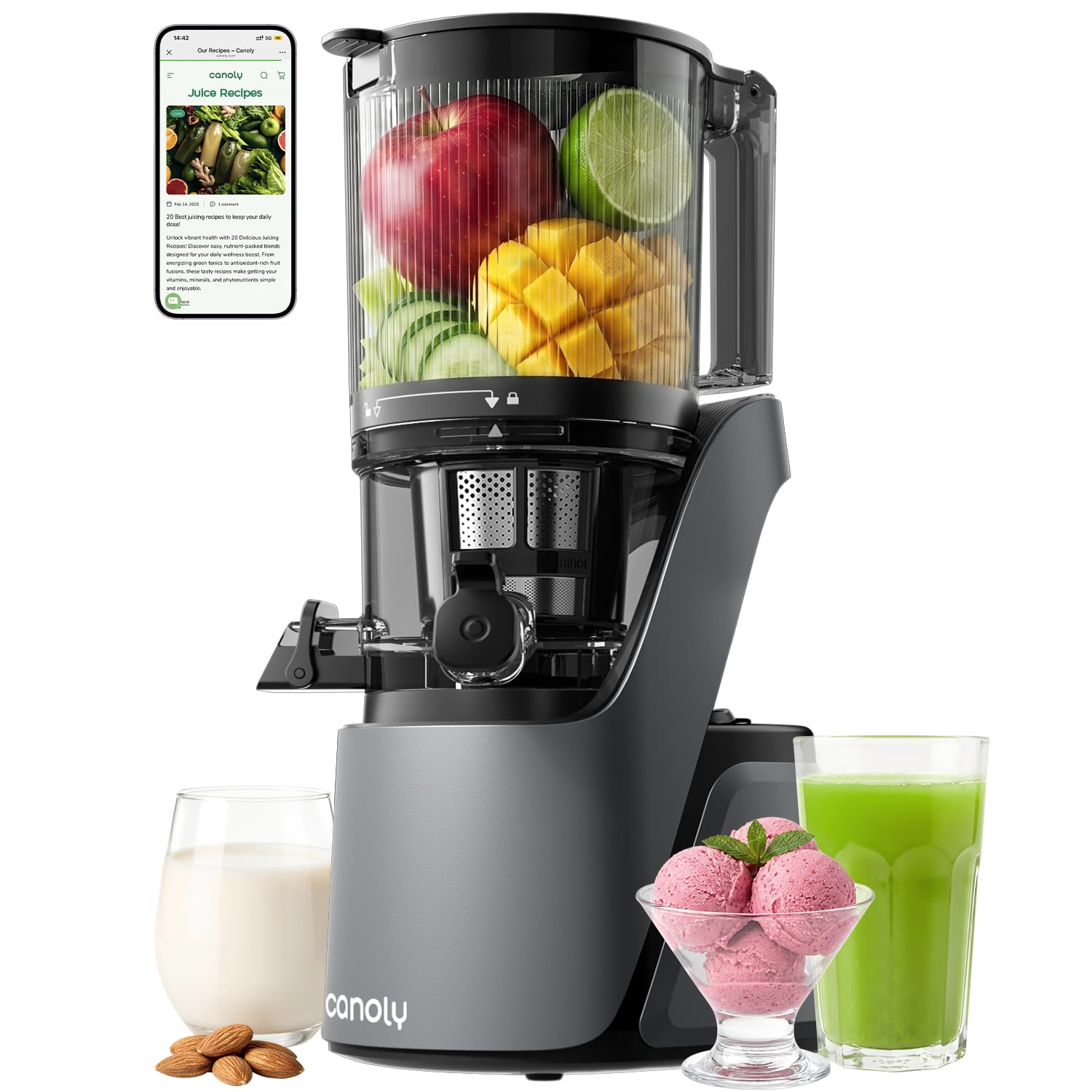
A 7.1-inch feed chute is the widest opening in this set, and Canoly pairs it with a built-in precut blade, a 100-ounce hopper, and four strainers covering juice, smoothie, sorbet, and nut milk. On paper this is the most feature-complete machine here.

It is also the only one with a touchscreen and a Bluetooth app. We are skeptical of app control on a machine you operate for ninety seconds with wet hands, and loading produce the night before is not the same thing as juicing it fresh, but the touchscreen itself is clear and wipes down easily — which is more than we can say for a membrane panel.

The design is the real draw. It won a Red Dot award, the gray finish does not look like an appliance, and the whole thing sits solidly on the counter. In use it is quiet, it swallows big chunks, and the strainers swap without tools.

Our hesitation is about history rather than performance. This is a newer design than the C16 with far less of it in the world, and the parts that matter — hopper, strainers, blade — are the same plastic. If the app and the extra inch of chute solve a problem you actually have, it is a pleasure to use. If you just want batch juicing, the C16 does the same job for a third of the money.

Pros

  • 7.1-inch chute takes whole fruit
  • Four strainers cover juice to nut milk
  • Touchscreen is clear and wipes clean
  • 15-year motor warranty

Cons

  • Precut blade misses some pieces
  • Heavy at 13.2 pounds to lift
Our verdict

Buy the C50 for the widest chute and app control in this set; the batch juicing underneath is good, but you are paying for novelty too.

Check Latest Price
8

Tight Counters

Ninja NeverClog JC151

89 /100
Trail Score Excellent

Key details

Motor
150W
Juice Jug
24 oz
Dimensions
12.11 x 7.15 x 15.93 in
Pulp Container
36 oz
Check Price on Amazon

At 7.15 inches wide and just under 16 inches tall, this is the machine that fits where the others do not. It ships with a 24-ounce juice jug and a 36-ounce pulp container, plus two pulp filters so you can dial texture from nearly clear to thick.

Two things it does better than its price suggests. Every removable part is dishwasher safe and assembly is a quick job rather than a puzzle, so nothing about it feels like a project. We also liked the pulp control: the less-pulp filter produces juice that does not need straining, and the one-touch start and reverse make it approachable in a way the bigger machines are not.

The limits are the ones a compact 150-watt, single-glass design imposes. The feed opening is narrow enough that apples, beets, and big carrots all need cutting, and the 24-ounce jug means a family session is a series of empties. Neither matters if you are juicing one glass at a time, which is exactly who this is for.

None of this makes it a bad machine; it makes it a small one. For one person in an apartment kitchen, a footprint that fits a narrow counter strip and parts that go in the dishwasher are worth more than a hopper you never fill. It is also the least intimidating machine here if you have never owned a juicer.

Pros

  • Fits a narrow counter strip
  • Dishwasher-safe parts, quick assembly
  • Two pulp filters control texture
  • One-touch start and reverse

Cons

  • Loud with fibrous produce like apples
Our verdict

A compact, dishwasher-safe first juicer for one person — the Ninja trades batch capacity for a footprint that fits almost anywhere.

Check Latest Price

How We Tested Commercial Cold Press Juicers

We started by researching the models sold to juice bars, cafés, and small production kitchens, filtering by motor size, feed chute dimensions, counter footprint, warranty terms, parts availability, and budget. From that list, we brought in six machines and ran them in a working juice-bar setup for nine months. Each one faced the same schedule: a morning rush of back-to-back orders, afternoon batches of leafy greens and fibrous roots, and a full disassembly and wash at close.

We weighed produce in and juice out to compare yield, and we timed how long each machine took to process a standard batch of kale, cucumber, apple, and ginger. We noted where pulp packed around the screen, how often we had to stop and clear a clog, and whether the feed chute handled whole produce or needed extra knife work. Noise got judged by whether we could take an order over the machine while it ran, not just by a decibel reading.

Cleaning was its own test: we dismantled each juicer after every shift, timed the wash, and checked how easy it was to reach the screen, auger, and pulp bin without tools. We tracked the small stuff that separates smooth service from frustration—how stiff the locking mechanism felt, whether the controls were clear after a long day, and how many parts had to be hand-scrubbed. Over nine months, we watched for wear on seals, cracks in plastic housings, and any drop in yield that signaled a tired motor. Value came down to output per hour, produce waste, and labor minutes per gallon—not the sticker price alone.

How to Choose a Cold Press Juicer for High-Volume Juicing

What Commercial-Grade Means on a Countertop

None of the machines here is a certified commercial unit, and for a home kitchen putting away a pitcher at a time that is fine. What separates the ones that come closest is duty cycle: a motor rated to run for half an hour without a cooldown, a chamber big enough for a full batch, and a build that does not need babying. Wattage is the least useful number to shop by, because torque at the auger matters more than the figure on the box.

Match the rating to your longest session. If you juice a glass or two at a time, a standard machine with a rest between batches is plenty. If you bottle several days at once, or sell juice, pay for the continuous-run rating — the Kuvings AUTO10 is the only machine here rated for a half-hour stretch.

Feeding: Hopper or Chute?

A wide chute and a hopper do different jobs. A chute saves knife work on individual pieces; a hopper lets you load a whole recipe and walk away. The second is what turns juicing into a routine, and it is the feature we pay for first when we are choosing one for ourselves — the Nama J2, the Canoly C16 and the TUUMIIST all lean on it.

The trap is assuming a six-inch opening means no prep. Large apples still want halving, celery wants breaking down, and fibrous stalks feed better cut to length. Budget a minute with a knife whatever the specification promises, and you will not be disappointed by the first session.

Yield Shows Up in the Pulp

Every listing claims high yield; the pulp is the only honest measure. Dry, crumbly pulp means the auger got the juice out. Pulp that still feels damp and heavy is juice you paid for and threw away, so run it through a second time before it goes in the compost.

Strainer design matters here too. A toothed or perforated filter rinses more easily than a fine mesh screen, and machines with a detachable pulp outlet — the Canoly C16 is the clearest example in this set — are quicker to clear when greens bind up. Single-strainer designs like the TUUMIIST cut down on washing, at the cost of texture control.

Cleanup Decides How Often You Use It

A cold press juicer has four or five parts that touch wet fiber, and the strainer is always the worst of them. Dishwasher-safe parts are the difference between juicing on a workday and saving it for the weekend: the Canoly C16 and the Ninja JC151 both go in the machine, while the Nama J2 and the AMZCHEF are hand wash only.

Read past the phrase easy to clean and look for two specifics instead — whether the pulp outlet detaches, and whether a brush comes in the box. A detachable outlet means you can clear the chute properly rather than running water through it and hoping.

Frequently Asked Questions

Final Verdict

For most people shopping this category, the Nama J2 is the answer. A hopper that takes a full recipe, dry pulp, and a quiet 50 RPM auger add up to a machine you will reach for on a weekday, and the cleaning routine does not depend on a dishwasher.

If you juice in long sittings rather than daily, the Kuvings AUTO10's half-hour duty cycle and 3-liter chamber justify the premium. On a tight budget, the TUUMIIST buys you a 100-ounce hopper for the least money here, with plastic fittings as the trade.