Best Bumper Plates of 2026

The first time you drop a loaded barbell from overhead, you find out what your bumper plates are made of. Good ones absorb the fall without bouncing across the garage, load cleanly, and keep their shape through months of cleans and snatches. Bad ones announce themselves with a rubber smell that takes over the room, a slick film that makes chalk feel useless, or a collar that cracks at the worst moment. A decent set fixes the practical stuff: it protects your platform and bar, keeps the weight honest, and lets you stop thinking about your plates.

Over the past eight months, my team and I lifted with eight bumper plate sets, from budget pairs to beefier competition-style plates. We weighed every plate on a calibrated scale, lived with the finishes through chalky hands and weekly wipe-downs, and noted odor out of the box, greasy residue, and whether a set still looked and felt solid after repeated drops. A set is only as good as its worst plate, which is why the picks below are the ones I'd trust on my own rack.

1

Best Overall

AMGYM 190 lb Bumper Plate Set

93 /100
Trail Score Outstanding

Key details

Bounce
High bounce
Diameter
17.5 in
Center Hole
2 in steel insert
Set Contents
Pairs of 10, 15, 25, 45 lb
Check Price on Amazon

Seventeen and a half inches is the number that decides whether a set of bumper plates behaves like a set. Every plate in this AMGYM kit measures that across — the 10s as well as the 45s — so the bar starts at the same height for a warm-up at 95 pounds and a working set at 225, and a dropped bar lands on four plate faces instead of one small one. It is the property that separates a real set from a pile of rubber discs, and it costs nothing extra to get right.

The 190-pound package is pairs of 10, 15, 25 and 45, which is the most sensible composition in this group: enough to load a bar meaningfully off a 45-pound bar, with color-coded markings that make grabbing the right pair quick between sets. A matched diameter plus a complete run of pairs is exactly why this is our default recommendation for a gym being built from nothing.

High-bounce rubber is the trade-off to understand. It soaks up more of the drop, which is kind on a garage floor, and it also sends the bar back up at you — fine for deadlifts, less welcome when you are drilling snatch technique and want the bar to stay put. The steel inserts are rust-resistant, and the plates slide on and off the sleeve cleanly with no wobble once they are seated.

One practical note: 190 pounds of rubber does not arrive in one box. Expect several shipments that may land on different days, so do not schedule your first session around a single delivery. The rubber smell is the other thing to plan for, and a soap-and-water wipe plus a week or two in a ventilated garage handles most of it.

Pros

  • Every plate shares the same 17.5-inch diameter
  • Four pairs cover a full beginner range
  • Rust-resistant steel inserts seat cleanly
  • Color-coded markings speed up loading

Cons

  • Set stops at a single pair of 45s
  • Plate weights vary slightly within a set
Our verdict

We recommend this set to anyone outfitting a home gym from scratch: four matched pairs, one diameter, one order, and the best value in this group for the coverage you get.

Check Latest Price
2

Best Budget

CAP Barbell Rubber Bumper Plate

90 /100
Trail Score Outstanding

Key details

Hub
Steel floating hub
Bounce
Medium bounce
Weight
45 lb single
Center Hole
2 in
Check Price on Amazon

Per pound, nothing else in this group comes close to the CAP 45. It is a single plate rather than a set, which is the entire point: if you already own iron and just need something that can be dropped, one of these does the job for a fraction of what the premium plates here cost. We think that is the right first purchase for anyone who is not sure yet how deep they are going with home training.

The design is unfussy and sensible. A floating steel hub lets the plate centre itself on the sleeve instead of binding, medium bounce takes the edge off a dropped deadlift without launching the bar at your shins, and the color-coded weight markers are readable from standing height. At 45 pounds it is the plate that does most of the work in a home gym anyway — you will load it more often than everything else combined.

What you pay for that saving is a plate that needs cleaning before it is welcome indoors. Ours came out of the box with a film of oil on the rubber that takes dish soap and warm water rather than a dry rag, and you will want to do all of them at once, outside, before they touch a floor you care about. Budget rubber is budget rubber; the cleanup is the difference in the box.

Pros

  • Cheapest route to a 45 lb bumper plate
  • Floating steel hub loads without binding
  • Medium bounce suits mixed training
  • Weight markers readable at a glance

Cons

  • Rubber smell lingers in a closed room
  • Sold as a single plate, not a pair
Our verdict

If you just need a 45 on the bar for as little as possible, this is the one we point to — take the smell and the oil as the price of the saving.

Check Latest Price
3

Best for Quiet Drops

REP Fitness Rubber Bumper Plates

89 /100
Trail Score Excellent

Key details

Core
Machined steel
Bounce
Low bounce
Weight
10 lb pair
Sizes Available
5 to 45 lb
Check Price on Amazon

The CAP plate above is what you buy when the budget decides; the REP pair is what you buy when the fit does. The machined steel core sits on an Olympic sleeve with almost no play — no rattle when you rack the bar, no plate shifting between reps — and that tightness is the difference between loading a bar and fighting one.

Low bounce is the other half of the pitch, and it is why we keep reaching for these on technique days. The plates land and stay, so you are not chasing a rebounding bar across the garage or waiting for it to settle before the next rep. REP also lists a 5-pound plate in this line, the only one in this group, which is genuinely useful for adding small jumps without hunting for change plates.

The catch is cost. Per pound this is one of the pricier ways to buy rubber here, and the money goes into the machining and the rubber rather than into the amount of weight you get. That is the right trade for someone working on cleans and snatches at moderate loads and the wrong one for someone who just wants to load heavy and put it down. As listed it is a pair of 10s, so treat it as an addition to a set, not a beginning.

Pros

  • Steel core fits the sleeve with almost no play
  • Low bounce keeps the bar where it lands
  • 5 lb option for small jumps
  • 10 lb plates are not flimsy

Cons

  • Costs more per pound than crumb rubber sets
  • Rubber smell fades slowly
Our verdict

We keep this pair for technique days: the tight core and low bounce are worth the higher price per pound if your lifts are more technical than heavy.

Check Latest Price
4

Best for Olympic Lifts

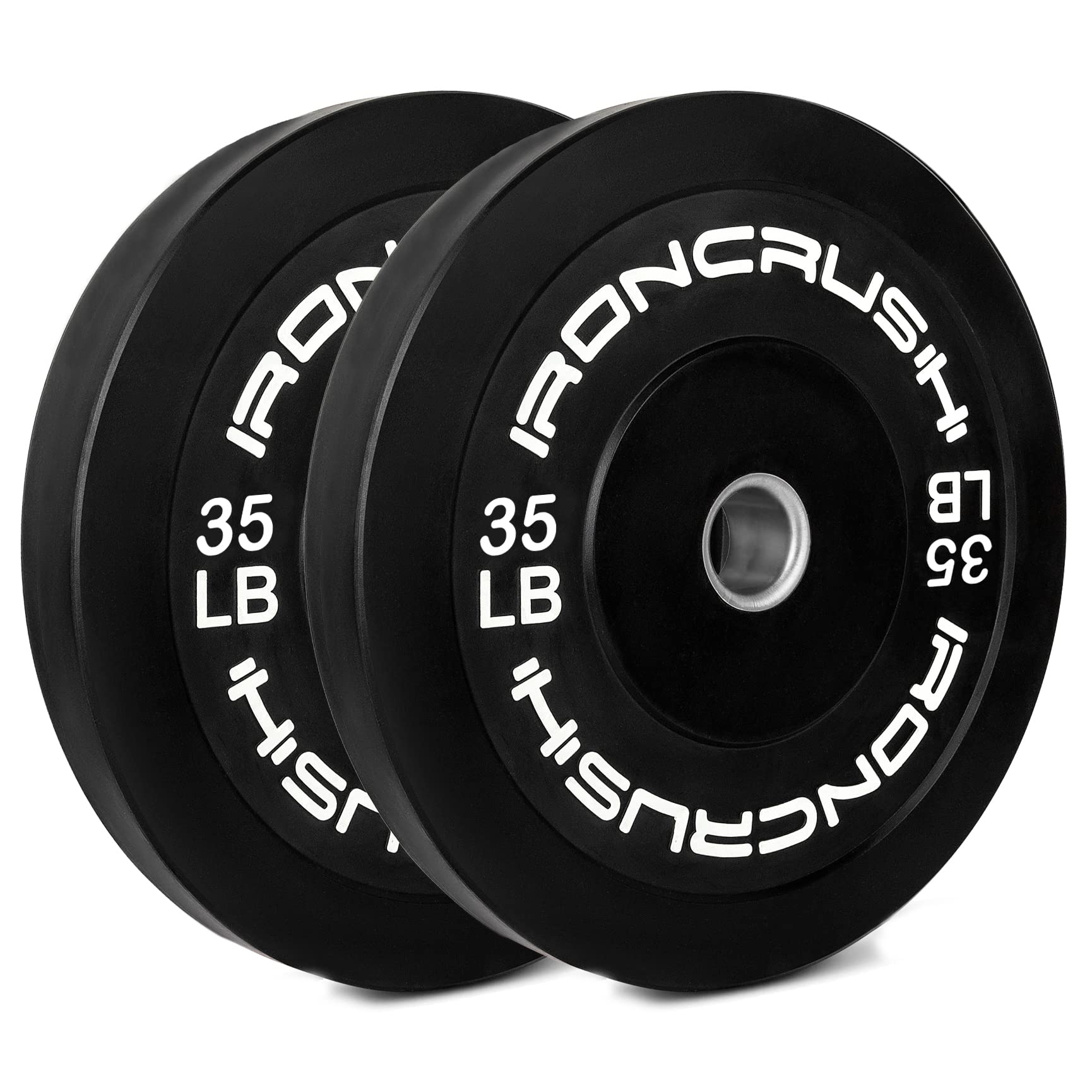
Iron Crush Olympic Bumper Plates

91 /100
Trail Score Outstanding

Key details

Bounce
Dead bounce
Insert
Stainless steel
Sold As
Pairs, 10 to 45 lb
Diameter
450 mm (IWF)
Check Price on Amazon

Bumper plates are meant to be one standard size, and Iron Crush actually publishes the number: 450 mm, the IWF diameter, the same as every plate on a competition platform. Pair that with a dead bounce — the plates land and stay down — and you have the best plate in this group for lifts that finish on the floor.

We found the dead bounce changes how a session feels. A high-bounce plate throws the bar back at you; these drop flat, which matters when you are working overhead under a low ceiling and matters more when you are learning to receive a clean. The trade-off is that a dead plate puts more of the impact into your floor rather than into the rebound, so this is a plate that wants a mat under it. The stainless inserts are a step up from the painted steel elsewhere, and the 10s are built thicker than usual so they do not fold the first time a bar comes down on them.

Virgin rubber rather than crumb explains part of the price, and so does the machining. Per pound this is a premium way to add weight, and that is the whole argument against it: if your training never leaves the rack, you are paying for a property you will not use. The rubber arrives with a light film that wipes off, and the fit on the sleeve is the good kind of snug — tight enough to stay put, loose enough to load without a fight.

Pros

  • True 450 mm IWF diameter
  • Low dead bounce keeps the bar down
  • Stainless steel inserts
  • Thicker 10 lb plates resist folding

Cons

  • Premium price per pound
Our verdict

For barbell lifts that finish on the floor, the true IWF diameter and dead bounce make this our pick, as long as a premium per-pound price does not put you off.

Check Latest Price
5

Best for Daily Garage Use

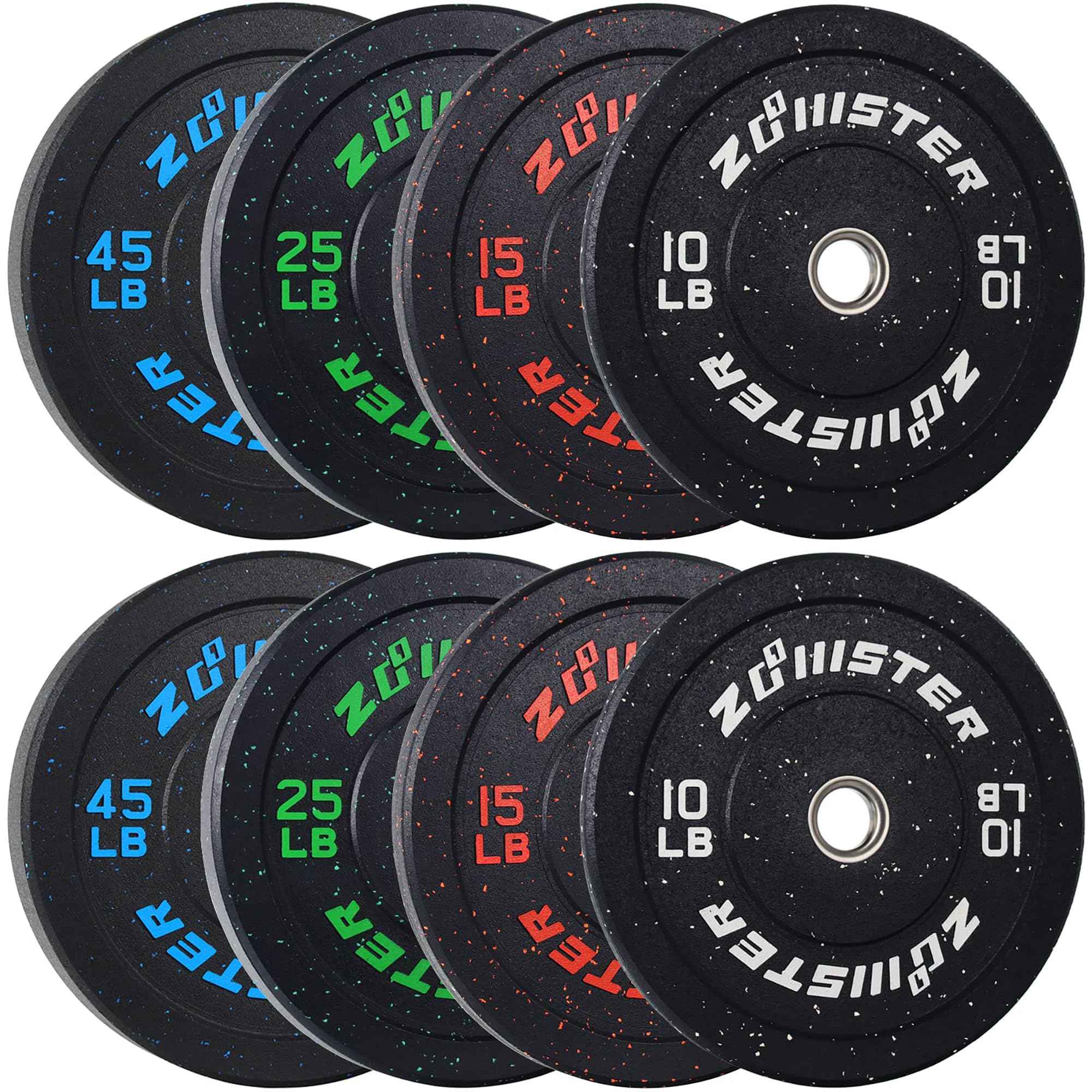
Zoomster High-Bounce Bumper Plates

93 /100
Trail Score Outstanding

Key details

Bounce
Controlled rebound
Plates
8
Set Weight
190 lb
Center Hole
2 in
Check Price on Amazon

A garage gym is a hard life for a plate: dropped on concrete, loaded and unloaded a few hundred times a month, left on the bar between sessions. The Zoomster set is built for that grind rather than for a platform, and it takes the abuse without asking much of you in return.

The 190 pounds of dense rubber have a controlled rebound that keeps the noise inside the garage, and the plates do not skate on a smooth floor the way harder rubber can. Bold markings are readable from across the room, which counts for more than it sounds when you are changing weights between sets with chalky hands.

Two things we noticed. The plates come with an oily film that wants a soapy wipe before the first session, which is the norm here rather than an exception. And the 10-pounders are the plates to watch in any set — thin rubber at that size is what warps first if it gets dropped on its own.

If your gym is a garage that gets used five days a week, this is the set we point to: mid-priced, complete enough to train with, and not precious about any of it. The 190 pounds will carry most lifters for a long stretch before they need to add anything.

Pros

  • Holds up to daily garage use
  • Quiet on impact for a shared house
  • Bold markings readable across a room
  • Good value for 190 lb of plates

Cons

  • Rebound is higher than low-bounce plates
Our verdict

This is the set we point to for a garage gym that sees daily use and does not want to think about plates again for a couple of years.

Check Latest Price
6

Best Warranty

PROIRON Olympic Rubber Bumper Plates

90 /100
Trail Score Outstanding

Key details

Bounce
Low bounce
Weight
44 lb (20 kg) single
Warranty
5 years
Center Hole
2 in steel sleeve
Check Price on Amazon

Five years is the longest warranty in this group by a wide margin, and it is attached to a plate that is solid rubber all the way through rather than a rubber shell over something else. The steel sleeve is a proper 2-inch Olympic fit and the bounce is low enough that a dropped bar stays dropped, which is the behaviour you want from a plate that will spend most of its life on the floor.

The sizes are metric — 5, 10, 15 and 20 kilograms — so the big plate is 44 pounds, not 45. That is a small thing that stops being small when you are chasing a round number on the bar, and it is the main reason we do not hand this to everyone. For a lifter who wants one good plate to keep for a decade and does not care whether the total lands on a round number, this is the most reassuring buy here.

Pros

  • Five-year warranty, longest here
  • Solid rubber through the whole plate
  • Low bounce keeps drops quiet
  • Steel sleeve fits any 2-inch bar

Cons

  • Metric sizing means 44 lb, not 45
Our verdict

With a five-year warranty and solid rubber through the whole plate, this is our pick for the lifter who wants one plate to keep for years.

Check Latest Price
7

Best Starter Set

HANDBODE 70 lb Bumper Plate Set

91 /100
Trail Score Outstanding

Key details

Bounce
Low bounce
Diameter
450 mm (17.7 in)
Center Hole
2 in
Set Contents
2 x 10 lb, 2 x 25 lb
Check Price on Amazon

Two 10s and two 25s looks like an odd way to sell plates until you do the arithmetic: on a 45-pound bar that is 45, 65, 95 and 115, which covers most of what a new lifter touches in the first six months. It is a starter set and it does not pretend otherwise, which we appreciate more than a box full of plates you cannot yet use.

The plates are 450 mm across, so the 10s and the 25s sit at the same height, and that is the property cheap sets most often get wrong. Color-coded stripes make the two weights easy to tell apart from across the room, and the rubber is a low-bounce compound, so the bar tends to stay where you put it rather than leaping back at your shins.

Where it runs out is weight. Seventy pounds of plates means a pair of 45s is in your near future, and it is worth pricing the larger configurations in this listing against the small one before you commit — the jump may be smaller than you expect. As a first set for a small space, or a second set for a bar in a spare room, it does the job, and we think that is a fair trade for the money.

Pros

  • Cheap way to cover a first year
  • 450 mm diameter across both plate sizes
  • Color-coded stripes for quick ID
  • Low bounce keeps drops contained

Cons

  • Tops out at 115 lb on a 45 lb bar
Our verdict

A cheap, tidy first set: 70 pounds of color-coded plates that gets a new lifter to 115 pounds and leaves room to add weight later.

Check Latest Price
8

Deadlift Pairs

Papababe 45 lb Crumb Rubber Plates

92 /100
Trail Score Outstanding

Key details

Bounce
High bounce
Weight
45 lb pair
Material
Crumb rubber
Center Hole
2 in
Check Price on Amazon

The surface is the first thing we noticed. Papababe's crumb rubber has a rough, grainy texture that grips a sweaty hand and holds chalk, and it does not get slick the way a smooth plate does after a few sets of high-rep deadlifts. The colored flecks running through the rubber are a nice touch that makes a garage gym look less like a storage unit.

These are 45s sold as a pair, which is the right shape of purchase for someone who already owns lighter plates and has run out of headroom. The anti-slip surface also makes them easier to pick up off a rubber mat than a glossy plate that wants to skate, and the rough edge holds up to being set down rather than lowered.

The 10,000-drop rating on the listing is a claim rather than a guarantee, but the edges have resisted chunking under daily deadlifts, which is the part that matters. Bounce is on the high side, so a dropped bar comes back up — fine on a concrete floor with a mat, less fine if you are working under a low ceiling with a bar overhead.

Plan on airing them out first: the rubber smell is strong when they are new, and a week in the garage does more than a day. Once that settles, this is the pair we reach for when we want to add genuine weight to a bar without paying premium per-pound prices.

Pros

  • Rough surface grips chalk and sweat
  • Cheaper per pound than premium plates
  • Colored flecks look good in a garage
  • Edges resist chunking under drops

Cons

  • Weight can vary slightly between plates
Our verdict

If your rack already holds lighter plates, this pair of 45s is a sensible way to add real weight, as long as you air them out first.

Check Latest Price

How We Tested Bumper Plates for a Garage Gym

We started by comparing plate diameters, collar widths, listed set weights, rubber type, and the warranties behind each set, then narrowed the field to eight sets that covered the price, size, and durability range. I ruled out anything that looked like the same plate with a different finish.

For eight months, those sets lived on a garage gym platform. We loaded them for squats and deadlifts, dropped them from overhead after cleans and snatches, and stacked them on the floor between sessions. I lifted in the morning before work and on hot weekend afternoons, often with a training partner, so the plates saw quick sets, sloppy misses, and plenty of chalk.

Out of the box, I smelled each plate and then checked again after a week in a closed garage; some rubber odors faded and some settled in. I wiped every surface with a dry towel to see if it came away greasy, then handled the plates with chalky hands to judge grip. Sets that felt slick stayed slick even after a wipe, while the better ones went back to a matte finish.

Each plate went on a calibrated scale and was compared with its listed weight. After drops, I checked for cracking at the collar, uneven bounce, and scuffed finishes, and I noted which sets still looked tidy after a wipe-down. At the end, we compared how each set held up against what it cost per pound, since value here is about more than the sticker.

How to Choose Bumper Plates

Diameter matters more than the weight

The whole point of a bumper plate is that every size is the same width across, so the bar starts at the same height and a dropped bar lands on four plate faces instead of one small one. The weightlifting standard is 450 mm, roughly 17.7 inches, and the sets here that publish it — AMGYM, Iron Crush, HANDBODE — hold it across the range. That is the first thing we check in a listing and the first thing to measure when a set arrives.

Where a listing gives a diameter only for the big plates, assume nothing. A 10-pound plate that is smaller than the 45 sits lower on the platform, takes the impact on its own edge, and is the plate that warps first. It is also the reason we do not recommend mixing brands on one bar without checking: two brands at two diameters make a bar that never sits level.

High bounce or dead bounce: pick for how you lift

Bounce is the design choice that changes how a session feels. A high-bounce plate throws the bar back up and absorbs more of the impact, which is forgiving on a concrete garage floor and keeps a heavy deadlift moving. A low or dead bounce plate stays where it lands, which is what you want for snatch and clean technique and for a basement with a low ceiling — chasing a rebounding bar across the room gets old fast.

Neither is better; they suit different sessions. If your training is mostly deadlifts and rows, high bounce is fine. If you receive cleans and drop from overhead, the dead-bounce plates here — Iron Crush, REP, PROIRON — behave more like what you will find on a platform.

The steel insert is the part that fails

The rubber almost never fails first. The bond between the rubber and the steel hub does, which is why a proper steel insert matters more than a thick-looking edge. Look for a steel sleeve described as stainless or rust-resistant if the plates will live in a garage, and check every plate on arrival for a gap or a wobble where the sleeve meets the rubber; a plate already separating only gets worse under drops.

Keep the plates off grit and don't drag them across concrete on their edge. A cheap plate cared for will outlast an expensive one that gets loaded over a sandy floor.

Plan for the smell and the oil

Almost every rubber plate arrives with a mold-release film and a rubber smell, and both are normal rather than a fault. The fix is boring and it works: wipe each plate with dish soap and warm water, dry it, then let the plates stand somewhere ventilated — a garage or a covered porch — for a week or two before they go into a spare room.

If your gym shares a wall with a bedroom, buy the plates you actually need rather than the biggest set on offer, and air them before the first session. Odor is the single most common complaint in this category, and no plate here is immune to it.

Buy the plates you will actually load

Work backwards from the numbers you train at. A pair of 45s with a pair of 25s and a pair of 10s covers most warm-ups and working sets off a 45-pound bar, and adding a second pair of 45s later costs less than buying a bigger set up front. Compare price per pound rather than the sticker on the box, because a 10-pound pair can cost more per pound than a 45.

The other trap is buying for the lifter you might become. A starter set you outgrow in two months was not cheap; a pair of good 45s that you keep for a decade was.

Frequently Asked Questions

Final Verdict

The AMGYM 190-pound set is the one we point most home gyms to. It covers a beginner-to-intermediate range in a single order, holds one diameter across every plate, and uses steel inserts that seat cleanly on the sleeve — all for less per pound than the premium low-bounce plates here.

If your training is Olympic lifts and you want the bar to stay where you drop it, buy Iron Crush instead; the true 450 mm diameter and dead bounce are worth the premium. And if the budget only stretches to a couple of plates, two CAP 45s will still get you lifting this weekend.