Best Basal Thermometers for Ovulation of 2026

The hardest part of tracking ovulation isn't reading the chart — it's taking your temperature at 5:30 a.m., half-asleep, without moving too much or knocking the thermometer off the nightstand. Basal thermometers are built for that exact moment: they read the small overnight temperature shift that signals ovulation, often down to a hundredth of a degree, and they have to do it before you sit up, drink water, or start negotiating with the day. A good one makes that groggy ritual quick and legible; a bad one adds doubt to the one number you're supposed to trust.

The first thing I noticed testing these at home was how much a backlight and a big, clear display matter when your eyes are still half shut. Basal readings shift by mere fractions of a degree, so accuracy, reading time, and reliability matter as much as a long feature list. We spent four months with 14 thermometers, and the best ones — not always the priciest — made the early-morning routine feel almost automatic, with no squinting or fumbling for a phone light.

1

Best Overall

easy@Home EBT-100B

88 /100
Trail Score Excellent

Key details

Display
Blue backlit LCD
Reading Time
90 seconds
Stated Accuracy
± 0.05 ℃ / ± 0.09 ℉
Reading Precision
1/100th of a degree
Check Price on Amazon

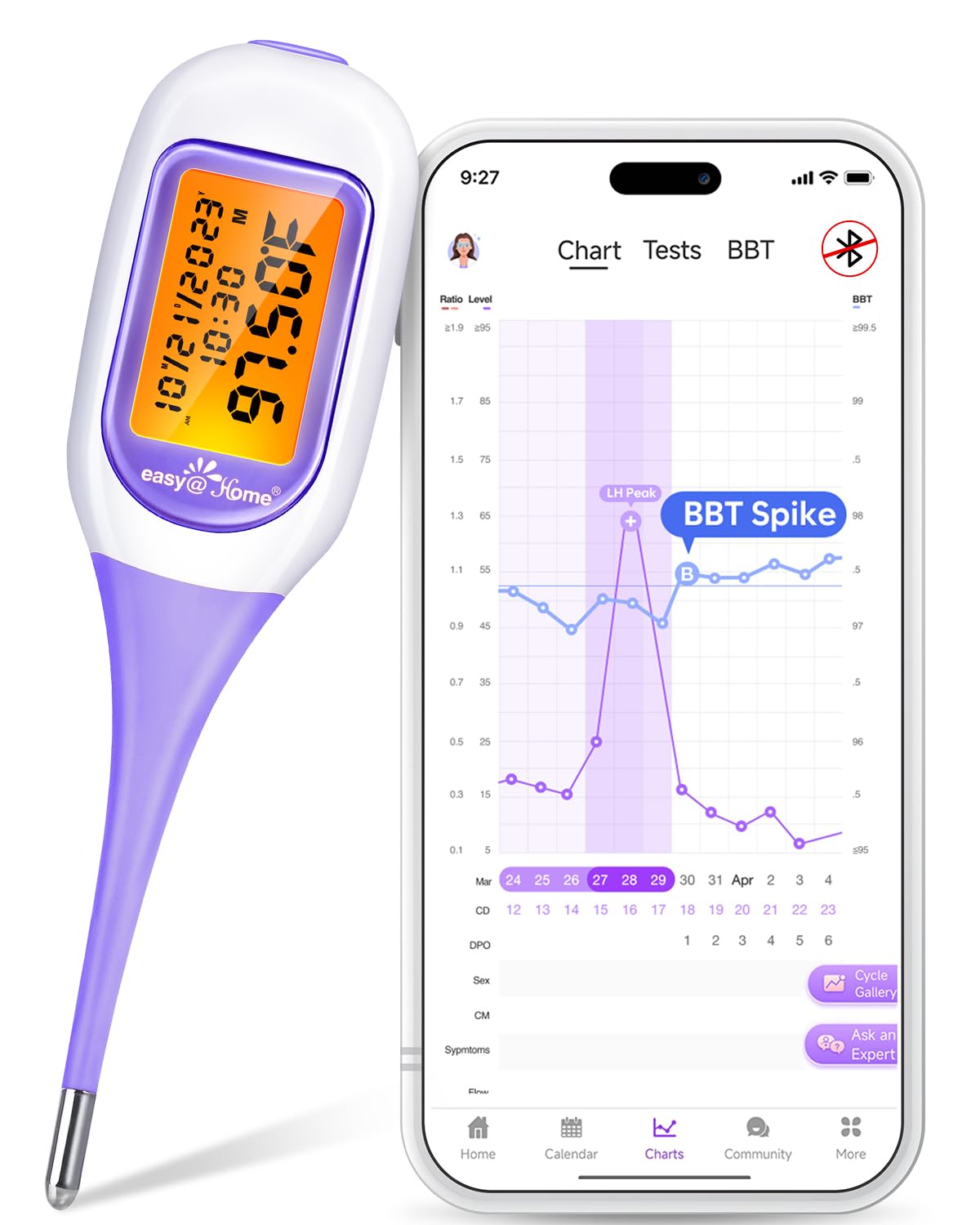
Two decimal places, lit from behind. That's the pair of features a basal thermometer actually needs, and the easy@Home EBT-100B has both: a reading to a hundredth of a degree — 97.41 rather than 97.4 — on a blue backlit screen you can see without switching on a lamp.

It's the one we point most charters to first, because it covers the whole job at the low end of the price range. The stated accuracy is ± 0.05 ℃ / ± 0.09 ℉, the tip is flexible and waterproof, there's a case in the box, and the memory holds 30 readings — roughly a month of mornings. That memory turned out to be the feature we valued most: a number you forgot to write down is still waiting when you finally get up.

Ninety seconds is a long time to lie still at dawn, and it's the thing we minded most. A fever thermometer finishes faster because it predicts where your temperature is heading; this one waits for the probe to settle, which is the more honest way to measure a basal reading and the slower one. The confirmation beep is deliberately soft — kind to whoever is asleep beside you, useless if you doze off, which is the second job the memory does. Watch the trend rather than any single morning: if consecutive readings swing a degree or more, re-seat the probe, change the battery, and use the one-year warranty if it keeps happening.

There's no Bluetooth, so charting means typing the number into Premom — free, and it draws the coverline for you — or into a paper chart. Against the EBT-300 below, that's a few seconds of thumb-work at dawn in exchange for never depending on a pairing that can drop.

Pros

  • Reads to a hundredth of a degree
  • Blue backlit screen for dark mornings
  • 30-reading memory covers about a month
  • Free Premom app charts and draws the coverline

Cons

  • 90-second reading is long to hold still
  • No Bluetooth; every reading is typed in
Our verdict

Our pick for most charters: two-decimal readings, a backlight and a month of memory for about the price of a drugstore thermometer, if you can live with 90 seconds.
Check Latest Price
2

Best for Automatic Charting

easy@Home EBT-300 Bluetooth

89 /100
Trail Score Excellent

Key details

Memory
Unlimited, stored in the cloud
Connectivity
Bluetooth to Premom
Reading Time
About 1.5 to 2 minutes
Stated Accuracy
± 0.09 ℉ / ± 0.05 ℃
Check Price on Amazon

Some charts don't fail at the thermometer; they fail at the writing-down. If yours have a graveyard of half-finished months, this is the model built for you: the EBT-300 pairs with your phone over Bluetooth and files each morning's reading into Premom on its own.

That's the entire reason it costs the most of anything here, and for a particular kind of charter we think it's worth it. Premom charts the numbers, draws the coverline, and folds ovulation and PdG test results into its fertile-window estimate, and the readings live in the cloud rather than in a 30-slot memory. Stated accuracy is ± 0.09 ℉ / ± 0.05 ℃, and the screen is large and backlit for the mornings you can't face opening an app.

The costs are time and patience. A reading runs about 1.5 to 2 minutes, the longest wait here, and the pairing is what decides whether the whole arrangement works: when it drops, you're reconnecting at 5:45 a.m. or typing the number in anyway. Set Premom up on your phone before the thermometer arrives, so you find out early that the app installs and that you like using it. Battery life is worth watching too — a spare cell in the nightstand drawer is cheap insurance for a device that never leaves the bedside table.

Pros

  • Syncs each reading into Premom automatically
  • Draws the coverline and folds in other fertility signs
  • Cloud records instead of a 30-slot memory
  • Large backlit screen

Cons

  • Bluetooth pairing can drop and need reconnecting
  • Longest read here at about 1.5 to 2 minutes
Our verdict

The pick if the writing-down is what breaks your charting: it files every reading into Premom by itself, at the cost of the longest read here.

Check Latest Price
3

Best Backlit Display

iProvèn BBT-127

87 /100
Trail Score Excellent

Key details

Memory
30 readings
Display
Backlit jumbo LCD
Reading Time
60 seconds
Reading Precision
2-decimal readings
Check Price on Amazon

The screen is the argument. Jumbo digits, a backlight that stays lit long enough to actually read the number, and a 60-second cycle — at 5:45 in the morning that combination is worth more than any spec-sheet flourish, and it's why this is the one we reached for when the bedroom was pitch dark.

The readings are two-decimal, so they chart properly, and the memory holds 30 of them, which means a dozed-off morning isn't a lost data point. There's a case, the battery comes included, and the display is the clearest in this group: large numbers, good contrast, lit rather than reflective. If your eyes aren't what they were, or there's no lamp within reach of the bed, that's the whole recommendation right there.

The reservation is durability. Readings taken back to back on the same morning should land within a tenth or so of each other; if yours wander, and the unit starts toggling between °F and °C instead of measuring, that's a warranty conversation rather than a technique problem. iProvèn backs it with a 100-day replacement policy — the most generous cover here — so put it through a hard first few weeks rather than babying it.

Pros

  • Jumbo backlit digits readable half-asleep
  • 60-second reading, quicker than our top pick
  • 30-reading memory plus a storage case
  • 100-day replacement policy

Cons

  • Can stop measuring and toggle between °F and °C
Our verdict

The clearest read in a dark room: jumbo backlit digits, a 60-second cycle and 30 readings of memory, backed by a 100-day replacement policy.

Check Latest Price
4

Fast Household Checks

Boncare T28

86 /100
Trail Score Excellent

Key details

Memory
Last 10 readings
Resolution
0.1°C or 0.1°F
Reading Time
9 seconds
Measurement Sites
Mouth, armpit or rectal
Check Price on Amazon

Nine seconds. Nothing else here finishes close, and on a morning when you've already been up twice, that speed is genuinely pleasant. What buys it is a smaller job than charting: this is a household thermometer that rounds to one decimal place — 0.1°C or 0.1°F — and a basal chart is built out of hundredths.

As a household thermometer it's easy to like. The display is big and high-contrast, and you can set it for mouth, armpit or rectal use, which is more flexibility than the basal-only models offer. It remembers the last 10 readings, sounds a fever alarm, and is small enough to live in a purse.

Where it falls short is the job in the keyword. The shift you're charting is a few tenths of a degree, and a display that rounds to the nearest tenth flattens that into two or three visible steps: you'll see the jump, but the day-to-day texture a coverline depends on disappears. If you want one thermometer for the whole household plus a rough basal trend on the side, this does that cheaply. If the chart is the point, pay for hundredths.

Pros

  • Nine-second reading, the fastest here
  • Large, high-contrast display
  • Mouth, armpit or rectal settings
  • Remembers the last 10 readings

Cons

  • Rounds to one decimal place, not two
Our verdict

A fast, extremely legible household thermometer with a basal mode; buy it for nine-second readings, not for the fine-grained chart a fertility app expects.

Check Latest Price
5

Budget Charting

iProvèn BBT-113Ai

86 /100
Trail Score Excellent

Key details

Display
Unlit LCD
Reading Time
60 seconds
Reading Precision
0.01 degree
Replacement Policy
100-day, no-questions-asked
Check Price on Amazon

The first dark morning tells you what this thermometer is. There's no backlight, so the number arrives in a dim grey LCD that you'll be squinting at by phone glow or a low lamp. Set your phone to its dimmest setting before you go to sleep and it stops being a problem; it doesn't stop being a compromise.

What you get in exchange is a fast route to hundredths: iProvèn claims 0.01-degree precision and a 60-second read, matching the quickest two-decimal model here, and the small tip is the mechanical reason it warms up as fast as it does. Readings are meant to be typed into any ovulation app or a paper chart. We think it's the right pick when charting is a habit you're testing rather than a project, or when there's already a lamp on the nightstand.

Two practical notes before you buy. The battery sits behind a cap that takes a few deliberate steps to open, so read the instructions once rather than improvising at 6 a.m. with a fingernail. And the 100-day replacement policy is the same generous cover iProvèn gives its more expensive model — long enough to find out whether you got a good one.

Pros

  • 0.01-degree precision with a 60-second read
  • Small tip warms quickly
  • 100-day replacement policy

Cons

  • No app sync; chart it by hand
Our verdict

A two-decimal, 60-second read for very little money: you supply the light and the app, it supplies a clean number.

Check Latest Price
6

Cheapest App Setup

femometer DMT-3032

84 /100
Trail Score Excellent

Key details

App
Femometer, manual entry
Battery
1 LR44, included
Water Resistance
Waterproof
Reading Precision
1/100th of a degree
Check Price on Amazon

Charting is the part people quit, and femometer's pitch is that its app does the drawing: you type the morning's number into Femometer, and it plots the curve and marks the coverline. The thermometer is the inexpensive part of that arrangement — small, pink, waterproof, and four inches long, so it disappears into a washbag.

On its own it's a plain two-decimal oral thermometer: 1/100th-degree readings, a clear LCD, an LR44 battery in the box and a protective case. Its listing is unusually candid about pace, calling it not the fastest but accurate. That's the right frame for basal thermometers generally — the probe is waiting for your temperature to stop moving rather than predicting where it will land, so a longer finish isn't automatically a worse reading.

Where it earns its place is as the least expensive way onto a charting app in this group, and that's a real benefit if you want the curve drawn for you. The hesitation is the dependency. The app is the reason to choose this thermometer, the readings go in by hand, and anything about its availability or subscription terms is worth checking before a cycle starts rather than after. If you prefer not to depend on an app at all, the iProvèn BBT-113Ai takes a paper chart just as happily.

Pros

  • 1/100th-degree readings at the lowest price here
  • App plots the chart and marks the coverline
  • Waterproof and small enough for a washbag

Cons

  • Manual entry; nothing syncs to the phone
  • Slower finish than a standard fever thermometer
Our verdict

The least expensive way onto a charting app: two-decimal readings, a waterproof body and a chart that draws itself once you type the number in.

Check Latest Price

How We Tested Basal Thermometers for Ovulation

I started with a long list of basal thermometers sold at drugstores and online, then narrowed it to 14 models by reading specs, manuals, and customer reviews for claims about accuracy, display size, and backlight. We ruled out anything with a vague precision claim, a cramped-looking screen, or a price that felt out of step with what it actually did. Over four months, testers used each one at home for early-morning readings before getting out of bed, plus lazier weekend mornings when the alarm wasn't setting the pace.

The first check was the 5:30 a.m. test: how long the reading took, whether the beep was loud enough to notice without waking a partner, and whether the display was readable in a dark bedroom without turning on a lamp. We logged repeat readings taken back-to-back and compared each thermometer against a reference unit to see if the numbers stayed in the same neighborhood; a model that jumped around got marked down on reliability no matter how nice the display looked. We also noted how easy it was to cycle through memory, switch modes, or silence the beep while half asleep.

Because these live on a nightstand and get handled before coffee, we paid attention to build quality — button feel, battery-door fit, and whether the screen scratched or fogged after weeks of use. Value for money came down to whether extras like memory recall or a soft backlight earned their keep in that groggy routine, not whether the box had more features. The strongest models were the ones we stopped thinking about: they fit the habit quietly and gave us a number we didn't second-guess.

How to Choose a Basal Thermometer for Ovulation

Two Decimal Places, Not One

The whole method rests on a small number. After ovulation, basal temperature rises by a few tenths of a degree and stays there, and the chart is the record of that step. A thermometer that shows one decimal place rounds every morning to the nearest tenth, so the shift arrives as a two- or three-step staircase, and the day-to-day texture a coverline depends on disappears.

Buy 0.01-degree resolution, then look at the stated accuracy beside it. Our top pick quotes ± 0.05 ℃ / ± 0.09 ℉, and that tolerance is the honest measure of how much weight one morning's reading can carry.

How Long You'll Lie Still

Unlike a fever thermometer, which predicts your final temperature from a heat curve, most basal models wait for the probe to settle. That's 60 seconds on the iProvèn pair, 90 on our top pick, and up to two minutes with the Bluetooth easy@Home.

The practical question is what you do with that time. If you drift off mid-read, memory matters more than speed — 30 stored readings means the morning isn't lost. If you're up and moving, a nine-second model is tempting, but check what the speed costs in resolution before you commit.

The 5 A.M. Light Problem

Basal temperatures are taken before you get up, which means in the dark, which means the display is the thing you'll bless or curse every morning. A backlight is worth paying for, and big digits matter nearly as much; the iProvèn BBT-127 puts both on one screen.

Two traps live here. A backlight that cuts out after a couple of seconds gives you one glance and no chance to double-check, and a screen bright enough will wake you properly. If neither appeals, keep a dim lamp within reach and buy on digit size instead.

Memory, Batteries and the Long Haul

These are small battery devices used once a day for months, and that's where they give trouble: a unit that stops measuring mid-cycle, a cell that dies in the night, a memory that fills before you've written anything down. Ten readings of memory is thin; 30 covers roughly a cycle.

Check which battery the model takes and whether it ships with one. LR44 and nonstandard cells turn up often in this category, and none of them are the AA in your kitchen drawer. Whatever you buy, run it hard in its first weeks, while the replacement window is still open.

How the Number Gets Into the Chart

There are two routes. Manual means reading the display and typing the number into an app or a paper chart, which works with any thermometer and costs a few seconds of thumb-work at dawn. Automatic means the easy@Home EBT-300 pairs with Premom and files the reading itself — the biggest quality-of-life upgrade here, and the one that can break, since a dropped pairing puts you back to typing.

Whichever you choose, install and test the app before the thermometer arrives, and keep a paper backup for the morning the phone is on two percent.

Frequently Asked Questions

Final Verdict

If you want one thermometer and no further decisions, take the easy@Home EBT-100B: two decimal places, a backlight you can read at 5:45 a.m., 30 readings of memory and a free app to chart them, for about what a basic digital thermometer costs. The 90-second wait is the price, and the soft beep is exactly why that memory earns its keep.

If typing the number in is the step that would end your streak, the Bluetooth EBT-300 does it for you. That is what its premium buys, and nothing else here does it.