Best Forehead Thermometers of 2026

It's 2 a.m., your kid feels warm, and the last thing you want is a wrestling match with a thermometer. A forehead thermometer should solve that: a quick swipe, a beep, a number you can trust. But two models that look identical can disagree by a full degree, and the fastest reader isn't always the most accurate. In my house, the right one makes a sick day calmer — one-handed, quick, and consistent enough that you're not second-guessing every reading.

We put 14 forehead thermometers through six months of middle-of-the-night checks, daycare-morning scrambles, and everyday use. What separated them wasn't the spec sheet: it was whether repeated readings held steady, whether the display was readable in a dim bedroom, and whether the battery was still alive when we needed it. The best ones nailed speed, ease of use, and a reading we could compare to a reference thermometer without a shrug; their extras, like memory recall and fever alerts, actually earned their keep. Below are the ones I'd keep in the medicine cabinet.

1

Best Overall

Goodbaby No-Touch Thermometer

91 /100
Trail Score Outstanding

Key details

Modes
Forehead, room, object
Power
2 AAA batteries
Weight
2.36 oz
Dimensions
1.65 x 1.42 x 6.04 inches
Check Price on Amazon

The one-button no-touch routine is what makes this the first thermometer we reach for in a house with a moving child. There is no probe cover to fumble with and no need to hold a squirming toddler still for a long count: point, press, and the number appears. At 2.36 ounces and about six inches long, it is light enough to keep in one hand while you steady a child with the other, and the grip is shaped so your thumb lands on the button naturally.

What earns it the top spot, though, is the display. The numbers are large and uncluttered, which matters when you are reading them at 2 a.m. without your glasses. It also switches to room and object modes, so the same device can check a nursery or a surface without a second gadget. We used it mostly for forehead checks, but that extra mode gives it a longer life on a shelf.

The caveat is consistency. Forehead readings are sensitive to distance and to a forehead that will not stay still, and back-to-back scans can disagree. The fix is technique rather than a different button: aim at the same spot, hold the same distance, wait a beat, and take a second reading before you decide the first one was wrong. That is true of every infrared thermometer here, but it is the reason we treat this as a screening tool rather than a diagnosis.

Pros

  • One-button no-touch operation
  • Large, uncluttered display
  • Light 2.36-ounce body
  • Forehead, room, and object modes

Cons

No notable drawbacks to flag.

Our verdict

We make this our top pick because the light, one-button no-touch design is easy to live with, and it turns a temperature check into a two-second routine.

Check Latest Price
2

Best Budget

ANMEATE Forehead Thermometer

91 /100
Trail Score Outstanding

Key details

Power
2 AAA batteries (included)
Memory
35 readings
Display
3-color backlight
Response Time
1 second
Check Price on Amazon

This is the budget option in the group, and it does not feel like a stripped-down afterthought. The one-second read, green/yellow/red backlight, and 35-reading memory cover the basics that make a forehead thermometer useful. The memory is the detail we did not expect at this end of the set: it lets you see whether a fever is climbing over an evening instead of trusting your recollection of the last number.

The plastic body is light and easy to hold, and the display is uncluttered enough to read in a dim room. It takes two AAA batteries and they are included, so it is ready out of the box. The color bands are the part we notice most; they turn a number into a quick cue when you are still half-asleep.

We see this as a second thermometer for a bag, a guest room, or a household that already has a backup. It is not the model we rely on as the only check for a newborn, but for quick screening before school or a camp form, it earns its place. The low cost is the point, and the memory makes it more useful than the price suggests.

Pros

  • One-second readings
  • 35-reading memory
  • Color-coded backlight
  • Batteries included

Cons

  • Readings can drift with angle and distance
Our verdict

This is the budget pick we recommend: one-second readings, a 35-reading memory, and everything you need for a quick check.

Check Latest Price
3

Best for Diaper Bags

Viproud Touchless Thermometer

91 /100
Trail Score Outstanding

Key details

Modes
Forehead and object
Power
2 AAA batteries (included)
Carry Pouch
Included
Response Time
1 second
Check Price on Amazon

The carrying pouch is the small detail that makes this one easy to live with. It keeps the thermometer from rolling around loose in a diaper bag or a kitchen drawer, and the pouch gives the sensor window a little protection between checks. That sounds minor until the first middle-of-the-night search for a thermometer that has buried itself under a pack of wipes.

The rest of the routine is equally simple: one button, a one-second reading, and a display that is easy to read in a dim room. The screen is white on black, which is easier to read in low light than a low-contrast LCD. The one-touch mute is a genuinely thoughtful addition for a sleeping baby, because the beep is often what wakes them after the reading is done. It also has an object mode, so it can check a room or a surface when you need it.

Between the pouch, the mute, and the one-second routine, this is the model that stays in the diaper bag, and the object mode adds a little versatility. It is a simple device by design, and that is the right call for travel and shared family use. The mute is the feature we miss when we switch to another model.

Pros

  • One-second touchless readings
  • Included carry pouch
  • One-touch mute
  • Body and object modes

Cons

  • Accuracy can vary between readings
Our verdict

We recommend this for diaper-bag duty: fast touchless checks, a clean carrying pouch, and a simple routine that works in a dim room.

Check Latest Price
4

Multi-Use Checks

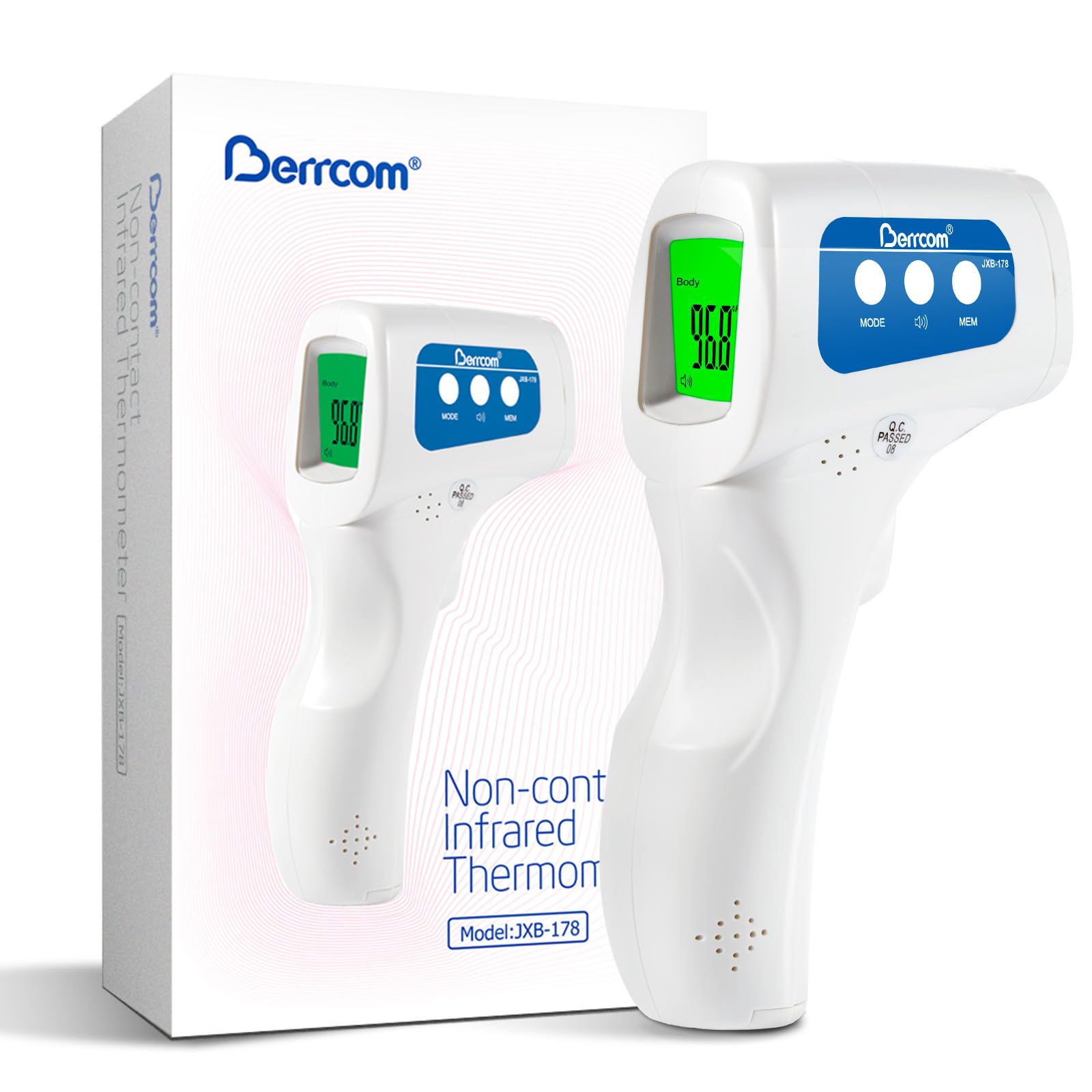
Berrcom JXB-178

91 /100
Trail Score Outstanding

Key details

Modes
Body, milk, food, room
Power
2 AA batteries (not included)
Memory
32 readings
Measuring Distance
3–5 cm
Check Price on Amazon

The reason to look at the Berrcom is the extra modes. It is not just a forehead thermometer: it also measures milk, food, and room temperature, and it stores the last 32 readings. If you warm bottles, keep a nursery, or want one drawer gadget for the whole household, that range is more useful than another color-changing screen.

We appreciate the explicit 3–5 cm measuring distance, because it gives you something concrete to practice before a sick night. The three-color fever alarm and the 32-reading memory are sensible additions, though the extra modes mean a longer first read of the instructions than a one-button model. This is the one in the group that asks you to learn its logic before it rewards you.

The 3–5 cm distance is close enough to require a steady hand, which is fine for a sleeping child and less fine for a thrashing toddler. The unit is compact enough for a drawer, and the memory is useful for tracking a temperature over a day. For multi-use checks, the Berrcom earns its place.

Pros

  • Measures body, milk, food, and room
  • 32-reading memory
  • Color-coded fever alarm
  • Stated 3–5 cm measuring distance

Cons

  • Batteries are not included
Our verdict

Choose the Berrcom if you want one device for forehead, milk, food, and room checks; just put in batteries before the first fever.

Check Latest Price
5

Nighttime Readings

hetaida No-Touch Thermometer

93 /100
Trail Score Outstanding

Key details

Power
2 AAA batteries (included)
Display
3-color backlit LCD
Response Time
1 second
Temperature Range
93 to 109 °F
Check Price on Amazon

The purple body is the first thing you notice, but the display is what earns this thermometer a place by the bed. The backlit LCD uses green, yellow, and red to flag the range, and the numbers are large enough to read without turning on a lamp. We found the color change more useful than a beep alone, especially when checking a child who is half-asleep.

Readings come in about a second, and the no-touch design means you are not trying to hold a probe in place. It takes two AAA batteries and they are included, so it is ready out of the box. The routine is simple enough that a grandparent or babysitter can use it without a tutorial.

The included batteries are worth checking before the first use; a set that has sat on a shelf can arrive flat. Once it is running, the backlit display is the reason to keep it by the bed rather than in a drawer. It is a nighttime convenience, not a lab instrument, and that is the right expectation.

Pros

  • Backlit color-coded LCD
  • One-second readings
  • Batteries included
  • Fahrenheit and Celsius switchable

Cons

  • Accuracy can vary between readings
Our verdict

We recommend it for dim-room checks: the backlit color display is easy to read, and the one-second reading helps you avoid waking a sleepy child.

Check Latest Price
6

Comfortable Grip

femometer DET-306

89 /100
Trail Score Excellent

Key details

Modes
Body and object
Power
2 AAA batteries (included)
Weight
0.19 lb
Response Time
1 second
Check Price on Amazon

The contoured body is the detail that sets the DET-306 apart. It sits in the hand with a slight curve where your fingers go, and at 0.19 pounds it is light enough to hold for a longer check without your wrist complaining. That matters more than it sounds when you are trying to keep a sick child still and read a screen at the same time.

The 0.1-degree resolution, three-color backlight, and one-button operation are the practical core. It also switches to object mode, so it can check a room or a surface. We like that the display is simple rather than busy; when everyone is tired, fewer icons are better.

Battery life is the weak spot. The included AAA batteries can run down quickly, and a thermometer that is dead when you reach for it is worse than a basic one that works. Keep a spare pair in the drawer. A spare pair in the drawer is the small habit that keeps it useful.

Pros

  • Contoured, nonslip grip
  • Light 0.19-pound body
  • One-second readings
  • Body and object modes

Cons

  • Readings can vary between scans
Our verdict

We recommend this one for comfort: the contoured body and low weight make it easier to hold through a longer check on a restless child.

Check Latest Price

How We Tested Forehead Thermometers

We started with about 40 forehead thermometers from major retailers, then narrowed the field by reading spec sheets, customer reviews, and feature lists: no-touch versus contact, backlit displays, memory recall, fever alarms, and battery compartments that didn't require a screwdriver. We filtered out models with repeated complaints about readings that swung wildly or displays that were impossible to read at night, and kept a mix of budget and midrange options. That left 14 units, which we tested over six months.

Testing happened where thermometers actually live: on nightstands, in diaper bags, and on the bathroom counter. We took readings on adults and kids — including a few deliberately squirmy toddlers — and timed each one from button press to beep. We took three readings in a row on the same person within a few minutes and noted whether the numbers stayed within a tight range or bounced around. We also compared each reading against a reference oral thermometer, and checked the display in a dark room with the lights off; if I had to squint, it lost points.

Ease of use got judged one-handed: could we hold a child and take a reading without setting the thermometer down? We noted how many buttons it took to get to a reading, whether the beep was loud enough to hear across the room, and whether the memory recalled the last reading without a manual. For battery life, we logged every battery change and left a few units on standby for weeks to see if they drained. Quality came down to the small stuff — battery doors that felt flimsy, lens covers that popped off, and how each unit survived a few drops onto a carpeted floor. Value was the last filter: we asked whether the extras were worth paying for, or whether a simpler model did the same job.

How to Choose a Forehead Thermometer

Accuracy Starts With Your Aim

A forehead thermometer reads the skin surface, not the core temperature, so distance and placement do most of the work. The same model can give a sensible number at the center of the forehead and a low one at the temple or too far away. Before you need it, take a reading when everyone is well and note the number your household normally runs. Then use the same spot and distance every time. A second reading a minute later is more useful than a single dramatic number, and it is the quickest way to tell whether the device or the aim is the problem.

Speed, Light, and Mute Matter at Night

A one-second read is not a luxury when a child is half-asleep. Look for a backlit display and large digits; a color band can help you sort normal from elevated before you focus on the number. A mute button is worth having if the beep tends to wake the person you are checking. The Viproud's one-touch mute and the hetaida's color-coded backlight are the kinds of details that make a 3 a.m. check less disruptive. If you mostly check during the day, these features matter less and a simpler screen is fine.

Forehead-Only or Multi-Mode?

Most people need only the forehead mode, and a simple one-button model is easier to hand to a babysitter. A multi-mode device adds object, room, or food temperature readings; the Berrcom goes further with milk and food modes, while the Goodbaby and Viproud can check a surface or a room. If you already have a kitchen thermometer and a nursery monitor, those extras may never earn their space. If you warm bottles or want one device for the whole household, they can.

Batteries and Storage Are Part of the Purchase

A thermometer is only useful if it works when you grab it. Check whether batteries are included and what size it takes; a model that uses two AA cells is easy to feed, but a spare pair in the drawer is the real insurance. A carrying pouch keeps the sensor clean and the device findable in a diaper bag. Models without a pouch can live in a small zip bag, but loose in a drawer they collect lint and disappear. Put fresh batteries in before the first sick night and note the replacement date.

Who Will Use It?

Every model here claims to work for babies through adults, but the household matters. A no-touch design and one-second read help with a wriggling toddler; a large display helps an older adult or a babysitter; a mute setting helps with a sleeping child. If you are checking a newborn, follow your pediatrician's guidance on confirmatory readings and don't rely on a single forehead scan. For most families, one good all-around model plus a simple backup is more useful than a drawer full of specialized devices.

Frequently Asked Questions

Final Verdict

For most families, we recommend the Goodbaby No-Touch Thermometer: it is light, simple to aim, and its large display makes repeated checks easy. If you want a low-cost second thermometer for a bag or guest room, the ANMEATE is the better fit. And if you need one device for milk, food, and room checks as well as forehead readings, choose the Berrcom and put in batteries before the first fever.