Best Anti-Fatigue Mats for Standing Desks of 2026

The ache shows up around hour four. You're still at the desk, still typing, and your heels and the balls of your feet have started sending up complaints that no amount of shifting from foot to foot will quiet. An anti-fatigue mat is the cheapest fix in the standing-desk conversation — a slab of foam or rubber that gives your feet somewhere softer to land and keeps you standing longer than you would on bare floor. The catch is that the wrong one turns into its own problem: too soft and you wobble, too thin and you might as well be on tile, too small and you're constantly stepping off the edge.

I've been rotating mats under my own desk and in front of the kitchen sink for the better part of a year now, and my team has put 12 of them through eight months of real workdays, dish duty, and long stretches at the stove. The pattern that emerged had less to do with thickness than I expected. Before you shop, measure the floor space where you actually stand and note whether you're usually barefoot, in socks, or in shoes — that single detail changes which mat feels right. The picks below are organized around what each one is genuinely good at, and there's a mat here for a standing desk, a prep counter, and everything in between.

1

Best Overall

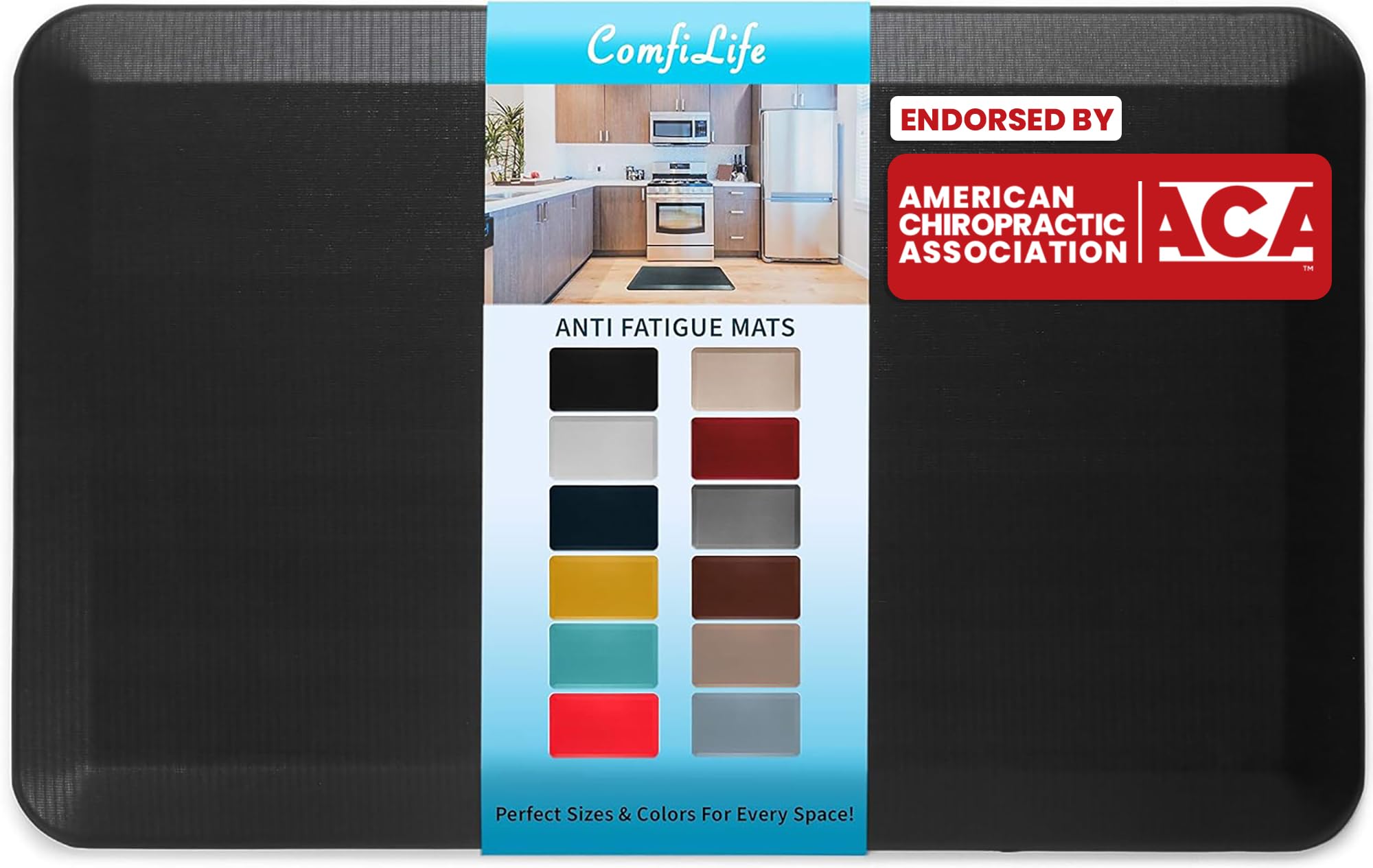
ComfiLife Anti Fatigue Mat

96 /100
Trail Score Outstanding

Key details

Base
Non-slip
Size
32 x 20 in
Material
Memory foam
Thickness
0.75 in
Check Price on Amazon

Three-quarters of an inch of memory foam over a full 32-by-20-inch footprint is the most useful combination in this group: room to shift your stance, and enough softness that a wood or tile floor stops being the thing you notice. It's the mat we hand anyone setting up a standing desk for the first time, because nothing about it asks you to adapt.

What surprised us is how much give there is. Memory foam molds under the heel and the ball of the foot rather than pushing back, so the first minute on it feels almost springy, and after that you simply stop thinking about your feet. The backing grips a hard floor firmly enough that the mat stays where you put it, and the smooth matte surface wipes down with a damp cloth — handy in a home office where the mat also catches crumbs and the occasional coffee drip.

Where it gives ground is variety. It's a plain rectangle, with nothing to stretch a calf against or roll an arch over, so a fidgeter will get more out of the contoured Topo. For the rest of us that simplicity is the appeal: it comes in enough colors to blend with a floor, it doesn't need breaking in, and it costs about the same as the FEATOL without asking you to rethink your desk height.

Pros

  • Roomy 32-by-20-inch standing area
  • Soft memory foam that eases heels
  • Non-slip backing keeps it in place
  • Wipes clean with a damp cloth

Cons

  • Flat surface offers no contours to stretch against
Our verdict

For most standing desks, this is the mat we recommend: a roomy, softly cushioned rectangle that stays put, wipes clean, and costs no more than the midrange mats around it.
Check Latest Price
2

Best for Active Standing

Topo by Ergodriven

95 /100
Trail Score Outstanding

Key details

Size
29 x 26.25 in
Weight
8 lb
Surface
Contoured terrain
Thickness
2.7 in at highest point
Check Price on Amazon

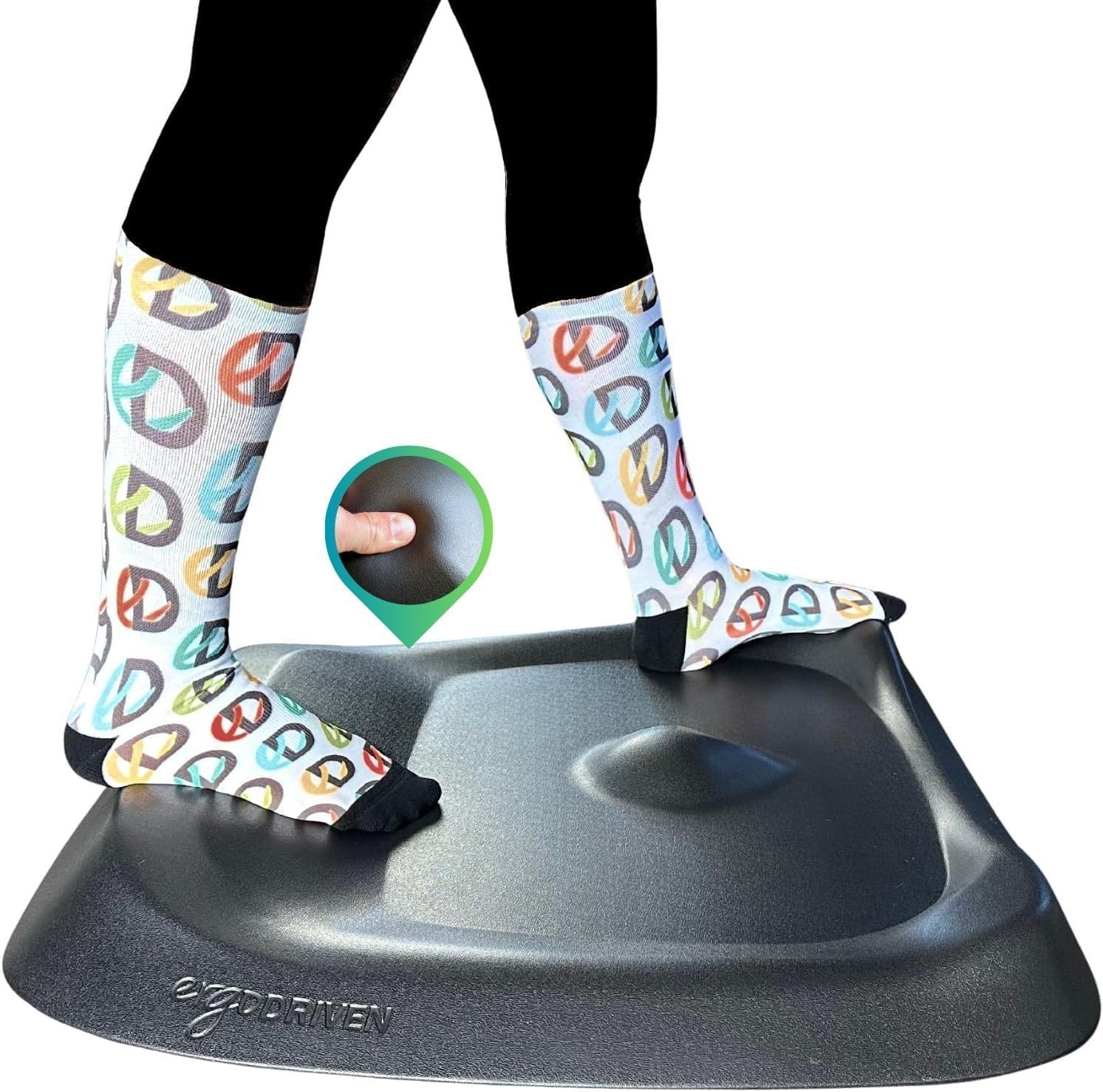
The Topo is the most expensive mat here, and the only one shaped like landscape rather than a rug. A raised ridge runs around the perimeter, a dome sits in the middle, and a teardrop slope gives you somewhere to put a foot when you want a stretch. At 2.7 inches at its highest point and roughly 29 by 26 inches overall, it's closer to a piece of furniture than a floor covering.

Stand on it for an hour and the shape starts earning its keep. Because the surface is never quite level, you keep making small adjustments without deciding to, and we found ourselves doing slow calf raises mid-sentence. The foam is firm rather than plush — it supports you instead of swallowing your weight — and the raised edges mean you can put one foot up without hunting for a step.

Whether the premium is worth it comes down to how you stand. If you stand still and read, the contours do nothing for you, and one of the flat mats here will feel better and cost far less. If the problem you're solving is restlessness — the reason you raised the desk in the first place — this is the mat that keeps you in motion instead of counting the minutes.

Pros

  • Contoured terrain prompts constant small movement
  • Firm foam supports without sinking
  • Raised edges for foot-up stretching

Cons

  • Highest price in this group
  • Large 26-inch footprint in a tight desk area
Our verdict

If you fidget at your desk and want a mat that turns standing into gentle movement, the Topo is worth the splurge; buy it for the contours, not for extra cushioning.

Check Latest Price
3

Best for Extra-Thick Cushioning

FEATOL Anti Fatigue Mat

93 /100
Trail Score Outstanding

Key details

Size
32 x 20 in
Weight
4.2 lb
Material
High-density foam
Thickness
0.9 in
Check Price on Amazon

Nine-tenths of an inch of high-density foam makes the FEATOL the thickest flat mat in this group, noticeably deeper than the three-quarter-inch pads most of these picks use. The top is a diamond-textured PU leather over the foam, and the edges taper down to the floor rather than ending in a wall you kick.

That extra height does something you don't think about until you're standing on it: you're nearly an inch taller at the desk. If your monitor or keyboard is already at the top of its adjustment, plan to raise it, or you'll spend the day reaching down. The PU top is the other practical advantage — crumbs and spills sit on the surface, and a damp cloth deals with them in seconds.

For anyone whose feet are what give out first, this is the one we point to. The foam is dense enough to push back rather than swallow your weight, and the low-angle bevel means you don't catch a toe walking past, which matters more than it sounds in a small room. The care instructions ask you to hand wash a floor mat, which gets sillier the longer you think about it; a wipe has done the job for us.

Pros

  • Thickest flat cushion in this group
  • Dense foam supports instead of sinking
  • Tapered edge won't catch a toe
  • PU leather top wipes clean

Cons

  • Care instructions specify hand washing
Our verdict

Buy the FEATOL if cushioning is the whole point for you: it's the deepest flat pad here, and the extra height is easy to plan around once you know about it.

Check Latest Price
4

Best for Small Spaces

ergohead Standing Desk Mat

91 /100
Trail Score Outstanding

Key details

Size
22 x 17 in
Weight
1.9 lb
Features
Built-in handle, massage points
Thickness
0.75 in
Check Price on Amazon

A handle is the sort of thing you don't know you want on an anti-fatigue mat until you stand up and push your chair in. The ergohead weighs under two pounds and has a molded grip along one edge, so it lifts off the floor with one finger and hangs on a hook or leans behind the desk while you sit. That alone makes it our pick for a desk you switch between sitting and standing all day.

The trade-off is size. At 17 by 22 inches this is a standing spot rather than a standing area: your feet fill it, and a wide stance puts a heel back on the bare floor. What you get in exchange is the molded bumps across the surface, which feel genuinely good underfoot in socks and effectively disappear through a shoe sole. It's also one of the least expensive mats here, which makes it a sensible first mat or a second one for a shared desk.

Pros

  • Built-in handle clears it in one motion
  • Under two pounds, easy to hang or stow
  • Molded bumps encourage small foot movement
  • Non-slip bottom holds position

Cons

  • Small 17-by-22 surface leaves no room to shift
Our verdict

For a desk you flip between sitting and standing, the ergohead is the easy answer: light, handle-equipped, and inexpensive enough to buy before you're sure a mat will help.

Check Latest Price
5

Best Budget

KMAT Cushioned Comfort Mat

91 /100
Trail Score Outstanding

Key details

Size
28 x 17.3 in
Weight
2 lb
Material
PVC over foam
Thickness
0.47 in
Check Price on Amazon

The KMAT is a kitchen runner that happens to work under a desk. It's 28 by 17.3 inches, about half an inch thick, and made from a textured PVC top over foam, with a subtle pattern that keeps it from looking like a slab of rubber. It's the least expensive mat in this group by a comfortable margin.

That makes it the low-risk experiment: if you aren't yet sure a mat will change how a long stand feels, start here, and pick up a second for the sink for less than one of the thicker mats. The surface is the friendly part — water-resistant, easy to sweep, easy to wipe, and patterned enough to pass as a small rug in a room that isn't purely an office.

Half an inch is closer to a thick rug than to the foam slabs the other picks use, and you feel the floor come through sooner. Call it a 20-minute mat: enough to take the edge off a short stand or a burst of meal prep, not enough to carry an afternoon. In a home office where you're up and down rather than planted, that's a fair trade for the money.

Pros

  • Cheapest mat here by a wide margin
  • Waterproof top wipes and vacuums clean
  • Patterned surface looks less utilitarian

Cons

  • Narrow 17.3-inch width limits your stance
Our verdict

Start with the KMAT if you want to find out whether a mat helps before spending more; it's the cheapest here, and it's honest about being a short-stand mat.

Check Latest Price
6

Firm Flat Feel

Ophanie Anti Fatigue Mat

93 /100
Trail Score Outstanding

Key details

Size
32 x 20 in
Packing
Ships flat, not rolled
Material
PVC top over PU foam
Thickness
0.8 in
Check Price on Amazon

The Ophanie arrives flat rather than rolled, which sounds like a shipping detail until you've spent a week stepping over the corners of a mat that won't lie down. It's 20 by 32 inches and just over three-quarters of an inch thick, with a PVC leather top over recycled foam and a progressive bevel that ramps down to the floor.

The foam is firmer than memory foam. It holds its shape underfoot instead of molding to it, and that firmer ride is why it stays comfortable deep into a long stand, though it's less lovely under bare feet first thing in the morning than the ComfiLife's softer core. The bevel is well judged too: you walk over it rather than onto it, which matters in a room where the mat sits in a traffic path.

Put those together and you get the most put-it-down-and-forget-it mat in this group at a midrange price, and the one we point to when someone wants a plain rectangle that behaves from day one. It's also the firmest ride here, which is a preference rather than a problem — just don't buy it expecting the sink-in of memory foam.

Pros

  • Ships flat, with no curl to wait out
  • Firm foam holds up through long stands
  • Progressive bevel eases the step on and off
  • Leather-like top wipes clean

Cons

  • Top layer can separate at the seams over time
Our verdict

Choose the Ophanie if you want a firm, flat mat that's ready the day it arrives; it's the least fussy mat here, as long as you aren't after memory-foam softness.

Check Latest Price

How We Tested Anti-Fatigue Mats

We started by pulling together every mat we could find that was sold in more than one size, since a mat that only comes in one footprint is a non-starter for anyone with a narrow galley kitchen or a wide desk setup. From that pool we filtered by material, thickness, edge construction, and price, then ordered 12 mats across the price range and ran them for eight months.

Each mat lived in a real spot: under a standing desk during weekday work blocks, in front of a kitchen sink for dishes and meal prep, and at a counter for long cooking sessions. We stood on them barefoot, in socks, and in shoes, and noted where our feet sank versus where they stayed planted. To check how the cushioning held up, we dropped a 10-pound weight on each one and looked for a dent the next morning, and we walked heel-to-toe along every edge to see whether corners curled or caught a toe.

Durability got the least glamorous test of all. We lifted each mat every couple of weeks to check for cracking, compression lines, and delamination, and we dragged them across hardwood and tile to see whether the backing left marks. For cleaning, we spilled coffee on one and a slick of cooking oil on another, let both sit, and timed how long a damp cloth took to bring the surface back. Value came down to square footage of coverage per dollar and whether the mat still looked and felt new at month eight — several didn't, which made the shortlist shorter than we planned.

How to Choose an Anti-Fatigue Mat for a Standing Desk

Thickness Matters Less Than Density

A mat can be an inch thick and still be useless after twenty minutes if the foam collapses under your heels. The flat mats here run from about half an inch to nine-tenths of an inch, and for a desk you stand at in long stretches we prefer the upper half of that range in a dense foam; half an inch is plenty for short bursts at a counter or a printer.

There's a simple test, in a store or once the box arrives: press a thumb hard into the middle of the mat. If you can feel the floor coming up underneath, your heels will find it too, and no amount of extra height will fix that.

Match the Footprint to How Much You Move

Twenty by thirty-two inches is the size most desk mats settle on, and it's what three of our picks use: enough for a shoulder-width stance with a step to either side. A 17-by-22 mat turns standing into a fixed spot, which is fine at a counter and cramped at a desk you stand at for an hour.

Before you size up, look down. A mat that overlaps the path of your chair casters gets rolled onto and shoved all day, and the edge you keep kicking is the one that eventually curls.

Flat Cushion or Contoured Terrain

Flat mats do one job: they take the hardness out of the floor. Contoured mats add a second job, prompting the small weight shifts and calf raises that make standing easier to sustain. If you stand still and read, a flat mat at three-quarters of an inch is more comfortable. If restlessness is the reason you raised the desk, terrain earns its keep.

Just count the cost in floor space. Our contoured pick is 26 inches deep and weighs 8 pounds, so it claims a real patch of floor and doesn't slide out of the way when you sit.

Edges, Backing, and How It Arrives

Most of the problems that end a mat's useful life happen at its edge. A bevel that tapers to the floor doesn't catch a toe as you walk past; a blunt edge or a corner that curls is a trip hazard, especially near a doorway or in a caster path. Backing matters too on hard floors, where a mat with weak grip wanders out from under you.

Flat packing is worth seeking out. A rolled mat can take days to settle, and the corners that never quite lie down are exactly the ones you catch your foot on.

Frequently Asked Questions

Final Verdict

For most standing desks, the ComfiLife is the mat we point to: a full 32 by 20 inches of soft memory foam that stays put, wipes clean, and costs no more than the midrange mats around it. It's the one that asks nothing of you except standing on it.

Pay for the Topo instead if what you want is movement. Its contoured surface keeps your feet and calves working, and that, more than cushioning, is what gets people through a long afternoon on their feet.