Best Adjustable Weight Benches of 2026

The first time an adjustable bench shifts under a heavy set, you never quite trust it again. A good one should lock flat, incline, and decline without wobble, fit your height and your space, and hold up to the way you actually train. The category's built-in tradeoff is that every extra position adds another pin, hinge, or gap to get right. That's why I care less about a long adjustment list and more about whether the pad stays put, the legs stay planted, and your lower back isn't hunting for support between the seat and back pad.

Over nine months, I've put 11 adjustable benches through their paces in my garage gym, with two training partners who are both taller and heavier than I am. We assembled each one, checked its footprint, and cycled through flat, incline, and decline work with dumbbells and a barbell. The benches that made the list felt solid at every angle, adjusted without pinching fingers, and were worth the money; the rest wobbled, crowded our space, or had a weight limit that felt optimistic.

1

Best Overall

Keppi 1200

91 /100
Trail Score Outstanding

Key details

Dimensions
58.5"D x 24"W x 49.6"H
Item Weight
59 lb
Weight Capacity
1,200 pounds
Angle Combinations
36
Check Price on Amazon

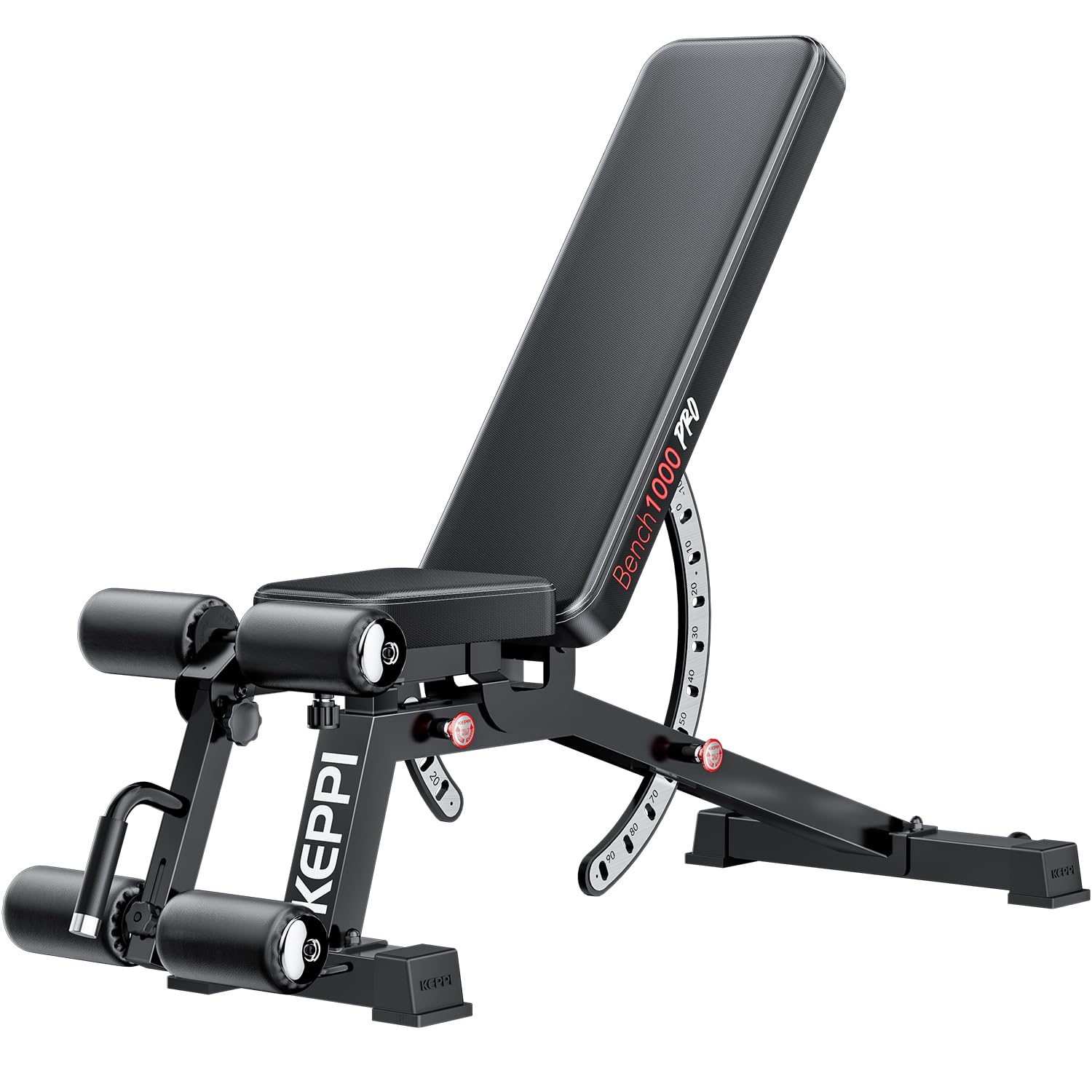
The 59-pound frame and 1,200-pound rating tell you most of what the Keppi 1200 is about: this is a bench that stays put. The welded steel is visibly beefier than the folding benches here, and the 24-inch width gives you room to set your shoulders without feeling perched. We noticed the difference most when loading dumbbells from the floor—the bench barely shifts.

The adjustment system is equally serious. You get 12 backrest positions and three seat positions, with up to 36 combinations, plus a three-position foam foot catch for decline work. We like that the foot catch adjusts for shin length; it is the detail that makes decline presses and sit-ups feel secure rather than improvised. Changes take a deliberate pin pull and reset, not a one-second flip, so it suits a session where you settle into a few angles.

The padding is firm and wide enough for pressing, and the leg support does not dig in during incline work. We did miss having a folding mechanism when the session ended—this is a bench that owns its corner of the room. The payoff is the stiffest feel in this group and a capacity that leaves room for a heavy lifter plus plates.

For a home gym with a permanent spot for a bench, that trade is straightforward. The 59 pounds are what you feel when you move it and what you stop noticing when you press.

Pros

  • 1,200-pound listed capacity
  • 36 angle combinations
  • Three-position decline foot catch
  • Welded commercial-style steel frame

Cons

  • Premium price tier
Our verdict

For a home gym that can leave a bench set up, the Keppi 1200 is the one we trust under a loaded bar, with a rock-solid frame and a decline setup that holds your legs.

Check Latest Price
2

Best Foldable

Keppi Bench500

91 /100
Trail Score Outstanding

Key details

Positions
11 back, 4 seat, 3 foot
Dimensions
37"D x 24.8"W x 11"H
Item Weight
30 lb
Weight Capacity
900 lb
Check Price on Amazon

A 30-pound bench that folds into a compact package is the one that disappears into a closet, and that is exactly why we kept the Keppi Bench500 in the rotation. It still carries a 900-pound rating, so it is not a flimsy afterthought. The trade is a frame that feels lighter under a heavy press than the 1,200-pound Keppi.

The one-pull fast bolt is the best adjustment system in this set for quick switches. We moved from flat to incline between sets without hunting for a pin, and the auto-lock gives a positive click. You get 11 backrest, four seat, and three foot positions, which covers the angles most home lifters use.

The 24.8-inch width and thick pad make it comfortable for dumbbell presses, and the fold is clean enough to tuck beside a dresser. We did not love it for maximal barbell loads; the lighter frame lets you know it is there. For a small apartment gym, that is a fair trade for a bench you can put away.

The Bench500 is the one we reach for when the workout has to share a room with everything else.

Pros

  • Folds into a compact package
  • One-pull auto-lock adjustment
  • 900-pound listed capacity
  • Light enough to move at 30 pounds

Cons

  • Less rigid under maximal barbell loads
Our verdict

For apartment lifters who need a real bench that folds away, the Keppi Bench500 is the rare compromise that still feels like training equipment.

Check Latest Price
3

Best for Tight Spaces

YOLEO Adjustable Bench

93 /100
Trail Score Outstanding

Key details

Positions
84 combinations
Folded Size
31.5"x12.6"x13"
Backrest Length
28 inches
Weight Capacity
827 lb
Check Price on Amazon

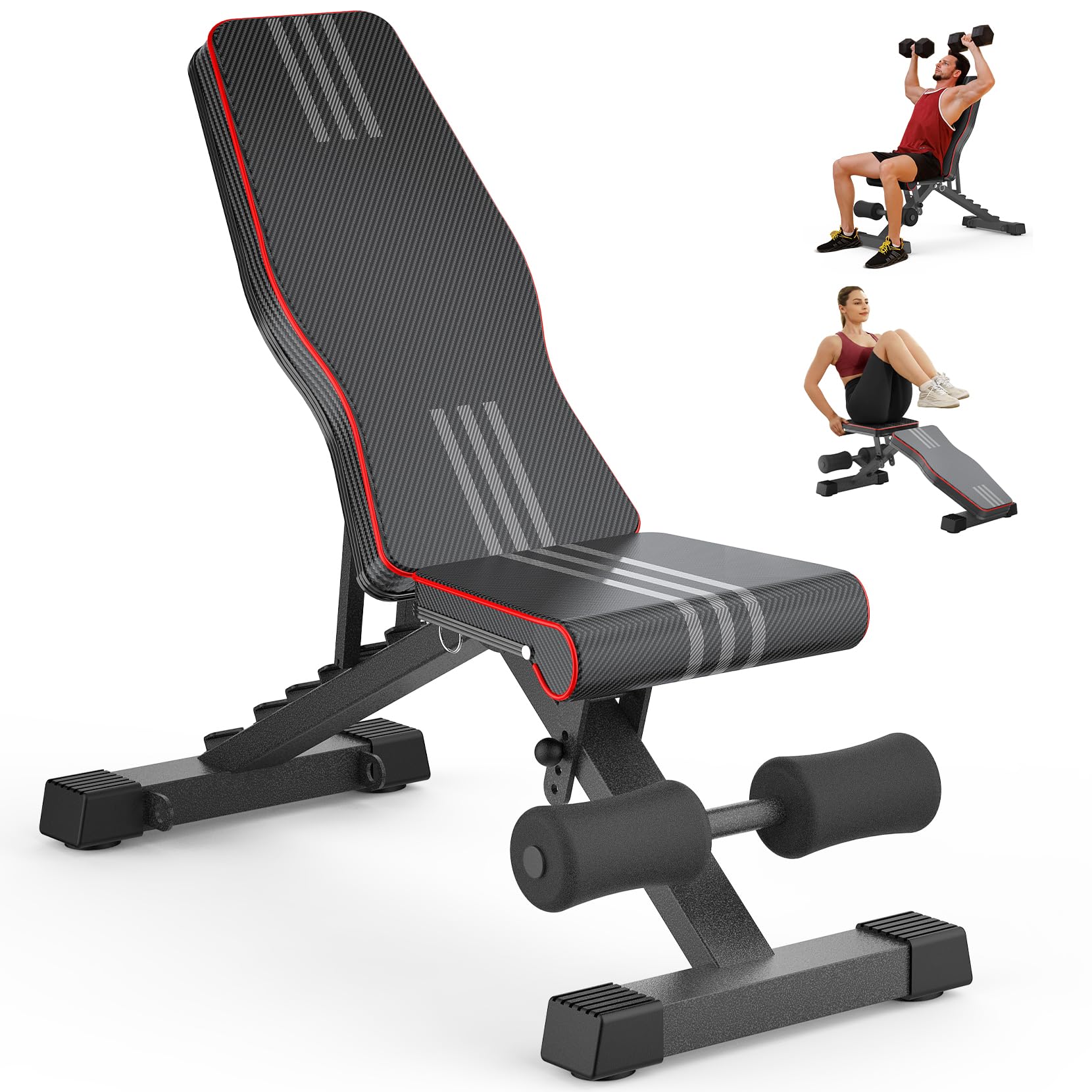
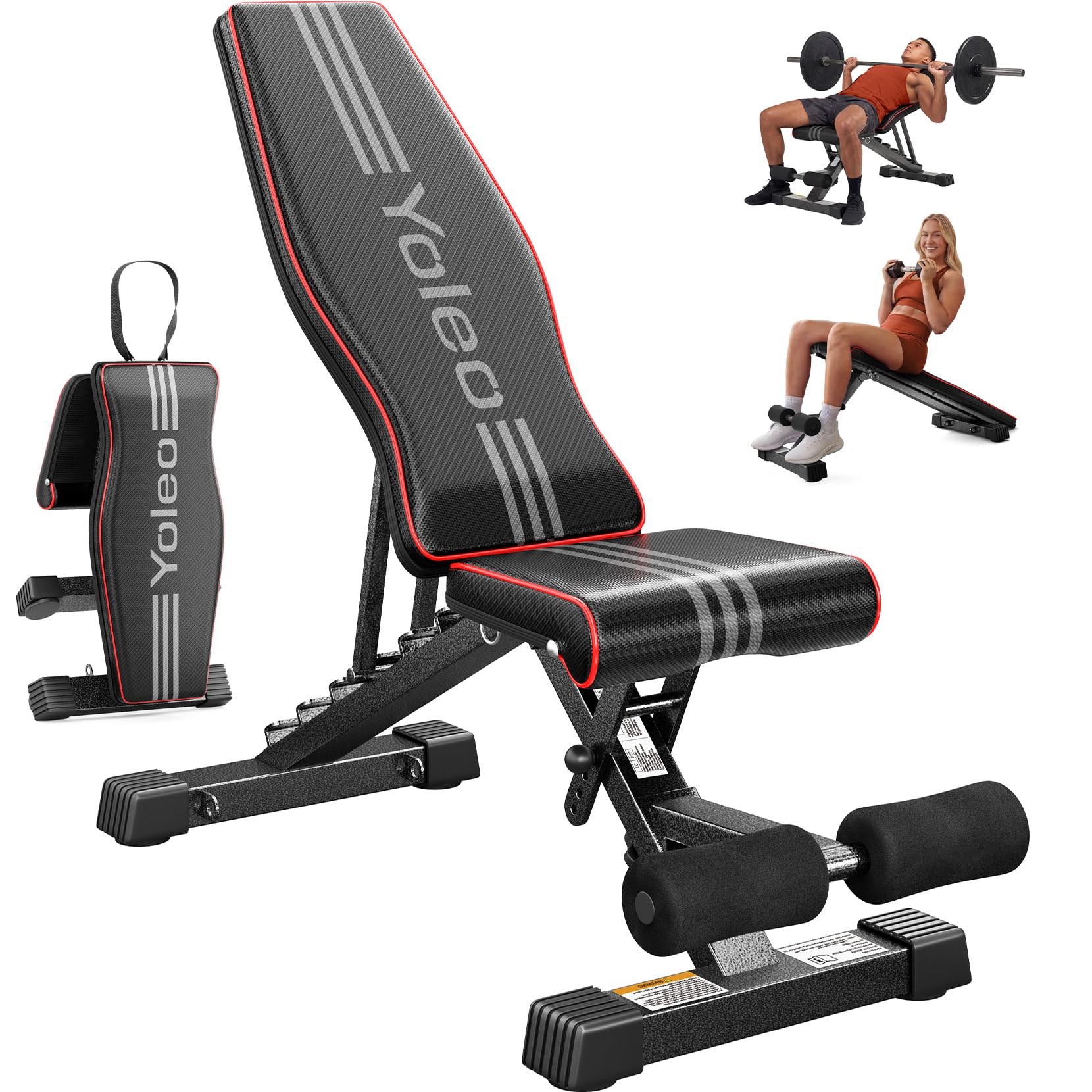
Setup is closer to unpacking than building: the YOLEO arrives 98% assembled, and we had it open and pinned before we finished clearing space. At 23.2 pounds, it is light enough to move with one hand, yet the listed capacity is 827 pounds. That combination is why it works in a spare room.

The bench folds to 31.5 by 12.6 by 13 inches, which is small enough for a closet floor or under a bed. The 13-inch seat and 28-inch backrest are sized for compact spaces; the 84 adjustment combinations cover flat, incline, and decline work. We found the backrest angle easy to change and the seat stayed put once pinned.

For dumbbell presses, flys, and incline work, it felt stable enough that we stopped thinking about the frame. The light weight is the point: you can fold it, carry it, and put it away between sessions. It is not a bench for a heavy barbell program, and the compact pad makes that clear.

If your training is mostly dumbbells and your gym shares a wall with the living room, the YOLEO is the least fussy way to get a real FID bench.

Pros

  • Arrives 98% preassembled
  • Folds to 31.5 by 12.6 by 13 inches
  • 827-pound listed capacity
  • 84 adjustment combinations

Cons

  • 28-inch backrest is short for taller users
Our verdict

For a small apartment and a dumbbell-first routine, the YOLEO is the easy bench to live with: it arrives nearly built, folds flat, and still feels solid.

Check Latest Price
4

Best for Back Extensions

Finer Form FID Bench

90 /100
Trail Score Outstanding

Key details

Settings
23
Dimensions
62"D x 20"W x 30.25"H
Item Weight
46.3 lb
Weight Capacity
1,000 pounds
Check Price on Amazon

The Roman-chair attachment is why the Finer Form is a different purchase from the other benches here. We used the back-extension setup with the calf pads and support pads adjusted, and it turns a flat/incline bench into a station for lower-back and core work. That is a different job from a bench you only press on.

The frame is rated to 1,000 pounds, and the 20-inch width gives you a stable platform. You get eight backrest positions, three seat positions, eight support-pad positions, and four calf positions, for 23 settings. We found the range genuinely useful, not just a long spec list, especially for decline sit-ups and extensions.

The trade is size. At 62 inches long and 46 pounds, it is a piece of furniture, and the build takes more patience than the pre-assembled benches. We checked that the adjuster was seated squarely before loading because the back pad can feel crooked if it is not. Once set, the bench felt solid on a hard floor.

For a home gym that wants one bench to cover pressing and back extensions, the Finer Form is the most versatile pick in this group. The footprint is the price; the extra stations are the reward.

Pros

  • Roman-chair and back-extension station
  • 1,000-pound listed capacity
  • 23 settings across back, seat, support, and calf
  • Transport wheels

Cons

  • Large 62-inch footprint
  • Assembly takes more patience
Our verdict

If you want a bench that also handles back extensions and decline core work, the Finer Form is the most versatile option here—provided you can give it a permanent corner.

Check Latest Price
5

Best Budget

OUNUO Compact Bench

91 /100
Trail Score Outstanding

Key details

Positions
7 back, 4 seat, 3 foot
Item Weight
23.1 lb
Pad Thickness
1.4 inches
Weight Capacity
660 lb
Check Price on Amazon

The OUNUO is the least expensive bench in this group, and we expected the compromise to show up immediately. It did not. The 1.4-inch pad is thick enough for dumbbell presses, the fold is simple, and the 660-pound rating is more than most home dumbbell setups need. We used it as a second bench for lighter sessions and it did the job.

You get seven backrest, four seat, and three foot positions, so it covers flat, incline, and decline work. The frame is based on a double-triangle design and it feels planted at moderate loads. The bench weighs 23.1 pounds, which makes it easy to move from room to room and tuck away.

The limits show up when you push the load or your height. This is not the bench for a heavy barbell program, and the compact dimensions suit smaller lifters better than tall ones. The padding is comfortable, but the narrow footprint leaves less room to shift your stance.

For a first home gym, a rental, or a dumbbell-only setup, the OUNUO gets you a real adjustable bench without asking for much money or floor space.

Pros

  • Thick 1.4-inch padding
  • Folds for storage
  • 660-pound listed capacity
  • Seven backrest positions

Cons

  • Not for heavy barbell work
Our verdict

For light dumbbell work and a tight budget, the OUNUO is the folding bench we point to first—it is comfortable, simple, and honest about its limits.

Check Latest Price
6

Best for Angle Range

FLYBIRD WB5

91 /100
Trail Score Outstanding

Key details

Positions
144
Item Weight
28.5 lb
Backrest Length
30 inches
Weight Capacity
800 lb
Check Price on Amazon

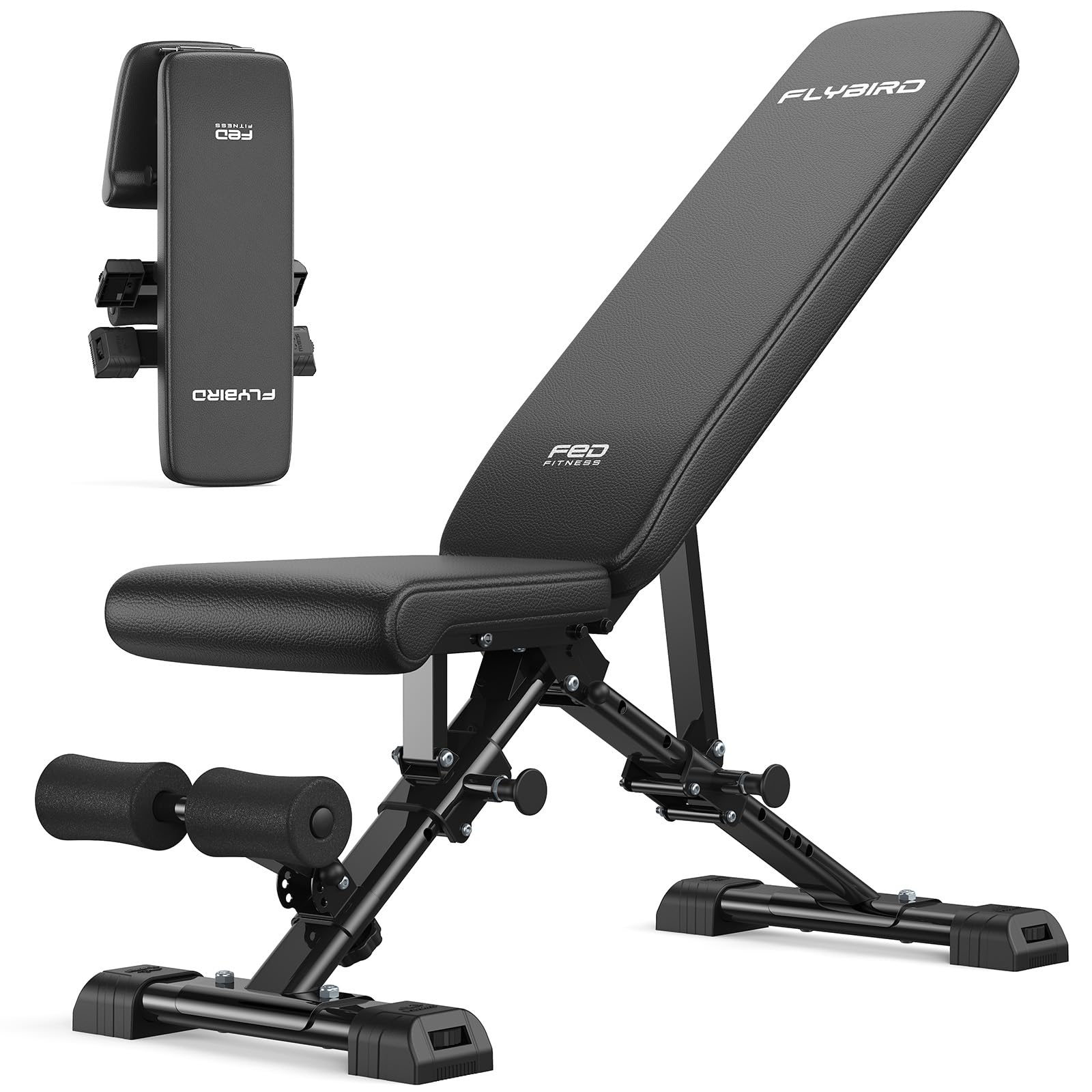
The FLYBIRD sits high off the floor, and that changes how you set up for a flat press. We noticed it right away: your feet want a firmer plant, and the bench feels taller than the compact folding models. The payoff is a very broad angle range, from 30 degrees below flat to 90 degrees upright, with 144 positions in the listing.

The 30-inch extended backrest is the other reason to look. It gives taller lifters more head and neck support than the short pads on the budget benches, and the 46-inch length gives you room to slide up or down. We found the incline positions secure and the decline useful for core work.

The 800-pound ASTM-rated frame is not the stiffest here, and the 13-inch width feels narrower than the Keppi benches. We kept our pressing moderate and appreciated the bench most for angle variety and dumbbell work. The fold is a bonus in a room that has to reset after training.

If you chase a specific decline angle or want one bench to cover a wide range of dumbbell movements, the FLYBIRD has the flexibility. It is less convincing as a heavy flat-press platform.

Pros

  • Wide -30 to 90 degree range
  • 30-inch extended backrest
  • 144 adjustable positions
  • Folds for storage

Cons

  • 13-inch pad width feels narrow
  • Not the stiffest under heavy loads
Our verdict

For a dumbbell-focused home gym that wants a wide angle range and a backrest long enough for taller frames, the FLYBIRD is the flexible pick.

Check Latest Price
7

Beginner Home Gym

NICEPEOPLE Bench

93 /100
Trail Score Outstanding

Key details

Item Weight
17 lb
Backrest Angles
8
Backrest Length
29.3 inches
Weight Capacity
660 lb
Check Price on Amazon

At 17 pounds, the NICEPEOPLE is the bench you can carry with one hand and lean against a wall. We used it for dumbbell flys, curls, and step-ups, where a light bench is an advantage. The 660-pound rating is respectable for the size, and the 29.3-inch backrest gives more support than the compact price suggests.

The eight backrest angles cover the incline work most beginners actually do, and the seat and pad are covered in a non-slip, breathable leather that wipes down easily. The frame uses a reinforced triangular support, and it feels stable when your weight is centered.

The trade is stability under load. With heavier dumbbells or an off-center press, the light frame lets you know it is there. The size also runs small for taller users; at 46 inches long, it is a compact bench rather than a full-length platform.

For a beginner, a teenager, or a second bench in a small room, the NICEPEOPLE is a sensible first step. The light weight is the feature; the wobble under heavy loads is the boundary.

Pros

  • Light 17-pound frame
  • Eight backrest angles
  • 29.3-inch backrest
  • Wipe-clean breathable leather

Cons

  • Wobbles under heavier loads
Our verdict

For a beginner or a small-room setup, the NICEPEOPLE is a light, inexpensive bench that covers the basics—just keep the loads moderate.

Check Latest Price
8

Leg Developer

Marcy SB-350

89 /100
Trail Score Excellent

Key details

Included
Leg developer
Item Weight
51 lb
Back Positions
6
Weight Capacity
600 lb
Check Price on Amazon

The leg developer is the reason to consider the Marcy. It adds leg extensions and curls to a six-position utility bench, and that combination is rare in this group. We used the rollers for extensions and found the motion smooth enough for accessory work, though the range is shorter than a dedicated machine.

The bench itself is an old-school steel utility design with a powder-coated frame, high-density foam, and a transport handle and wheels. At 51 pounds, it feels substantial, and the foam rollers are covered in vinyl, so they wipe clean. The six back positions use a sawtooth adjustment.

The limits are the highest back positions and the leg developer's range. We noticed a little movement at the top settings, and the leg developer does not match a standalone leg extension for range of motion. The 51-pound frame is also a hassle to move between rooms, even with the handle.

For a home gym that wants a leg station without buying a second machine, the Marcy earns its spot. It is a specialist, not the best all-around pressing bench.

Pros

  • Built-in leg developer
  • Six-position back pad
  • Transport handle and wheels
  • Vinyl-covered foam rollers

Cons

  • Wobbles at highest back settings
  • 600-pound capacity is the lowest here
Our verdict

The Marcy is the pick if a leg developer is non-negotiable and you want one bench to cover leg accessories; for pure pressing, its capacity and stability trail the others.

Check Latest Price

How We Tested Adjustable Weight Benches

We started with 23 benches from major fitness retailers, then cut the list to 11 based on listed weight capacity, adjustment range, footprint, and price. We skipped vague weight ratings and anything that looked like a rebadged duplicate. Over nine months, those 11 lived in my garage gym, where two training partners and I used them four or five days a week for flat pressing, incline dumbbell work, seated rows, and the occasional decline sit-up.

We timed assembly with a stopwatch and a standard hex-key set, noting whether one person could do it alone and whether the hardware bag matched the instructions. We measured each bench's footprint and seat height, then checked those numbers in use: whether my 6-foot-2 partner could plant both feet during flat presses, and whether the pad gap dug into my lower back on incline. To judge stability, we set each bench on the same rubber floor and tried to rock it side to side before loading it.

Then we loaded the bar to each maker's stated capacity—or as close as we safely could—and repeated the same presses and rows, watching for flex in the frame, creaking at the hinges, and any lift at the feet. We changed positions repeatedly, too, timing how long it took to go from flat to incline and noting whether the pop pins lined up cleanly or needed a second hand. After nine months, we checked the upholstery for compression and seams for splitting, and we looked at welds and powder coat for rust or chips. The benches that held up earned their place; the ones that didn't were loose at the joints or had adjustment gaps that made certain angles feel unsafe.

How to Choose an Adjustable Weight Bench

Start With the Frame and Capacity

A long list of angles is easy to print; a frame that stays flat under a loaded press is harder to build. We start with the listed capacity and then look at how the frame is braced—triangular supports, welded steel, and enough bench weight that it does not skitter. A 600-pound bench can be fine for dumbbells and bodyweight work. Loaded barbell pressing calls for more margin. If the bench lives in one spot, a heavier frame is usually the better trade.

Check the Fit Before the Features

Bench fit is not just length. A short backrest leaves your head hanging during incline presses, and a narrow pad makes you feel perched. Check the backrest length and seat width against your torso, and think about height: a taller bench changes foot placement for flat pressing. We also measure the open footprint, not just the folded size. A bench that folds to 13 inches still needs a clear run of floor when it is set up.

Look at the Adjustment and Locking System

Back, seat, and foot adjustments do different jobs. Backrest angles get the press; the seat angle keeps your hips from sliding; a foot catch makes decline work usable. We prefer pin systems that seat with a clear click and a second lock, and we check that the pad does not rock once locked. If you switch angles often, a one-pull bolt is worth having. If you settle into one or two angles, a simpler pin is fine.

Decide How Much Portability You Need

Folding is a real feature, but it is not free. A 30-pound bench that folds to suitcase size is easy to live with; a 59-pound fixed bench is easier to trust under a heavy load. We decide based on where the bench spends most of its time. If it goes into a closet after every session, folded dimensions and weight matter more than another backrest position. If it stays out, prioritize stability and pad support.

Padding, Wear, and the Parts That Loosen

Thick foam is comfortable; dense foam holds its shape. We look for a wipeable cover and seams that do not sit under your shoulders. Then we check the hardware: folding pins, bolts, and welds take the load, and a bench that loosens after a few sessions needs attention. Tighten bolts at the start, check the pins are fully seated, and stop using any bench that develops a crack or a rocking hinge.

Frequently Asked Questions

Final Verdict

The Keppi 1200 is the bench we recommend first for a home gym that can keep it set up. Its 1,200-pound frame, wide pad, and three-position foot catch make flat, incline, and decline work feel settled, and the 59-pound build is the reason. If storage is the deciding issue, the Keppi Bench500 folds to a closet-friendly package and still rates 900 pounds. For back extensions, the Finer Form is the one to choose.