Best Walking Canes for Neuropathy of 2026

Neuropathy doesn't just make the ground feel uncertain; it turns a loose rug, a wet curb, or a crowded aisle into a decision about whether to trust your next step. The right walking cane won't erase that, but it gives you a stable base, a grip that stays comfortable through a long afternoon, and a height adjustment that holds instead of rattling loose. The wrong one can skate on tile or fold when you need it rigid, which is why sturdiness, stability, and quality matter more than the finish. Over the past six months, I've walked with 14 canes—folding and fixed—on sidewalks, through grocery stores, and up the stairs at home, focusing on foldability, adjustability, and whether each one felt like a good value.

A quick piece of wisdom: tip size and material often matter more than handle shape, especially on smooth floors. The picks below are the ones that made me feel steadier, and they cover different needs—some fold small enough for a tote, some stay rigid for daily walks, and all adjust without tools.

1

Best Overall

KINGGEAR Self-Standing Cane

93 /100
Trail Score Outstanding

Key details

Base Type
Quad rubber
Height Range
31-36 in.
Folded Design
Yes
Weight Capacity
300 lb
Check Price on Amazon

The first thing you notice about the KINGGEAR cane is the wide quad base, and that is the reason it earns our top spot. For neuropathy, the hard part is often trusting your footing when the feedback from your feet is unreliable. The four-point rubber base sits flat and lets the cane stand beside a chair, so you are not bending to pick it up before every step. The offset EVA handle gives the palm a broader, softer place to push than a narrow crook, and the push-button height adjustment runs from 31 to 36 inches in one-inch steps.

At 1.1 pounds, it is light enough to carry from room to room, and it folds when you need to put it in a car or a closet. The 300-pound capacity gives it more margin than several picks here. We also like that the rubber base is non-marking, which makes it easier to use indoors without feeling like you are dragging a piece of equipment across the floor.

For a shorter or average-height adult who wants a steady everyday cane, the combination of a self-standing base, a cushioned offset grip, and a simple push-button lock is the most useful package here. The self-standing base is the detail we keep coming back to: it turns a cane from something you lean in a corner into something that is ready where you left it.

Pros

  • Self-standing quad base steadies stops and starts
  • Cushioned offset handle supports the palm
  • Folds for storage and travel
  • 300-pound weight capacity

Cons

  • 36-inch height ceiling is short for taller users
  • Wide base can catch on stairs and in tight rooms
Our verdict

For neuropathy-related balance worries, this is the cane we recommend first: a self-standing quad base and cushioned offset grip make everyday walking feel more secure.

Check Latest Price
2

Best for Travel and Uneven Ground

REHAND Folding Cane

93 /100
Trail Score Outstanding

Key details

Base Type
All-terrain rubber
Fits Heights
5 ft to 6 ft 5 in
Handle Shape
Longer, wider PP/TPR
Height Settings
8, one-inch increments
Check Price on Amazon

A folding cane only earns its keep if it feels like a real cane when it is open, and the REHAND is the one we reach for when the ground is uneven. The handle is longer and wider than a standard T-grip, so the palm has more surface to press against. The all-terrain rubber base is designed to flex and absorb shock, which matters when numbness turns every pavement seam into a jolt.

We like this one for travel because the fold is quick and the package fits into a bag without becoming a project. The wider grip is the real upgrade, though: on a long walk, the extra contact area is easier on the hand than a skinny crook. The base is also broader than a traditional tip, so it sits more securely on gravel, grass, or a sloped sidewalk. Eight one-inch height settings give you a fair amount of fine-tuning.

The thing to check is the minimum height. The listing covers a broad range, but a cane that starts too tall is worse than one that is a little short, especially if you are near the bottom of that span. If you are very short, measure before you order. For everyone else, this is the folding cane that makes the most sense for errands, trips, and streets that are not perfectly flat.

Pros

  • Longer, wider grip supports the palm
  • Shock-absorbing all-terrain base
  • Eight one-inch height settings
  • Folds for travel

Cons

  • 14-inch folded length is longer than the Vaunn's
Our verdict

When the ground is uneven, this is the folding cane we take: a broad grip and shock-absorbing tip make rough pavement feel less punishing.

Check Latest Price
3

Best Secure Folder

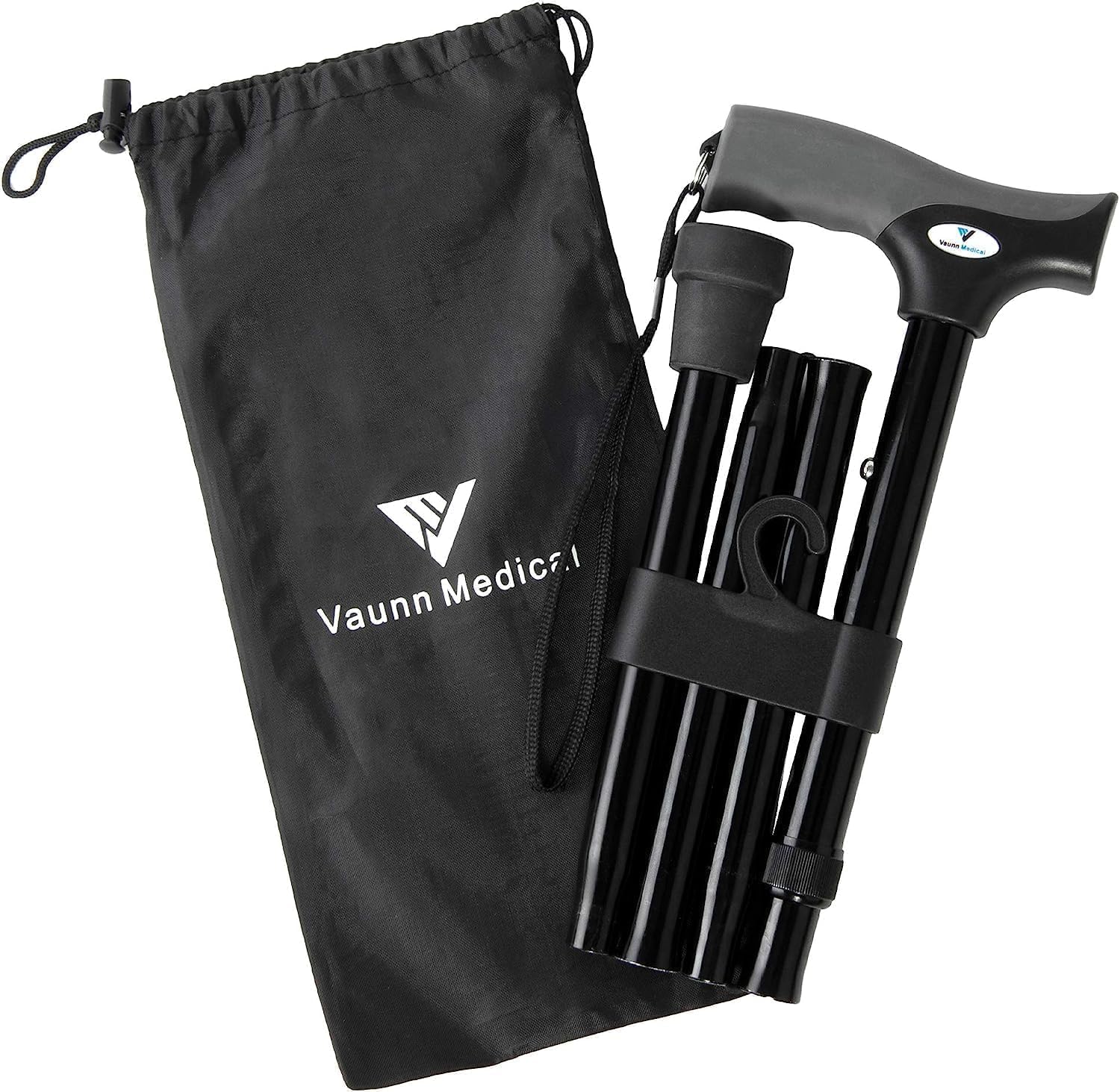
Vaunn Folding Cane

94 /100
Trail Score Outstanding

Key details

Weight
13 oz
Handle Shape
Palm-shaped rubber
Height Range
33-37 in.
Weight Capacity
300 lb
Check Price on Amazon

The self-locking hinge is the detail that makes the Vaunn folding cane worth a look. Folders can feel vague at the joint; this one is designed to lock open securely, and that is the first thing we check on any cane that comes apart. The palm-shaped rubber handle is built to spread pressure across the hand rather than concentrate it on a narrow ridge, and the concentric rubber tip is meant to take some of the sting out of hard pavement.

We recommend it to someone who wants a folder for daily errands, not a specialist travel cane. It folds to roughly 11 by 5 inches, light enough to tuck into a tote, and the 33-to-37-inch range covers a useful middle ground. The 300-pound rating gives it more margin than the Vive, and the height adjustment is simple enough to set once and forget.

If you are in the middle of the height range and want a folder that feels locked solid, this is our pick. The handle is firm rather than pillowy, so it is not the softest grip here, but it gives your fingers something definite to hold. The self-locking joint is the reason we are comfortable recommending it as a daily cane rather than a just-in-case cane.

Pros

  • Self-locking hinge
  • Palm-shaped grip spreads pressure
  • Shock-absorbing rubber tip
  • Folds to about 11 by 5 inches

Cons

  • 33-to-37-inch range leaves out taller and very short users
Our verdict

If you want a folder that feels locked solid, start here; the palm-shaped handle and shock-absorbing tip make daily errands easier.

Check Latest Price
4

Best Budget Everyday Cane

DMI Walking Cane

95 /100
Trail Score Outstanding

Key details

Weight
12 oz
Handle Shape
Soft offset
Height Range
30-39 in.
Weight Capacity
250 lb
Check Price on Amazon

This is a plain fixed cane, and that is the point. The DMI has no hinge, no quad base, and no travel bag; what it does have is a 30-to-39-inch adjustment range, a soft offset grip, and a locking ring that keeps the two shaft sections from rattling. At 12 ounces, it is light enough to carry from the bedroom to the car without thinking about it.

We recommend it as the budget pick for someone who wants one cane by the door and does not need it to fold. The offset handle gives the hand a more natural angle than a straight T, and the wide height range makes it easy to fit without measuring twice. The wrist strap is a small thing, but it saves a lot of bending over if the cane slips.

The simple frame is also easy to trust: there is no joint to check and no folded section to line up. For a spare cane or a first cane, the lack of features is the feature. If you need to stash a cane in a purse or a carry-on, look at the Vaunn or the Vive instead.

Pros

  • 30-to-39-inch height range
  • Soft offset handle with wrist strap
  • Only 12 ounces
  • Locking ring reduces rattle

Cons

  • 250-pound weight limit is lower than most here
Our verdict

Our budget choice is this light, widely adjustable fixed cane for someone who wants a dependable cane by the door and no folding mechanism to fuss with.

Check Latest Price
5

Best Lightweight Basic

Medline Offset Cane

94 /100
Trail Score Outstanding

Key details

Weight
1.1 lb
Handle Shape
Soft foam offset
Height Range
29-38 in.
Weight Capacity
300 lb
Check Price on Amazon

At just over a pound, the Medline cane is the one we reach for when the goal is simple, light support that does not feel like equipment. It has a soft foam offset handle, a rubber pad at the bottom, and a height range from 29 to 38 inches. The aluminum shaft is rated to 300 pounds.

The foam handle is the part we appreciate most on a quick trip to the mailbox or around the grocery store. It is softer than the hard plastic grips on some basic canes, and the offset shape keeps the wrist from folding into an awkward angle. The height adjustment is straightforward, with a wide range that should suit a lot of hands and frames.

We recommend it to someone who wants a basic cane with a genuinely broad height range. The foam handle and light shaft make it easy to use for long errands, and the locking hardware is less fiddly than a push button for some hands. If you mostly walk on flat, familiar surfaces, it is a straightforward cane that does not ask much of you.

Pros

  • 29-to-38-inch range suits shorter users
  • Soft foam offset handle
  • Very light aluminum shaft
  • 300-pound weight capacity

Cons

  • Single tip gives less standing stability than a quad base
  • Does not fold for travel
Our verdict

Buy this if you want a simple, lightweight cane with the lowest starting height here and mostly walk on flat, familiar surfaces.

Check Latest Price
6

Best for Shorter Users

BeneCane Walking Cane

93 /100
Trail Score Outstanding

Key details

Fits Heights
5 ft 1 in to 5 ft 8 in
Height Range
31-36 in.
Folded Length
17 in.
Weight Capacity
300 lb
Check Price on Amazon

If you are 5-foot-8 or shorter, the BeneCane's listed 5-foot-1 to 5-foot-8 fit and 31-to-36-inch range are a useful shortcut. It is a folding cane with a soft foam offset handle, a wrist strap, and a 300-pound rating. The lower starting point is the reason it is here: a lot of canes bottom out at a height that leaves shorter users hiking their shoulder.

The offset handle is shaped to keep the wrist straighter than a straight T-grip, and the foam is soft enough for bare hands. The middle joint has a screw coupling that tightens the shaft, a small detail that matters if you have had a cane rattle at the joint. The push-button height adjustment is simple, and the wrist strap stays put.

The 300-pound capacity is generous for a cane this light, and the foam grip is one of the softer ones here. The cane feels substantial in the hand without being heavy, which is a good balance for everyday use.

We recommend it to a shorter adult who wants a folder with a cushioned grip and does not need a quad base. If you are taller than about 5-foot-8, the KINGGEAR or REHAND is the better fit. For everyone in its range, it is a comfortable, stable folder that does not ask you to compromise on capacity.

Pros

  • 31-inch starting height
  • Soft foam offset handle
  • 300-pound weight capacity
  • Folds for storage

Cons

  • 17-inch folded length is long for a small bag
Our verdict

Shorter adults who want a softer handhold should start with this folder, which pairs a 31-inch starting height with a foam offset grip.

Check Latest Price
7

Wooden Style

Asterom Oak Walking Cane

96 /100
Trail Score Outstanding

Key details

Weight
16 oz
Warranty
5-year limited
Length Options
32-39 in.
Shaft Material
Oak
Check Price on Amazon

The Asterom is the cane you notice before you use it: solid oak, a smooth derby handle, and a finish that looks more like furniture than medical equipment. The wood grain and color options are the draw, but the handle shape is the practical part. A derby grip gives the palm a broad curve to hold, and the oak shaft has a reassuring heft.

That heft is why some people like a wooden cane: it feels planted in a way that a light aluminum tube does not. The Asterom comes with a spare tip and a wrist strap, and the five-year craftsmanship warranty is longer than most here.

We recommend it to someone who wants a wooden cane and is willing to order a fixed length. The length options run from 32 to 39 inches, and the company sizes them to height, so the fit is decided at checkout. That is the main compromise for neuropathy: a push-button cane is more forgiving if your needs change or if you share the cane.

The Asterom is also the most expensive cane here, and it does not fold. Those are the trade-offs for the craftsmanship. If you want one handsome cane for around-the-house and short outings, it earns its keep; if you need a cane to live in a bag, choose a folder.

Pros

  • Solid oak construction
  • Broad derby handle
  • Five-year craftsmanship warranty
  • Handsome enough for daily use

Cons

  • Heavier than the aluminum picks here
Our verdict

Choose this oak cane if you want a fixed-length walking stick with real craft and are willing to order the size carefully.

Check Latest Price
8

Compact Carrying

Vive Folding Cane

94 /100
Trail Score Outstanding

Key details

Weight
8 oz
Handle Shape
Contoured grip
Folded Design
Three-point fold
Weight Capacity
250 lb
Check Price on Amazon

The Vive folds at three points and comes in patterns, which makes it the least medical-looking cane in this group. The aluminum frame is rated to 250 pounds, the grip is contoured, and the rubber tip is replaceable with other tips. For someone who needs a cane only on bad days, that is a useful combination.

We like it for a bag or a glove box. The fold is compact, the wrist strap is integrated, and the patterned finish is the kind of detail that makes a cane easier to actually carry. It is not as planted as the quad-base KINGGEAR, but it is not trying to be; this is a cane for light, occasional support.

The contoured grip is comfortable for shorter walks, and the three-point fold is simple to open once you have done it a few times. It is a compact cane rather than a full-time support system, and that is how we judge it.

We recommend it to a lighter user who wants a compact cane that does not look like a hospital loaner. The patterns are not a reason to buy on their own, but they are a reason to actually carry it. If you need all-day support, choose the KINGGEAR or Vaunn instead.

Pros

  • Folds at three points
  • Contoured grip
  • Replaceable rubber tip
  • Patterned finish

Cons

  • 250-pound weight limit
Our verdict

Keep this compact folder in a bag for lighter, occasional support; its three-point fold and patterned finish make it easy to carry.

Check Latest Price

How We Tested Walking Canes for Neuropathy

We started with a shortlist of canes sold for neuropathy and general balance support, then narrowed it by height range, handle shape, tip type, weight capacity, and whether replacement tips were easy to source. That left 14 canes, which we tested over six months.

I set each cane to the right height for me and for a taller tester, then walked a measured loop on sidewalk and indoor tile, used it through a grocery store aisle, and practiced standing up from a dining chair. At every height setting, I checked whether the locking pin clicked into each hole and whether the joint had side-to-side play. To judge sturdiness and overall quality, I leaned my weight through the handle while walking and pressed down hard on the tip, then looked for cracks at the collar, loose rivets, and worn rubber after each week of use.

We timed folding and unfolding each cane one-handed, stowed it in a tote and a car door pocket, and noted whether it rattled, pinched, or refused to lock flat. We also tracked what came in the box, how easy replacement tips were to find, and whether the cane still felt solid after six months; that final tally is how we judged value—not the sticker alone, but whether it stayed tight, adjusted smoothly, and came with useful extras.

How to Choose a Walking Cane for Neuropathy

Start With the Grip, Not the Color

Neuropathy can make the hand feel numb, tingly, or weak, so the handle is doing more than finishing the cane. A broad offset or derby grip spreads pressure across the palm and keeps the wrist closer to neutral than a narrow T-handle. Foam and padded rubber are kinder on bare hands, while hard plastic can feel unforgiving on a long walk. We look for a handle that fills the hand without forcing the fingers into a tight curl. The KINGGEAR's padded offset grip and the REHAND's wider handle are good examples of the shape we prefer.

Match the Height Range to the Person

A cane should let you stand upright with the handle at wrist height, and the only reliable way to compare is by the stated range and a real measurement. Most listings give a shaft range and a suggested user height; the shaft range is the one to check against your wrist crease while wearing the shoes you walk in. Short adults should look at the low end first, because a cane cut for a taller frame will push the shoulder up. Taller users need a range that reaches their wrist height, and a cane that stops at 36 inches will not suit everyone; the DMI reaches 39, while the KINGGEAR stops at 36.

Choose the Base for the Ground You Walk On

A single rubber tip is light and easy to place; a quad or broad pivoting base stands on its own and gives more visual confidence when you stop. It is not automatically better on stairs or in crowded rooms, where a wider footprint can catch. If you walk mostly on pavement and want the cane to stand beside a chair, the KINGGEAR's quad base is the most supportive design here. If you are often on gravel, grass, or sloped sidewalks, the REHAND's all-terrain, shock-absorbing tip is the one we prefer.

Decide Whether Folding Is Worth the Joint

Folding canes earn their place in a bag, a car, or a restaurant booth, but every fold adds a joint that has to lock firmly. We treat a folder as a travel tool first and a full-time cane second. If you need a cane every day on familiar ground, a fixed cane such as the DMI or Medline is simpler and has less to check. If you need it only sometimes, the Vaunn's self-locking hinge and the Vive's three-point fold are easier to live with.

Frequently Asked Questions

Final Verdict

For most people with neuropathy, the KINGGEAR is the cane we recommend first. The quad base makes stops and starts feel less precarious, the offset foam grip is kind to a numb or weak hand, and six height settings cover a lot of shorter and average-height adults.

If you need to fold a cane into a bag or walk on rougher ground, the REHAND is the better travel companion. Shorter users who want a softer, lighter folder can look at the BeneCane, but the KINGGEAR remains our default.