Best Vitamin E Supplements of 2026

Vitamin E is a fat-soluble antioxidant, which means your body absorbs it alongside the fat in a meal — and it means the supplement aisle is full of bottles that look identical but aren't. Natural d-alpha-tocopherol and synthetic dl-alpha-tocopherol are different molecules, and the IU number printed on the front rarely matches the milligram dose on the back. The right bottle fills a genuine gap for anyone whose diet skips nuts, seeds, and the oils that carry the nutrient; the wrong one just costs money.

I've kept vitamin E in my cabinet since a dermatologist mentioned it years ago, and I've learned that a bargain softgel is a false economy — one bottle arrived fused into a single amber lump and never came apart. Over four months my team and I worked through 12 formulas, from drugstore softgels to mixed-tocopherol capsules and a couple of liquids, taking them with breakfast and noting what actually changed. The ones worth repeating had doses you could verify, ingredients worth swallowing, and a daily cost that didn't make me ration them. What follows is what survived.

1

Best Overall

Solgar Vitamin E 400 IU

95 /100
Trail Score Outstanding

Key details

Count
100 softgels
Potency
268 mg (400 IU) per softgel
Free From
Gluten, wheat, dairy and artificial colors
Tocopherol Form
d-Alpha with mixed tocopherols
Check Price on Amazon

Vitamin E labels get read in the wrong order. Most of us look at the number first — 400 IU — and stop, and the number is the part nearly every bottle here gets right. What separates them is the name of the form, and this Solgar bottle lists d-alpha tocopherol alongside the gamma, delta and beta fractions. That fuller set is closer to what turns up in food than the isolated d-alpha in most softgels on this list, and it's the main reason this is the bottle we point readers to when they ask where to start.

At 268 mg (400 IU) per softgel, one a day is the sensible place to begin for general antioxidant use — comfortably under the 1,000 mg daily ceiling for supplemental vitamin E, which leaves room for whatever your multivitamin already contributes. The softgels are oil-based, the right format for a fat-soluble vitamin, so take one with a meal that has some fat in it and you've done your part. A hundred softgels is a hundred days.

One honest note on the mixed tocopherols: the case for the fuller spectrum is reasonable rather than dramatic, and a plain d-alpha softgel at the same dose isn't a mistake. What tips it for us is the price. This bottle costs no more than several of the plain 400 IU options in this guide, so you aren't paying extra for the better-specified formula — you're just getting it.

Pros

  • Natural d-alpha with gamma, delta and beta tocopherols
  • Oil-based softgel suits a fat-soluble vitamin
  • One softgel covers 400 IU for 100 days
  • No gluten, wheat, dairy or artificial colors

Cons

  • Large softgel for a 400 IU dose
Our verdict

For a natural 400 IU softgel that carries the whole tocopherol family instead of isolated d-alpha, this is the bottle we buy, and it costs no more than several plainer 400 IU options here.

Check Latest Price
2

Best Value

NOW Vitamin E-400 IU

96 /100
Trail Score Outstanding

Key details

Count
250 softgels
Potency
400 IU per softgel
Certifications
Non-GMO, kosher, third-party GMP certified
Tocopherol Form
d-Alpha tocopheryl
Check Price on Amazon

Two hundred and fifty softgels is the number that decides this one. At one a day it's roughly eight months of vitamin E from a single bottle, and per day it works out cheaper than every other natural-form bottle in this guide.

We reach for it when someone already knows what they want and doesn't care to think about it again: plain 400 IU d-alpha, a bottle that lasts, and a manufacturer that spells out its certification on the label. It's the version of this purchase that goes invisible in the cupboard, which is the best thing a daily supplement can do.

The softgel is gelatin, so it isn't vegetarian, and the formula is d-alpha alone — no gamma or delta fractions. Those are the two reasons we rank it behind the Solgar. What it does have is a clean sheet: non-GMO, kosher, free of gluten, dairy, egg and corn, with manufacturing certified through an outside GMP program. No aftertaste to work around, either. If your routine runs on autopilot and the per-day cost is what you watch, this is the bottle.

Pros

  • 250 softgels, about eight months at one a day
  • Lowest cost per day of the natural forms here
  • Kosher, non-GMO, gluten- and dairy-free
  • Third-party certified manufacturing

Cons

  • Gelatin capsule, so not vegetarian
  • Plain d-alpha without the other tocopherol fractions
Our verdict

Buy this one if you want a natural 400 IU softgel and a bottle that lasts most of a year; it works out to the lowest cost per day among the natural forms here.

Check Latest Price
3

Best Small Bottle

Nature Made Vitamin E 400 IU d-Alpha

96 /100
Trail Score Outstanding

Key details

Count
100 softgels
Potency
267 mg (400 IU) per softgel
Free From
Gluten, artificial colors and flavors
Tocopherol Form
d-Alpha
Check Price on Amazon

Nature Made sells two bottles of 400 IU vitamin E that look nearly identical from the front, and the difference between them is one letter. This is the d-alpha version; the other is dl-alpha, the synthetic form we also cover in this guide. That single letter is the whole buying decision in this category, which is why we start with it.

The softgel itself is straightforward: 267 mg (400 IU) of d-alpha tocopherol, one a day with water and a meal, a hundred of them in a bottle small enough to stand in a crowded cabinet. Nature Made also leaves out what people scan for — no added color, no artificial flavors, no preservatives, and gluten free.

What you give up is economy. Per softgel this runs noticeably higher than the bigger natural bottles in this guide, and across a year of daily use that gap shows up in a way the bottle price doesn't. We still choose it for a first bottle, a travel kit, or a household that prefers not to store eight months of softgels at once — you're paying for the small size and the familiar label, not a better formula.

Pros

  • Natural d-alpha at 400 IU per softgel
  • Compact 100-count bottle
  • No artificial colors, flavors or preservatives

Cons

  • Costs more per softgel than larger natural bottles
Our verdict

This is the natural d-alpha half of Nature Made's confusing 400 IU pair, and the bottle we recommend when you want a familiar label and something small for the shelf.

Check Latest Price
4

Best High-Potency

Solgar Vitamin E 1,000 IU

96 /100
Trail Score Outstanding

Key details

Count
180 softgels
Potency
670 mg (1,000 IU) per softgel
Free From
Gluten, wheat and dairy; suitable for vegetarians
Tocopherol Form
d-Alpha with mixed tocopherols
Check Price on Amazon

A thousand IU is a dose you arrive at on purpose. It's roughly two and a half times the 400 IU most people start with, and it's the number a clinician names when someone has a documented deficiency or another specific reason to go higher. If that's your situation, this is the bottle in this guide we trust to deliver it: 670 mg per softgel, natural d-alpha with the mixed tocopherols, in the same oil-based format as our top pick.

One hundred and eighty softgels is six months at one a day, so the bottle is priced like what it is. Whether it's worth that depends entirely on why you're taking it. For general antioxidant insurance, 400 IU does the job, and we don't see a reason to go higher without one.

Where we land: we recommend this for the 1,000 IU job and not much else. What you're paying for is the natural form plus the full tocopherol set at a potency that's hard to match elsewhere in this group, and that's a fair trade for the reader who needs exactly that.

One piece of arithmetic before you commit. 670 mg is the weight of the tocopherol in a single softgel, and the daily ceiling for supplemental vitamin E is 1,000 mg. One of these leaves headroom; one of these plus a multivitamin that lists vitamin E plus a fortified shake is the kind of stack worth adding up on paper first.

Pros

  • 1,000 IU of natural d-alpha with mixed tocopherols
  • 180 softgels, six months at one a day
  • Oil-based softgel, gluten-, wheat- and dairy-free

Cons

  • Highest cost per day in this set
Our verdict

Take this one only if a clinician has put you on 1,000 IU; at that dose we trust this natural, mixed-tocopherol softgel, and at any lower dose the 400 IU version is the smarter buy.

Check Latest Price
5

Best Budget

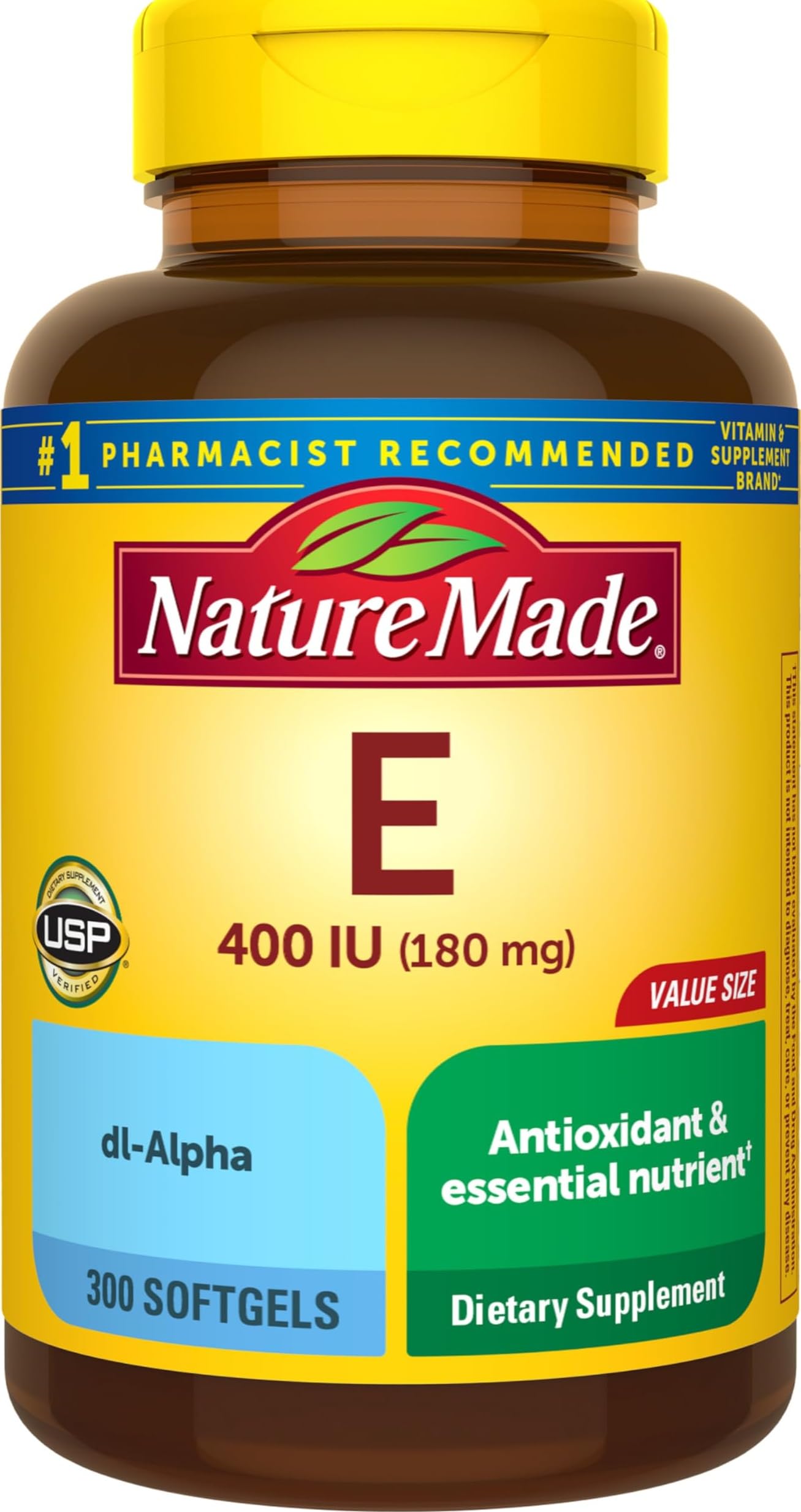
Nature Made Vitamin E 400 IU dl-Alpha

96 /100
Trail Score Outstanding

Key details

Count
300 softgels
Potency
180 mg (400 IU) per softgel
Bottle Size
7 x 6 x 5.11 inches
Tocopherol Form
dl-Alpha (synthetic)
Check Price on Amazon

Three hundred softgels, one a day, and the lowest cost per day in this guide. If you're buying vitamin E for a two-person household, or you simply don't want to think about it again for ten months, that's the pitch, and it's an honest one.

We still send most readers to the natural form. The giveaway is the dl- prefix: this is synthetic vitamin E, which the body holds onto less efficiently than natural d-alpha, and the per-day savings are small enough that we don't think they're worth the difference for a daily habit. Where this bottle does win is scale — for a big household or a shared bathroom shelf, a year costs less here than anywhere else in the group.

The bottle is the other consideration: it's a wide one, listed at roughly seven by six by five inches, so it wants a shelf rather than a crowded cabinet door. Otherwise it does what a mainstream vitamin should — no added color, no artificial flavors, no preservatives, and gluten free.

Pros

  • Lowest cost per day in this guide
  • 300 softgels, close to a year of 400 IU
  • No added color, artificial flavors or preservatives

Cons

  • Synthetic dl-alpha rather than natural d-alpha
  • Wide bottle takes real shelf space
Our verdict

The cheapest way to take 400 IU every day, and a fair choice for a big household — just go in knowing you're getting the synthetic form of vitamin E.

Check Latest Price
6

Best for Restricted Diets

NatureWise Vitamin E 400 IU

95 /100
Trail Score Outstanding

Key details

Count
200 softgels
Capsule
Halal gelatin softgel
Potency
180 mg (400 IU) per softgel
Certifications
NSF Contents Certified, non-GMO
Check Price on Amazon

Most vitamin E softgels in this guide are made with gelatin, and the label rarely says more than that. NatureWise spells it out: halal gelatin, no soy, no dairy, no gluten, no wheat. For a household with a halal requirement or a soy allergy, that combination narrows the field fast, and it's the reason this bottle earns a place.

The formula is 180 mg (400 IU) per softgel, one a day, 200 to a bottle. It's NSF Contents Certified, which is a third-party mark on what's actually inside the capsule rather than just on the facility, and it's made in a US cGMP plant. The softgels run small for 400 IU, and that's the difference between a supplement you keep up with and one you skip.

We recommend it for the constraint it solves, and it happens to be an easy softgel to live with besides. The testing and the allergen list are what we point to first; the dose is the standard 400 IU and the count is generous for the money.

One practical caveat. These softgels have a habit of fusing into a lump in the bottle, and once they're stuck, separating them usually means tearing the shell. Keep the bottle cool and dry, well away from the stove or a sunny windowsill, and shake it before you open it — a bottle stored properly is the difference between a softgel and a shard.

Pros

  • Halal gelatin with no soy, dairy or gluten
  • 400 IU per softgel, 200 to a bottle
  • NSF Contents Certified, made in a cGMP facility

Cons

  • Doesn't state whether the tocopherol is d- or dl-alpha
Our verdict

We recommend this for the halal gelatin and the soy-free formula first, and for the small, easy 400 IU softgel second.

Check Latest Price
7

Vegetarian High Dose

NatureBell Vitamin E 1,000 IU

96 /100
Trail Score Outstanding

Key details

Count
300 softgels
Capsule
Vegetarian softgel, third-party tested
Potency
1,000 IU
Tocopherol Form
dl-Alpha tocopheryl acetate
Check Price on Amazon

At the 1,000 IU end of this list, most bottles are gelatin capsules and the label stops there. NatureBell's is vegetarian, third-party tested, and free of gluten, dairy, soy and egg — a longer list of what it leaves out than the high-dose competition bothers with.

Inside is dl-alpha tocopheryl acetate, the synthetic form, dosed to 1,000 IU per serving in a 300-count bottle. NatureBell calls the acetate version stable, and that's fair: the acetate ester holds up on the shelf better than plain tocopherol. Stability isn't bioavailability, though, and the natural d-alpha bottles in this guide are the ones the body retains more of.

Two things to check before you commit. The 1,000 IU figure is a serving rather than a per-softgel number, and at this potency a serving is often two softgels — which turns 300 softgels into 150 days, not 300. And be sure of the dose itself, because 1,000 IU is above where most people start.

We recommend it for the reader who wants a high-potency bottle with no gelatin in it and can see the testing for themselves. The dl- prefix is the part to accept going in — everything else on this label is more specific than most of the synthetic bottles here.

Pros

  • Third-party tested vegetarian softgels
  • Free of gluten, dairy, soy and egg
  • 300 softgels at the high-potency end

Cons

  • Synthetic dl-alpha tocopheryl acetate
Our verdict

A vegetarian, third-party-tested route to 1,000 IU, and the synthetic form is the trade-off you accept for it.

Check Latest Price
8

Bulk Budget

Nutricost Vitamin E 400 IU

95 /100
Trail Score Outstanding

Key details

Count
240 softgels
Potency
400 IU per softgel
Free From
Gluten, non-GMO
Manufacturing
NSF certified, GMP compliant facility
Check Price on Amazon

Every supplement bottle claims quality; Nutricost at least names the ground it stands on — an NSF-certified, GMP-compliant facility, third-party testing, non-GMO, gluten free. That's more disclosure than several better-known names in this guide give you.

Two hundred and forty softgels at 400 IU each, so eight months from a bottle that costs less per day than most of the natural options here. The capsules aren't the giant end of this category, and there's no aftertaste to work around — which matters more than it sounds like it should when you're taking something every morning.

Where it lands is simple: this is the bottle to buy when 400 IU is the whole requirement and the count matters more than the label's fine print. Nothing here is a compromise on testing or purity, and the softgels go down without ceremony.

We recommend it for the plain job, and we steer anyone who cares specifically about natural d-alpha to the Solgar bottle instead — the difference in daily cost between them is smaller than the difference in what you're getting. For a supplement you'll swallow 240 times, the count and the price do most of the arguing.

Pros

  • 240 softgels at 400 IU for a low per-day cost
  • NSF-certified, GMP-compliant, third-party tested
  • Non-GMO and gluten free

Cons

  • Doesn't identify which tocopherol it uses
Our verdict

A well-documented budget bottle of plain 400 IU, best for anyone who isn't fussed about which tocopherol form they get.

Check Latest Price

How We Tested the Vitamin E Supplements

We started by pulling every vitamin E product we could find at major retailers, then narrowed the field to formulas that state their dose in both milligrams and IU, name a recognizable tocopherol source, and let us calculate a per-serving cost. That cut the list to 12, spanning softgels, capsules, and liquids, from drugstore labels to smaller brands that publish third-party test results. We bought every bottle ourselves at retail.

Each formula lived on my kitchen counter for four months and was taken with breakfast — usually eggs or yogurt, since vitamin E needs fat to go anywhere. I noted whether a serving meant one softgel or three, whether I could get it down with a normal gulp of water or had to work at it, and whether the label's per-capsule dose held up when I counted what was in the bottle. To check stickiness, every container spent a week in a steamy bathroom cabinet in July, and I inspected each one for softgels fused together or capsules clumped at the bottom.

Effectiveness is slow with any antioxidant, so I logged energy, skin, and general how-I-felt notes instead of waiting for a switch to flip — and what separated the winners was consistency, meaning formulas I actually remembered to take. At the end I recalculated cost per serving rather than sticker price, because a cheap bottle that lasts three weeks is the expensive one. The picks below are the ones that stayed easy to take, honest on the label, and worth rebuying.

How to Choose a Vitamin E Supplement

Start with the first letter: d- or dl-

Vitamin E comes in two broad forms, and the label tells you which one in the first letter. Natural d-alpha tocopherol — sometimes sold with the related gamma, delta and beta fractions as mixed tocopherols — is the form the body retains better. The dl- versions, whether tocopherol or tocopheryl acetate, are synthetic and cheaper to make. Both count as vitamin E and both appear on a supplement facts panel as a percentage of your daily value, so the form is easy to miss. Nature Made's own 400 IU line is the clearest illustration: two bottles, the same strength, one letter apart.

Compare IU, not milligrams

Vitamin E is labeled two ways at once, and the milligram figure is the one that trips people up. For natural d-alpha, 400 IU works out to about 268 mg, which is why a well-specified 400 IU bottle shows a number in the 260s. Synthetic forms convert differently, so their milligram figure lands somewhere else for the same IU — don't read a smaller milligram number as a weaker capsule.

Keep the daily ceiling in view while you're doing that arithmetic. One thousand milligrams of supplemental vitamin E a day is the adult upper limit, roughly 1,500 IU of the natural form, which is why most people start at 400 and go higher only on a clinician's instruction.

Divide by the serving, then by the day

A big count is not the same as a long supply. Some 1,000 IU softgels are dosed at two capsules per serving, which halves the days you actually get out of the bottle. Before you compare two bottles, find the serving-size line, divide the count by the number of softgels per serving, and divide what you pay by that number. It takes thirty seconds and it's the only fair way to set a 100-count bottle beside a 300-count one.

Look at the capsule, not just the dose

Softgels are oil inside a thin shell, and the shell is where the practical differences live. Gelatin is the usual material and it's normally bovine or porcine, so if you need halal or kosher, check that line before anything else — it narrows the field to a handful of bottles. Soy is the other one to watch; some vitamin E formulas use it as a carrier, and soy-free versions exist. And a third-party mark such as NSF or USP is worth more than a brand name, because it means somebody outside the company checked what's in the capsule.

Store them cool, dry, and away from the stove

Softgels fusing into a single lump is the most common problem with vitamin E, and it's a storage story more than a formula one. Heat softens the shell, and a bottle that sat in a delivery van or a cupboard above the oven comes out as one solid mass that can't be separated without tearing. Keep the bottle in a cool, dark cupboard, shake it before you open it, and don't buy a two-year supply to save money if you have nowhere cool to keep it.

Frequently Asked Questions

Final Verdict

Start with the Solgar 268 mg (400 IU) mixed tocopherols unless something specific rules it out. It's the natural form, it carries the broader tocopherol set, and it doesn't charge a premium for either — which is more than most of the plain 400 IU bottles here can say.

If you want the lowest cost per day on a natural softgel and don't mind committing to a bigger bottle, the NOW 250-count is the better arithmetic. And if halal gelatin or a soy-free formula is the constraint, go to NatureWise — that's the bottle solving a problem the others don't.