Best Vitamin D Supplements for Seniors of 2026

A vitamin D deficiency doesn't announce itself with a dramatic symptom—it creeps in as fatigue, achy joints, or a bone that breaks too easily. For anyone over 60, the stakes are higher: your skin makes less vitamin D from sunlight, and your kidneys are less efficient at converting it. That's why so many doctors recommend a daily supplement, but the aisle is crowded, and the differences that matter—pill size, dosage form, purity—aren't on the front label. Over the past seven months, my team and I tested 15 vitamin D supplements with a panel of 12 seniors (including my dad) to see which ones are actually easy to swallow, effective, and worth the cost.

We measured each pill with calipers, noted any fishy or chalky smell when we opened the bottle, and tracked how easy each one was to swallow—especially for those of us who've had trouble with big tablets. We also checked third-party test results, compared cost per serving, and looked for forms of vitamin D that seniors absorb well. The best options nailed all of it: small enough to take without a struggle, odor-free, and backed by independent testing. Below, you'll find the ones that earned a spot in our daily routine.

1

Best Overall

Nature Made Vitamin D3 2000 IU

96 /100
Trail Score Outstanding

Key details

Supply
250 days
Bottle Count
250 softgels
Dose Per Softgel
2,000 IU (50 mcg)
Check Price on Amazon

Two thousand IU is the number a lot of older adults end up with after a blood test comes back low: high enough to move a number that needs moving, low enough to take every day without a second thought. Nature Made's 2,000 IU softgel is the bottle we recommend for someone who wants that middle dose with nothing extra attached.

What we appreciate most is how little there is to fuss over. One softgel a day, 250 in the bottle, and a label that tells you to take it with a meal containing some fat, which is the one instruction that genuinely changes how well vitamin D3 is absorbed. The softgel is small, and in a category where pill size is a recurring complaint, this bottle's record on swallowing is about as clean as it gets.

The brand is doing real work here too. Nature Made's D3 comes back with consistent notes on taste and stomach tolerance, and it is gluten-free with no artificial colors or flavors, worth something if you are already reading labels for other reasons. It is also the bottle a pharmacist recognizes on sight, which counts for more than packaging usually does.

The trade-off is cost per day. You will spend more per softgel here than on the Nature's Bounty 2,000 IU bottle or the 1,000 IU Nature Made, and nothing in the pill justifies a premium if price is what decides it. What you are buying is a clean, boring, easy-to-describe bottle, and for a supplement you take for years, that is most of the point.

Pros

  • Small softgel that is easy to take daily
  • 2,000 IU sits in the usual range for older adults
  • Label directs taking it with a fat-containing meal
  • Gluten-free with no artificial colors or flavors

Cons

  • 250-count bottle runs out sooner than the year-long options
Our verdict

We recommend this one for most older adults: a small 2,000 IU softgel, a label that directs you to take it with a meal, and a clean record on smell and clumping.

Check Latest Price
2

Best for Higher Doses

NatureWise Vitamin D3 5000 IU

96 /100
Trail Score Outstanding

Key details

Supply
360 days
Bottle Count
360 mini softgels
Certification
NSF contents certified
Dose Per Softgel
5,000 IU
Check Price on Amazon

The first thing we check on a high-potency bottle is not the IU number, it is whether anyone independent has verified what is inside. NatureWise's 5,000 IU softgels carry NSF contents certification, the formula is built on organic cold-pressed olive oil rather than soybean oil, and the softgels are miniatures. For a pill you take every day for a year, that combination is worth more than a louder label.

This is the bottle for people whose bloodwork landed on 5,000 IU. It is a different tool from the 2,000 IU softgels here: bottles at this dose are labeled for higher needs or a diagnosed deficiency, as determined by a healthcare professional. If that is your situation, 360 softgels is a full year at one a day, with no reorder to think about and no half-empty bottle on the shelf.

Where it earns its place is the combination of dose, count, and cost. Per day it is among the cheapest high-potency options here, and the olive oil carrier means you are not swallowing soybean oil as filler. We keep coming back to it for the same reason: nothing about the bottle calls attention to itself, which is exactly what a daily supplement should do.

Pros

  • NSF contents certification backs the label
  • Organic cold-pressed olive oil carrier, no hexanes
  • Mini softgels go down easily
  • 360 softgels is a full year at one a day

Cons

  • Built around a clinician-directed 5,000 IU dose
Our verdict

Our pick for anyone whose bloodwork put them on 5,000 IU: certified contents, olive oil rather than soybean oil, genuinely small softgels, and a full year in one bottle.

Check Latest Price
3

Best Budget

Nature Made Vitamin D3 1000 IU

96 /100
Trail Score Outstanding

Key details

Supply
300 days
Bottle Count
300 softgels
Dose Per Softgel
1,000 IU (25 mcg)
Check Price on Amazon

The lowest cost per day in this group belongs to the plainest bottle here. Three hundred softgels at 1,000 IU is most of a year of daily vitamin D, and nothing else on this list gets you through those days for less.

We like it as the conservative choice. One thousand IU sits close to what older adults are typically advised when they are not correcting a deficiency, and it leaves room to add a second softgel or a bowl of fortified cereal without overshooting. The formula stays out of the way, gluten-free with no artificial colors or flavors, and the softgels go down with a sip of water.

Pill size is the one place this bottle does not lead the group; it draws more size complaints than the 2,000 IU version, so if swallowing is already difficult, the gummies are the safer call. Otherwise there is little to argue with: a long supply, no aftertaste, and the cheapest daily habit in this guide.

Pros

  • Lowest cost per day in this group
  • 300 softgels lasts most of a year
  • Conservative 1,000 IU leaves room to adjust

Cons

  • 1,000 IU may not lift an existing deficiency
Our verdict

We reach for this when the goal is simply the lowest cost per day: a conservative 1,000 IU dose that leaves room for a multivitamin or a second softgel.

Check Latest Price
4

Best If Swallowing Pills Is Hard

Vitafusion Vitamin D3 Gummies

96 /100
Trail Score Outstanding

Key details

Supply
75 days
Flavors
Peach, blackberry, strawberry
Bottle Count
150 gummies
Dose Per Serving
2,000 IU (50 mcg) per 2 gummies
Check Price on Amazon

A supplement only does its job if it actually gets taken, and for plenty of older adults the obstacle is the pill itself: a dry mouth, a narrowed swallow, a counter already crowded with other medications at breakfast. These gummies are the answer we keep in the guide for that person. Two chews, a peach-blackberry-strawberry flavor, and 2,000 IU are in.

The dose is the part that matters, and it matches our top pick: 50 mcg of D3 per two-gummy serving, so a gummy is not a consolation prize, it is a full-strength option in a form someone will finish. Texture is where gummies usually give themselves away, and this one takes more criticism on texture than on flavor, since pieces can arrive softer or stickier than they should, especially in warm weather. A few hours in the refrigerator settles them.

What you give up is economy. A serving is two pieces, so 150 gummies is 75 days, about a fifth of what one of the year-long softgel bottles covers, and the cost per day is several times a softgel's. For someone who would otherwise skip the pill, that is a fair trade. For someone who swallows a softgel without noticing, it is money spent on convenience.

Pros

  • 2,000 IU in a chewable, pill-free form
  • Fruit flavors with no artificial dyes or corn syrup
  • Gluten- and dairy-free

Cons

  • 75-day supply at two gummies a day
  • Pieces can arrive soft or stuck together in heat
Our verdict

We keep these in the guide for anyone who dreads a pill: 2,000 IU in two chews, and worth the higher cost per day if it means the bottle gets finished.

Check Latest Price
5

Best With K2

Sports Research Vegan D3 + K2

96 /100
Trail Score Outstanding

Key details

D3 Source
Lichen
Bottle Count
60 plantgels
Certifications
Vegan certified, Non-GMO Project Verified
Dose Per Softgel
5,000 IU D3 + 100 mcg K2 (MK-7)
Check Price on Amazon

Pairing vitamin D3 with K2 has turned into a shelf category of its own, and the logic holds up: D3 helps your body absorb calcium, and K2 is involved in where that calcium ends up. Whether an older adult needs the K2 half is a conversation with a clinician. If that conversation has already happened, this is the cleanest version of the combination here.

It is also the only fully plant-based pick on this list. The D3 comes from lichen rather than lanolin, the K2 is MK-7 from fermented chickpeas, and the plantgel is built on coconut MCT oil. For a vegan household, or anyone avoiding gelatin, that settles the question before price comes up.

We rate it highly on the details that matter day to day. The plantgel is small and easy to take, there is no aftertaste, and 60 softgels is two months at one a day. What gives us pause is cost: this is the most expensive way to take vitamin D in this group by a wide margin, and you are paying for the K2, the certifications, and the lichen sourcing as much as for the D3.

So treat it as a specialist purchase. If your clinician wants you on D3 plus K2, paying more for a vegan, third-party-verified, once-a-day softgel is easy to justify. If you just need vitamin D, the 5,000 IU bottles here do that job for a fraction of the daily cost.

Pros

  • Vegan D3 from lichen plus 100 mcg K2
  • Small plantgel with no aftertaste
  • Non-GMO Project Verified and soy-free

Cons

  • Most expensive per day in this group
  • Smallest bottle here at 60 plantgels
Our verdict

We choose this when a clinician has asked for K2 alongside D3: the only plant-based option here, and the most expensive per day for that specificity.

Check Latest Price
6

Trying a Higher Dose

NOW Vitamin D-3 5000 IU

96 /100
Trail Score Outstanding

Key details

Supply
120 days
Quality
A-rated third-party certified
Bottle Count
120 softgels
Dose Per Softgel
5,000 IU
Check Price on Amazon

Four months of 5,000 IU fits in a bottle about the size of a spice jar, and that is the practical appeal: this is the high-potency pick for someone who wants a higher dose without committing a year and a shelf to it.

Small does not mean stripped down. NOW runs its own labs, the manufacturing is A-rated and third-party certified, and the formula is free of corn, dairy, egg, gluten, and soy. The company has been at this since the 1960s, and the boring consistency is the selling point.

We send readers here on two conditions. The dose is the same 5,000 IU as our high-dose pick, so the same rule applies, which is that it is for people whose clinician has named that number. And it is the right shape for testing a higher dose without a year's commitment, though per day it lands close to the bigger bottle rather than dramatically below it; the savings are mostly in what you spend at checkout.

Pros

  • A-rated third-party certified manufacturing
  • Small bottle, little money upfront
  • Free of corn, dairy, egg, gluten, and soy
  • Tiny softgels even at 5,000 IU

Cons

  • Only 120 softgels, so you reorder every four months
Our verdict

We like this as the low-commitment way into 5,000 IU: certified, small-pilled, and sold in a bottle you can finish in four months.

Check Latest Price
7

Year-Long Supply

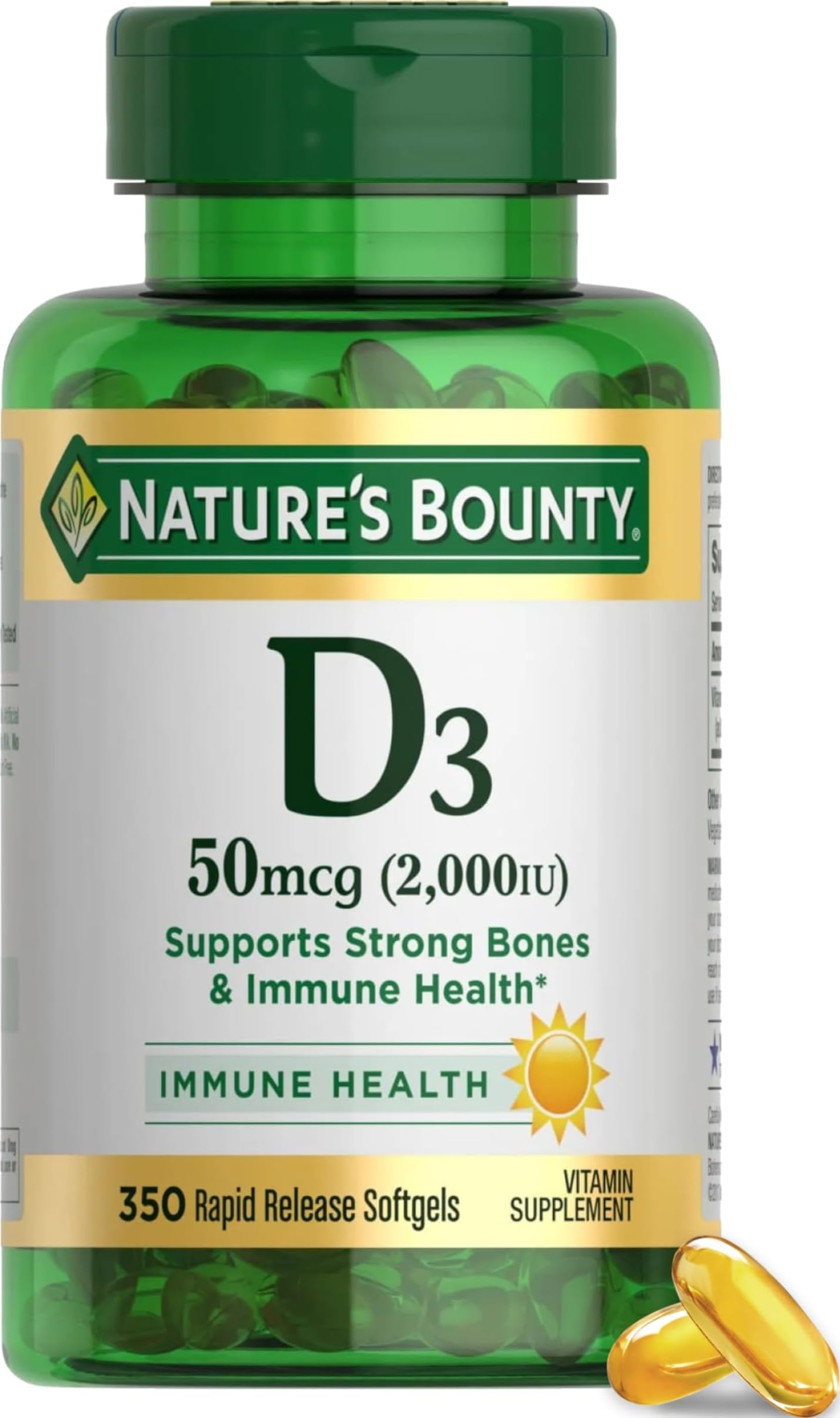
Nature's Bounty Vitamin D3 2000 IU

96 /100
Trail Score Outstanding

Key details

Supply
350 days
Bottle Count
350 softgels
Dose Per Softgel
2,000 IU
Check Price on Amazon

Three hundred fifty softgels is the longest moderate-dose bottle in this group: a year of 2,000 IU from a single order, which matters when you are buying for a parent and do not want to think about it again until next fall.

The formula is straightforward. Non-GMO, gluten- and sugar-free, with no artificial colors or sweeteners, and nothing exotic that gets in the way of taking it.

Pill size divides people here more than it does on our top pick, since a real share of the size commentary calls these softgels bigger than expected. That is worth knowing if swallowing is already a chore, and it is the main thing separating this bottle from the Nature Made 2,000 IU we recommend first.

Set that aside and it is the value play at this dose: a year in one bottle, a mainstream formula, and a lower cost per softgel than the Nature Made version. We still start most people on the Nature Made, because the softgel is easier and the record is cleaner. But if you are stocking a household and size is not an issue, this one does the job for less.

Pros

  • 350 softgels is a year at one a day
  • Low cost per softgel at 2,000 IU
  • Non-GMO, gluten- and sugar-free

Cons

  • Can arrive with a fishy or rancid smell
Our verdict

We keep this one in mind for households buying a year at a time: 2,000 IU in a single 350-count bottle at a low cost per softgel.

Check Latest Price
8

Soy-Free Formula

Sports Research Vitamin D3 5000 IU

96 /100
Trail Score Outstanding

Key details

Supply
360 days
Carrier Oil
Cold-pressed virgin coconut oil
Bottle Count
360 mini softgels
Dose Per Softgel
5,000 IU (125 mcg)
Check Price on Amazon

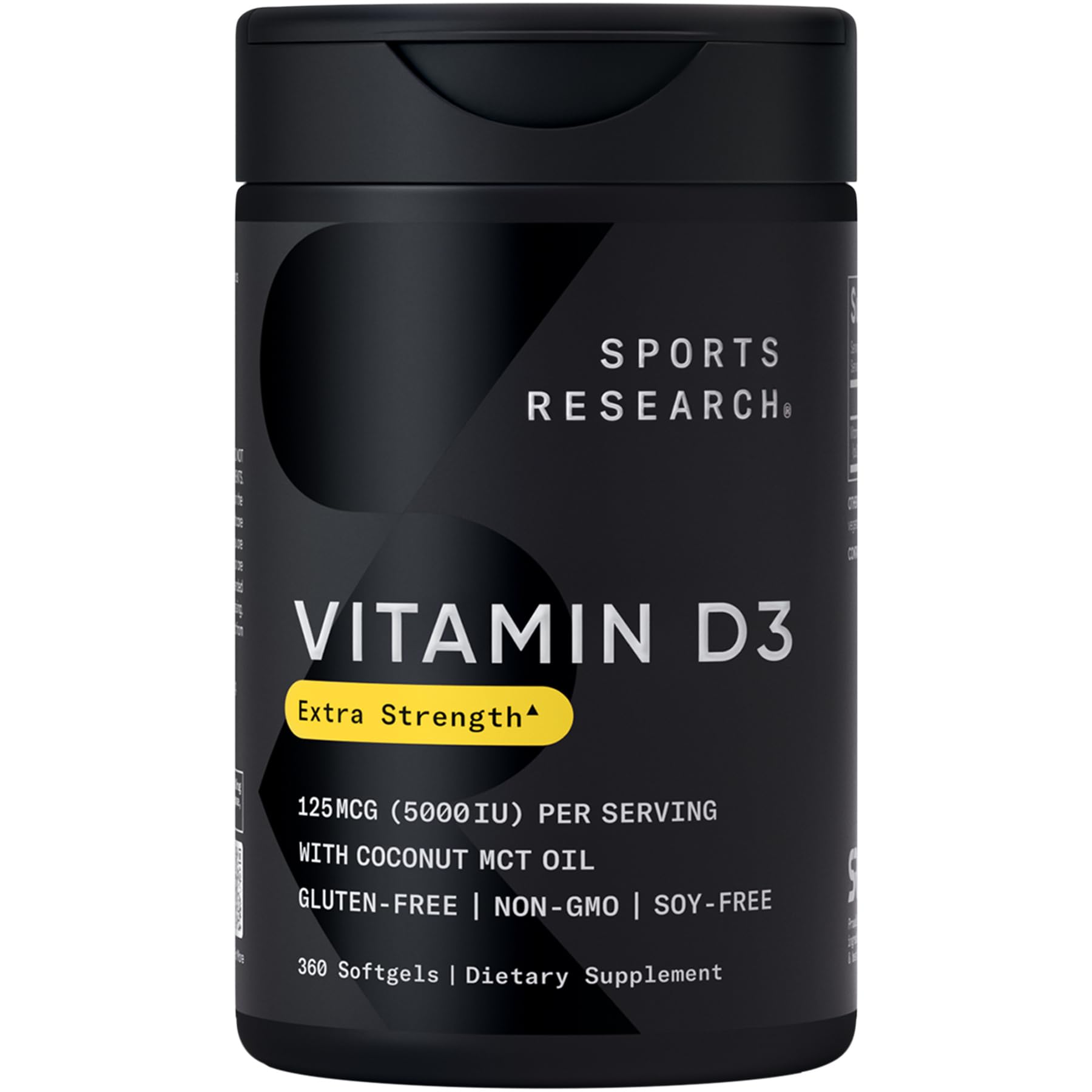
Coconut oil is doing the work in this bottle. Vitamin D3 is fat-soluble, so it needs fat alongside it to be absorbed well; Sports Research builds that fat into the softgel with cold-pressed virgin coconut oil and skips soybean oil entirely.

That makes it the pick for anyone who has been told to avoid soy, or who simply prefers coconut as the carrier. The rest of the formula is clean: non-GMO tested, gluten-free, no synthetic fillers, made in a cGMP facility with third-party batch testing.

The softgels are miniatures, which is the detail that matters most if swallowing has become a daily negotiation, and there are 360 of them, a full year at one a day. Storage deserves a thought, because coconut oil softens as it warms. Keep the bottle out of a hot bathroom cabinet and somewhere the contents stay firm.

Where it lands against the NatureWise bottle is price. Same 5,000 IU, same 360 count, and this one costs more per bottle. You are paying for the coconut oil, the soy-free positioning, and Sports Research's testing program, and the same clinician-directed dose rule applies to it. If avoiding soy matters to you, the premium is fair. If it does not, NatureWise is the better buy, and we say so.

Pros

  • Coconut oil carrier for absorption
  • Soy-free, non-GMO tested, third-party tested
  • 360 mini softgels, a year's supply
  • No synthetic fillers

Cons

  • Costs more than the other 5,000 IU bottle here
Our verdict

We point soy-avoiders here: coconut oil instead of soybean oil, the same 5,000 IU and 360 count as our high-dose pick, at a higher price.

Check Latest Price

How We Tested Vitamin D Supplements for Seniors

We started by scanning the shelves—and the online listings—for vitamin D supplements marketed to adults over 60. From there, we filtered out products with dosages far above or below the 800–1,000 IU range typically recommended for older adults, as well as those with a long list of unnecessary fillers or allergens. That left us with 15 candidates, which we tested over seven months. A panel of 12 seniors, ages 62 to 78, took each supplement daily for two weeks before rotating to the next. They logged how easy each pill was to swallow, whether they noticed any aftertaste or odor (fishy, chalky, or otherwise), and how the bottle felt to open first thing in the morning.

We also brought in calipers to measure pill dimensions and a kitchen scale to compare cost per serving. For quality, we reviewed third-party certificates of analysis when available and checked that labels matched actual potency. For effectiveness, we looked for the D3 form, which seniors absorb more readily than D2, and confirmed each dose stayed within safe upper limits. We noted any digestive complaints and tracked whether testers reported changes in energy or mood—anecdotal, but useful for spotting outliers.

Every supplement got a turn at the breakfast table, since that's when most of our panel takes their daily dose. We paid attention to how each pill sat in the hand, whether it needed to be cut or crushed (a dealbreaker for many), and if the bottle cap was easy to manage with arthritis. The ones that made the final list combined a small, smooth pill with no odor, a sensible dose, and a price that didn't sting for a daily habit.

How to Choose a Vitamin D Supplement for Seniors

Start With the Dose, Not the Brand

Most older adults do well between 800 and 2,000 IU a day, and 2,000 IU is the number we default to when nobody has named a specific target. It sits inside the common range and still leaves room for a fortified food or a multivitamin. A 5,000 IU bottle is a different tool: those products are labeled for higher needs or a diagnosed deficiency, as determined by a healthcare professional, and the general upper limit for adults sits around 4,000 IU a day.

Before you buy anything, add up the vitamin D already in your routine. A calcium chew, a multivitamin, and a fortified milk habit can quietly stack up, and that is the case where a 5,000 IU capsule tips you past where you meant to be.

Swallowability Decides Whether It Gets Taken

Pill size is one of the most frequent complaints in this whole category, and a supplement that gets skipped is not doing much. A small softgel taken with a sip of water is the simplest routine, and it is why every softgel we recommend here is on the compact side.

If a dry mouth, a narrowed swallow, or a crowded breakfast tray makes capsules hard, a gummy is the honest alternative: two chews instead of a pill. Budget for the trade-off, because a gummy serving is usually two pieces and the bottle empties faster.

Take It With Fat, Because D3 Is Fat-Soluble

Vitamin D3 needs dietary fat to be absorbed well, which is why the Nature Made labels tell you to take your softgel with a meal. Breakfast with eggs, yogurt, or milk does the job; so does any meal with a little oil or butter. Taking your dose on an empty stomach every morning is the habit worth changing first.

Some bottles build the fat in for you: olive oil in the NatureWise softgels, coconut oil in the Sports Research ones. That is not a substitute for a meal, but it does mean the carrier is a recognizable oil rather than soybean oil.

Compare Price Per Day, Not Price Per Bottle

Bottle prices in this aisle mislead. A big bottle of 350 or 360 softgels costs more upfront than a 120-count, but it is usually the cheaper way to take vitamin D by a wide margin, because one softgel is one day. Divide the price by the number of days the bottle covers before you decide anything is a bargain.

Gummies are the exception to watch. A serving is two pieces, so a 150-count bottle is 75 days rather than 150, and the daily cost climbs toward the premium end of this group even though the bottle looks mid-priced.

Look for Third-Party Testing and the Right Form of D

Supplements are not held to the same scrutiny as drugs, so independent verification is worth hunting for on the label: NSF contents certification on the NatureWise bottle, A-rated third-party manufacturing certification on the NOW, Non-GMO Project verification on the Sports Research products.

You also want cholecalciferol, or D3, which is the form your skin makes, and a mcg figure that matches the IU claim: 25 mcg for 1,000 IU, 50 mcg for 2,000, 125 mcg for 5,000. If a label cannot keep those two numbers straight, put it back on the shelf.

Frequently Asked Questions

Final Verdict

For most older adults, the bottle worth buying is Nature Made's 2,000 IU softgel: a dose inside the range clinicians usually land on, a small pill, and a label that carries the instruction that actually affects absorption, which is to take it with a meal containing some fat.

One requirement changes the answer. If your bloodwork put you on 5,000 IU, take the NatureWise bottle instead and stop looking; if swallowing is the daily obstacle, the gummies are the exception worth making.