Best Teething Toys of 2026

The first time my daughter chewed through a onesie sleeve to get at my knuckle, I understood what she was after: not a toy, but pressure on those gums, and nothing in the house was small enough, soft enough, and safe enough to deliver it. A teething toy is a blessedly simple object, but simple doesn't mean interchangeable. The shape decides whether a 4-month-old can actually keep hold of it, the material decides whether it survives the dishwasher, and the size decides whether it rides in the car seat or gets quietly retired to a high shelf.

Over the past four months, my team and I have put 18 of them through real life — the freezer door, the diaper bag, the high chair tray, and the 2 a.m. wake-up. The pattern that emerged surprised me: babies don't reach for the cleverest design, they reach for whatever fits a small fist and stays cold long enough to matter. The picks below run from drugstore basics to boutique silicone, and each one earned its place for a different reason. Somewhere in the list is the one your baby will refuse to put down.

1

Best Overall

Comotomo Silicone Teether

96 /100
Trail Score Outstanding

Key details

Shape
Finger-shaped prongs
Material
Food-grade silicone
Dimensions
2.5 x 2 x 4.7 inches
Check Price on Amazon

Babies spend their first months chewing their own knuckles, and the Comotomo copies them: a round silicone handle with four finger-sized prongs on top. Hand it to a four-month-old and the chewable end lands exactly where the hand already goes. That's the case for it as a first teether, and it's why this is the one we recommend for a young baby without much discussion.

The single-piece build settles it. There's no gel to chill, no valve, no seam between a handle and a chew head, so nothing can come apart in a mouth and nothing needs assembling. The food-grade silicone takes heat, which puts the dishwasher, a pot of boiling water, and a steam sterilizer all on the table. Teethers spend half their lives on the floor, and one you can genuinely sterilize gets properly cleaned instead of wiped on a sleeve.

It's small, at 2.5 by 2 by 4.7 inches, which is the point for a three- or four-month-old who can't yet manage a banana or a carrot. Past the first few teeth, a bigger baby will want more surface and more variety, and that's when we hand over the Winkel or the Fu Store tubes. Until then, nothing here does the basic job better.

Pros

  • One-piece silicone with nothing to leak or detach
  • Dishwasher, boiling water, and sterilizer safe
  • Finger-shaped prongs reach the gums a fist reaches
  • Small enough for a three-month-old's grip

Cons

  • Attracts lint and pet hair between uses
Our verdict

The teether we hand a young baby first: one piece of silicone, nothing to come apart, and a shape that reaches gums a fist can't.

Check Latest Price
2

Best for Gripping and Shaking

Manhattan Toy Winkel

96 /100
Trail Score Outstanding

Key details

Age
Newborn and up
Care
Surface wash only, do not submerge
Material
BPA-free soft tubing
Dimensions
5 x 4 x 3.5 inches
Check Price on Amazon

Two hands, one toy: the Winkel is a looped maze of soft tubing that a four-month-old can grab with both fists and shake, and the rattle in the middle makes the shake worth repeating. Of everything we handled, it's the pick that doubles as a real toy, with the teething almost a side effect of all that grabbing.

The tubes are the teething part, and there are a dozen angles to mouth, so a baby can find the one that matches the spot that hurts. It's rated from newborn up and measures 5 by 4 by 3.5 inches, which makes it the most forgiving shape here for a very young baby still working out how hands operate. It's also soft enough that a wild swing at the face doesn't end the session.

Where it doesn't suit: a baby working on molars wants something slim that reaches the back of the mouth, and this maze doesn't get there. It's a front-of-the-mouth toy that happens to be excellent company.

It's the most expensive of the small teethers here, and the extra buys the rattle and the construction rather than more chewing surface. We still think it's worth it, because this is the one babies pick up on their own long after the gums have settled.

Pros

  • Dozens of tube angles to mouth
  • Two-handed grip babies manage early
  • Rattle keeps it in play after teething
  • Rated from newborn up

Cons

  • Surface wash only, so no dishwasher or boiling
Our verdict

Buy it if you want one object that teethes and entertains; the two-handed grip and the rattle earn their keep, provided you can live with surface washing.

Check Latest Price
3

Best Texture Variety

Infantino Lil' Nibbles Teether Set

96 /100
Trail Score Outstanding

Key details

Care
Surface clean only
Pieces
3 teethers
Material
Food-grade silicone
Check Price on Amazon

Three teethers in one pack, each a different vegetable with a different surface: ridges on the carrot, bumps on the corn, a handle at each end of the pod. We think it's the smartest buy here for the four-to-eight-month stretch, when a baby wants variety but can't yet tell you which shape is working.

The silicone is soft enough that a missed swing lands without a yelp, which we came to value at the stage where aim is approximate. Each shape offers a genuinely different feel, so a baby working on front teeth can choose between a broad surface and a narrow ridge, and three of them means one can live in the car, one in the diaper bag, and one in the wash.

The carrot is a substantial mouthful, and smaller babies can find it awkward; the three-to-six-month crowd did noticeably better with the Comotomo. Once a baby is sitting up with a couple of teeth in, the bigger surfaces here turn into the advantage rather than the problem.

Pros

  • Three shapes and textures in one pack
  • Soft silicone that forgives a missed swing
  • Handles that let a baby use one hand or two
  • Easy for tiny hands to grasp

Cons

  • Care instructions conflict, so hand-wash to be safe
Our verdict

The best variety in this group: three shapes with different surfaces, sized for the months when a baby starts choosing what feels good.

Check Latest Price
4

Best for Gum Massage

Baby Banana Teether Toothbrush

96 /100
Trail Score Outstanding

Key details

Age
6-18 months
Care
Dishwasher safe
Material
Food-grade silicone
Dimensions
4 x 3 x 1 inches
Check Price on Amazon

Most teethers are lumps of silicone shaped to be chewed. This one has bristles, which makes it the only pick here doing two jobs at once: it scrubs a sore gum, and it gets a baby used to the idea of a brush in their mouth before anyone has to fight about it.

The peel-shaped handles are the design detail we didn't expect to care about. They stop the brush end from going too far back, and the whole thing is flexible enough that a tumble onto it isn't the accident a rigid toothbrush would be.

We treat it as a second teether rather than a first. It earns its place from around six months, when a baby starts poking at their gums with a finger and the bristles give more feedback than a smooth surface. The chewing motion is the same one they'll use on a brush later, which is the real reason it stays in the rotation.

It's dishwasher safe, so it's the easiest thing here to keep clean, and at 4 by 3 by 1 inches it drops into a cup holder or a diaper-bag pocket. That's more than the bigger teethers on this page can manage.

Pros

  • Bristles massage gums and start a brushing habit
  • Peel handles limit how far it goes back
  • Flexible silicone is forgiving in a fall
  • Dishwasher safe

Cons

  • Small brush head covers less gum at once
Our verdict

The one to add once a baby is around six months: bristles that scrub sore gums and start a toothbrush habit, in a shape that can't go too far back.

Check Latest Price
5

Best Cooling Teether

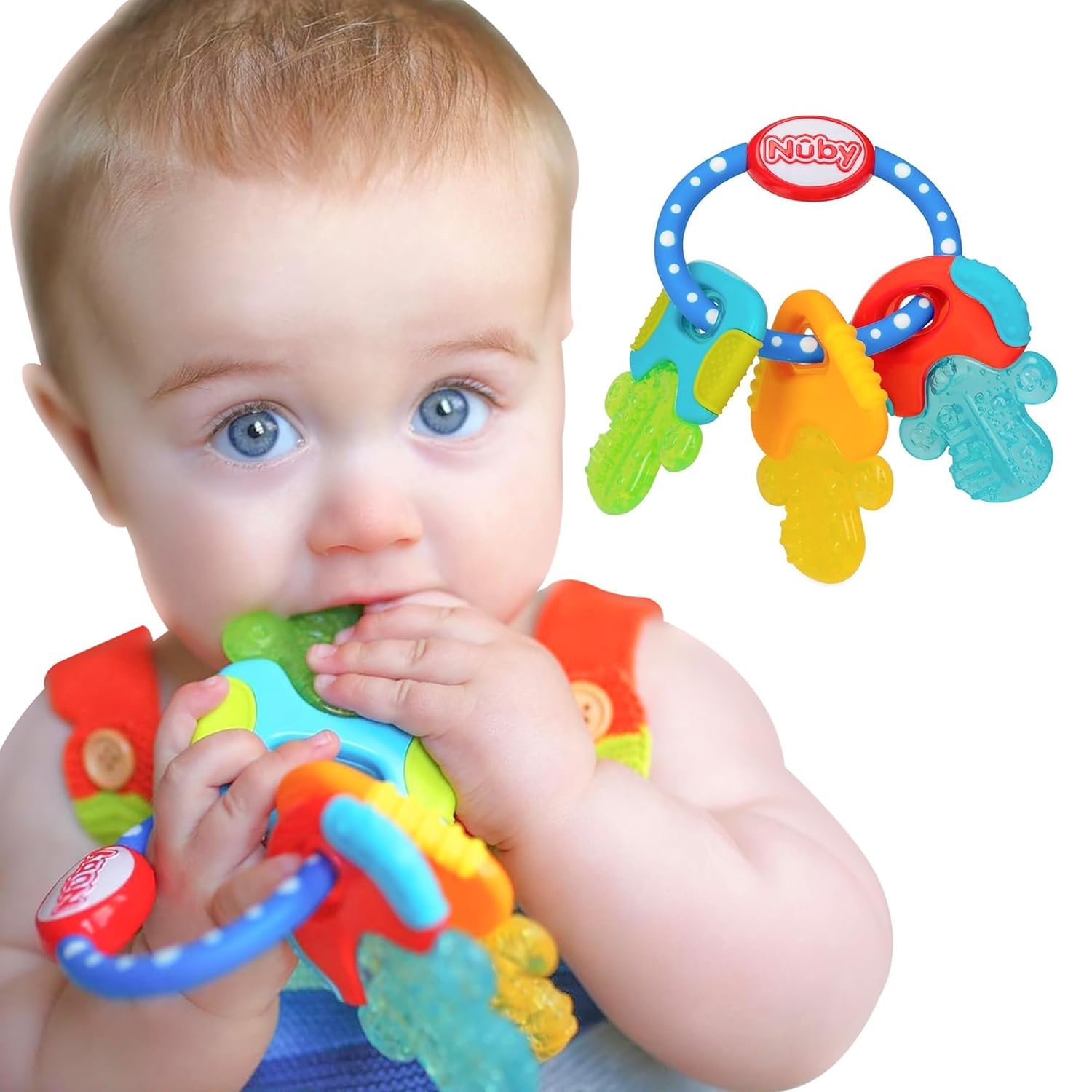
Nuby Ice Gel Teether Keys

95 /100
Trail Score Outstanding

Key details

Care
Warm water and mild soap
Weight
2 oz
Material
Silicone with ice gel fill
Dimensions
1.5 x 6.5 x 4.1 inches
Check Price on Amazon

Cold is the oldest trick for sore gums, and these keys are built around it: silicone keys with ice gel sealed inside, meant to sit in the refrigerator. Chilled and handed over, they buy a few minutes of real relief, and then the gel warms up and you're holding a room-temperature keyring again. That's the honest shape of a cooling teether.

What surprised us is how much the keys work without the cold. The ring holds several keys with different bumps and edges, so there's a surface for every part of the gum, and a baby can gnaw the handle end while the rest hangs. As a plain teether it holds its own against anything here that doesn't chill.

Care is specific and worth following: warm water and mild soap, per the maker. High heat is the risk with a gel fill, since a bottle sterilizer or a rolling boil can damage the seal, and a damaged gel teether is one to replace rather than keep using. Wash it, chill it, hand it over.

It won't be the only teether a baby uses, and it isn't trying to be. It's the one that comes out when a tooth is actually moving and nothing else is working.

Pros

  • Gel-filled keys chill in the refrigerator
  • Several key shapes and bumpy edges to chew
  • Works as a plain teether without chilling

Cons

  • Big and heavy in a young baby's hands
Our verdict

The cooling pick, and the only one here that chills: worth it for the worst evenings, as long as you keep it out of the sterilizer.

Check Latest Price
6

Best for Babies Who Drop Everything

Smily Mia Penguin Teether

95 /100
Trail Score Outstanding

Key details

Care
Dishwasher safe, boilable
Count
2 teethers
Material
Food-grade silicone
Dimensions
4.4 x 1.85 x 3.7 inches
Check Price on Amazon

If your baby refuses a pacifier and treats every teether as something to drop off the side of the stroller, this is the one to try. The penguin is a chunky open silicone shape with a wing on either side, so a small fist closes around the body and the chewing surface sits right at the mouth.

It's one piece of food-grade silicone with meaty walls, firm enough to take a real bite without turning into hard plastic, and it goes in the dishwasher or a pot of boiling water. The two-pack is the practical part: one for the diaper bag, one for home, and a spare whenever one is in the wash.

The case for it over a slimmer teether is grip. A baby who drops everything else holds this one, and the chewable surface stays at the mouth instead of swinging past it. Of the picks here, it's the one we hand a baby who can't yet manage a stick or a tube.

Pros

  • Open shape stays gripped in a small fist
  • Thick silicone takes a hard bite
  • Dishwasher and boiling safe
  • Two-pack keeps a spare clean

Cons

  • Rated only to six months, so it's outgrown fast
Our verdict

The teether for a baby who drops everything or won't take a pacifier: chunky enough to stay gripped, sold as a two-pack so one is always clean.

Check Latest Price
7

Back-Gum Reach

Fu Store Hollow Teether Tubes

96 /100
Trail Score Outstanding

Key details

Care
Hand wash, dishwasher, boiling
Count
5 tubes
Shape
Hollow apple-shaped tubes
Material
Food-grade silicone
Check Price on Amazon

Back gums are the hardest thing to reach. A baby can get a finger to the front teeth, but the molars at the sides and back need something long and slim, and these hollow tubes are exactly that: an apple-shaped handle with a tube a baby can run along the side of the mouth.

They're food-grade silicone, dishwasher safe, and safe in boiling water, and the hollow centre means drool runs through instead of pooling around the chew. Five in the pack sounds excessive until you've watched one roll under the stroller for the third time; we kept one in the stroller, one in the diaper bag, and the rest in the kitchen, and there was always a clean one.

It's a specialist, not a starter teether. The tube does one thing well, reaching the sides and the back, and a baby who wants a big soft mouthful still goes back to the Comotomo or the carrot. This is the pick you add once the molars start moving.

Where it wins is the combination of reach and redundancy. Nothing else here gets to the back of the mouth as easily, and nothing else survives being lost quite so gracefully: losing one costs you a fifth of a pack, not the whole purchase.

Pros

  • Slim tubes reach the sides and back gums
  • Dishwasher and boiling safe
  • Five per pack, so one is always clean

Cons

No notable drawbacks to flag.

Our verdict

The specialist for back gums, and the pack we take on trips: five slim tubes that reach where a finger can't, for the molar months.

Check Latest Price
8

Comfort and Chew

Itzy Ritzy Lovey with Teether

98 /100
Trail Score Outstanding

Key details

Care
Surface clean only
Material
Sherpa plush and silicone
Chew Piece
Textured silicone
Dimensions
6 x 2.25 x 9.75 inches
Check Price on Amazon

This isn't a teether the way the others here are, and we'll say so up front: it's a small sherpa bunny with a textured silicone teether where the face would be, plus ribbons to finger and crinkly arms. A baby can chew the silicone corner. The rest is for cuddling, grabbing, and the car seat.

At three to five months, that combination is more useful than it sounds. A baby that age can't hold a big teether for long, but can clutch a soft body against their chest and get the teether corner to their mouth. The crinkle is quiet enough not to be maddening in the back seat, and the ribbons give fingers something to find.

It's 9.75 inches from ear to foot, which is bigger than it looks in photos: long enough for a baby to drape over an arm, small enough to tuck beside them in the stroller. The silicone corner is the part that goes in the mouth, and it wipes clean in seconds.

What it can't do is the hard work. There's no cooling, no bristles, and nothing long enough to reach the back gums, so it sits alongside a real teether rather than instead of one. As the thing a tired baby cuddles while a tooth comes through, though, it's the most comforting object here.

Pros

  • Plush body a small baby can clutch and cuddle
  • Textured silicone corner to chew
  • Quiet crinkle and ribbons for fingers

Cons

  • Surface clean only; the plush can't be machine washed
Our verdict

A comfort object with a chewable corner rather than a real teether: lovely for a tired three-to-five-month-old, and a supplement to a proper chew.

Check Latest Price

How We Tested 18 Teethers Through Four Months of Real Teething

I built the shortlist starting with materials and safety: food-grade silicone, natural rubber, and untreated beechwood made the cut, while anything with beads, loose parts, or a seam that could split under a determined jaw did not. From there I filtered by size (nothing narrow enough to slip past a cheek), whether the manufacturer actually stood behind dishwasher cleaning, and whether the shape gave a baby a real place to grip rather than a smooth blob to fumble.

Then came four months with 18 teethers and a baby cutting her first teeth the entire time. They lived in the freezer door, the diaper bag, the stroller basket, and the car seat. I handed each one over during the fussy stretch before naps, after dinner in the high chair, and at 2 a.m. when the molars arrived. A rotating cast of friends' babies, from 3 to 14 months, chewed on the rest so I could see how each one performed with different mouths and different grips.

What I watched for: whether a 4-month-old could keep hold of it one-handed or whether it hit the floor every 30 seconds; how long a chilled teether stayed cold in a warm fist before it stopped settling anyone; and how each one came out of the dishwasher and off the tile floor after weeks of chewing on the same corner. I also noted which ones got tossed into the bag on the way out the door — the ones a caregiver actually reaches for are rarely the fanciest.

How to Choose a Teething Toy

Match the shape to the hand, not the age on the box

A three-month-old grips with the whole palm and can't rotate a wrist yet; a nine-month-old picks things up with a thumb and forefinger and wants to steer them. That's why the small, finger-shaped Comotomo suits a young baby while the long Fu Store tubes only become useful once there's some control. The rating on the package is a decent proxy, but the real test is whether the chewable end reaches the mouth once the hand closes around the handle. If a baby has to fight the grip, they drop it and chew a fist instead.

One piece or filled: what can come apart

A one-piece silicone teether has nothing to leak, split, or come apart, which is why we default to it for the youngest babies. A gel-filled teether like the Nuby keys adds cooling, and the trade is that the seal is the whole product: high heat in a sterilizer or a pan of boiling water can damage it and end its life early.

If you want the cold, buy the gel teether and treat the care line as a rule rather than a suggestion. If you want to boil something after a week in a diaper bag, buy solid silicone.

Cleaning is a buying decision, not a footnote

A teether goes on the floor, into a diaper bag, and into a mouth several times a day. Anything that can go in the dishwasher or a pot of boiling water gets genuinely clean; anything surface-wash-only gets wiped with a cloth and hope. The Winkel is the best toy in this group and the hardest to clean, which is why we pair it with something washable rather than making it the only teether in the house.

If the care instructions contradict each other, hand-wash until you know better. A minute with soap and warm water has never damaged a teether.

Texture decides which gums get relief

Front teeth want a broad, soft surface. The molars at the back want something long and narrow that can slide along the side of the mouth. Sore gums in between respond to bristles and nubs that give a little feedback. That's why three different textures beat three of the same thing, and why the bristled Baby Banana and the hollow Fu Store tubes earn a place next to a plain silicone chew rather than replacing it.

Cooling helps for minutes, not hours

A chilled teether dulls the ache long enough to get a baby over a hump, and then it doesn't. Gel warms against a hot mouth, and nothing here holds a chill for long. The practical move is two gel teethers on rotation in the refrigerator door so one is always cold.

Keep it out of the freezer if the maker only mentions the fridge, and keep it well away from the sterilizer.

Frequently Asked Questions

Final Verdict

Buy the Comotomo. From about three months it's the simplest thing here to get right: one piece, nothing to leak or come apart, small enough for a baby to aim, and cleanable in the dishwasher or a pot of boiling water.

If your baby wants to grab and shake as much as chew, the Winkel is the better toy. If the evenings are bad, add the Nuby keys and keep them in the fridge door. Two or three teethers, chosen for grip and for how you'll wash them, cover the whole first year.