Best Tea for Arthritis Inflammation

There's a particular morning I keep coming back to: a cold kitchen, a jar lid that wouldn't budge, and hands that felt a decade older than the rest of me. Searches for arthritis tea rarely start with a flavor craving — they start with stiffness and the hope that something warm you drink anyway might quietly help. But a tea only earns a place in your day if it tastes good enough to finish, cup after cup, and if the ginger, turmeric, or green tea in it is actually present in meaningful amounts rather than trailing at the bottom of the ingredient list.

My team steeped 16 different teas over the past three months — bagged grocery staples, loose-leaf blends, and a few that cost more per cup than my morning coffee. What separated them had almost nothing to do with the promises on the box. It came down to whether the spice came through, whether the bag survived a second steep, and whether I reached for another cup the next morning without thinking about it. The handful that did are the ones I've kept restocking.

1

Best Overall

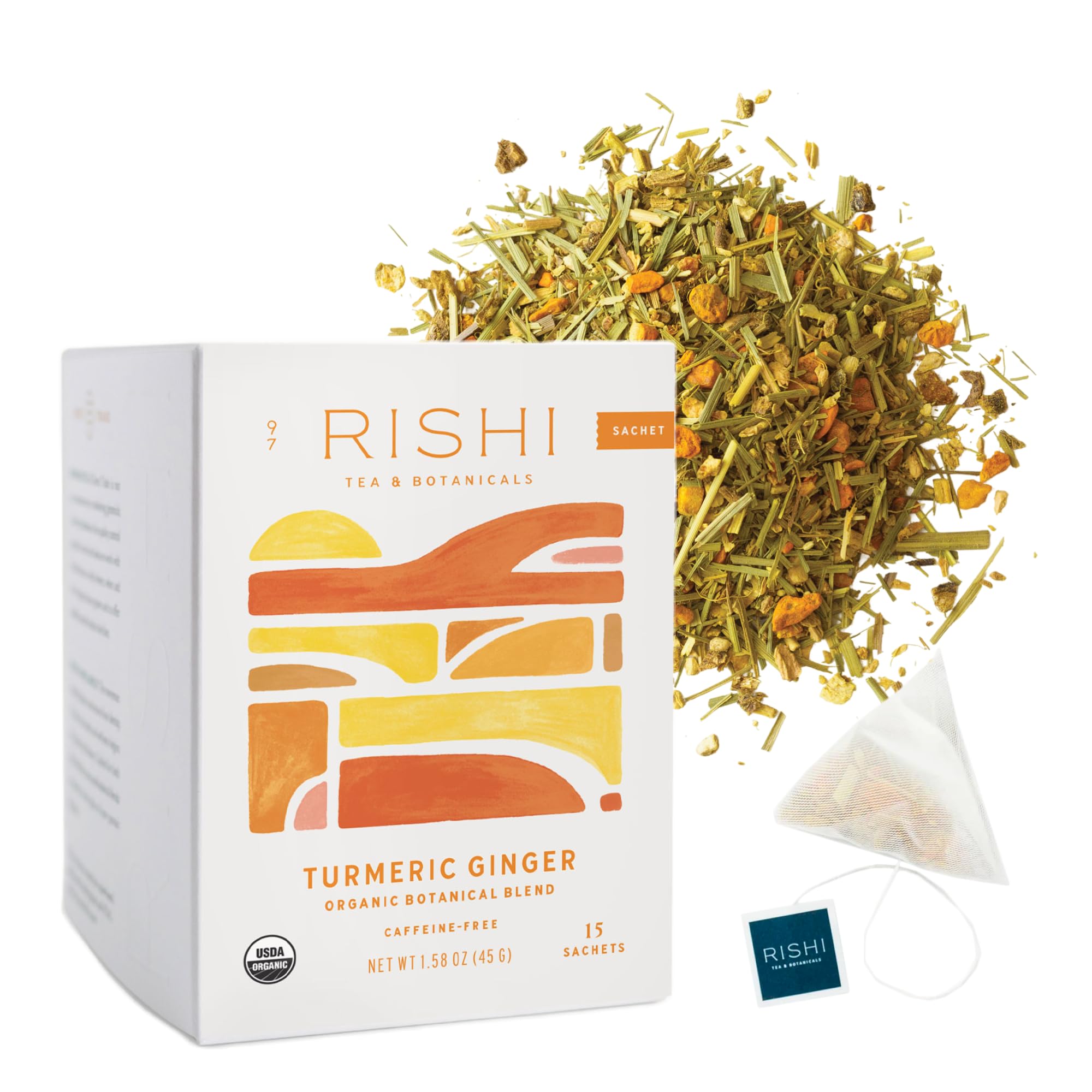
Rishi Turmeric Ginger

93 /100
Trail Score Outstanding

Key details

Count
15 sachets
Steep
200°F for 5–7 minutes
Caffeine
Caffeine-free
Certification
USDA Organic, Non-GMO
Check Price on Amazon

Set Rishi's sachet next to the other turmeric blends we brewed and the difference shows up in the first mouthful: this one tastes like spices rather than like something made medicinal. Turmeric, ginger, citrus and a little licorice, with the ginger carrying real heat. That matters more than it sounds, because the way this category fails is not a bad first cup — it is the box you stop opening in week two.

The brewing directions are unusually specific, 200°F water for five to seven minutes, and they are worth following. Pull the bag early and you get a thin, chalky cup; give it the full seven minutes and the turmeric turns round and earthy, with the licorice softening the finish. We noticed the citrus most in the aftertaste, which is what keeps it from tasting like a spice drawer.

Where it lands for us: this is the box to open when you want the cup rather than the routine. It is a flavor pick rather than a value pick, and if turmeric tea is going to be three mugs a day, a bulk pouch makes more sense. But if you are trying to build the habit at all, start with the one you will actually finish.

Pros

  • Bold, spicy turmeric-ginger flavor
  • Licorice softens the earthy finish
  • USDA Organic, biodegradable sachets

Cons

  • Small 15-sachet box at the highest cost per cup
Our verdict

Start here: the best-tasting turmeric-ginger tea we brewed, and the one that makes a daily cup easy to keep.

Check Latest Price
2

Best Bulk Value

VAHDAM Turmeric Ginger

93 /100
Trail Score Outstanding

Key details

Bags
Plant-based, biodegradable
Count
100 pyramid bags
Caffeine
Caffeine-free
Packaging
Resealable pouch
Check Price on Amazon

A hundred pyramid bags in one resealable pouch changes how you drink the stuff: there is no rationing, no saving the last bag for a special morning, and the pouch seals well enough that the tea at the bottom is still good when you get to it.

The trade-off is strength. These bags brew a milder, more ginger-forward cup than the turmeric content suggests, and the fix is simple — steep longer than feels necessary, or drop two bags in the mug. Even at two bags a cup you are spending less per mug than most of the sachets here cost, which is the entire argument for buying in bulk.

Ginger is the loudest thing in the cup and the turmeric sits behind it, earthy rather than bitter. The bags are plant-based and biodegradable, the blend is caffeine-free, and the whole thing is built for someone who has already decided turmeric tea is part of the day.

Pros

  • Hundred bags in a resealable pouch
  • Lowest cost per mug in this set
  • Plant-based, biodegradable pyramid bags

Cons

  • Bulky pouch takes up shelf space
Our verdict

For anyone already drinking turmeric tea once or twice a day, the big pouch is the practical buy — mild, ginger-forward, and the lowest cost per mug here.

Check Latest Price
3

Best Herbalist-Formulated Blend

Traditional Medicinals Turmeric Meadowsweet

93 /100
Trail Score Outstanding

Key details

Count
16 tea bags
Caffeine
Caffeine-free
Ingredients
Turmeric, ginger, meadowsweet
Certification
USDA Organic
Check Price on Amazon

Meadowsweet is what separates this box from every other turmeric blend here, and it is also the reason some readers should skip it. The third herb has a long history of use against inflammation, and it carries salicylates — the same family of compounds as aspirin — so if you have an aspirin allergy, buy a different box. For everyone else it is the most purposeful formula in the set.

The cup is warming and savory rather than bright: turmeric and ginger up front, a soft hay-like edge from the meadowsweet, and enough spice to notice without any burn. It is herbalist-formulated and certified organic, and it goes down without honey, which is not something we say about every turmeric tea here.

If you have read about meadowsweet and want it in a cup rather than a capsule, this is the only blend here that has it. The earthy, savory character is closer to a traditional herbal infusion than to the chai-spiced cups most people start with, and that is the honest trade: more purposeful, less immediately likable.

Pros

  • Meadowsweet adds a third traditional herb
  • Warming, savory, gently spiced cup
  • Certified organic, caffeine-free, compostable

Cons

  • Small 16-bag box
Our verdict

A herbalist-built blend that earns its place on the third ingredient — warming, savory, and easy to drink without sweetener.

Check Latest Price
4

Best Morning Cup

Bigelow Matcha Turmeric Green Tea

94 /100
Trail Score Outstanding

Key details

Count
108 tea bags
Caffeine
Caffeinated
Packaging
Individually foil-wrapped
Ingredients
Green tea, matcha, turmeric
Check Price on Amazon

Seven in the morning is the wrong time for a caffeine-free cup, and almost every turmeric tea here is exactly that. Bigelow puts green tea and matcha in the bag alongside the turmeric, so one mug does the job a turmeric capsule and a coffee were doing separately.

We expected the turmeric to be buried, and it isn't — it lands as a peppery finish under the green tea. The matcha gives the cup body, and this is the easiest of the bunch to drink without honey. The caffeine is gentle, well short of a mug of black tea, so an afternoon cup is fine.

The format is the practical argument: six boxes of eighteen, every bag in its own foil pouch, so the ones you are not drinking stay fresh. That is a lot of cupboard space and a lot of foil, and it is the one here we restock for mornings rather than evenings.

Pros

  • Green tea and matcha alongside turmeric
  • Individually foil-wrapped for freshness
  • Turmeric still reads through the green tea
  • Gentler caffeine than black tea

Cons

  • Caffeine rules out an evening cup
Our verdict

The turmeric tea to buy if the cup also has to replace your morning coffee — real matcha body and gentle caffeine.

Check Latest Price
5

Best Single-Herb Nettle

Traditional Medicinals Nettle

94 /100
Trail Score Outstanding

Key details

Count
16 tea bags
Caffeine
Caffeine-free
Ingredients
Organic nettle leaf
Check Price on Amazon

Nettle is not a turmeric substitute; it is a different errand. There is no curcumin here — instead you get a dark, grassy, mineral-tasting leaf that people drink for seasonal allergies and for swelling, and it is the option in this set for anyone who finds the spice blends too much first thing.

Traditional Medicinals' version is the tidy introduction: organic nettle in a plain bag, brewing up dark and grassy with a faintly savory, hay-like finish. It takes honey well and does not want milk, and it is mild enough to drink without thinking about it.

The trade against a bulk pouch is convenience for quantity: sixteen measured bags, no strainer, no guessing at a spoonful. What you give up is volume — a pound of leaf makes far more cups — so this is the box while you are deciding whether you like nettle at all.

Pros

  • Organic nettle in a measured bag
  • Grassy, mild cup that takes honey
  • No strainer or measuring needed

Cons

  • Earthy, hay-like flavor will not suit everyone
Our verdict

The nettle tea to buy if you want bags rather than loose leaf: organic, mild, and easy to drink plain.

Check Latest Price
6

Best Loose-Leaf Value

MagJo Nettle Leaf

93 /100
Trail Score Outstanding

Key details

Format
Cut and sifted loose leaf
Origin
Wild-harvested, Eastern Europe
Weight
16 oz
Packaging
Resealable foil pouch
Check Price on Amazon

Dried nettle does not sting — the sting is gone once the leaf is dry — so a pound of it arriving in a resealable foil pouch is less intimidating than it sounds. There is nothing to handle carefully, just a big bag of green, hay-scented tea.

Cut and sifted means small, even pieces rather than whole leaves, so a tablespoon goes a long way and you will want a fine strainer. What you get for the fuss is quantity and freshness: the leaf is wild-harvested in the foothills of Eastern Europe and brews a deep green, full-bodied cup.

Our take: if nettle is already a daily habit, this beats boxed bags on both volume and cost per cup, and the pouch keeps it fresh between scoops. If you have never had nettle, buy a box first — the flavor is exactly what it sounds like, and a pound is a long commitment to a maybe.

Pros

  • Full pound of cut-and-sifted leaf
  • Resealable pouch keeps it fresh
  • Wild-harvested; no sting once dried

Cons

  • Needs a fine strainer and a measuring spoon
  • Not portable the way tea bags are
Our verdict

Buy this once nettle is a daily habit — a pound of wild-harvested leaf, resealable, and far more cups than boxed bags.

Check Latest Price
7

Best for Iced Tea

Republic of Tea Turmeric Ginger

93 /100
Trail Score Outstanding

Key details

Count
50 tea bags
Steep
Just under boiling, 1–3 minutes
Caffeine
Low caffeine
Ingredients
Turmeric, green tea, ginger, cinnamon, honey flavor
Check Price on Amazon

Iced is where this one earns its place. Fifty bags in a canister, a short steep — one to three minutes in water just short of boiling — and a turmeric-green tea with no bitter aftertaste, which is exactly what you want when you are pouring it over ice.

The blend is turmeric, green tea, ginger, cinnamon and honey flavor, and the honey is doing quiet work: it rounds off the turmeric so the cup reads smooth rather than sharp. It is a light tea, delicate enough that a heavy spoon of honey or a splash of milk will flatten it.

If you want the turmeric to lead, use two bags and steep at the top of the range; that is the adjustment this one asks for. At one bag it is a pleasant, mild cup that is closer to a green tea with a golden tint than to a spice blend.

What we like is the flexibility. Low caffeine means it works in the afternoon, and it is the one here we keep making by the pitcher rather than the mug. Buy the canister if iced tea is how you will actually drink it; for a hot, spicy cup, Rishi is the better answer.

Pros

  • Fifty bags in a reusable canister
  • Smooth, honey-rounded, no bitterness
  • Low caffeine works in the afternoon
  • Holds up hot or iced

Cons

  • Costs more per cup than the budget boxes
Our verdict

The turmeric tea for people who drink it iced — light, smooth, low-caffeine, and built for a pitcher rather than a single mug.

Check Latest Price
8

Budget Chai

Yogi Honey Chai Turmeric

95 /100
Trail Score Outstanding

Key details

Bags
Compostable
Count
16 tea bags
Caffeine
Caffeine-free
Certification
USDA Organic and Non-GMO Project Verified
Check Price on Amazon

Yogi does the friendliest thing anyone here does with turmeric: it turns it into chai. Cinnamon, cardamom, ginger, clove and a honey flavor, and the spice mix covers the dusty edge that puts people off straight turmeric tea.

It is caffeine-free and takes milk well, which makes it a genuine evening cup rather than a spice tea you drink out of duty. The honey flavor does the sweetening for you, and the spice is warming rather than hot.

What you get is a low-commitment way in: one small box and a cup that answers the question of whether you like turmeric at all before you buy a hundred bags.

The compostable tea bags and B Corp certification do not change the taste, but they are the details we noticed on the box and they make an inexpensive tea easier to keep buying. What is left is a chai that happens to have turmeric in it — and if that is what gets you drinking the stuff daily, that is the whole point.

Pros

  • Chai spices make turmeric easy to drink
  • Caffeine-free, no sweetener needed
  • Compostable bags, B Corp certified

Cons

  • Sweetness comes from honey flavoring, not honey
Our verdict

The gentlest way into turmeric: a caffeine-free chai that needs no sweetener and costs the least to try.

Check Latest Price

How We Picked and Steeped 16 Teas

We started with ingredient panels rather than product names. Anything that listed its headline spice after the flavorings was set aside, as were blends that only came in single-serve boxes priced like a splurge; we wanted a mix of bagged and loose-leaf, caffeinated and herbal, and a real spread of cost per cup. That left 16 teas, each steeped at the temperature and time its package specified.

Testing happened where tea actually gets drunk: at the kitchen counter before work, in a travel mug on a 20-minute walk, and at my desk around three in the afternoon. I tasted every one plain first, then with honey and lemon, and noted whether the flavor sharpened or fell apart. Each tea got a second steep to see what was left, and I counted bags per box against the price to work out cost per cup.

Strength was mostly a question of steep time — some turned bitter at four minutes, while others stayed mild and pleasant at six. For quality, I checked whether the bag held whole pieces of root and leaf or fine dust, and whether the seams held up. Soothing came down to mouthfeel and whether a cup sat easily on an empty stomach. On effectiveness, I'll be straight with you: nobody can measure inflammation from a kitchen, so we judged each tea on how much of the active ingredient was genuinely in the bag and whether it was something I'd drink daily — which, over months, is the only version of that benefit that counts.

How to Choose a Tea for Arthritis Inflammation

Match the botanical to what you're managing

Turmeric and ginger are the pair with the longest tradition behind them for joint complaints, and they are what most of this category is built on. Nettle is a different errand: it is the leaf people reach for when seasonal allergies and swelling are part of the picture, and it makes a serviceable caffeine-free evening cup. Green tea blends split the difference, giving you antioxidants and a little caffeine alongside the turmeric.

One trap worth knowing: turmeric's position at the top of an ingredient list tells you it is the largest component by weight, not how much curcumin reaches your cup, and no tea bag states that figure. Judge a blend by how it smells when you open the pouch and how strong it brews, not by where the turmeric sits in the list.

Decide whether caffeine belongs in the cup

Three of the picks here are built on green tea, which means caffeine — useful if the mug is replacing your morning coffee, a bad idea if you are planning one before bed. If you want two or three cups spread across a day, buy caffeine-free and stop doing arithmetic.

A simple rule: if you drink tea after six in the evening, keep a caffeine-free turmeric or nettle blend on the shelf and save the green tea versions for the morning. It also makes the cup easier to drink for a reason rather than as a treat.

Judge strength before you commit to a big box

The most common disappointment in turmeric tea is not flavor, it is a bag that brews pale and slightly dusty no matter how long you leave it. Steeping instructions are your best clue from the outside: a blend that asks for five to seven minutes at 200°F is built for a long extraction, while a one-to-three-minute steep is aiming at a lighter cup.

Buy the small box first. A hundred bags is only a bargain if you would happily drink the hundredth, and if you find yourself using two bags per mug to taste anything, the value quietly disappears.

Bags, sachets, or loose leaf

Individually foil-wrapped bags hold their aroma longest, which is why the large multi-box counts are packed that way, but you are unwrapping something every time. A resealable pouch is fine if you finish it within a few months and is the better choice for a genuine daily habit.

Loose leaf is the cheapest route per cup and the best if you like a strong infusion, but it needs a fine strainer and a tablespoon measure, and it is not something you will make at a desk. Start with bags; move to loose leaf once the habit has stuck.

Frequently Asked Questions

Final Verdict

Rishi's Turmeric Ginger is the box we point people to first. A turmeric habit only survives if the cup is good enough to want twice, and this is the one here that tastes like something you would choose rather than something you are taking.

If the tea is already a daily fixture, VAHDAM's hundred-bag pouch is the cheaper way to keep it going, and a longer steep closes most of the strength gap. And if seasonal allergies are part of the picture alongside joint pain, start with nettle instead — Traditional Medicinals' bags to find out whether you like it, MagJo's pound once you know.