Best Rebounder Trampolines for Adults of 2026

A rebounder looks like a toy until you spend ten minutes on one. Then it becomes a low-impact cardio session, a quick mood lift, and a reason to move when weather keeps you inside. The appeal is simple — springy, joint-friendly exercise without a gym — but the category splits in two. Cheap models feel wobbly and wear out; sturdier ones cost more and take up space. What a good adult rebounder fixes is the gap between exercise you dread and movement you might look forward to.

I put nine adult rebounders through eight months of workouts, quick work breaks, and weekend sessions, assembling each myself and living with it long enough to notice small annoyances. We compared build quality, bounce, and frame stability, then checked how mats and springs held up—because a rebounder that feels fun for five minutes but wobbles by week three is not a good value. The winners were the ones I reached for without scheduling a workout, and that made exercise feel less like a chore.

1

Best Overall

JumpSport 250 Rebounder

92 /100
Trail Score Outstanding

Key details

Warranty
Lifetime frame, 2 yr cords and mat
Bounce System
30 EnduroLast bungee cords
Jumping Surface
36 in mat in a 39 in frame
Weight Capacity
250 lb
Check Price on Amazon

What you notice first on the JumpSport 250 is the absence of noise. The bungee cords give a soft, even bounce with none of the creak and twang of a spring deck, so a session in a living room does not announce itself to the rest of the house. That quiet is the main reason this is the rebounder we point most adults to — but the legs run it close.

Instead of four straight posts, JumpSport bends each leg into a wide arch that sits flat on the floor, and the frame stays planted when you pick up the pace. At 39 inches across with a 36-inch mat, there is room for jogging, side steps, and narrow jumps; wide, floppy moves put you near the edge. The bounce is soft and progressive, the kind that lets you keep your feet low instead of launching.

Two practical notes before you order. There is no handlebar in the box — JumpSport sells one separately — so plan on a corner, a wall, or the extra purchase while you find your balance. Setup is the legs and nothing else, about twenty minutes with the supplied wrench, and the 22-pound frame moves between rooms with one hand.

What the money buys over the budget decks is the wear pattern and the paperwork: a lifetime warranty on the steel frame and legs for home use, two years on the cords and mat, and 60 days of access to JumpSport's workout library so the thing does not just sit there. For a rebounder that gets used most days, that is what the premium is for.

Pros

  • Near-silent bungee bounce
  • Arched legs that stay planted
  • Soft landing that spares joints
  • Lifetime frame warranty

Cons

  • 250-pound capacity caps who can share it
Our verdict

For most adults, this is the rebounder that gets used: a soft, near-silent bounce on legs that stay put, backed by a lifetime frame warranty.

Check Latest Price
2

Best Adjustable Bounce

JumpSport 350 PRO

92 /100
Trail Score Outstanding

Key details

Warranty
Lifetime frame, 4 yr cords and mat
Bounce System
36 EnduroLast 4-knot cords, adjustable
Jumping Surface
35 in mat in a 39 in frame
Weight Capacity
300 lb
Check Price on Amazon

The 350 PRO is the same quiet ride as our top pick with one meaningful difference: you can change the bounce. Its four-knot EnduroLast cords adjust from firm to extra firm, and the whole range sits harder than the softer two-knot feel of the 250.

That adjustability is what earns it a place. If you want a fast, athletic platform that returns energy — jogging intervals, anything where you are pushing the pace — the tightened setting is the most capable surface in this set. The range runs from firm upward, though, so it rewards people who want a hard deck rather than the cushioned, yielding feel that draws most adults to rebounders in the first place.

Then there is the build. Thirty-six cords, a 300-pound rating, a 35-inch mat in a 39-inch frame, and the longest coverage of anything here: lifetime on the frame for home use, four years on the mat and four on the cords. It stands on its side for storage, and it stays silent enough that a downstairs neighbor will not know.

Pros

  • Adjustable firm-to-extra-firm bounce
  • 300-pound capacity
  • Quiet enough for a shared home
  • Four-year mat and cord coverage

Cons

  • Handlebar sold separately
  • Premium price over the top pick
Our verdict

The pick for anyone who wants a firmer, tunable platform: it keeps the silence and stability that make our top pick great and adds capacity.

Check Latest Price
3

Best Premium Pick

MXL FIT Bounce PRO

93 /100
Trail Score Outstanding

Key details

Setup
Arrives fully assembled
Storage
Half-fold with folding legs
Bounce System
60 bungee connectors
Weight Capacity
400 lb
Check Price on Amazon

The Bounce PRO is the only rebounder here that arrives ready to step onto. It ships assembled; you unfold it, the spring-loaded legs lock down, and that is the job. In a category where most boxes mean twenty minutes of bolting on legs and threading a handle, that is a real convenience.

Sixty bungee connectors — twice what most of these decks use — spread the load into the deepest, softest landing in this set. That is a bounce you sink into rather than spring off, which suits long low-impact sessions and anyone who wants to keep their feet close to the mat. It is also the quietest thing we bounced on: a soft shush, nothing more.

The half-fold makes it liveable. The frame folds in two and the legs fold flat, so it goes from floor to standing storage in a couple of moves, and the carry bag means it can travel or live in a closet. Nothing has to be unbolted, and no tools come out.

At the top of the price range, this is the one for a household where silence and setup matter more than anything else, and where 400 pounds of capacity means two adults can share it without a second thought. It is the most expensive way to buy a rebounder, and it is also the least fussy one to own.

Pros

  • Arrives fully assembled
  • Deep, gentle 60-connector bounce
  • 400-pound capacity
  • Half-folds for storage

Cons

  • Stability bar is an optional extra
  • Folding legs take a firm push
Our verdict

Buy it when quiet and no-assembly matter most and the budget has room — 400 pounds of capacity on the softest bungee deck here.

Check Latest Price
4

Best for Heavier Adults

BCAN BT4 Soft Land Pro

90 /100
Trail Score Outstanding

Key details

Frame
One-piece 16-gauge steel
Handlebar
5-level adjustable with phone holder
Bounce System
Two bungee sets, 60 cords total
Weight Capacity
500 lb
Check Price on Amazon

Five hundred pounds is the rating, and it is the highest here by a clear margin. The BT4 is built on a one-piece 16-gauge steel frame with a wide non-slip base, and it is the one we hand to a household where two very different people will use the same machine — a beginner finding their feet and a strong jumper who wants resistance.

Its real trick is the cords. Thirty-eight 8 mm bungees make a lighter, endurance-oriented deck; twenty-two 9 mm ones stiffen it up; mix the two sets and BCAN counts six tension levels. That flexibility matters more than we expected — one rebounder can serve a cautious first-timer and a heavy, fast jumper without either feeling like they are on the wrong setting.

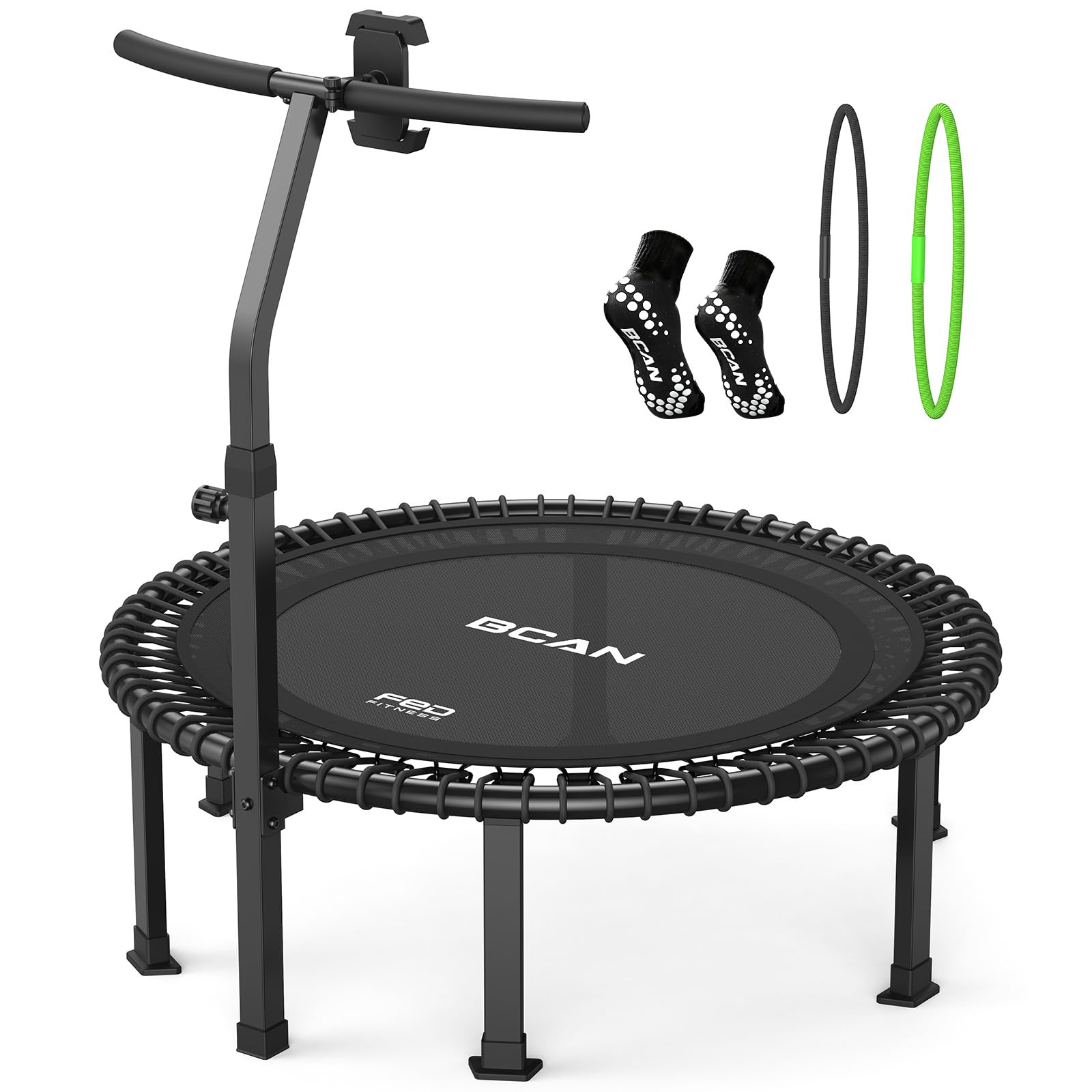
Everything else is sorted: all sixty bungees arrive pre-strung, so setup is legs and handlebar; the five-position bar has a foam grip and a phone holder; and two pairs of socks come in the box. It is quiet, it is steady enough that the bar is a comfort rather than a necessity, and the frame does not shift when you push the pace.

Pros

  • 500-pound rating
  • Two cord sets for six tension levels
  • Handlebar with phone holder
  • One-piece frame stays planted

Cons

  • Changing bounce means swapping cord sets
  • Tallest deck here at 14 inches
Our verdict

The pick for a heavy jumper or a shared household: a 500-pound frame, a handlebar, and a bounce you can retune by swapping cords.

Check Latest Price
5

Best Budget with a Handlebar

BCAN SP2 Rebounder

89 /100
Trail Score Excellent

Key details

Handlebar
3 height settings
Folded Size
About one-quarter of the frame
Bounce System
32 alloy springs
Weight Capacity
330 lb
Check Price on Amazon

If a handlebar is non-negotiable and the budget will not stretch to a bungee deck, this is the pick. The SP2 gives you a full-width padded bar with three height settings, a 330-pound frame, and a deck that folds, for less than any other bar-equipped rebounder here — and unlike most of the budget set it arrives 80 percent assembled, so setup is legs and a bar rather than a whole afternoon.

It is a spring deck, and that shapes everything. The surface is firm and quick, noticeably livelier than the bungee models and less forgiving on landing, which suits jogging in place and drills more than lazy bouncing. The 40-inch frame with 32 springs is the most common size in this set for good reason: it fits a corner of a bedroom and still leaves room for side steps.

Two things to stay on top of. Screw-in legs on a frame like this work loose over weeks of use, and a leg backed out half a turn is a wobble you feel at speed — check them weekly. The straps that anchor the springs are the part that goes first on a hard-used budget springer, so a ten-second look before each session is worth more than a warranty claim.

Pros

  • Handlebar at a budget price
  • 330-pound capacity
  • 80 percent pre-assembled
  • Folds down when you need the floor back

Cons

  • Louder spring deck than the bungee picks
  • Folds only after the bar and legs come off
Our verdict

Our budget answer: a padded bar, three heights, and a 330-pound frame for the least money of any bar-equipped rebounder here.

Check Latest Price
6

Best Small Footprint

Stamina 36-Inch Mini Trampoline

89 /100
Trail Score Excellent

Key details

Monitor
LCD jumps, time, calories
Frame Size
36 in
Bounce System
30 tension bands
Weight Capacity
250 lb
Check Price on Amazon

The Stamina is the only rebounder here with a screen. An LCD on the frame tracks jumps, time, and calories, and it pairs with the free muuv app for coached sessions — the sort of thing that helps on the days when the idea of counting anything in your head is enough to keep you off the mat.

It is also the smallest way into the category: 36 inches across, 30 tension bands, and a frame that folds with the legs off so it slides under a bed or into a closet. At 8.75 inches tall it is the lowest deck here, which makes it easy to step onto in a low-ceilinged room.

Where it earns its place is as a first rebounder or a small-room trainer: it folds flatter than anything else here, it costs the least, and the monitor gives a shape to a session that a bare mat does not. The bands return a short, quiet bounce that is good for jogging and balance work and disappointing if you were hoping for air — that is the trade, and at this end of the market it is the right one to make.

Pros

  • LCD monitor and free app
  • Folds flat under a bed
  • Lowest deck here at 8.75 inches
  • Least expensive way in

Cons

  • No handlebar on the frame
  • 250-pound rating limits shared use
Our verdict

For a small room and a walking-pace workout, it is the least expensive entry here and the only one that counts your jumps.

Check Latest Price
7

Tall Users

BCAN BT3 51-Inch Octagonal

91 /100
Trail Score Outstanding

Key details

Frame Size
51 in octagonal
Folded Size
15 x 30 in
Bounce System
8 mm bungee cords
Weight Capacity
440.9 lb
Check Price on Amazon

Fifty-one inches, octagonal, and the biggest deck in this set by a wide margin. If you are tall, or you want to throw in side kicks and wide jumps without watching your feet, this is the one with room to spare — the octagon adds corner space that a 40-inch circle does not have.

The rest is standard bungee kit done well: 8 mm cords, a three-position handlebar that adjusts from about 30 to 41 inches, and a fold that takes the frame down to roughly a fifth of its footprint, which makes it far easier to put away than the size suggests. Half the cords come pre-strung, so setup is legs, bar, and the remaining connectors.

For a taller adult who wants room to move, that combination is hard to beat: more usable deck than anything else here, a 200 kg capacity, and a fold that genuinely shrinks it. It is not the most polished frame in the group — the premium decks feel more finished and carry far longer coverage — but it does the job at a midrange price.

Pros

  • Largest deck in this set
  • 200 kg capacity
  • Folds to a fifth of its size
  • Three-position handlebar

Cons

  • 51-inch frame needs a dedicated spot
  • Cords and straps can wear under daily use
Our verdict

The one to get if you are tall or want room: the biggest deck here, a 200 kg rating, and a fold that really shrinks it.

Check Latest Price

How We Chose and Tested Adult Rebounders

We started with a shortlist of adult rebounders from established fitness and home retailers, filtering out kids' models, frames that looked too small for adult strides, and listings without a clear weight capacity. We compared mat materials, spring versus bungee designs, frame dimensions, and replacement-part availability, then narrowed the field to nine models that could plausibly handle daily adult use and fit in a normal living room or garage. That shortlist is the same nine I mention above.

Testing ran for eight months. I assembled each rebounder solo out of the box and timed how long it took, whether the instructions matched the hardware, and whether the last step required a second person. During the first week I did steady marching and side steps; later I added faster intervals and jumps, noting whether the frame walked across the floor, whether the legs flexed, and whether the bounce felt lively and controlled or dead and jarring. I also checked mat stitching, spring or bungee tension, and leg joints every few weeks, looking for stretched fabric, squeaks, rust, and wobble.

To judge fun and exercise value, I kept each rebounder in the room where I would actually use it—living room, home office, garage—and tracked whether I chose it for a ten-minute break without a workout plan. I compared what each one cost against its build, assembly ease, and how often I wanted to use it. The models that scored best were not the bounciest or the cheapest; they were the ones that stayed stable, felt good for real sessions, and made me want to come back the next day.

How to Choose an Adult Rebounder

Springs, Bands, or Bungee Cords

Springs are firm and quick. Bands are quieter but shallower. Bungee cords are the softest and the quietest, and they cost the most. That one choice explains most of the price spread in this set: the spring and band decks sit at the bottom, the cord decks at the top. If the rebounder lives in an apartment or above someone else's ceiling, buy cord — a spring deck has a metallic voice that carries through a floor.

Two things to check either way. Look at how many connectors the deck uses: the MXL's 60 bungees spread the landing more gently than a 30-spring frame. Then look at what the connectors are covered by, because that is where the premium money actually goes.

Weight Capacity and Shared Use

The rating on the box is not only about the person jumping. A frame rated well above its working load flexes less, which is why the heavier-rated models here also feel the steadiest underfoot. Capacities in this set run from 250 pounds to 500, so the arithmetic is simple: buy for the heaviest regular user, not the average one.

A 250-pound deck is right for one adult and wrong for a household where a heavier partner wants a turn. If two people of very different sizes will share the machine, look at a model with both headroom and a handlebar, like the BT4.

Handlebars, Deck Size, and Floor Space

Some picks include a bar and some do not; on the MXL it is an optional extra. Height range matters more than it looks. The BT3's bar adjusts from about 30 to 41 inches, and a bar that tops out below your hip is a bar you stoop to hold. Deck size is the other half of the fit: 35 to 40 inches is enough for jogging and side steps, while the 51-inch BT3 is the one for wide moves or a taller frame.

The trap is the word foldable. On most of these frames it means the legs and handlebar come off first, which makes folding a seasonal job rather than a nightly one. If you need the floor clear every day, a half-fold design like the MXL's is the more honest choice.

What Wears Out, and What's Covered

Every rebounder here has a wear part, and it is never the frame. Springs lose tension, cords fray, and the straps holding either one to the mat let go before the steel does. A ten-second look at the connectors before each session is worth more than any warranty claim.

Then compare coverage, because it varies wildly. The JumpSport frames are covered for life with two to four years on cords and mat, the BCAN models and the MXL carry a single year, and the Stamina's parts coverage runs 90 days. For daily jumping, that gap is the real price of the premium picks.

Frequently Asked Questions

Final Verdict

Most adults should buy the JumpSport 250. It is the quietest and steadiest rebounder in this set, its cords and mat are covered for two years with a lifetime frame, and it is the one that ends up used rather than folded away.

Two requirements change that. If anyone in the house is over 250 pounds, the JumpSport 350 PRO adds capacity and a firmer, adjustable bounce. If you want a handlebar in the box, the BCAN SP2 covers it cheaply and the BT4 covers it all the way to 500 pounds.