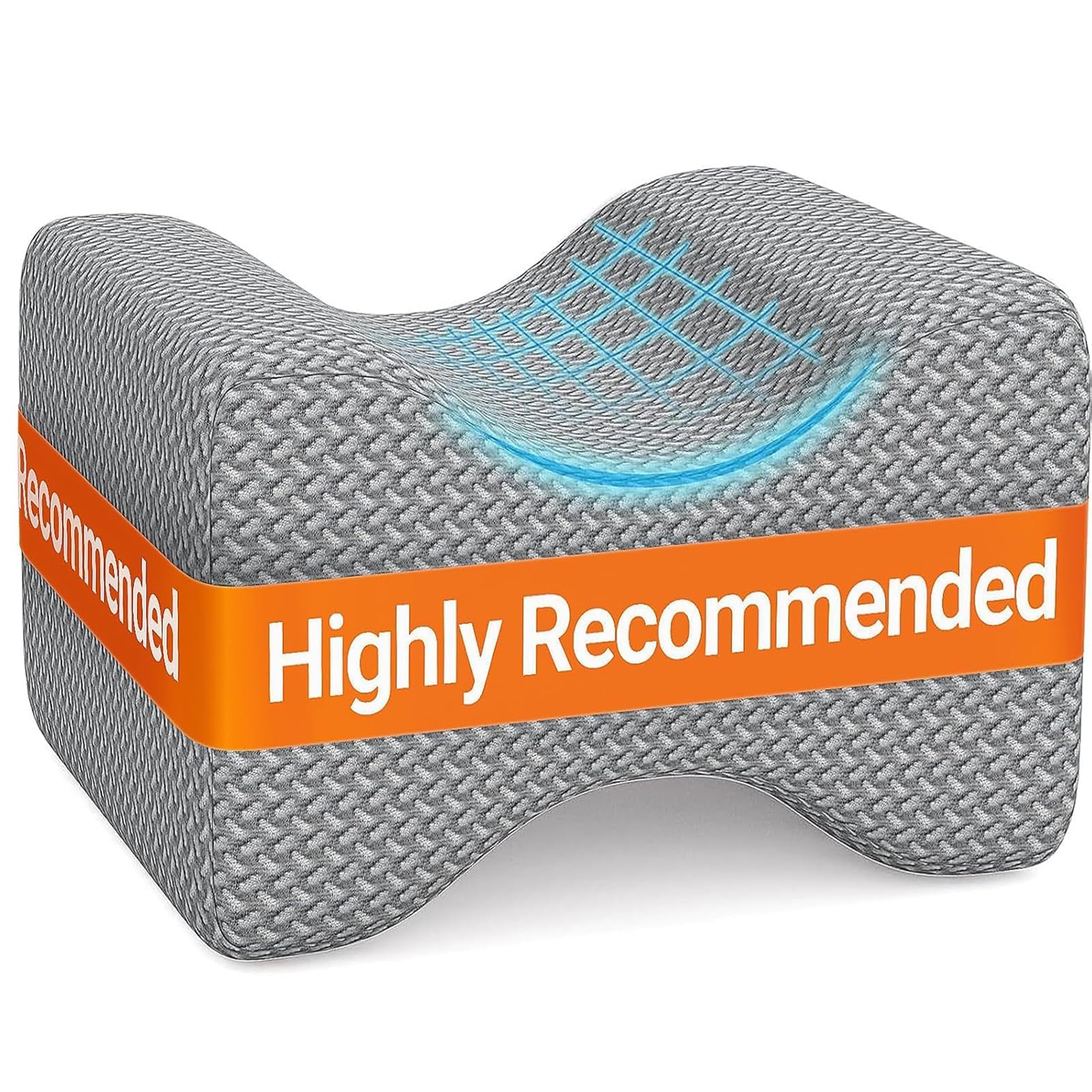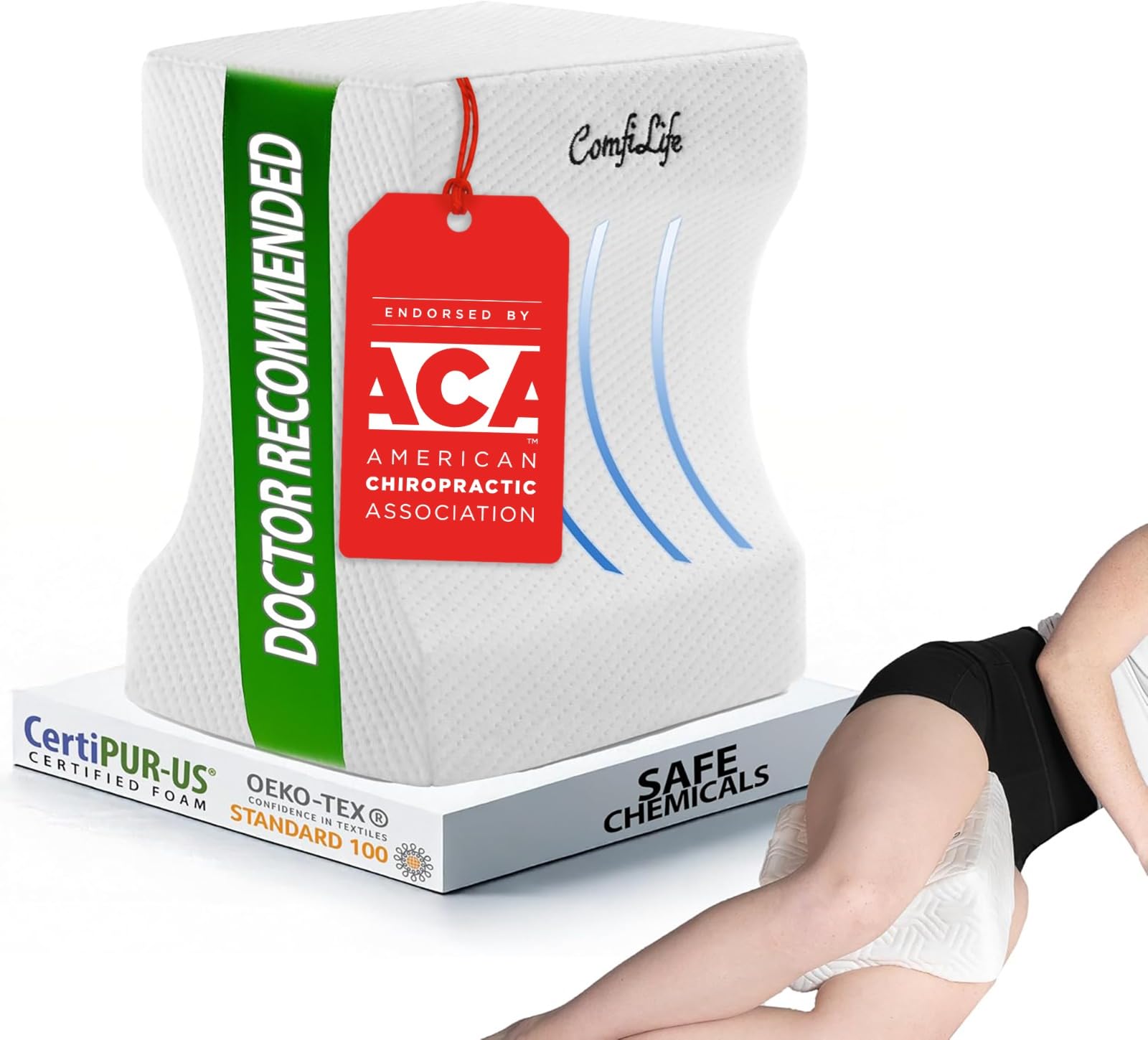
Best Pillow for Hip Pain While Sleeping of 2026

Hip pain at 3 a.m. has a way of making every position feel wrong. A pillow can’t fix the joint, but the right one can take pressure off the hip, keep your knees and pelvis stacked, and stop the small movements that wake you up. The trick is that a pillow that feels lovely on night one can go flat by night ten, or be so bulky you fight it every time you roll over.

I slept with 12 different pillows over three months—between my knees, under my hip, and tucked at my waist—and the differences showed up in the morning, not the showroom. Firmness mattered more than loft; too soft and my top knee sank forward, too firm and my hip felt jabbed. Size and weight decided whether I could turn over without wrestling it, and stability was the difference between waking up rested and waking up stiff. The picks below are the ones that earned a permanent spot on my bed.

1

Best Overall

Everlasting Comfort Knee Pillow

88 /100
Trail Score Excellent

Key details

Fill
High-density memory foam
Cover
Removable, machine washable
Strap
Removable
Dimensions
8.5"L x 6.3"W x 10.5"H
Check Price on Amazon

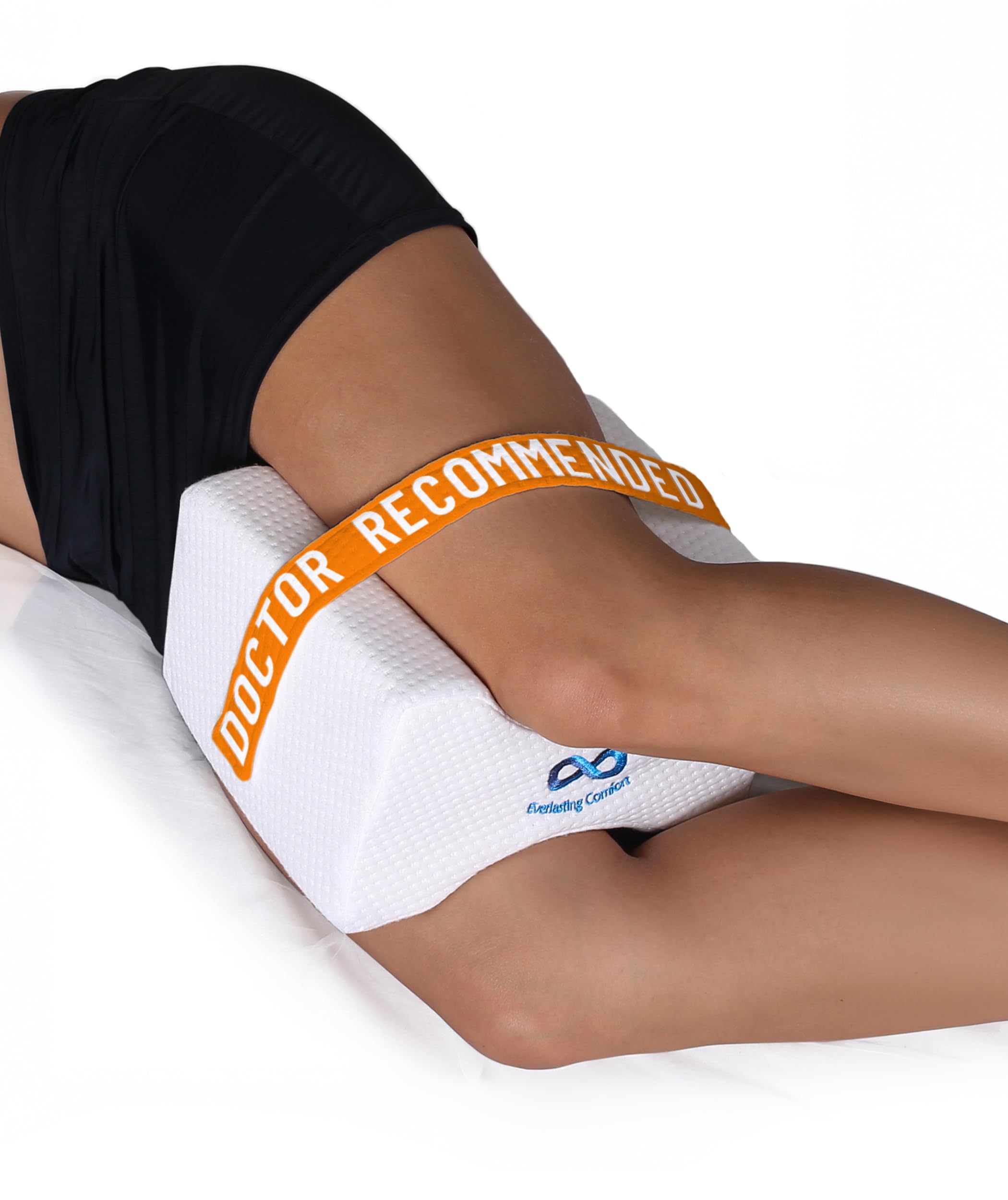
Most knee pillows here make you choose between staying put and feeling unencumbered. This one refuses to: the strap loops around the thigh to keep the cushion between your legs all night, and it unhooks in a couple of seconds when you want nothing wrapped around you. We left it on and stopped waking up to fish the pillow out from under the duvet.

The shape underneath is a shallow H, with a hollow on each side so both knees settle into their own dip instead of fighting over one wedge of foam. It's dense enough to hold the gap rather than pancaking, and that's the whole mechanism: hold the top leg level and the pelvis stops rotating forward. Of everything here, this is the one we tell a first-time buyer to get — a few seconds to fit, no learning curve, and a lifetime replacement policy behind it.

Where it gives ground is softness. The foam has a yielding quality that suits average builds but can compress under a heavier leg, and if you want a hard, unyielding wedge jammed between the knees, this isn't it. The upside of that give is that it never digs into the bony inside of the knee, which is where the firmest pillows in this group draw their complaints.

The cover unzips and goes in with the rest of the bedding, which matters more than it sounds for something pressed against your skin for eight hours a night.

Pros

  • Removable strap holds it in place
  • Concave shape cradles both knees
  • Cover unzips for machine washing
  • Lifetime replacement policy

Cons

  • Short: covers the knees, not the thigh
Our verdict

We recommend it as the default knee pillow: contoured foam, a strap you can remove, and a lifetime replacement policy, for side sleepers who turn over in the night.
Check Latest Price
2

Best Contoured Support

Contour Legacy Leg & Knee Pillow

88 /100
Trail Score Excellent

Key details

Fill
Ventilated memory foam
Cover
Washable
Warranty
1 year
Dimensions
10"L x 9.5"W
Check Price on Amazon

The waist of this thing is the point. The hourglass cut narrows in the middle, so your knees settle into the dip and stay separated while the wider ends support the leg above and below. It's more shaping than the plain blocks here, and it does the alignment work without asking anything of you in the middle of the night.

The foam is ventilated, with channels running through it, and that isn't decoration: a solid slab of memory foam traps heat against your legs and you feel it by two in the morning. This one breathes. The cover comes off for washing, the edges are soft crescents rather than hard corners, and the whole pillow is light enough that it doesn't drag the sheets with it when you move.

Firmness is where it splits the room. The foam is dense and cool at first contact, and it takes a night or two of body heat before it softens around your legs; lighter sleepers who want something yielding can find it hard-edged in the meantime. We rate it near the top of this set for contouring — no other knee pillow here shapes itself around both legs this deliberately — as long as you like a firm feel.

The design has been made in this shape since the early nineties, and it shows in the plainest way: no straps, no adjusters, nothing to fail.

Pros

  • Hourglass shape separates both knees
  • Ventilated foam sleeps cooler
  • Light enough to reposition easily
  • Cover removes for washing

Cons

  • Stops just past the knee; no thigh support
Our verdict

Buy it if you want the shaping to do the work: a firm, ventilated hourglass that holds both legs apart, best for average to solid builds.

Check Latest Price
3

Best Without a Strap

5 Stars United Knee Pillow

89 /100
Trail Score Excellent

Key details

Fill
Memory foam
Cover
Removable, machine washable
Material
Latex-free
Dimensions
9.8"L x 7.8"W x 6"H
Check Price on Amazon

The blue band across the product photos isn't part of this pillow — there's no strap, and the listing says so outright, which we appreciate after seeing how many listings let a picture imply otherwise. Everything else is the most straightforward version of the idea here: a firm memory foam wedge, 9.8 by 7.8 by 6 inches, with a soft knit cover and latex-free foam. For a sleeper who stays put, the missing strap is a fair trade for having nothing to adjust at three in the morning.

The density is the reason to choose it. Nothing about this pillow gives way — it holds its full height under a leg and keeps the hips stacked. It's also the most versatile shape in this group: between the knees for side sleeping, under the knees for back sleeping, or between the calves when your knees need a break.

The flip side of that density is pressure. Against the bony inside of a knee, a pillow that won't yield can feel like a brick, and lighter sleepers notice first. Give it a week before deciding; foam this firm softens slightly with body heat, but it never becomes plush.

The care instructions are worth reading before the first wash: cover off, cold water, air dry, and the foam core kept well away from the machine.

Pros

  • Firm foam that doesn't bottom out
  • Works between knees, calves, or under knees
  • Latex-free with a washable knit cover
  • Chiropractic association endorsement

Cons

  • No strap; can migrate if you sleep restlessly
Our verdict

Pick it for firm, strap-free support if you sleep mostly on one side; look elsewhere if you turn constantly or want something soft against the knee.

Check Latest Price
4

Best Full-Body Pillow

Snuggle-Pedic Body Pillow

88 /100
Trail Score Excellent

Key details

Fill
Shredded gel memory foam
Size
20 x 54 in
Cover
Bamboo, machine washable
Weight
4 lb
Check Price on Amazon

Four pounds is the number to think about here. This is a long, dense body pillow, and hauling it across the mattress to reposition takes actual effort — the kind of thing you notice at two in the morning when you've rolled over and it hasn't. What the weight buys is fill that doesn't collapse: shredded gel memory foam, packed so the section between your knees keeps its loft instead of flattening by the end of the week.

The coverage is the other half of the argument. At 20 by 54 inches it runs from your knees to your shoulders, so you can hug the top end while the bottom keeps your legs apart, and it fills the space in front of your chest so your top arm isn't hanging. The bamboo cover is soft, and the pillow is listed as machine washable — unusual for foam, and worth a lot over years of use.

As a hip solution it's indirect. You're buying a yard of support to solve a problem that lives in a six-inch gap, and a knee pillow does that specific job with far less bed space. It can also overwhelm a small frame, and on a twin bed it takes up most of the mattress.

Where we keep coming back to it is the nights when hip pain arrives with shoulder or back pain: the same loft that props the top leg supports the top arm, and it doesn't need repositioning every hour the way a small cushion does. That's a different purchase from a knee pillow, and worth it when the discomfort isn't confined to the hip.

Pros

  • Shredded foam resists flattening
  • Runs from knees to shoulders
  • Machine-washable bamboo cover
  • Fills the space in front of the chest

Cons

  • Heavy and awkward to reposition
  • Too much pillow for a narrow bed
Our verdict

The pick for whole-body support: shredded foam that holds its loft from knees to shoulders, if you can live with the weight and the footprint.

Check Latest Price
5

Best Adjustable Fill

ALLOPERA U-Shape Body Pillow

91 /100
Trail Score Outstanding

Key details

Fill
Adjustable polyester fiber
Size
57 in
Weight
6.6 lb
Certification
OEKO-TEX Standard 100
Check Price on Amazon

There's a zipper on the inner cover, and that's the whole reason this U-shape beats the others: open it, pull out handfuls of polyester fiber, and set the loft where your hips want it. Every body pillow here asks you to accept someone else's idea of full, and this is the only one of the group you can re-stuff. You can repeat the adjustment in a few months when the fiber settles.

The rest is coverage. The 57-inch U wraps both sides of the body at once, so when you roll, the other arm is already where you need it — no hunting in the dark, no re-tucking. It supports back and belly as well as hips and knees, and the velvet outer cover unzips and washes. The materials are OEKO-TEX Standard 100 certified, which we like for something you breathe against for eight hours.

It weighs 6.6 pounds, and the footprint is real: changing the sheets becomes a two-hand job, and on a shared queen the U claims a solid share of the mattress. If your bed is narrow or your partner is territorial, a knee pillow is the more livable answer.

For hip pain specifically, the U earns its keep on the nights you can't settle. Instead of arranging a small cushion every time you turn, you roll into the other arm and the support is already there.

Pros

  • Fill can be added or removed
  • Supports both sides, so rolling is easy
  • OEKO-TEX Standard 100 materials
  • Removable, washable velvet cover

Cons

  • Polyester fill compacts and needs topping up
Our verdict

Our pick among the full-body options: adjustable fill, support on both sides, and a washable cover, provided your bed has room to spare.

Check Latest Price
6

Best Budget

BlissTrends Memory Foam Knee Pillow

85 /100
Trail Score Excellent

Key details

Fill
High-density memory foam
Cover
Removable, machine washable
Weight
13.4 oz
Dimensions
10"L x 7.9"W x 5.7"H
Check Price on Amazon

The least expensive thing here is also perfectly reasonable. It's a compact H-shaped block of memory foam, 10 by 7.9 by 5.7 inches, with a zip-off cover and enough density to hold the knees apart. If you've never used a knee pillow and want to know whether the idea works for your hips before spending real money, this is the sensible experiment.

It does the basic job without fuss. The foam doesn't go flat under a leg, which is the main thing at this end of the price range, and the cover comes off for the wash. The pillow is light enough at just over 13 ounces that it won't drag the duvet when you turn.

What you give up is refinement. The cut is square where the Contour Legacy is hourglass, so there's less of a waist for your knees to settle into, and 5.7 inches is thin for a taller or broader sleeper — if your hip still aches in the morning, the loft is the first thing to suspect rather than the concept. For a smaller frame, or a spare room, it's easy to justify.

One thing that stands out at this price: the memory foam is the same high-density type the midrange picks use, not the soft squishy stuff that quits after a month.

Pros

  • Least expensive pick here
  • Holds shape under a leg
  • Cover zips off for washing
  • Light enough not to drag bedding

Cons

  • No strap, so it drifts during the night
  • 5.7-inch loft is thin for larger frames
Our verdict

Worth trying if you're unsure a knee pillow will help: a firm little block that costs the least here, best for average and smaller frames.

Check Latest Price
7

Bigger Frames

ComfiLife Orthopedic Knee Pillow

86 /100
Trail Score Excellent

Key details

Fill
Polyurethane foam
Weight
8 oz
Firmness
Medium firm
Dimensions
9.8"L x 7.9"W x 6.3"H
Check Price on Amazon

Most knee pillows here sit at one end or the other: a hard wedge that holds the gap and presses into the knee, or a soft cushion that feels lovely and flattens by midnight. ComfiLife lists this one as medium firm, and the middle setting is what makes it useful — 6.3 inches of foam that gives a little under the leg but still keeps it lifted.

It's a broad block, 9.8 by 7.9 inches, and that surface is why we point bigger sleepers to it: there's more pillow under the leg, so it doesn't feel like balancing on a brick, and the contoured center still cradles the knee. The cover is a breathable knit rather than a fuzzy fleece, and after a warm night that difference matters more than the pattern on it.

Firmness is the open question. Medium firm is a description, not a standard, and the feedback splits hard: some sleepers find it supportive, others unyielding, and a lighter person may compress it enough that the knees come close to touching. Size runs the same way — broad enough for a big frame, more pillow than a small one needs.

The foam is cut rather than molded, so the sides are flat and it sits on the mattress like a block rather than a dome. That's the honest summary of the whole pillow: sturdy, unfussy, and no more complicated than it needs to be.

Pros

  • Wide surface suits bigger frames
  • Medium-firm feel between hard and soft
  • Breathable, washable zippered cover
  • Latex-free foam

Cons

  • Firmness splits feedback; can feel hard
Our verdict

For bigger frames, this is the block we point to: a wide, medium-firm surface and a washable cover, with some variance in how firm it feels.

Check Latest Price
8

Restless Sleepers

NATUMAX Knee Pillow

88 /100
Trail Score Excellent

Key details

Fill
Memory foam
Strap
Attached
Extras
Sleep mask and ear plugs
Dimensions
9.45"L x 6.5"W
Check Price on Amazon

A sleep mask and a pair of ear plugs come in the box, which is an odd way to sell a knee pillow and not remotely why you should buy it. The part that matters is the strap: a simple loop over the thigh that keeps the butterfly-shaped cushion oriented on the knee rather than riding up the leg.

It's a small pillow — 9.45 by 6.5 inches — which cuts both ways. There's less bulk between the legs and less to shove out of the way when you turn, but also less coverage up the thigh, and the medium-soft foam is comfortable against the inside of the knee without fighting to hold a wide gap.

The strap is the whole argument for this one. If you change sides in the night, a strapless pillow ends up near your ankle and you spend the small hours fishing for it; this one stays put and stays oriented. If you don't move much, the strap is just one more thing around your leg, and it takes a night or two before you stop noticing it.

Where it fits best is as a second pillow, or as a first one for a sleeper who wants something light rather than a wedge: it's the least obtrusive of the strapped options, and the sizing risk sits at the opposite end from most of this set — too much pillow rather than too little.

Pros

  • Attached thigh strap keeps it oriented
  • Compact and light between the legs
  • Breathable zippered cover washes
  • Medium-soft foam won't press on the knee

Cons

  • Limited thigh coverage
  • Sleep mask and ear plugs add little
Our verdict

The strapped option for restless sleepers who want something small and light, provided you don't need support from knee to thigh.

Check Latest Price

How We Tested Pillows for Hip Pain

We built the shortlist by scanning reviews and return policies for knee pillows, hip wedges, contoured memory foam, and body pillows, then narrowing by available firmness levels, dimensions, and weight. We ended up with 12 pillows, which I slept with for three months.

Each pillow got at least a week on my bed, with notes on side-sleeping, back-sleeping, and the 2 a.m. roll from one to the other. I slid each between my knees, under my hip, and at my lower back, then checked in the morning whether my hip felt stiff, achy, or neutral. I also paid attention to how it behaved during the night: whether it stayed put when I turned, whether my top knee sank forward, and whether I had to fluff it back into shape.

At the end of each week, I checked for flattening, seam strain, and cover pilling, and washed removable covers according to care labels. I compared the price against how it held up after three months, and asked whether each pillow was easy to move, store, and roll over with—some were comfortable but too bulky to turn with, others relieved pressure but went flat by morning. The final picks are the ones that improved sleep quality and hip comfort over the full three months, not just the first night.

How to Choose a Pillow for Hip Pain

Start with the shape, not the filling

Three shapes do this job. A between-the-knees knee pillow is the targeted option: small, easy to live with on a shared bed, and cheap enough to try without agonizing. A straight body pillow runs from knees to shoulders, which helps when the ache isn't only in your hip — the Snuggle-Pedic is the one we reach for there. A U-shaped pillow supports both sides at once so you can roll without rearranging anything; the ALLOPERA is our favorite of those.

Choose by coverage first and bed space second. On a narrow mattress, a knee pillow is the only one of the three that doesn't take territory from your partner.

Loft is the number that decides it

Lie on your side with your hips stacked and look at the gap between your knees. That gap is the loft you need. Too little and the top leg drops forward, taking the hip with it — exactly the twist the pillow is supposed to prevent. Most knee pillows here land around six inches; if you measure more, look for adjustable fill rather than guessing at the thickest block.

The same logic applies to a body pillow. If the section between your legs compresses to an inch by morning, the pillow is decoration. Adjustable fill is the fix when you're between sizes, and a zippered inner cover — the ALLOPERA has one — is how you tell before you buy.

Firmness decides whether you keep using it

Memory foam is sold as one material and behaves like several. The dense ventilated foam in the Contour Legacy holds a gap firmly and takes a night or two of body heat to soften; the softer fill in budget picks gives immediately but can bottom out under a heavier leg. Neither is wrong. The mistake is buying firm because firm sounds supportive when you're light, or buying soft because soft sounds comfortable when you're broad.

If you can't press one before ordering, read the height alongside the firmness language. A tall, dense pillow under a light sleeper is the combination that produces most of the too-hard complaints.

Footprint, heat, and washing

A U-shape weighs several pounds and claims a serious slice of a queen mattress. A knee pillow you can move with two fingers. Be honest about what your bed and your partner can absorb, especially if you also change the sheets regularly.

Two things to check before ordering: whether the cover unzips for washing, since the foam core itself doesn't belong in a machine, and how warm the materials sleep. Polyester fiber fills and plush velvet covers trap more heat than ventilated foam or a knit cover, and on a hot night that's the difference between using the pillow and kicking it to the floor.

Frequently Asked Questions

Final Verdict

We recommend the Everlasting Comfort knee pillow as the default for hip pain: contoured foam that holds the gap, a strap that keeps it there through the night, and a cover that goes in the wash with the sheets.

If a strap sounds like a nuisance, the 5 Stars United is firmer, simpler, and just as easy to place. And when the ache runs from hip to shoulder, the Snuggle-Pedic body pillow supports the whole line of your body — it just asks for weight and bed space in return.