Best Pill Reminder Devices of 2026

The hard part of taking a pill every day isn't the swallowing — it's the remembering, and the quiet way one missed dose turns into a missed week. I watched an afternoon dose slide past 3 p.m. more days than I'd like to admit, which is why devices that do more than beep started to interest me. A good one takes the guesswork out of the day: it holds the pills, sounds an alarm you can hear from the next room, and in some households keeps the compartments locked until it's actually time.

Here's what surprised me: the fanciest dispensers aren't automatically the most dependable. A device that's fussy to refill gets abandoned by week two, and one with a faint chirp might as well have no alarm at all. We've spent the past seven months living with 12 of these, from simple timed organizers to locking dispensers, running them through real morning and bedtime routines. The picks below are the ones that kept their promises when nobody was watching.

1

Best Overall

Zoksi Automatic Pill Dispenser

89 /100
Trail Score Excellent

Key details

Access
Fingerprint lock
Alerts
Voice, light, app
Dose Rings
7
Compartments
31
Check Price on Amazon

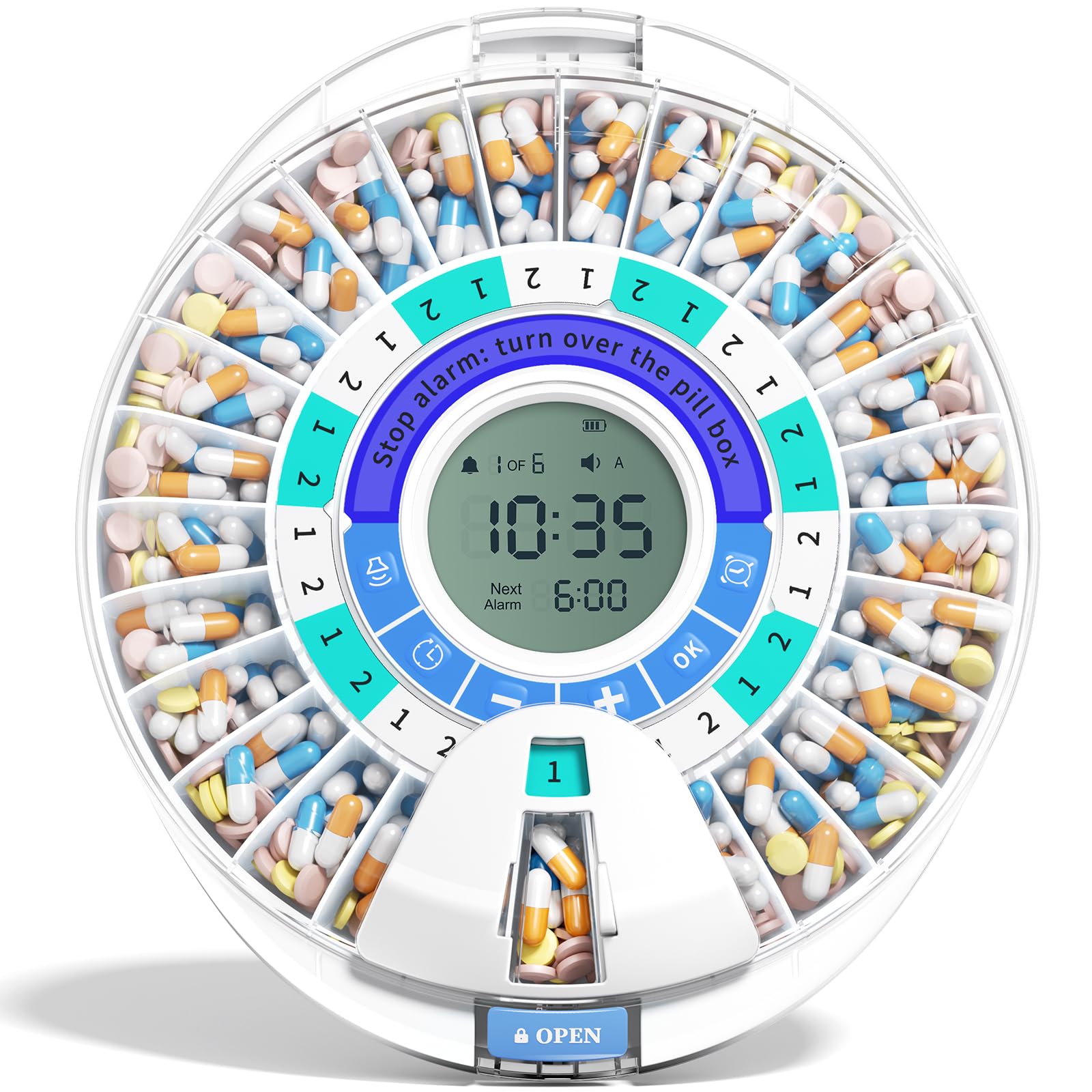
Three reminders fire at once on the Zoksi: a voice alert, a light cue, and a phone notification through the companion app. The dispenser holds 31 compartments and comes with seven dose rings, so you can change how many doses a day the carousel handles. We loaded the tray with morning and evening doses and liked that it lifts out for refilling, which made the setup feel less like a monthly chore.

That redundancy is why it earns our top spot. A reminder that depends on one channel is easy to ignore or sleep through; the Zoksi gives a caregiver a second and third chance to notice. The push-button retrieval is also easier on arthritic hands than the snap lids on several organizers here, and we could release a dose with a light press instead of prying at a compartment.

The fingerprint lock is the feature we did not expect to care about as much as we did. It keeps grandchildren out and makes an extra dose harder to take on impulse. The app adds a medication log, though the on-device alerts are the part that matters day to day.

The trade-off is setup: this is the most feature-dense dispenser here, and a caregiver should program it before handing it over. Once the schedule is in, though, the Zoksi is the one we trust to carry the routine.

Pros

  • Three alert types reinforce the reminder
  • 31 compartments with seven dose rings
  • Fingerprint lock adds access control
  • Push-button retrieval is easier on hands

Cons

  • More setup than a basic alarm clock
Our verdict

We recommend the Zoksi for anyone who wants a locked, month-long dispenser with voice, light, and app alerts doing the reminding.

Check Latest Price
2

Best for Low Vision

ORKA Talking Clock

87 /100
Trail Score Excellent

Key details

Power
AC powered
Voice
Recordable messages
Alarms
Up to 8
Dimensions
9.63 x 5.69 in
Check Price on Amazon

A recorded voice saying a name and a medication instruction is the detail that makes the ORKA feel different from a beeping clock. You can attach a personal message to each of up to eight alarms, and the large day-clock display spells out the time, day, and date in letters big enough to read across a room. We recorded a short message during setup and found the spoken prompt easier to place than a generic beep, especially when the person with the reminder is in another room.

The ORKA is best for someone whose main problem is seeing or hearing the reminder, not for someone who needs the pills locked away. There is no dispenser here; the clock tells you when to take a dose, and you still open the bottle or organizer yourself. For a person with mild dementia who responds to a familiar voice, that can be enough, and the adjustable volume lets you make the alarm as gentle or as persistent as the household tolerates.

One practical catch: the ORKA is AC powered, and the battery is a backup rather than a travel supply. We had to keep it near an outlet, which is fine on a bedside table but not something you toss in a bag. The large display and eight alarms are worth that stationary placement if the clock will live in one room.

Pros

  • Up to eight recordable voice alarms
  • Large day-clock display reads across a room
  • Adjustable volume adapts to the room
  • Simple programming for time and date

Cons

  • Needs an outlet; battery is only backup
  • Does not store or lock medication
Our verdict

Choose the ORKA if a familiar recorded voice and an enormous day-clock display will reach someone a beep will not.

Check Latest Price
3

Best Budget Automatic

Windtrace Automatic Pill Dispenser

89 /100
Trail Score Excellent

Key details

Tray
Removable
Alerts
Alarm, flashing light
Dose Rings
6
Compartments
28 large
Check Price on Amazon

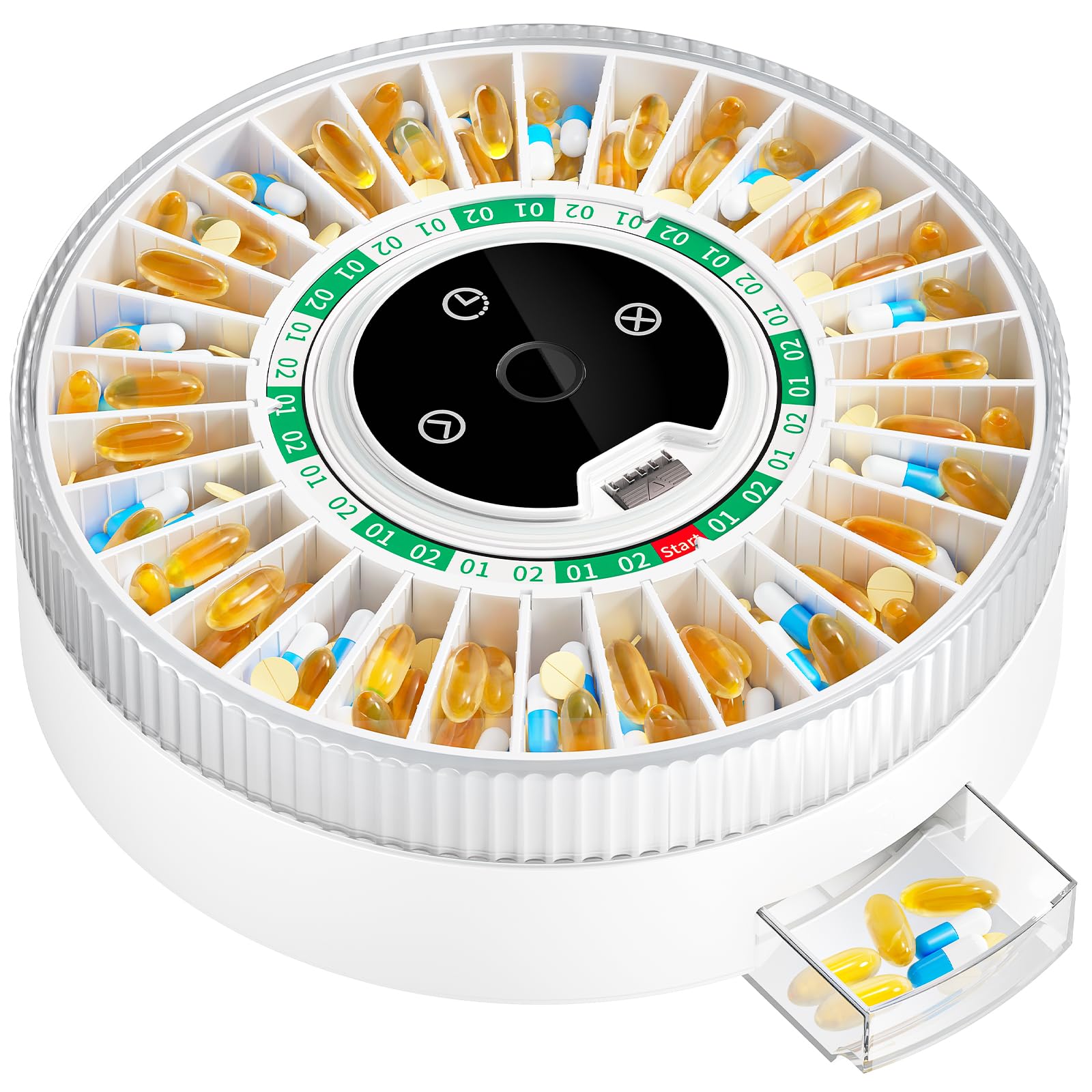
The Windtrace is the least expensive way here to get a dispenser that rotates each dose into view. It has 28 large compartments, six dosage rings, and a loud alarm with a flashing blue light. The tray lifts out for refilling, and the sliding retrieval window means you do not have to open the whole machine every time.

The capacity math is the part to get right. Those 28 compartments cover a month only at one dose a day; at four doses a day, you are refilling about once a week. The six rings let you match the schedule to the prescription, but programming takes patience. We had to walk through the setup more than once to get the dose times aligned, and the lid and locking mechanism feel like the places where the lower price shows.

That makes the Windtrace a sensible budget automatic dispenser for a user who can handle a little setup and does not need a fortress. If the goal is simply to stop the did-I-take-it loop and keep doses in order, it does the core job. We do not recommend it first for someone who will not have a caregiver nearby to straighten out a missed rotation. The alarm is loud enough to carry, and the flashing light helps in a dim bedroom.

Pros

  • Rotates each dose into view
  • 28 large compartments
  • Loud alarm with flashing blue light
  • Removable tray simplifies refills

Cons

  • Setup and locking take patience
Our verdict

The Windtrace is our budget automatic pick for a user who can tolerate a fiddly setup in exchange for rotating doses and a loud alarm.

Check Latest Price
4

Best for Travel

e-Pill TimeCap

85 /100
Trail Score Excellent

Key details

Alarms
Up to 24 daily
Weight
1.45 oz
Battery
1 lithium metal (included)
Tracking
Last opened time and date
Check Price on Amazon

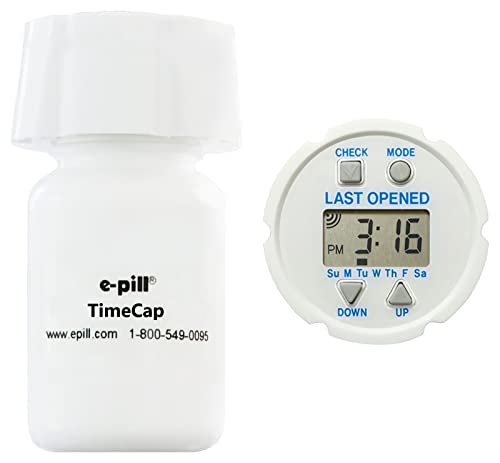
The e-Pill TimeCap answers the question a beeping alarm cannot: when did I last open this bottle? It replaces the cap on a pill bottle, shows the day and time of the last opening, and can be set for up to 24 daily alarms. The alarm beeps for 10 seconds, and the display keeps flashing until the bottle is opened.

We like it best for travel and for anyone who wants to keep pills in their original pharmacy bottle. It weighs almost nothing, so it disappears into a toiletry bag, and the last-opened record is more useful than a generic reminder when you are out of your routine. The catch is the alarm schedule: it works on the hour, so a dose due at 7:30 does not fit cleanly. We adjusted our test schedule to the hour and treated the cap as a backup cue.

The cap fits a bottle rather than organizing a week of doses, so it will not help someone who needs the pills pre-sorted or locked away. It is also a single-bottle tool; if you take several medications at different times, you need one cap per bottle or a different system. For the right user, though, the last-opened display is the most reassuring detail here.

Pros

  • Shows the exact last-opened time and date
  • Up to 24 daily alarms
  • Turns an existing bottle into a reminder
  • Light enough for travel

Cons

  • Alarms set only on the hour
  • One cap covers one bottle
Our verdict

We reach for the TimeCap when the pills need to stay in their original bottle and the real question is whether the last dose was taken.

Check Latest Price
5

Best App-Connected Value

Betife Automatic Pill Dispenser

84 /100
Trail Score Excellent

Key details

App
Bluetooth Pillcalendar
Lock
Fingerprint + mechanical
Display
LCD with 8 icons
Capacity
28-day
Check Price on Amazon

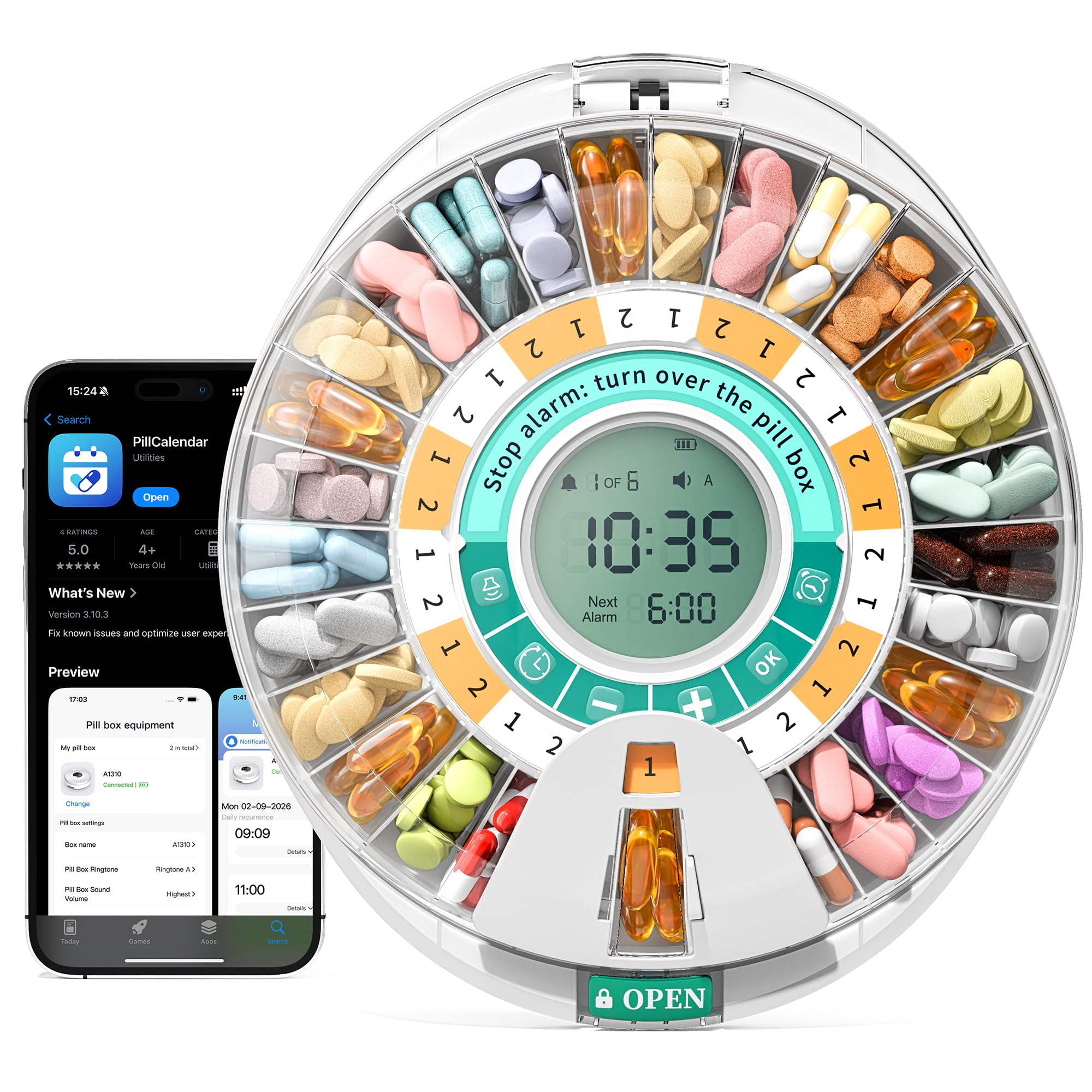
Betife's smart dispenser gives you two ways to run it: the Pillcalendar app over Bluetooth, or a large LCD with eight on-device icons. That matters because app-controlled dispensers often leave you stranded when the phone is upstairs or a caregiver is not logged in. We set a schedule on the device first, then paired the app to see the medication log.

The hardware is a 28-day carousel with a fingerprint lock and a mechanical key backup. The fingerprint reader is the kind of security that makes sense for a household with curious kids or a person who might take an extra dose. The compartments are large enough for a normal daily handful, and the drawer release is easy to work one-handed.

The app is where the tracking lives. After a dose, you confirm it in the app and the log records the time; that record is useful for a caregiver who checks in remotely. The fingerprint unlock also means you do not have to hand over a key, though you should have a backup plan for a fingerprint that will not read.

We see the Betife as the smart dispenser for someone who wants app tracking without paying the top-tier price. It is not as polished as the Zoksi, and the app adds a step, but the on-device controls mean the reminder still works if the phone does not.

Pros

  • App and on-device LCD controls
  • 28-day capacity with fingerprint lock
  • Medication log in the app
  • Mechanical key backup

Cons

  • Bulky for a small travel bag
Our verdict

Betife is the smart dispenser for a household that wants app tracking but still needs the device to work from its own screen.

Check Latest Price
6

Monthly Capacity

Colorwing Smart Pill Dispenser

87 /100
Trail Score Excellent

Key details

Lock
Fingerprint + key
Battery
1200mAh, 30+ days
Dose Rings
7 reversible
Compartments
31
Check Price on Amazon

The Colorwing's draw is the month-at-a-glance capacity: 31 compartments, seven reversible dose rings, and a fingerprint lock with a mechanical key. We like that combination for a caregiver who wants to fill once and then leave the schedule alone, and the rechargeable battery is a welcome change from chasing AA cells.

The battery is rated for 30+ days in energy-smart mode, and Bluetooth 5.0 lets you sync the schedule from a phone. The press-release picker box is designed for arthritic hands, and we found it easier to work one-handed than a snap lid. The clear layout also makes a missed day obvious at a glance.

The compromises are real. The base feels less solid than the rest of the unit, and the electronics are the part we trust least; if the carousel stops advancing, the lock and capacity will not help. The lid can also catch in the open position, so check that each compartment snaps shut before you walk away. For a large monthly fill with a lock, it is still worth a look.

Pros

  • 31 compartments and seven reversible rings
  • Fingerprint lock with mechanical key
  • Rechargeable battery rated 30+ days
  • One-touch picker box

Cons

  • Lid can catch in the open position
  • Base feels less solid than the rest
Our verdict

The Colorwing suits a caregiver who wants a full month locked in one unit and can live with a lid and base that feel less refined.

Check Latest Price
7

Full-Month Organizing

MedCenter 31-Day Pill Organizer

90 /100
Trail Score Outstanding

Key details

Alarm
Talking, 4 times daily
Capacity
31 days
Dimensions
10 x 8 x 7.25 in
Daily Compartments
4
Check Price on Amazon

The first thing you notice about the MedCenter 31-Day system is how much it asks of your hands. Each day has four compartments, and the daily boxes pull out of a large monthly tray, but the lids take a firm pull to open, the kind of resistance that can be a dealbreaker for weak or painful hands. We had to brace the box against the counter to get some compartments open.

What the MedCenter gets right is the month-long layout and the talking alarm. You can load 31 days at once, label morning, noon, evening, and night, and set the clock to speak a reminder four times a day. The voice is loud enough to carry from another room, and the large labels are easy to read.

We see it as a useful full-month organizer with a reminder built in, not as an easy daily device. The alarm is fixed at four times a day, so a person who takes pills three times daily will still hear a fourth prompt; that is a small annoyance for some and a confusing extra cue for others. If a caregiver does the filling and the user mainly needs a spoken reminder, it can work. If the user must open it alone, choose a dispenser with a lighter release.

Pros

  • Full 31-day organizer with four daily compartments
  • Talking alarm four times daily
  • Large high-contrast labels

Cons

  • Large countertop footprint
Our verdict

The MedCenter works for a caregiver-managed month of four daily doses, but only if the person taking them can manage stiff daily lids or has help.

Check Latest Price

How We Tested the Pill Reminders

We started by gathering every reminder device we could find, then cut the field to 12 based on how doses were held — single locked compartment versus a multi-day carousel — whether the alarm repeated, and whether the lock was mechanical or electronic. Each of the 12 then spent seven months in active use rather than a week on a counter.

Testers loaded each device with their own daily vitamins plus placebo capsules so we could see exactly what came out and when. One tester's 78-year-old mother used a locked dispenser for eight weeks straight, which told us more about legibility and lid pressure than any spec sheet. We timed refills from empty bottle to closed lid and noted the moment we were tempted to skip one. For alarms, we listened from the next room with the faucet running and again through a closed bedroom door, logging whether the alert repeated, how it was silenced, and whether it could be dismissed without the pills being taken.

Locking models got a fingernail in every seam and a firm pry at the lid, then a check of whether the lock stayed shut after a missed dose or popped open for the rest of the day. Each unit was knocked off counter height onto tile to watch hinges and latches, and we recorded every late, skipped, or doubled alarm across the seven months, swapping batteries on the manufacturers' schedules. Where a tray or lid was replaceable, we priced it out, since a device you can't maintain is a device you replace.

How to Choose a Pill Reminder Device

Start with the person, not the device

A talking clock is a cue; an automatic dispenser is a cue plus a locked carousel; a timer cap is a cue tied to one bottle. If the user mainly needs a louder, clearer prompt, a clock like the ORKA is simpler and easier to place. If the risk is taking the wrong dose or taking it twice, a dispenser or a last-opened cap gives you a record and a physical barrier. Match the device to the failure you are trying to prevent.

Do the dose math before you buy

A 28- or 31-compartment dispenser is not a month of coverage for everyone. At one dose a day, 28 compartments really do last about a month; at four doses a day, the same tray runs out in a week. Check the number of daily doses first, then look at the dose rings and refill interval. The seven-ring Zoksi and six-ring Windtrace let you match the carousel to the prescription, but the capacity still has to fit the schedule.

Make access and security work together

The lid or release is where a reminder becomes useful or frustrating. A stiff daily compartment can defeat the purpose for someone with arthritis, while a lock that is too easy to open offers little protection. Look for a light press-release, a large display, or a spoken prompt if dexterity or vision is a concern, and choose a fingerprint or keyed lock only if the household will actually manage it. A lock is not helpful if the caregiver cannot get it open in a hurry.

Plan the power and the place

Where the device lives decides how it should be powered. A bedside talking clock can stay plugged in, as the ORKA does, while a cap or compact dispenser should run on batteries you can replace without hunting for an outlet. Rechargeable units cut battery costs but need a charging spot. If the device will travel, favor a battery-powered cap or a compact dispenser, and test the lid and alarm before the first trip.

Frequently Asked Questions

Final Verdict

The Zoksi is the pill reminder we point most people to first because it combines three kinds of alert with a locked, easy-release dispenser and a month of compartments. It asks more setup than a talking clock, but it carries more of the routine once programmed.

If the person needs a spoken cue and a large display more than a locked dispenser, the ORKA is the better fit; for travel or keeping pills in the original bottle, the e-Pill TimeCap is the one we reach for.