Best Neti Pots of 2026

The misery of a head cold settling behind your eyes is specific: you can't breathe through your nose, so you sleep with your mouth open, wake with a raw throat, and add a whole new problem to the one you already had. A neti pot is the low-tech fix — a small vessel, a packet of saline, and a tilt of the head that rinses the gunk out of your nasal passages so you can breathe and sleep again. It costs less than a couple of boxes of cold medicine, and it doesn't leave you groggy.

What surprised me is how much the pot itself matters. I've used one that dribbled saline down my chin, and another with a spout angled so aggressively that the whole thing felt like a near-drowning. Over the past four months my team and I have worked through 14 neti pots and nasal rinse vessels, and the good ones all share a few quiet virtues: a spout that seals against your nostril, a tilt that lets water run in one side and out the other, and a material that doesn't stay damp and funky between uses. One thing nobody tells a first-timer: the salt-to-water ratio and the water itself matter as much as the pot — use distilled or previously boiled water, every single time. Below are the ones worth keeping on the bathroom shelf.

1

Best Overall

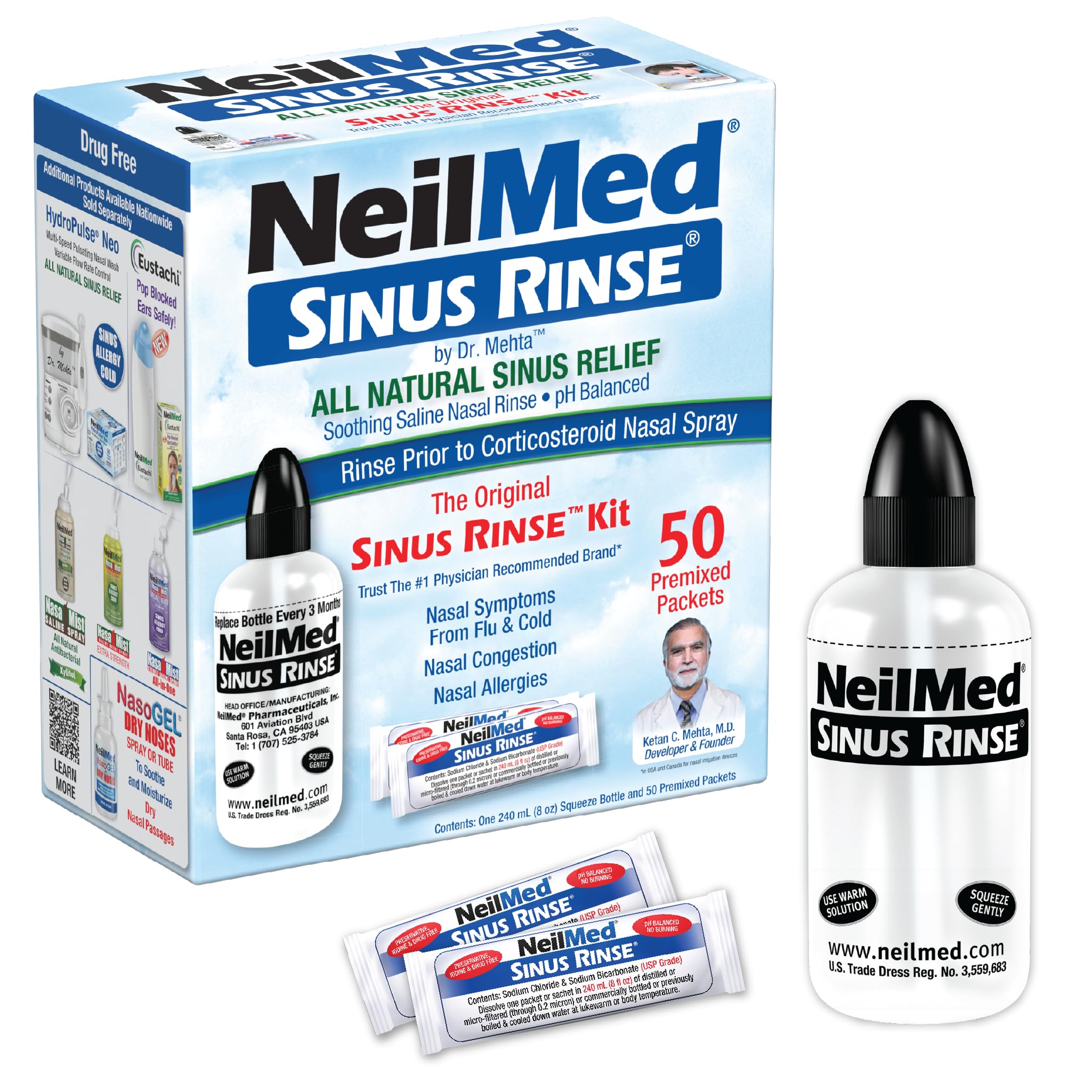
NeilMed Sinus Rinse Kit

95 /100
Trail Score Outstanding

Key details

Free Of
Preservatives, iodine, latex
Rinse Style
Squeeze bottle
Kit Includes
Bottle and 50 saline packets
Check Price on Amazon

A gravity pot asks you to line up a spout, tilt your head, and let physics take over — and if the angle is off, the water goes somewhere unhelpful. The NeilMed kit hands that control to your hand instead. You squeeze, the stream starts; you ease off, it stops. On a first rinse, that's the difference between getting through it and giving up.

The rest of the kit is deliberately unglamorous: a bottle, a stack of pre-measured saline packets, and instructions. The packets are the underrated part. A mix that's too strong or too weak is the usual reason a rinse stings, and tearing open one sachet removes that variable entirely. Fifty of them means you're set for a good stretch before you need to reorder.

What we noticed in use is how little technique it demands. Lean over the sink, tip your head, squeeze gently, and the water crosses from one side to the other. There's no perfect angle to hunt for, and the bottle rinses out and air-dries in a couple of pieces, which matters more than it sounds — a device you use twice a day has to be easy to keep clean or you quietly stop using it.

Nothing here is designed to look nice on a shelf, and the bottle is a tool rather than an object. What you get in exchange is the least fussy rinse we tried: fill, squeeze, rinse the bottle, done. If you want something that looks like pottery, the ceramics below are lovely — but start here.

Pros

  • Squeeze bottle lets you start, stop, and pace the stream
  • 50 pre-measured packets remove mixing guesswork
  • Preservative-, iodine- and latex-free

Cons

  • Saline packets are an ongoing purchase
  • The first rinse takes nerve to push through
Our verdict

We recommend it as the default because the squeeze bottle gives you control a tipping pot can't, and the packets keep every rinse consistent.

Check Latest Price
2

Best for Tap Water

SinuCleanse Soft Tip Micro-Filtered

91 /100
Trail Score Outstanding

Key details

Rinse Style
Gravity flow, soft tip
Kit Includes
Pot and 30 saline packets
Water Filter
Built-in certified micro-filter
Check Price on Amazon

Every nasal rinse starts with a water decision: buy distilled, or boil a kettle and wait for it to cool. This pot takes that decision off the counter. There's a certified micro-filter built in, so tap water goes straight in at whatever temperature feels right — and temperature is half of why a rinse stings.

That's why we rank it as the pick for daily rinsers. Rinse once a week in allergy season and the filter is a nice extra; rinse every morning and it saves you a kettle, a gallon jug, or both. The soft tip seals against the nostril without the hard edge of a ceramic spout, and the clear body shows how much solution is left.

Gravity sets the pace, so there's no squeeze to adjust when one side is more congested than the other — the honest limit of any pot here. Thirty packets come in the box, and cleaning is a rinse and an air-dry.

Pros

  • Certified built-in filter allows tap water at your chosen temperature
  • Soft tip seals comfortably against the nostril
  • 30 pharmaceutical-grade packets included

Cons

  • Costs more than the same pot without the filter
Our verdict

Buy this one if you rinse daily and don't want to keep distilled water on hand; the built-in filter is the difference that justifies the extra spend.

Check Latest Price
3

Best Ceramic

Baraka Ceramic Neti Pot

94 /100
Trail Score Outstanding

Key details

Colors
12 hand-glazed options
Capacity
10 oz
Cleaning
Dishwasher safe
Material
Food-grade ceramic, lead-free glaze
Check Price on Amazon

Most neti pots look like something you keep in a cupboard. This one doesn't. It's hand-glazed in a dozen colors and reads as pottery on the sink edge, and we like that a twice-daily ritual gets an object worth looking at. The single-piece ceramic body also means there's no seam or joint to work loose.

The function holds up to the finish. Ten ounces is a generous fill, the glazed surface wipes clean and goes in the dishwasher, and the rounded spout sits comfortably against the nostril. It feels substantial in the hand while you tilt, which we didn't expect to care about until we compared it with the plastic pots, which feel like they want to skate out of your hand.

The spout sits low enough in the body that the working fill lands a little under the stated ten ounces; fill to just below the opening and you still get a full rinse. Otherwise the compromise is money — this is the priciest ceramic here, and you're paying for color and craft rather than performance.

Pros

  • Hand-glazed in 12 colors; looks like pottery, not equipment
  • Dishwasher-safe single-piece body
  • Ten-ounce fill with a rounded, comfortable spout
  • Feels stable in the hand while you tilt

Cons

  • Will shatter if dropped on a hard floor
Our verdict

Our pick among the ceramics: it rinses well, goes in the dishwasher, and looks good enough to leave on the counter instead of hiding.

Check Latest Price
4

Best for Families

Waterpulse Neti Pot 300ml

93 /100
Trail Score Outstanding

Key details

Nozzles
Adult spray and kids' mist
Capacity
300 ml
Rinse Style
Button-controlled flow
Kit Includes
30 saline packets, temperature sticker
Check Price on Amazon

Two nozzles is the reason this one earns a place. One is a wide spray for adults, the other a gentler mist aimed at children, and both fit the same 300 ml bottle. In a house where more than one person rinses, that's the difference between one device on the shelf and three. A child still needs an adult's hands on it.

The flow comes from a valve button at the base rather than a squeeze, so the stream starts on a press and stays steady while it runs. There's a temperature sticker for the bottle, thirty packets in the box, and two tips that swap out for cleaning. Nothing about it feels precious, which is the right instinct in a bathroom shared with kids.

It's also the least expensive of the full bottle kits here, which matters when you're equipping more than one person. The plastic is ordinary and the two nozzles are the only parts that really need attention: rinse both after each use and let them air-dry.

Pros

  • Two nozzles cover adults and children from one bottle
  • Button valve gives steady flow without squeezing
  • 300 ml fill, 30 packets and a temperature sticker

Cons

  • Gentle flow won't push through heavy congestion
Our verdict

For a household with kids, this is the bottle we point to — two nozzles, one gentle button flow, and no squeezing to get wrong.

Check Latest Price
5

Budget Gravity Pot

SinuCleanse Soft Tip Neti Pot

91 /100
Trail Score Outstanding

Key details

Free Of
BPA and latex
Rinse Style
Gravity flow, soft tip
Kit Includes
Pot and 30 saline packets
Check Price on Amazon

This is the same soft-tip pot as the filtered SinuCleanse above, minus the filter. You get the flexible tip that seals comfortably against the nostril, a clear body, gravity flow, and thirty packets — for a good deal less money. What you don't get is a way to use water straight from the tap.

So it suits the person who already keeps distilled water in the house, or who rinses when a cold settles in rather than every morning. Boiling a kettle and waiting for it to cool is a small price for occasional use. If it becomes a daily habit, the filtered version pays for itself in convenience.

Pros

  • Soft tip seals comfortably without a hard spout
  • Least expensive way into a gravity pot here
  • 30 saline packets included

Cons

  • Plastic body can crack with daily use
Our verdict

We like it as the inexpensive way into a gravity pot, and the soft tip is easier on the nostril than a rigid ceramic spout.

Check Latest Price
6

Easy-To-Clean Pot

Into the Scented Garden Ceramic Neti Pot

93 /100
Trail Score Outstanding

Key details

Handle
Solid ceramic, not hollow
Capacity
8 oz
Cleaning
Dishwasher safe
Material
Lead-free porcelain ceramic
Check Price on Amazon

The handle here is solid ceramic rather than a hollow loop, so there's no channel inside it for water to sit in after a rinse. That's a small thing we ended up caring about: a pot you can't fully drain is a pot you end up scrubbing.

The rest is straightforward. Eight ounces of lead-free porcelain, a smooth tapered spout that seats well against the nostril, and a dishwasher-safe body with a finish that looks like a small teapot rather than medical equipment. Illustrated instructions come in the box, which helps if this is your first pot.

What you're buying is a pot that rinses clean and looks good enough to leave out, and for something you use every day that's a fair trade. It's porcelain, so give it a shelf rather than the sink edge — a knock against a tile floor is the end of it.

Pros

  • Solid ceramic handle leaves nowhere for water to sit
  • Dishwasher-safe lead-free porcelain
  • Smooth tapered spout seats well

Cons

  • Eight ounces covers one rinse, not two
Our verdict

The pot we reach for when we want something that cleans out completely and looks good doing it — the solid handle settles it.

Check Latest Price
7

One-Box Starter Kit

Himalayan Chandra Neti Pot Starter Kit

92 /100
Trail Score Outstanding

Key details

Cleaning
Dishwasher safe
Rinse Style
Gravity flow
Kit Includes
Pot, salt jar, Neti Wash Plus
Check Price on Amazon

Open the box and you get the pot, a jar of salt with a measuring scoop, a bottle of Neti Wash Plus, and illustrated instructions. That's a different proposition from the packet kits: instead of a stack of tear-open sachets, you're mixing your own saline from a jar that goes a long way.

The pot is a gravity design — fill, tilt, let it run — and it's dishwasher safe, which not every plastic pot here manages. The instructions are the clearest we read, with pictures, and for a first-timer that counts; the technique isn't obvious until someone shows you.

Expect a couple of awkward rinses while you find the tilt. Pour too fast and the solution goes down your chin instead of across your sinuses, and the scoop-and-mix approach means the first few batches are a bit of a guess. Neither is a design flaw so much as the cost of doing it the traditional way.

For the person who wants one order to cover the whole routine and no follow-up purchases, that's a good trade. It's the only kit here that includes the salt and the wash in one box, and the jar means you're not counting sachets.

Pros

  • Pot, salt jar and Neti Wash Plus in one order
  • Bulk salt instead of a fixed stack of packets
  • Dishwasher-safe pot with pictured instructions

Cons

  • The listing doesn't say whether the pot is plastic or ceramic
Our verdict

Buy it if you want everything in one order: pot, salt and the wash, with instructions that make a first rinse less intimidating.

Check Latest Price
8

Replacement Bottle

GuruNanda Sinus Rinse Bottle

91 /100
Trail Score Outstanding

Key details

Capacity
240 ml
Child Use
Supervision at 12 and under
Rinse Style
Easy-squeeze bottle
Kit Includes
Rinse bottle and comfort tip
Check Price on Amazon

This is a bottle and a comfort tip, nothing else — no salt, no packets, no thermometer. That reads like a shortcoming until you look in your own bathroom cabinet: anyone who has bought a full kit has a drawer of unused saline packets and, eventually, a bottle that cracked.

What you get is a 240 ml squeeze bottle with a shaped tip that sits comfortably at the nostril, an easy-squeeze body, and BPA- and latex-free plastic. The squeeze is the whole point: you set the pressure, and the flow stops when your hand does.

A 240 ml fill takes one standard saline packet, so the box left over from a kit that didn't last still has a use. It's light, it stores on a shelf edge, and there's nothing to assemble or plug in.

For a spare bottle, a travel bottle, or a straight replacement, that's the sensible buy — and it's the only bottle here that states a supervision age, at twelve and under. If you need salt in the box, buy a kit instead.

Pros

  • Bottle-only purchase for people who already have packets
  • 240 ml fill matches a standard saline packet
  • Stated supervision age for children twelve and under

Cons

  • Water can keep trickling out for a while after a rinse
  • Thin plastic that may not last
Our verdict

Worth it if you already own a box of saline packets and just need a bottle — inexpensive enough that replacing one isn't a decision.

Check Latest Price

How We Tested the Best Neti Pots

We built our shortlist by reading through specs and customer reviews for roughly 40 pots and rinse vessels, then narrowing by capacity, spout length and angle, material, whether saline packets or a measuring spoon came in the box, and whether the thing was dishwasher safe. That filtering left us with 14 units, which we rotated through real households over four months — through allergy season and two head colds, with morning and evening rinses done over the bathroom sink, in the shower, and, for two travel-friendly picks, out of town.

For each pot we noted how the spout sat against the nostril and whether the tilt let water flow through the upper nostril and out the lower one without gagging or spilling down the chin. We timed a full rinse, tracked how steady the flow was as the pot emptied, and checked whether the seal broke halfway through. To judge actual relief, we rated how clear the sinuses felt 20 minutes after a rinse and whether the nose stayed open through the night.

Comfort got the same scrutiny. We looked for redness, stinging, or chapping around the nostrils afterward, especially on pots with a rougher ceramic rim, and noted how each one felt with the standard saline packet versus a slightly weaker mix. We also dropped every pot into the sink from counter height, ran the dishwasher-safe ones through repeated cycles, and checked the seams for hairline cracks. After rinsing, we shook each one out and left it in a closed cabinet overnight to see whether the material held onto water, stayed damp, or picked up a smell by morning. Value came down to what was in the box — packets, a spoon, a travel case — and whether the included packets were already the right ratio.

How to Choose a Neti Pot

Gravity, Squeeze, or Button Flow

Gravity pots are the traditional design: fill, tilt, and let the water travel from one nostril to the other. They're quiet and simple, but you can't adjust the pressure. A squeeze bottle puts that pressure under your hand, which helps when one side is blocked and shortens the learning curve — that's why the NeilMed kit is our default.

Button-flow bottles sit between the two: press to start, release to stop, nothing to squeeze and judge. If your sinuses are badly congested and you want force, choose a squeeze bottle. If you want calm and predictable, choose a button.

The Water Comes First

Nothing else about a neti pot matters if the water isn't safe. Rinsing with untreated tap water can put organisms where you don't want them, so use distilled or sterile water, water you've boiled and cooled, or a device with a filter certified for nasal use. The SinuCleanse micro-filtered pot is the one here that qualifies.

A fridge pitcher or a tap-mounted filter doesn't count. If you buy a pot without a filter, either keep distilled water on hand or get into the habit of boiling a kettle the night before.

Capacity and One Rinse or Two

Pots here run from 8 to 10 ounces, bottles from 240 to 300 milliliters. That's a full rinse for most adults — roughly half per nostril — with a little spare in the larger bottles. You don't have to use the whole fill: if a full pass leaves water running down your throat, use half and stop.

Buy the size that matches your habit rather than the largest one on the page. A pot you fill halfway and rinse in a minute beats one you avoid because it's a whole production.

Packets, Jars, and Mixing

Pre-measured packets take the guesswork out of the salt-to-water ratio, which is the usual reason a rinse stings. They also cost more per rinse and run out at the worst moment. A jar with a scoop is cheaper over time and lets you dial the mix up or down, but every rinse becomes a small measurement.

Starting out, buy a kit with packets. Once you know the ratio your nose likes, a jar is fine — the Himalayan Chandra kit is the one here built around one.

Cleaning and How Long It Lasts

Anything you hold against your nose twice a day has to come clean easily. Dishwasher-safe ceramics like the Baraka and the Into the Scented Garden pot are the simplest to keep hygienic; plastic pots need rinsing and open air-drying, and they're the part of this category that cracks.

Solid handles beat hollow ones that trap water. If more than one person rinses, buy two devices or clean thoroughly between users — sharing a wet pot isn't the same as sharing a glass.

Frequently Asked Questions

Final Verdict

The NeilMed Sinus Rinse kit is the one we recommend first, because a squeeze bottle gives you control over a process that's mostly about not fighting your own reflexes, and the packets remove the mixing error that makes rinses sting.

If you rinse daily and don't want to keep distilled water in the house, the SinuCleanse micro-filtered pot is the better buy — it's the only one here with a filter certified for tap water. Everyone else can start with the NeilMed and add a ceramic pot later for the pleasure of leaving it out.