Best Ice Packs for Injuries of 2026

The trouble with ice packs is that the two things you want from one pull against each other: a pack cold enough to numb a swollen ankle comes out of the freezer stiff as a plank, while the pliable ones that drape over a shoulder tend to go lukewarm before you finish the episode you're watching. What a good one actually fixes is simpler than the packaging suggests — steady cold in the exact spot that hurts, held there without a hand, for long enough to be worth the walk back to the freezer. We've spent the past four months with 15 of them, from gel sleeves to clay wraps to bead-filled straps.

Ice packs became a fixture in my house after a fall on the stairs left me icing a knee twice a day for a month, and the lesson was that fit beats every claim on the box. A pack too broad for a wrist never gets cold where it counts; one too small for a thigh slides off the second you stand up. Wrap it in a thin towel, too, since a pack straight from the freezer can sting skin instead of soothe it. The picks below are the ones that earned permanent freezer space.

1

Best Overall

NatraCure FlexiKold Gel Ice Packs

95 /100
Trail Score Outstanding

Key details

Exterior
Thick nylon
Gel Fill
Proprietary gel formula
Pack Size
Medium
Packs Included
2
Check Price on Amazon

Two packs is the detail that makes this set work. Icing an injury properly means a session every few hours, and a gel pack straight out of the freezer needs hours to firm back up, so a second FlexiKold in the drawer is the difference between keeping to that schedule and rationing one pack. The medium size is the other half of the argument: it wraps a knee or drapes over a shoulder without the dead weight of a full back pad pulling it off.

Of everything here, this is the pair we recommend to most people. The gel stays soft and moldable out of the freezer, so it settles into the shape of the joint instead of bridging it, and the thick nylon exterior feels less like a plastic bag against skin than a vinyl pack does. Coverage is generous for a medium, enough for a knee, an elbow, or a shoulder, though it is not the pack for a whole lower back.

Double-sealed seams and the extra-thick exterior are the parts we paid closest attention to, because a split seam is how a gel pack dies. Store them flat in the freezer rather than crumpled in a door shelf and the gel stays evenly spread, which matters when you are pulling one out in a hurry with a knee the size of a grapefruit.

Pros

  • Stays soft and moldable straight from the freezer
  • Two packs keep a session going while one refreezes
  • Double-sealed seams and a thick nylon exterior
  • Medium size wraps a knee or shoulder without bulk

Cons

  • No strap or cover in the set
Our verdict

We recommend this two-pack to almost anyone icing an injury: the pads stay soft on a joint, and the spare keeps a real schedule going.

Check Latest Price
2

Best for Large Areas

Rester's Choice Large Ice Packs

95 /100
Trail Score Outstanding

Key details

Therapy
Hot and cold
Packs Included
2
Pad Dimensions
11 x 14.5 in
Weight Per Pack
About 2.6 lb
Check Price on Amazon

Eleven by fourteen and a half inches is not a number you appreciate until you have tried to ice a lower back with something smaller. This pad covers the whole lumbar area and still folds around a hip or a thigh, and there are two of them, so one is always cold. It is the pack we keep for back days; the FlexiKold handles knees and shoulders.

It works both ways. A couple of minutes in the microwave turns one into a heat pack for a stiff back, which is more use than most people expect from something sold as cold therapy. The edge binding is reinforced and the exterior is soft rather than tacky, so it does not drag across skin when you shift position under it.

For icing a broad area while you are lying down, the week after hip or back surgery or a pulled muscle, this is the set to buy. Two pads this size take up real freezer shelf, though, so clear a flat space before they arrive rather than discovering the problem with two frozen slabs in your hands.

Pros

  • Covers a whole lower back or hip
  • Two pads so one is always frozen
  • Works as a heat pack too

Cons

  • Stiff for the first minutes out of the freezer
  • Heavy enough to slide if you walk around
Our verdict

Our pick when the injury is a back or a hip: the largest coverage here, and two pads so one is always frozen.

Check Latest Price
3

Best Hands-Free Wrap

TrekProof Hot & Cold Gel Wrap Set

93 /100
Trail Score Outstanding

Key details

Therapy
Hot and cold
Fastening
Elastic Velcro strap
Set Contents
2 gel packs and wrap
Check Price on Amazon

The sleeve is the reason to buy this set rather than another pair of loose gel packs. Slide a pack into the fabric pocket, run the elastic strap around the knee or ankle, and the hook-and-loop closure holds it there while you get on with your evening, which is more than a bare gel pad manages without a rolled-up towel and some optimism.

You get two gel packs and the wrap, and the second pack is the unglamorous half of the value we ended up using most: one freezes while the other is strapped on. The pads stay pliable enough to fold around a joint, they take heat as well as cold, and the cloth face of the sleeve is a real barrier between frozen gel and skin.

Where it struggles is a shoulder. The strap and pad are shaped for a limb you can wrap around, and on a shoulder the whole assembly migrates; the REVIX wrap is the better shape for backs and shoulders. On a knee, an ankle, or an elbow, it does exactly the job it is sold for.

Pros

  • Sleeve and strap hold the pack in place
  • Two gel packs included for rotation
  • Cloth sleeve acts as a skin barrier

Cons

  • Strap can run short on a large thigh
  • Pad is small for a full back
Our verdict

We rate this the simplest hands-free setup for a knee, ankle, or elbow, with a sleeve that holds the pack where you put it.

Check Latest Price
4

Best Refillable Ice Bag

elitehood Reusable Ice Bags

95 /100
Trail Score Outstanding

Key details

Fill
Ice and water
Fastening
Elastic strap
Sizes Included
6, 9, and 11 in
Weight (9 In Bag)
3.5 oz
Check Price on Amazon

This is the one you fill yourself: ice two-thirds of the way up, a little water to fill the gaps, cap screwed down, elastic strap around the bag. That is a different proposition from a gel pack. There is no freezer to wait on, the cold is sharper in the first ten minutes, and the water shifting inside lets the bag settle onto a shoulder instead of perching on top of it.

The smallest of the three bags is the one we kept reaching for. Six inches is about right for a child's bumped knee or an adult's elbow, nine covers most joints, and eleven is the back one. The strap reads like an afterthought in the listing and turns out to be the part that makes a nine-inch bag usable on a leg you are trying to keep elevated.

After use, empty it, loosen the cap, and stand it somewhere to air dry, because a bag sealed wet comes out smelling like a pond. Expect some condensation on the outside in a warm room, so slide a thin towel underneath if it is going on the sofa.

Pros

  • Instant cold with no freezer wait
  • Three sizes from child to adult back
  • Included strap holds the bag in place

Cons

  • Needs ice and water on hand for every use
Our verdict

We keep one of these for instant cold without freezer space, and the three sizes cover a child's knee to an adult back.

Check Latest Price
5

Best for Lower Back

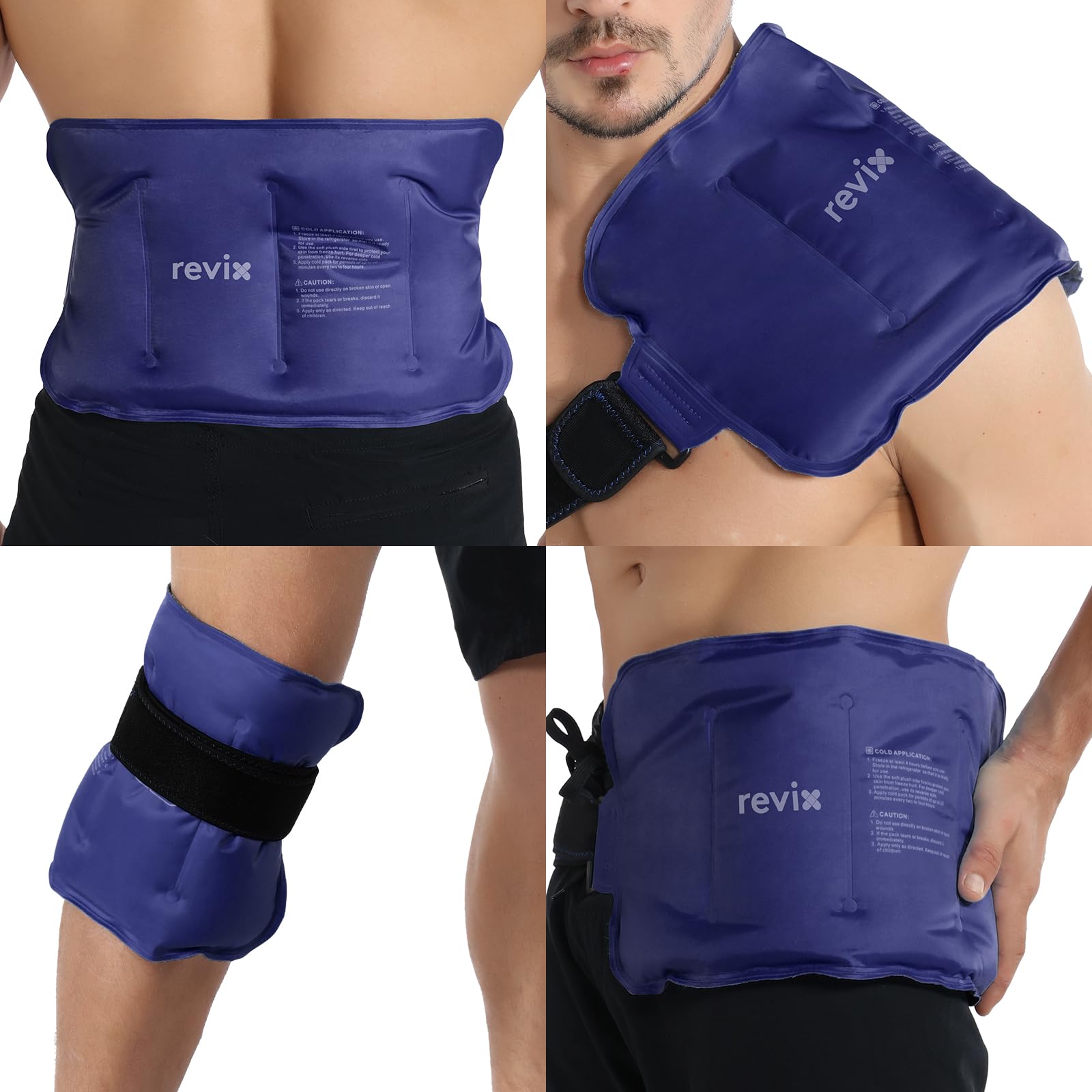
REVIX Lower Back Ice Pack Wrap

93 /100
Trail Score Outstanding

Key details

Lining
Plush
Coverage
Lower back and shoulder
Fastening
Stretch strap
Gel Freezing Point
-13 °F
Check Price on Amazon

The REVIX is built for one job: cold on a lower back with nobody holding it there. The gel is formulated to stay workable down to -13 °F, so it comes out of the freezer draping over a waist rather than standing up on its own, and the plush face can sit against skin without a towel in between.

The strap is wide, stretches, and closes with hook-and-loop, and the pad runs from the belt line to mid-back. Folded over a thigh or a calf after a strain, the same wrap works, which makes it more useful than a dedicated back-only shape suggests, and the soft lining is the detail that keeps it on a bare back without a fight.

For a back, we rate this the most comfortable pack in the group. The soft face does not need readjusting every few minutes, and it stays where you put it through a full session without a hand on it. For a knee or a shoulder, a flat pad makes more sense; the contoured shape has nothing to wrap around.

Pros

  • Stays workable at a -13 °F gel freezing point
  • Plush face against skin without a towel
  • Hands-free on a lower back through a session

Cons

  • Strap is short for larger waists and shoulders
Our verdict

We recommend this for lower-back icing you can do hands-free, with a plush face that skips the towel.

Check Latest Price
6

Best Budget

Rester's Choice Gel Pack with Wrap

93 /100
Trail Score Outstanding

Key details

Therapy
Hot and cold
Fastening
Adjustable wrap
Packs Included
2
Check Price on Amazon

This is the least expensive way in this group to get a gel pack strapped to a limb, and it throws in a second pack. For anyone icing a knee every evening for a month, that is the whole argument.

The wrap is a simple elastic band with hook-and-loop at both ends, and the packs are soft sealed gel that fold around a knee or an ankle. They run seriously cold, cold enough that the instructions tell you to put cloth between the pack and your skin, which is why the second pack matters: one is in use while the other refreezes.

We rate it the budget pick for nightly joint icing, and the band is forgiving enough to work on an ankle, a knee, or an elbow. It is also the pick that stows smallest: two flat packs and a rolled band take up less freezer room than a single large pad.

Pros

  • Lowest-cost hands-free option in this set
  • Two soft packs for rotation
  • Adjustable wrap works on knee, ankle, or elbow

Cons

  • Long strap tails need tucking on wrists and ankles
Our verdict

We point budget shoppers here: two gel packs and a strap-on wrap for less than any other hands-free option in this group.

Check Latest Price
7

Backup Freezer Packs

Perfect Remedy Gel Ice Packs

93 /100
Trail Score Outstanding

Key details

Size
Regular
Therapy
Hot and cold
Packs Included
2
Check Price on Amazon

Whether these stay soft in the freezer is the question, and the answer is not consistent. Some come out pliable enough to fold around a knee; others arrive stiff and need a minute of kneading before they follow the shape of a joint. That variability is the thing to weigh, because a pack that will not conform presses exactly where you do not want pressure.

The rest of the format is straightforward: two pads, each big enough for a knee or a broad stretch of lower back, usable hot or cold, filled with a continuous gel rather than beads that migrate to one end. They freeze quickly and come out of the freezer ready to use with a cloth over them.

Set against the FlexiKold, these are the cheaper pair with a similar footprint, and the FlexiKold is the more predictable of the two coming out of the freezer. That is the trade: a lower price against a bit of luck on the day.

Our take is that they earn a place as a second pair, and as a sensible choice for a flat area like a lower back where molding matters less. Freeze them flat and side by side, because a pack frozen crumpled keeps the crease.

Pros

  • Two pads usable hot or cold
  • Continuous gel fill rather than loose beads

Cons

  • Seams can split with repeated use
Our verdict

We see these as a spare pair for flat areas, since the stiffness out of the freezer makes them a gamble on a knee.

Check Latest Price
8

Rotation, Small Areas

AllSett Health 4-Pack Gel Ice Packs

93 /100
Trail Score Outstanding

Key details

Lining
Thick plastic
Therapy
Hot and cold
Packs Included
4
Check Price on Amazon

Four packs is a different proposition from one good one. It means one on the injury, one back in the freezer, one in a gym bag or a lunchbox, and a spare that is not a crisis when someone else in the house rolls an ankle.

They are thin, soft pads that mold over a knee or an arm and slide inside a brace, and they work hot as well as cold, so a short run in the microwave turns one into a heat pack for a stiff shoulder. Freezing is quick, which is the point of owning four.

The smooth plastic surface is why they slide into a brace so easily and also why nothing grips them: on a moving limb they need a wrap or a sleeve to stay put, and a thin layer of cloth helps on both counts.

What sold us is the rotation. Four modest packs, swapped at the twenty-minute mark, deliver more consistent cold across an evening than one thick pad that spends the rest of the night refreezing.

Pros

  • Four packs keep one always frozen
  • Thin enough to slide inside a brace
  • Microwavable for heat as well as cold

Cons

  • Seams can split after repeated freezing
Our verdict

We recommend the four-pack for households that need several small packs in rotation, not for one serious joint.

Check Latest Price

How We Tested the Best Ice Packs for Injuries

We started by gathering every ice pack we could find whose reviews pointed to either exceptional cold or exceptional comfort — gel packs, clay packs, bead-filled wraps, compression sleeves, and a couple of instant chemical packs for comparison. We filtered that list by size range, strap design, freeze time, and price, then ordered 15 and put them in rotation for four months. None of them got special treatment; they all went into the same crowded freezer drawer.

Each pack was used on real aches rather than in a lab: a knee the morning after a long run, a shoulder that had been slept on wrong, a shin bruise from a Saturday soccer game, and the dull neck stiffness that follows too many hours at a desk. We checked every pack at five-minute intervals to see when the cold faded from sharp to barely-there, and we timed how long each took to refreeze solid. Straight out of the freezer, we squeezed each one to see whether it folded around a forearm or cracked like a frozen steak, and we noted whether the edges stayed hard enough to dig into skin uncomfortably.

Fit got the most scrutiny, because that's where most packs fail. Two testers of very different builds tried the same wraps, and we watched whether straps held a pack against a moving shoulder while we walked around the kitchen, whether it stayed put when we stood up from the couch, and whether condensation left wet spots on clothing. We refroze and reused every pack at least 20 times to check seams, cracking, and lingering smells, and we asked each tester the blunt question: did the cold actually dull the pain, or just feel cold? The packs that survived all of that are listed below.

How to Choose an Ice Pack for Injuries

Match the pad to the body part

Coverage comes first, and bigger is not automatically better. An 11-by-14.5-inch pad like the Rester's Choice large set suits a lower back or a hip, where you are lying down and want one pass over the whole area. For a knee, ankle, elbow, or shoulder, a medium pad conforms better and will not drag itself off. The trap is buying the biggest pad for a joint: a heavy pack slides, and it takes longer to freeze solid. If you are icing a child's bump or an elbow, a small refillable bag in the six- to nine-inch range is easier to manage than any full-size pad.

Check how it behaves frozen

Flexibility matters more than gel volume. A pack that freezes into a board bridges the curve of a joint and presses on the sorest point instead of wrapping it. Look for wording about staying pliable or workable when frozen: the REVIX gel, for example, is formulated with a freezing point of -13 °F so it comes out of the freezer draping. Large flat pads are the ones most likely to come out stiff, so knead one for a minute before you strap it on, and do not judge a pack by its first thirty seconds out of the freezer.

Work out how it stays on

An ice pack you have to hold is an ice pack you use for five minutes. A strap, sleeve, or wrap is what turns twenty minutes of cold therapy into something you can do while reading or answering email, and it is the difference between the TrekProof set and a bare gel pad. The catch is fit: straps are cut for an average limb, and a large thigh, a broad shoulder, or a bigger waist can run out of webbing before the closure bites. Measure the limb or waist you are icing and compare it with the strap length before you order.

Gel pack or refillable ice bag

Gel packs live in the freezer and are ready when you are, with no water to mop up, but they take hours to refreeze and their seams are what eventually fail. A refillable bag filled two-thirds with ice and a little water gives sharper cold immediately and costs less per use, at the price of needing ice on hand, draining and drying after each session, and condensation on the outside. We keep gel packs for a nightly routine and a bag for travel, a desk drawer, or a freezer with no room left.

Frequently Asked Questions

Final Verdict

Our default is the NatraCure FlexiKold two-pack. The medium pads mold to a joint straight out of the freezer, the second pack keeps a genuine icing schedule going, and the double-sealed seams are the part that decides how long a gel pack lasts.

Change the job and the pick changes: for a lower back or a hip, the 11-by-14.5-inch Rester's Choice set covers what the FlexiKold cannot. If the pack needs to stay on without a hand, the TrekProof sleeve is the simplest answer for a limb, and the REVIX wrap is the one shaped for a back.