Best Freestanding Punching Bags of 2026

A freestanding punching bag should absorb a hard cross, not chase it across the garage floor. That's the worry I hear from friends building a home gym: they want heavy-bag fun without ceiling bolts, but they fear a leaking base, suction cups that quit mid-round, or a bag that wobbles on real contact. The right one fixes all three—and gives you a workout you'll actually repeat without turning assembly into a weekend project.

I've used these in cramped apartments and drafty garages, and the difference between a good bag and a frustrating one comes down to the base and the build. Over six months, my team and I tested 10 bags, noting how fast they assembled solo, whether they stayed put during hooks and kicks, and if the base leaked after filling. We also asked whether anyone wanted to use it again, and whether six months of wear justified the price. The picks below are built for real workouts, not showroom looks.

1

Best Overall

GIKPAL Freestanding Punching Bag

87 /100
Trail Score Excellent

Key details

Height
70 in
Included
Hand wraps
Base Fill
180 lb of sand
Base Grip
12 suction cups
Check Price on Amazon

The giveaway is what's missing: springs. Most pedestal bags perch a foam tower on four steel coils, and those coils are where the squeak and the wobble come from. GIKPAL pivots the bag on a damped tumbler instead, so the rebound arrives as a push rather than a snap and nothing metal grinds against anything else. In a room that shares a wall with a bedroom, that is the trade we care about most.

The base does the rest. Twelve cups under a fillable ABS tank bite on tile, hardwood, and marble; on carpet they are decoration and the 180 lb of sand is doing all the holding. Load it with sand rather than water, seat the cups on a clean hard floor, and the tower stays put through combinations that send lighter bags walking. Seventy inches of bag puts head, ribs, and low kicks in reach for users from about 47 to 70 inches tall, and a strap near the bottom gives low kicks something to aim at.

The box holds hand wraps rather than gloves, so add a pair if you don't own one. It is also a slimmer tower than most of the pedestal bags here, which makes it easier to live around in a spare room and a little less substantial to hit. What settles the decision is longevity: the striking surface and stem hold up better here than on any other tower in this group, and with no springs to tire there is simply less to go wrong.

Pros

  • Spring-free pivot keeps sessions quiet
  • Surface and stem outlast other towers here
  • Twelve cups grip tile and hardwood
  • Assembly is quick and simple

Cons

  • Base holds less sand than rival towers
  • Ships with hand wraps, not gloves
Our verdict

Our default pick: the quietest tower here and the one whose surface and stem hold up best, provided you have a hard floor to stick it to.
Check Latest Price
2

Best for Technique

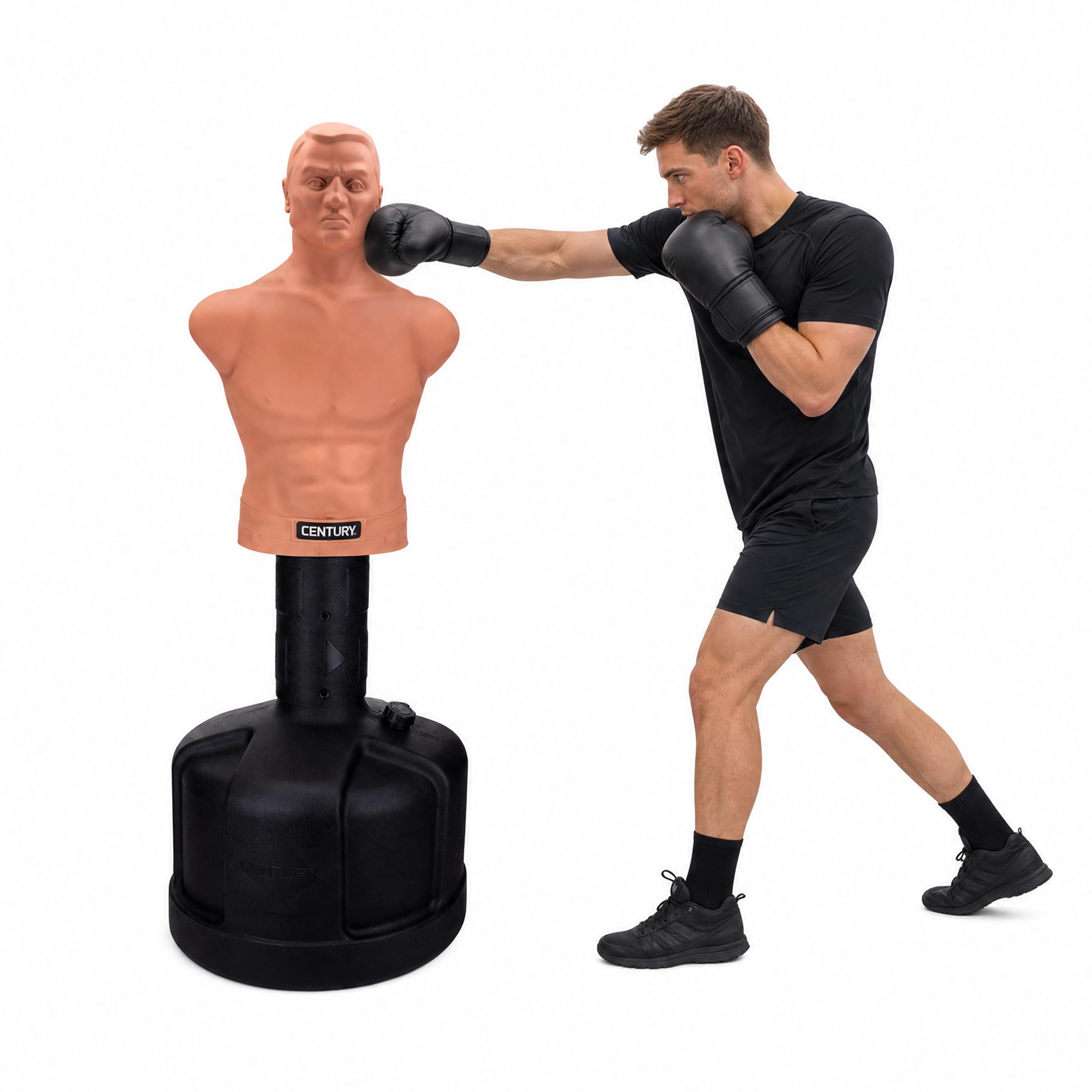
Century BOB Body Opponent Bag

93 /100
Trail Score Outstanding

Key details

Height
60–78 in, 7 positions
Target
Head and torso
Material
Plastisol
Base Fill
270 lb of sand or water
Check Price on Amazon

BOB isn't a tower with a bag on top so much as a torso on a pedestal: head, shoulders, chest, even a face. That shape is the whole argument. You can see where a jab lands and correct a combination that keeps drifting high, which is guesswork on a cylinder. Seven height settings between 60 and 78 inches let one unit serve a teenager and a six-foot-four adult without anyone crouching.

We think it is the best pure technique tool in this group, and the plastisol body is a big part of why: it is a solid target rather than foam over a pole, and it holds its shape under hard work. Where it stops is at the legs. There are none, so the bottom half of a roundhouse has nowhere to land, and anyone training Muay Thai or kickboxing is better served by one of the long bags here.

The base is the heaviest in this group at 270 lb of sand or water, though the torso sits on it rather than locking through it, so a hard hook can shift the whole thing a few inches. That is a shove back into place, not a repair. Assembly is the weak spot: the bolts don't always find their holes first time, and a stripped screw means a trip to the hardware store. What is left is a target that tucks into a corner more easily than the wide-based RDX.

Pros

  • Head and torso give real targeting feedback
  • Seven height settings from 60 to 78 inches
  • 270 lb base is the heaviest fill here
  • Plastisol body holds its shape

Cons

  • Bolts can fight the holes during assembly
  • Costs more than any other pick here
Our verdict

If you train to hit a person rather than a cylinder, BOB is the pick: seven heights, a 270 lb base, and a body to aim at, with kicks kept above the waist.

Check Latest Price
3

Best Full Kit

FITVEN Freestanding Punching Bag

91 /100
Trail Score Outstanding

Key details

Height
70 in
Included
Boxing gloves
Base Fill
205 lb of sand
Base Grip
12 suction cups
Check Price on Amazon

Two hundred and five pounds of sand is what the FITVEN's base takes, and that number does most of the work. Fill is what keeps a pedestal bag from walking across the room, and few towers here ask for more: the RDX is the only one that clearly does. We treat base weight as the first question in this category, and on that question this one answers well.

The spring stack is the other half of the feel. Dual absorbers and four springs return the bag at 15 to 45 degrees, which takes the sting out of a hard cross and keeps the tower from rocking on impact. The trade is more parts to wear, and over months the base and the spring mounts are where this bag shows its age first.

What arrives is a full kit: 70 inches of bag covering head height down to low kicks, a pair of gloves, and a three-year manufacturer warranty that runs longer than most here. Fill it with sand rather than water; the tank is happiest with it and the base stays planted. The gloves are basic, but they save you a second order.

Pros

  • 205 lb sand base plants the tower
  • Gloves included, so no second order
  • Full 70-inch height covers low kicks
  • Three-year manufacturer warranty

Cons

  • Base tank can seep when filled with water
Our verdict

The most complete package here for kickboxing at home: a 205 lb base, gloves in the box, and a warranty that outlasts most of the group.

Check Latest Price
4

Best Value

LEKÄRO Punching Bag with Stand

88 /100
Trail Score Excellent

Key details

Height
70 in
Included
12 oz boxing gloves
Warranty
6 years
Base Fill
205 lb of sand
Check Price on Amazon

Open the box and you get a bag, a base, a set of suction cups, and a pair of 12-ounce gloves. That is the full list a beginner otherwise assembles over three separate orders, and the gloves are not the afterthought they usually are: 10 mm of EVA foam, pre-curved, with enough padding for bag work.

The tower is the familiar 70-inch, four-spring pattern: a polypropylene tank that takes 205 lb of sand, cups underneath, and a striking surface of foam under synthetic leather. Sand is the fill the listing recommends and the fill that works. The tank is removable, which makes emptying it far less of an ordeal than it is on sealed bases.

Where it wins for us is completeness at the budget end: a full-height tower, a 205 lb base, and a wearable pair of gloves in one order, with assembly that doesn't need a second pair of hands. The savings show up later, because the springs and the mount don't feel as planted as the top pick's. For a first bag, or a second one for a teenager, that is a trade worth making.

Pros

  • Gloves, base, and cups in one box
  • 205 lb sand capacity plants the tower
  • Assembly doesn't need a second person
  • 70-inch height suits teens through adults

Cons

  • Springs and mount feel lighter than the top pick
Our verdict

Our value pick: tower, 205 lb base, and gloves in one order, with a build that won't outlast the premium options but doesn't have to.

Check Latest Price
5

Best Heavy-Duty Base

RDX XXL Freestanding Punching Bag

85 /100
Trail Score Excellent

Key details

Base
8-leg octa truss
Height
72 in
Included
Gloves, cover, funnel
Suction Cups
17
Check Price on Amazon

Eight legs, seventeen suction cups, and a base that spreads far wider than the tower above it: RDX solved the problem from the floor up. The octa-truss frame pushes the footprint out well past the bag, which is the geometry that resists tipping rather than merely sliding. Nothing else in this group is built that way.

We think it is the right pick if you hit hard and have the floor for it. The base loads with sand or water, the bag is 72 inches of PU-covered foam, and the kit includes gloves, a cover, and a fill funnel. Where it gives ground is at the seams: the base is the part that has cracked, and the stand is the piece to inspect the moment the boxes land.

The other cost is space. Legs extended, it claims more floor than anything else here, and it isn't a bag you tuck into a corner between sessions. What that buys is a tower that resists a shove instead of absorbing one, which on a concrete slab in a garage is most of what you wanted from a freestanding bag in the first place.

Pros

  • Eight-leg base resists tipping, not just sliding
  • Seventeen suction cups under the truss
  • Gloves, cover, and fill funnel included
  • 72-inch bag takes full-power combinations

Cons

  • Base seams can crack under fill and use
  • Ships in two boxes that may arrive apart
Our verdict

Built for hard strikers with room to spare: the widest, most planted base here and a 72-inch bag to match, as long as you have the floor for it.

Check Latest Price
6

First-Time Buyers

Dripex Free Standing Punching Bag

89 /100
Trail Score Excellent

Key details

Height
69 in
Rebound
4 springs, dual absorbers
Base Fill
182 lb of sand
Suction Cups
12
Check Price on Amazon

The 69-inch Dripex is the budget tower in this group, and it is built to the same recipe as the rest: foam under PU leather, a four-spring absorber stack, twelve suction cups under a round base. Nothing about the bag itself feels cheap. The springs return quickly without turning the surface mushy, and the seams are the same ones you find on towers costing considerably more.

The base is where the money went missing. At 182 lb of sand it holds less fill than any other full-size tower here, which puts more of the holding job on the cups: fine on a garage slab, useless on carpet. On a hard floor, punch in combination and it behaves; load up on one big right hand and you will be resetting it between rounds.

We kept it on the list because the trade is honest: less fill for a budget price, and the same wear items you would be watching on a bag two tiers up. It is also the least fussy of the towers to live with, thanks to a 19.7-inch base that doesn't demand a dedicated corner of the room.

Pros

  • Four-spring stack softens hard shots
  • 69-inch bag covers punches and kicks
  • Narrow 19.7-inch base fits small rooms

Cons

  • Lightest fill of the full-size towers here
Our verdict

A sensible first tower for a hard floor and a steady pace, just don't expect the 182 lb base to hold a full-power hook.

Check Latest Price

How We Tested 10 Freestanding Bags in Real Rooms

We started with a shortlist of two dozen freestanding bags, then cut anything with vague weight limits, recurring complaints about cracked bases, or assembly steps that seemed to require a second person. From there, we chose 10 that covered water-fill and sand-fill bases, different height ranges, and both smooth-floor suction-cup designs and plain weighted bases. We shopped the same way a normal buyer would, rather than accepting stripped-down demo units.

Each bag lived in a real home for six months—my garage, a teammate's basement, and a living-room corner—not a lab. We assembled every one alone with a stopwatch running, noting where the instructions skipped a step or a base cap fought back. Then we filled the bases with water and, when the manufacturer allowed it, sand, checking valves, seams, and caps for weeping or drips over the first week. A bag that left a wet ring or a crusty trail lost points immediately.

During workouts, we threw jabs, crosses, hooks, and low kicks, alternating bare hands and gloves, and watched whether the bag slid, walked, or tipped. On smooth concrete and garage epoxy, we noted whether suction cups grabbed or broke loose; on carpet, we ignored the cups and judged the base alone. We tracked durability through loose stitching, compressed foam, base cracks, and whether height adjustments still held after a few hundred combinations. We also kept a simple use log—who chose which bag, and whether they came back the next day—because fun and workout suitability show up in repeat sessions, not first impressions.

At the end, we compared six-month wear against what each bag cost, and we favored bags that stayed stable without needing a permanent floor spot. The best ones made us forget about the base and focus on the next combination.

How to Choose a Freestanding Punching Bag

Start With the Base, Not the Bag

Fill weight is the number to compare, and sand is the fill that works: it's denser than water, it doesn't seep past a cap, and it doesn't need draining when you move. Anything from about 180 lb up will hold a tower through a combination on a hard floor; 270 lb under a wider footprint holds it through a genuinely hard hook. The suction cups are a supplement rather than the answer. They bite on tile, hardwood, and finished concrete and do nothing on carpet, mats, or a rough slab, so check the floor before you check the bag.

Height and What You Want to Hit

A tower of 69 to 72 inches covers head height down to low kicks for most adults, and the listings usually state a user range, such as 47 to 70 inches, which is the figure that tells you whether it fits you. Adjustable units such as the Century BOB move through seven positions between 60 and 78 inches, which is how one bag serves a whole household. Compact in a listing tends to mean shorter rather than narrower, so a 48- or 54-inch bag is a body-work and kids' target, not a head-height one.

Springs, Rebound, and Noise

Four-spring towers return the bag at a sharper angle, which feels livelier and sends more of the hit into the floor. A spring-free pivot, like the one on our top pick, gives you a softer push and removes the metal-on-metal contact that eventually turns into a squeak. Neither design is more correct. If the bag hangs above someone else's ceiling, quieter is worth more than snappier; if you want the bag to snap back at your guard, the springs earn their keep.

Space, Filling, and the Cost After the Sale

Measure the footprint rather than the height. A round tank runs about 20 inches across, while an eight-legged frame spreads far wider and needs the room to match. Then budget for the fill: a 180 to 205 lb base takes roughly four 50 lb bags of play sand, which is a real purchase and a slow hour with a funnel if the port is small. Water loads and drains faster but weighs less per gallon and can find its way past a cap, which is why the makers here keep recommending sand.

Frequently Asked Questions

Final Verdict

The GIKPAL is the one we point most people to. No springs to squeak, a twelve-cup base that holds on a hard floor, and a striking surface that survives the sessions which finish cheaper towers make it the least fussy way to train at home.

If you are training to hit a person rather than a bag, spend the extra on the Century BOB; nothing else here gives you a head and shoulders to aim at. And if your floor is a garage slab and your combinations are heavy, the RDX's eight-legged base is the one that stays upright.